
Chevrolet had a real story to tell in 1973, and the K5 Blazer ad campaign that year reflects a company that knew exactly how to tell it. Rather than treating the redesigned Blazer as a minor update, period marketing materials leaned hard into the idea that this was a new kind of truck, one that could still handle a trail but no longer asked its owner to sacrifice comfort to do it. As someone who spends a fair amount of time in dealer archives and period print advertising, I think the 1973 campaign is one of the more interesting marketing pivots in the nameplate's history.
Car Features
7 min read
How Chevrolet Marketed the New 1973 Blazer
The K5 Blazer 1973 ad campaign ran two messages at once, trail capability for loyalists and comfort for new buyers, and both were genuinely true.
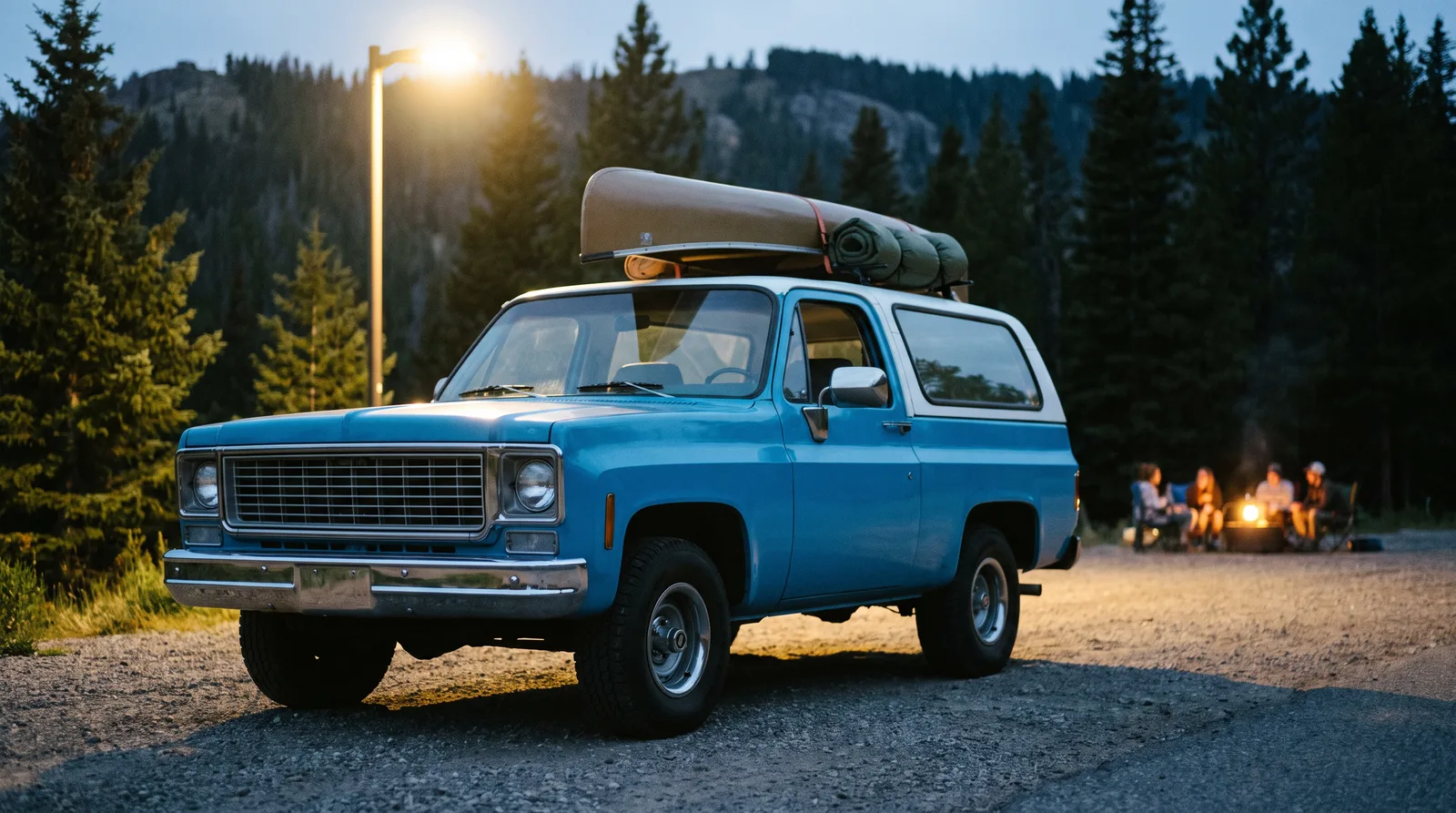
Selling comfort without abandoning the trail
The core tension Chevrolet's marketing team had to navigate in 1973 was real. The Blazer's reputation through 1972 rested entirely on its off-road credibility, built against the Ford Bronco and International Scout as a genuine trail vehicle. Now the company was introducing a larger, more comfortable squarebody, a nicer interior, and for the first time a two-wheel-drive option aimed at buyers who might never leave pavement. Period advertising handled this by running two parallel messages rather than picking one. Print ads aimed at rural and outdoor-oriented publications continued emphasizing 4x4 capability, ground clearance, and trail-ready hardware. Ads placed in more general-interest and suburban-leaning outlets shifted toward comfort, cabin room, and the Blazer as a practical family vehicle that happened to also be capable off-road.
That dual approach let Chevrolet avoid alienating its existing 4x4 loyalists while still reaching the broader buyer the redesigned truck was built to attract. It is a more sophisticated marketing strategy than a single, simplified message would have delivered, and it tracks closely with the dual-configuration strategy Chevrolet was running on the actual order sheet that year.
Imagery and where Chevrolet pointed the camera
Period print advertising for the 1973 Blazer consistently pairs the truck with either rugged outdoor settings, mountain roads, ranch land, hunting and camping scenes, or with suburban and family-oriented imagery depending on the publication and intended audience. This visual split reinforces the dual marketing strategy at a glance, before a reader even reaches the copy. Exact headline copy and publication placements from that campaign are hard to pin down with confidence this far removed from the period, so this account sticks to what surviving ads and dealer materials broadly show. What is consistent across surviving examples is Chevrolet's willingness to show the truck in genuinely varied contexts rather than settling on one narrow lifestyle image, a flexibility that mirrors how broadly the redesigned truck was actually being positioned to sell.
Dealer showroom materials from the period also emphasized the larger cab and improved cabin as headline features, a notable shift from earlier Blazer materials that had led almost exclusively with off-road capability, even as the removable top itself remained available and continued to appear in some period photography.
Competing directly against the Bronco and Scout
Comparative advertising, common in the truck segment through the 1970s, gave Chevrolet a direct way to argue the redesigned K5 offered a more complete package than its rivals. Marketing materials from the period point to interior room, ride comfort, and available configuration flexibility, 4x4 or 2wd, as differentiators against competitors who had not yet matched the Blazer's redesign with equivalent updates of their own. Ford's Bronco would not see a comparably significant redesign until years later, giving Chevrolet a genuine window where its marketing claims about comfort and modernization had real substance behind them rather than just copywriting.
That window mattered. Advertising claims only carry weight when the product backs them up, and dealer feedback from the period suggests the 1973 Blazer's actual showroom experience, the improved cabin, the quieter ride, largely supported what the marketing promised, which is not always the case with model year redesigns.
"The 1973 campaign is Chevrolet talking out of both sides of its mouth in the best possible way. Trail-ready for the buyers who needed that, comfortable and practical for the buyers who did not. Both messages were true, and the advertising committed to both."
- Tom Ramirez
How the campaign shaped buyer expectations
Marketing does more than sell a specific truck sitting on a specific lot. It sets expectations that follow a nameplate for years. The 1973 campaign's insistence on positioning the Blazer as both capable and comfortable helped cement an identity that the truck carried through the rest of its squarebody production run, all the way to 1991. Later model years leaned even further into comfort and trim options, but they were building on a foundation the 1973 marketing had already laid, a Blazer that could plausibly serve as either a family vehicle or a trail truck depending on how the buyer configured it.
For the full account of the redesign this advertising was built to sell, 1973 k5 blazer history covers everything Chevrolet changed that year. The color choices featured prominently in that period marketing are worth their own look too, covered in a related story.
If the period advertising has you thinking about the real thing, K5 Blazers for sale now is worth a browse to see what has survived.
Reading period ads as historical documents
Beyond their value as marketing curiosities, surviving 1973 print ads and dealer materials function as useful primary sources for researchers and collectors trying to understand original trim availability, factory option packaging, and even period color names that do not always match how those same colors get described decades later. A well-preserved dealer brochure from 1973 can settle disputes about original specification that build sheets alone sometimes leave ambiguous, which is exactly why these materials deserve more attention from the collector community than they typically get.
Television and the broader media push
Print was not the only channel Chevrolet used to sell the redesigned Blazer. Television spots from the period, where surviving footage exists, followed a similar dual-message approach, cutting between trail footage and family-oriented scenes within the same commercial rather than committing to a single tone. This was consistent with Chevrolet's broader 1973 truck campaign, which treated the Blazer, the pickup lineup, and the Suburban as a connected family of vehicles capable of serving overlapping but distinct buyer needs. Regional television buys also let Chevrolet tailor emphasis by market, leaning harder into off-road messaging in areas where that pitch would land and softer, comfort-focused messaging in markets where it made more sense.
Dealer-level cooperative advertising, funded jointly by Chevrolet corporate and individual dealerships, added another layer to the campaign, letting local dealers emphasize whichever configuration, 4x4 or the new 2wd option, moved best in their specific market. That local flexibility is part of why surviving period ads for the 1973 Blazer show more variation than a single, centrally dictated campaign would typically produce, and it is a detail researchers should keep in mind when trying to generalize from any one surviving ad about what Chevrolet's national strategy actually was.
Taken together, the print, television, and dealer-level advertising for 1973 amount to a coordinated, deliberately flexible campaign rather than a single fixed pitch, and that flexibility is exactly what the redesigned truck itself was built to support.
Sources and notes
Related Reading
Have a
Chevrolet Blazer
for Sale?
Reach thousands of serious classic car collectors across the US.
Sell It Here →
Selling a classic? Here's how: the best sites to sell a classic car
Are You a Classic Car Dealer?
List your full inventory and connect with targeted classic car buyers.
Join as a Dealer →

About the author
Tom Ramirez
Corvette researcher and historian based in Bowling Green, Kentucky. Two decades documenting Corvette production history from original factory records.
Related Listings - Chevrolet Blazer
Comments
Be the first to comment on this article.