
Engine choice is one of those details that sounds purely mechanical until you look at what it actually tells you about a manufacturer's priorities in a given year, and the k5 blazer 1973 engine lineup is a genuinely useful case study in that. Chevrolet was not just installing motors in a redesigned truck. It was making a set of decisions about what kind of buyer it expected to walk onto the lot, and those decisions still shape how the truck is remembered.
Car Features
7 min read
The Engines Behind the First Squarebody K5
The 1973 K5 Blazer's six-cylinder and V8 engine options reflect a truck built to serve two different buyers at once, inside a regulatory window that was already reshaping how engines were rated.
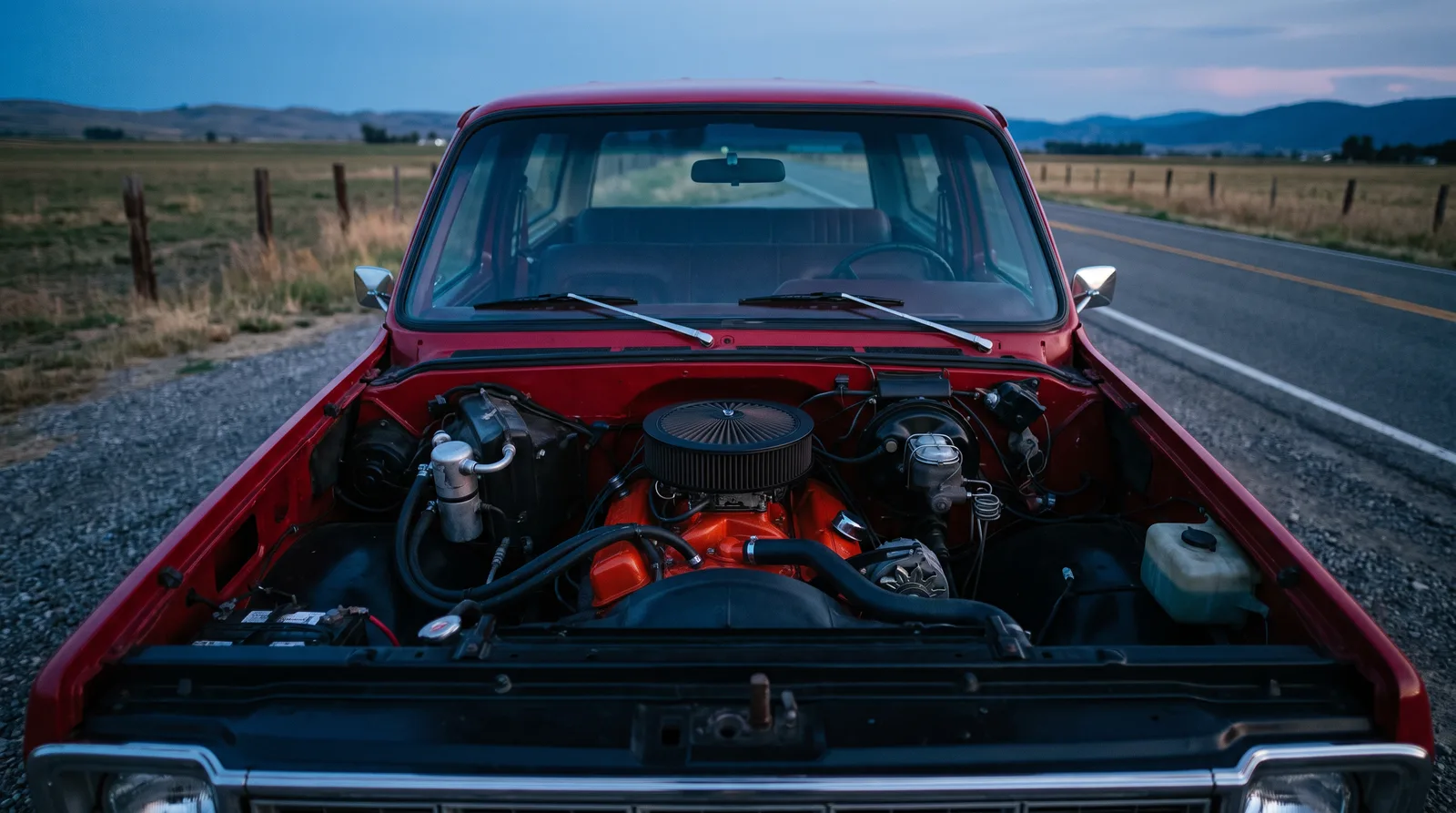
The lineup Chevrolet actually offered
The redesigned 1973 K5 Blazer arrived with a small spread of engine options rather than a single standard motor, reflecting a truck trying to serve two overlapping audiences at once, buyers who wanted efficient, low-maintenance power for everyday driving and buyers who wanted enough displacement to tow, haul, and climb without hesitation. A six-cylinder engine served as the entry-level choice, with V8 options above it giving buyers a straightforward path to more capability if they were willing to pay and accept the fuel consumption that came with it.
| Engine | Configuration | Typical role in the lineup |
|---|---|---|
| 250 cid inline-six | Six-cylinder, base option | Lower-cost entry point, favored by buyers prioritizing simplicity and economy |
| 307 cid V8 | Small-block V8 | Entry-level V8 for 1973, its last year in the Blazer lineup before the 305 eventually took its place |
| 350 cid V8 | Small-block V8 | Most common upgrade choice, balancing power and everyday usability, and the V8 that remained available the longest |
The 400 cid V8 that some enthusiasts associate with the squarebody Blazer did not actually arrive until 1975, two years after this redesign, and was offered only in 4WD models through 1979, so it was never part of the original 1973 lineup. The exact horsepower and torque figures published for the 1973 engines are worth treating carefully. Ratings that year reflect the industry's broader shift toward net power measurement rather than the more generous gross figures common in the 1960s, so a 1973 engine can look weaker on paper than an earlier engine of similar displacement even when the actual hardware is comparable. That measurement shift is easy to misread if you are comparing a 1973 spec sheet directly against a 1969 one without accounting for the different testing standard behind the numbers, and specific published figures are best pulled from period factory literature rather than repeated secondhand.
The weight difference between the six-cylinder and the V8s was not trivial either. A V8 up front shifted curb weight forward and could change ride quality and steering feel slightly, a shift that mattered less to a buyer cross-shopping purely for economy and mattered quite a lot to a buyer who wanted the truck to carry heavier loads without feeling nose-light front to rear. That tradeoff rarely shows up in period advertising copy, but it shaped how these trucks actually drove once they left the lot, and it is one more reason the engine decision at purchase was really a decision about the whole vehicle's character, not an isolated line item on the order form.
How power reached the ground: carburetion and transmission choices
The 1973 engine lineup was not just a question of displacement. Fuel delivery followed the same buyer-segmentation logic that shaped the rest of the order sheet. The 250 cid six-cylinder used a simple single-barrel carburetor suited to steady, unhurried driving, while the small-block V8s stepped up to two- and four-barrel carburetors depending on configuration, trading some of that mechanical simplicity for the ability to move more air and fuel when a driver actually needed it. That progression mirrors the same split Chevrolet had already built into the price sheet: the six asked for less attention and less money at the pump, while the V8s asked for more of both in exchange for capability the six could not offer.
Transmission choice followed a similar pattern. A three-speed manual was the standard gearbox across the lineup, the kind of unglamorous, easy-to-service setup that appealed to buyers who wanted a truck that would not surprise them with an expensive repair bill down the road. Buyers stepping up to a V8, and especially buyers planning to tow or haul on a regular basis, tended to pair that engine with the optional automatic, trading some driver involvement for a transmission that could absorb load changes without a foot constantly working the clutch pedal. That pairing pattern is not a coincidence. It is the same story the engine lineup tells on its own: Chevrolet built the 1973 K5 Blazer so that a buyer's whole set of choices, engine, carburetor, and transmission together, could be assembled around how they actually planned to use the truck, rather than forcing one configuration on everyone who walked onto the lot.
Emissions requirements were already reshaping engine design
By 1973, federal emissions regulations were a real and growing constraint on how GM's engineers could tune these engines, and that context matters for understanding why this generation's motors are remembered differently than the looser, less-regulated engines of the previous decade. Compression ratios generally came down industry-wide during this period to accommodate lower-octane unleaded fuel and emissions equipment, a tradeoff that cost some outright power in exchange for meeting requirements that were only going to get stricter through the rest of the decade. The 1973 K5 Blazer's engines were built inside that tightening regulatory window, and it shows in how the era gets talked about among people who drove both the earlier and later trucks.
"People love to compare horsepower numbers across decades like the engines were tested the same way. They were not. Read the number, then read what standard produced it, or you are comparing two different things and calling it one."
- Emily Chen
What buyers actually chose, and why it matters now
Engine choice at the dealership in 1973 was a real tradeoff conversation, not a formality. The six-cylinder kept the purchase price down and the running costs manageable, appealing to buyers using the truck primarily as transportation. The V8 options cost more upfront and drank more fuel, but they gave the K5 Blazer genuine towing and load-carrying credibility that the six-cylinder could not match. That split in buyer priorities is still visible in the used market today, where V8-equipped examples generally draw more collector interest, partly for outright capability and partly because the V8 became the engine most associated with the truck's reputation over the following decades.
Reading engine choice as part of the truck's story
None of this is really a story about carburetors and compression ratios in isolation. It is a story about how a manufacturer read its own customer base in a specific year and built a lineup to match, then had that lineup reshaped mid-decade by regulations nobody at the dealership could control. The 1973 K5 Blazer's engine options are a small, honest record of that moment, a truck built to please buyers who wanted economy and buyers who wanted muscle, inside a regulatory environment that was tightening around both choices at once.
For the fuller picture of the model year these engines belonged to, the full story covers the 1973 redesign in more depth. And for anyone whose interest in this engine history has turned into an actual search, it is worth taking the time to browse classic K5 Blazer listings and compare documented engine specs across a few examples before deciding which era of powertrain fits what you actually want to drive.
Sources and notes
Related Reading
Have a
Chevrolet Blazer
for Sale?
Reach thousands of serious classic car collectors across the US.
Sell It Here →
Selling a classic? Here's how: compare the places to sell classic cars
Are You a Classic Car Dealer?
List your full inventory and connect with targeted classic car buyers.
Join as a Dealer →

About the author
Emily Chen
Bay Area engineer with a deep focus on vintage Japanese and European performance cars. Approaches classic car research and restoration with an analytical eye.
Related Listings - Chevrolet Blazer
Comments
Be the first to comment on this article.