
The engine question behind the K5 Blazer Chalet is really a weight question first and an engine question second. Strap a pop-top camper roof, a water tank, a small galley, and two adults' worth of gear onto a short-wheelbase four-wheel-drive truck, and the drivetrain that was perfectly adequate in a stock Blazer suddenly has real work to do. Looking at what actually powered the Chalet, and what that choice meant in practice, tells you more about the package than the camper roof alone ever could.
Car Features
7 min read
What Powered the Camper-Laden Blazer Chalet
An evidence-based look at the engine options behind the K5 Blazer Chalet and why the choice between a six, a small V8, and a big block mattered once the camper weight was loaded on.
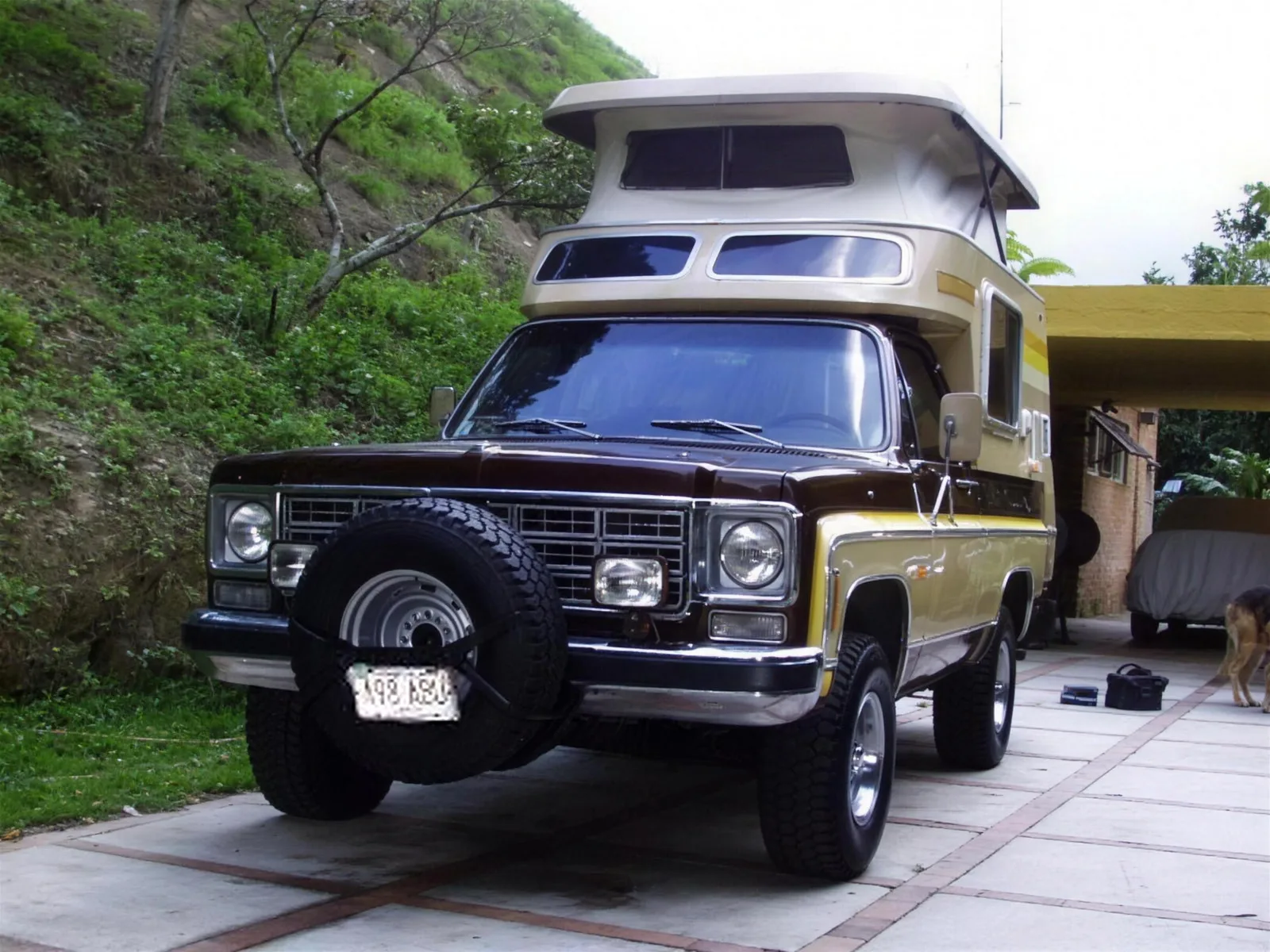
Photo courtesy of blazerchalet.com
The engine options available to Chalet buyers
The K5 Blazer Chalet was built on the same drivetrain menu as any other squarebody-era K5 Blazer ordered through a dealer during the package's run, which meant a choice of the 250 cubic-inch inline six or small block V8 options up to the 400, the same lineup offered on any 1976 or 1977 K5 Blazer, since the bigger 402 big block had already been dropped from the Blazer options list by that point in the squarebody run. There was no dedicated Chalet engine, no special tune built for the camper load. A buyer ordering the package was choosing from the same drivetrain sheet as anyone else, then adding camper hardware on top of whatever they picked. That matters, because it means the burden of hauling the extra weight fell entirely on however the original buyer had speced the truck, not on any factory accommodation built specifically for the camper's added mass.
Why the smaller engines struggled with the added weight
A base six-cylinder or a smaller V8 in a stock K5 Blazer is a reasonable, economical choice for a daily truck. Add a camper roof, a water system, and gear, and that same engine is now working meaningfully harder on grades, at altitude, and merging onto a highway loaded down. This is not a dramatic failure point, these engines were durable and buyers of the era were used to a truck feeling different loaded versus empty, but it is a real, measurable performance gap. A Chalet ordered with a modest engine would have felt noticeably slower and worked harder than the same truck without the camper package, and owners who used the camper function regularly would have felt that difference on every trip, not just the occasional one.
Why the bigger V8s made more sense for the job
Buyers who ordered a larger V8 alongside the Chalet package were, whether they framed it this way or not, making the more sensible choice for how the truck would actually be used. More torque and more reserve power matter more when a vehicle is consistently carrying extra weight than they do in a truck that only occasionally hauls a light load. The tradeoff was fuel economy, which was already a serious concern for buyers in the mid-1970s given the fuel prices of the period, so the choice between a modest engine that sipped less fuel and a larger V8 that handled the camper weight with less strain was a real one, not an obvious call either way.
| Consideration | Smaller engine (six or small V8) | Larger V8 |
|---|---|---|
| Everyday driving unloaded | Adequate, better fuel economy | More capable, higher fuel cost |
| Loaded with camper hardware and gear | Noticeably strained on grades | Handled the added weight with more margin |
| Best fit for regular camper use | Weaker match | Stronger match |
What this means when evaluating a Chalet today
For anyone looking at a surviving Chalet now, the original engine choice is worth understanding in context, not just as a spec line. A truck built with a smaller engine was not built wrong, it simply reflects a buyer who prioritized fuel economy or cost over towing and hauling margin, and it will still drive noticeably differently loaded versus empty compared to a big block equivalent. Neither choice is inherently more correct or more valuable on its own, but the engine does tell you something honest about how the original owner expected to use the truck. The k5 blazer chalet story covers how the package was built and marketed in more depth, and for readers who want the fuller history of the platform this camper package was built on, the full story is the place to go.
"The camper roof gets all the attention, but the engine is what actually decides whether the truck felt capable or strained once it was loaded up for a trip. That is not a small detail, it is the whole driving experience."
- Emily Chen
The honest verdict on engine choice and camper weight
If you are shopping for a Chalet with actual camping use in mind rather than static display, the drivetrain deserves as much scrutiny as the roof and interior hardware. A well-documented example with a larger V8 is going to be the more usable truck in practice, with more margin for the weight the camper conversion adds. A smaller-engine example is not a lesser truck, but it is a truck that will ask more of its driver on a grade with the roof loaded down. Buyers browsing classic K5 Blazers on the market should treat the engine spec as functional information about how the truck will actually behave once camper gear is on board, not just a line item to note and move past.
How the transmission and axle ratio factored in too
Engine displacement gets most of the attention in this conversation, but it was never the whole equation. Axle ratio and transmission gearing did as much to determine how a loaded Chalet actually felt on the road as the engine did on its own, and a buyer who ordered a numerically higher axle ratio alongside a modest engine could partially offset the weight penalty that a taller ratio and a smaller engine together would have made much worse. This is the kind of detail that gets lost when people talk about the Chalet purely in terms of small block versus big block, when the reality is that the whole drivetrain package, not just the engine, decided how the truck handled a loaded roof and a full water tank on a long grade.
Evaluating a surviving Chalet today with this in mind means looking past the engine tag alone. A modest engine paired with a favorable axle ratio might have been a perfectly reasonable, well-thought-out original order, while the same engine paired with a tall highway gear would have struggled noticeably more under camper load. Original build documentation, when it survives, usually specifies this whole combination together, and that combination tells a more complete story than the engine displacement by itself ever could.
None of this changes the basic engineering logic. More weight demands more margin somewhere in the drivetrain, whether that margin comes from displacement, gearing, or both together. What it does change is how carefully a buyer or appraiser should read the full drivetrain spec on a Chalet rather than fixating on the engine alone, because the engine was only ever part of how the truck actually handled the job it was built to do.
Sources and notes
Related Reading
Have a
Chevrolet Blazer
for Sale?
Reach thousands of serious classic car collectors across the US.
Sell It Here →
Selling a classic? Here's how: compare the places to sell classic cars
Are You a Classic Car Dealer?
List your full inventory and connect with targeted classic car buyers.
Join as a Dealer →
#small-block v8
#chevrolet k5 blazer
#k5 blazer chalet
#camper conversion
#squarebody engines
#classic truck drivetrain

About the author
Emily Chen
Bay Area engineer with a deep focus on vintage Japanese and European performance cars. Approaches classic car research and restoration with an analytical eye.
Related Listings - Chevrolet Blazer




Comments
Be the first to comment on this article.