
There is a photograph that circulates every few years in the truck forums. A woman in a rust colored sweater stands at the open back of a Chevrolet Blazer somewhere in the Cascades, holding a coffee cup, and behind her the roof of the truck has risen upward on canvas walls to become a small house. Her husband took the picture in the fall of 1977 and she has no idea it is still travelling. That is the K5 Blazer Chalet in one frame: a working four wheel drive that unfolded into a bedroom, sold for two model years, and then vanished so completely that most people who love these trucks have never seen one in person.
Car Features
11 min read
The Blazer Chalet: The K5 Camper
For two model years Chevrolet sold a four wheel drive Blazer that unfolded into a small house at the campsite. Then it vanished, decades before the world caught up with the idea.
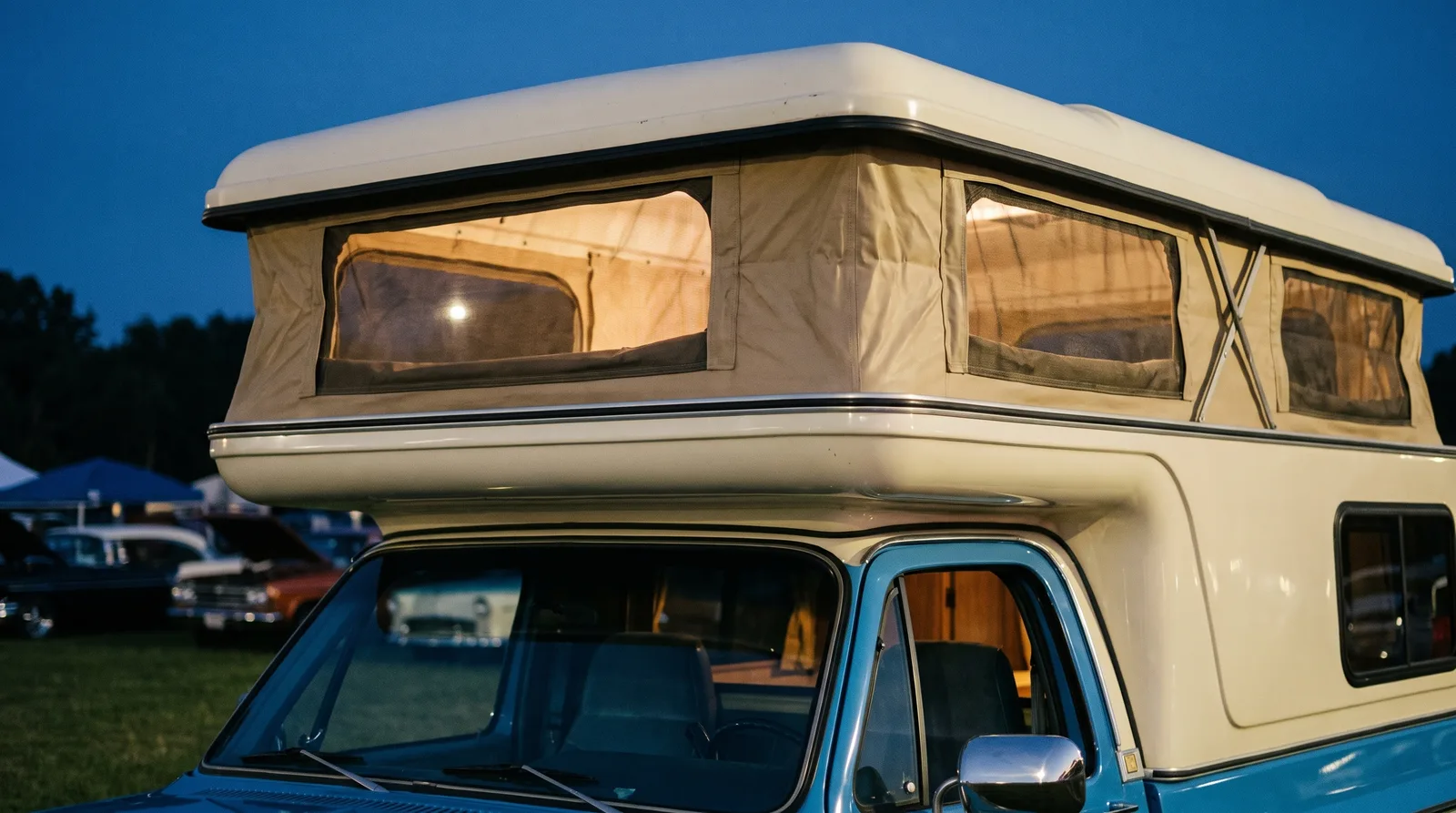
It is the strangest thing Chevrolet ever put in a Blazer brochure, and the reason it existed says a great deal about what Americans wanted in the middle of the 1970s.
Yakima, Washington, and an unlikely partnership
The Chalet was not built in Detroit. Chevrolet did what large companies do when they want a niche product without building a factory for it: they found somebody who already knew how. That somebody was Chinook Mobilodge, a camper manufacturer in Yakima, Washington, with a reputation for tidy, lightweight fiberglass units that did not fight the vehicle carrying them.
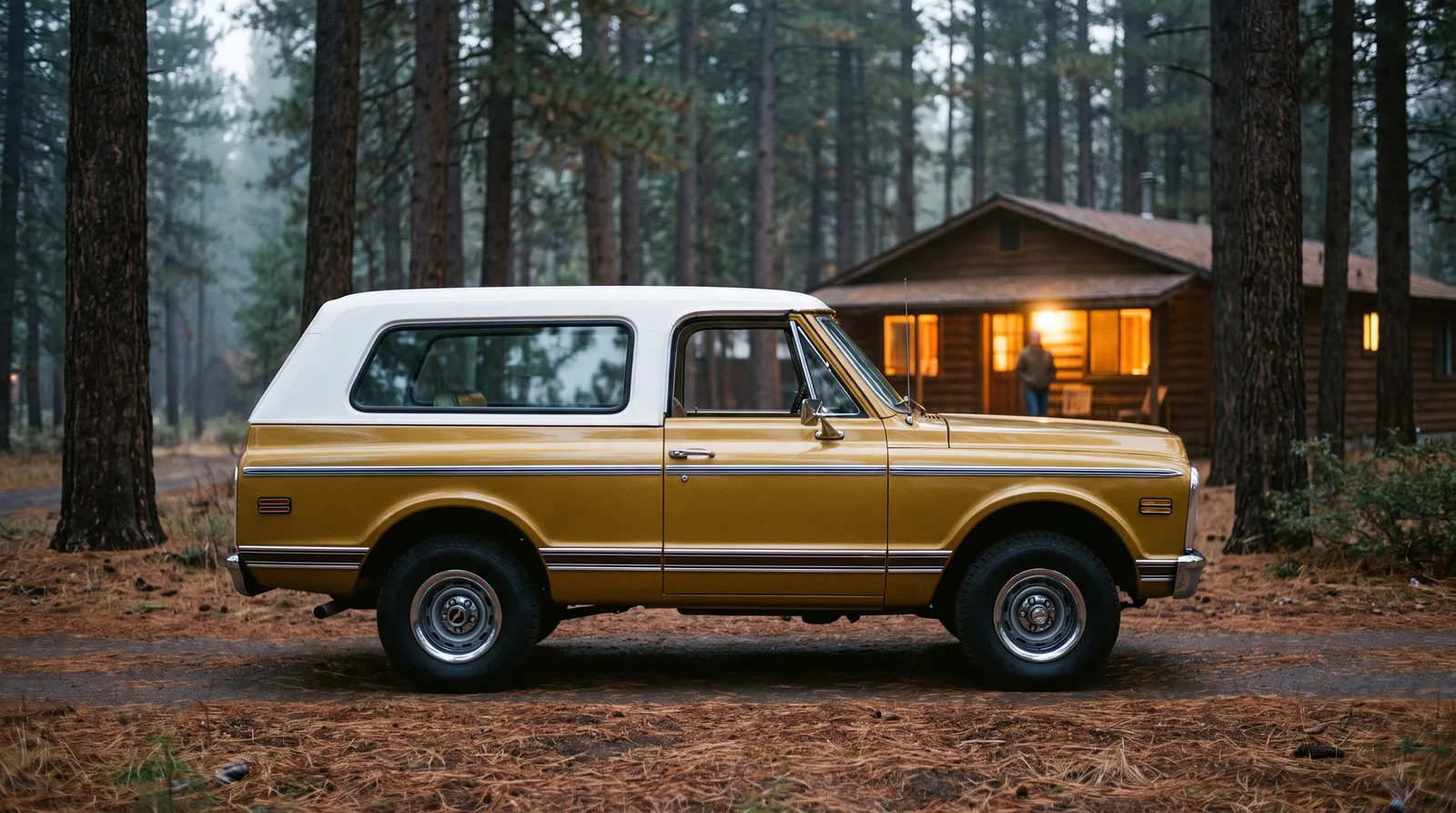
Complete Blazers went to Washington. The rear top came off, and in its place went a moulded camper body that bolted to the truck and blended into the cab line with a continuity that still surprises people. This was not a box dropped on a bed. The Chalet reads as though the factory drew it, and from twenty feet the profile looks like a slightly tall Blazer rather than a truck wearing luggage.
Chinook was a sensible choice for reasons that go beyond geography. The company had spent years building compact campers on small van and truck chassis and had learned the hard lesson that governs the whole category: weight ruins everything. Add too much and the vehicle handles badly, drinks fuel, wears out brakes and stops being fun to drive to the place you wanted to camp. The Chinook approach favoured thin moulded shells and low mounted mass, and that discipline is visible in how the finished Blazer sits.
Chevrolet then sold the finished thing through its own dealer network with warranty coverage, which is the detail that makes the K5 Blazer Chalet worth taking seriously. Plenty of aftermarket camper conversions existed in that decade. Almost none of them were ordered from a Chevrolet salesman in a tie.
What the K5 Blazer Chalet actually was
The mechanism is the charming part. Parked, the camper roof sat low enough to clear a standard garage door on a good day and low enough to look almost normal on the highway. At the campsite, the roof lifted on struts and canvas sides unfolded to give standing headroom inside. The transformation took a couple of minutes and required no tools, which in 1976 counted as engineering worth advertising.
Inside was a dinette that converted to a bed, a small galley with a sink and a stove, an icebox, water storage and a surprising amount of cupboard space for something built into what is fundamentally a short truck. Sleeping capacity was quoted for up to around four, though anyone who has actually done it will tell you that four is a number for the brochure and two is a number for the marriage.
The part that separates the Chalet from every other camper of its era is what stayed underneath. This was a real K5 with real four wheel drive, real ground clearance and a real transfer case. You could take the thing somewhere a motorhome would never reach, park it, raise the roof and make dinner. Nothing else on the market in 1976 offered that combination at a dealer.
The GMC Casa Grande and the badge engineering of it all
GMC dealers were not going to watch Chevrolet have all the fun. The Jimmy received the identical camper package under the Casa Grande name, and the differences amounted to grille, badging and whatever trim distinctions separated the two truck lines that year. Collectors treat them as the same animal with two spellings, and pricing follows condition rather than division.
Total production across both names remains a subject of argument. The figure most often cited, and backed by later research into GM and Chinook production records, is approximately 1,800 units built across the two model years and both badges. What is not in dispute is that survivors are scarce enough that regional club registries can list them by owner name.
| Detail | Blazer Chalet and GMC Casa Grande |
|---|---|
| Model years offered | 1976 and 1977 |
| Base vehicle | Full-size K5 Blazer and GMC Jimmy, half cab body |
| Converter | Chinook Mobilodge, Yakima, Washington |
| Roof | Manual lift pop top with canvas side walls |
| Interior | Convertible dinette bed, sink, stove, icebox, water tank |
| Estimated production | Roughly 1,800 across both badges |
| Drivetrain | Standard Blazer running gear including four wheel drive |
Living in eleven feet of truck
It is worth pausing on the timing. The Chalet appeared for 1976, the first model year of the half cab Blazer, which is not a coincidence. The fixed forward roof gave the converter a solid structure to work against and a clean line to marry the camper body into. On a full convertible truck the same conversion would have meant building the roof structure from nothing. The camper existed because Chevrolet had just made the Blazer less open, which is a small piece of irony the brochures never mentioned.
People who owned one describe the same rhythm. You drove all day with the roof down and the truck felt like a Blazer that had eaten well. You found a spot. You released the catches, pushed the roof up, and the interior became a room with a view of whatever you had chosen. Then you cooked something on two burners while the light went orange.
The compromises were real and nobody who owned one pretends otherwise. Fuel economy was poor even by the standards of a decade that had already lived through one oil shock. The added weight sat high, which made the truck lean into corners with a lazy roll that demanded a slower hand on mountain roads. Wind noise at highway speed was constant. Heat management in summer relied on opening things and hoping.
None of that stopped the people who loved theirs. The Chalet solved a specific problem beautifully. A family could reach a trailhead in the morning, sleep at the trailhead that night, and drive to a diner the next day without towing anything or renting anything. In the second half of the 1970s, when the national parks were filling up and the interstate system had finally made the whole country reachable in a week of vacation, that was an appealing promise.
"It was never really a camper with a truck attached. It was a truck that agreed, for one night at a time, to be a house. That is a small distinction until you are parked at nine thousand feet and it starts to rain."
- Nora Beckett
Why it lasted only two model years
Two model years is barely a product cycle, and the reasons for the short run were mundane rather than dramatic. Price was the first problem. The base 1977 Chalet carried a suggested retail price around 9,400 dollars, and a well optioned example could climb toward 13,000 dollars, far more than a standard Blazer, enough that a buyer comparing sticker to sticker could get a conventional camper and a used pickup for similar money.
The second problem was arithmetic. The conversion added several hundred pounds to a truck that already worked hard, and payload numbers after conversion left very little room for people, water, food and gear at the same time. Owners learned to pack light or ignore the plate on the door.
The third problem was simply the market. Class C motorhomes were getting cheaper and better, pop up trailers were selling in enormous numbers, and the buyer who wanted a bed in the wilderness had more choices every season. The Chalet occupied a narrow slot between two large categories, which is a wonderful place to be interesting and a terrible place to be profitable. Chevrolet let it go quietly after 1977 and never repeated the experiment.
Dealers played their part in the ending too. Selling a Chalet took time. A salesman had to raise the roof, explain the plumbing, answer questions about payload and warranty coverage, and then find a buyer willing to pay a premium for a vehicle that fitted neatly into no existing category on the lot. Meanwhile the same salesman could move three ordinary Blazers in the time it took to demonstrate one camper. Products that require education die in showrooms for reasons that have nothing to do with whether they were any good.
What survivors trade for now
The market for these has changed shape twice. Through the 1990s a Chalet was a curiosity worth less than a clean standard Blazer, because the camper interiors leaked, the canvas rotted, and nobody wanted a truck with a weird roof. Values sat on the floor for years, which is exactly when most of them were parted out or left in fields.
Then the overland movement arrived and rewrote the story. A factory backed, dealer sold, four wheel drive pop top camper from 1976 turned out to be precisely what a modern buyer wanted, decades before anyone used the word overlanding. Prices climbed hard. A genuinely presentable example now commands multiples of what a comparable standard Blazer brings, and rough project examples still find buyers because the bodies are effectively unobtainable.
If you are working out where the Chalet fits in the broader model line, it helps to read the k5 blazer story first, because the camper only makes sense once you understand what the base truck was doing in 1976. For anyone tracking values across the whole range, watching classic K5 Blazers on the market gives a useful baseline against which the Chalet premium becomes obvious.
The odd little monument
What the Chalet leaves behind is not a sales record. It is proof that a mainstream American manufacturer once looked at a work truck and asked what would happen if it could also be a place to sleep, then actually built the answer and put it in a showroom. That instinct went dormant for forty years and has come roaring back, which makes these trucks feel less like a footnote and more like a first draft.
There is also something quietly moving about how personal the surviving examples are. Almost every one carries evidence of the family that used it. A drawer lined with contact paper chosen in a hardware store in 1979. A curtain rod moved two inches because somebody kept hitting their head. Pencil marks inside a cupboard door recording the elevation of every pass they crossed. Restorers tend to sand that away in pursuit of correctness, and the ones who leave it are, to my mind, doing the better work.
The roof came off the K5 in more than one way during its life, and if the pop top version has caught your attention, the story of the full removable roof is the next chapter in the same argument about what a truck is allowed to be.
Sources and notes
Related Reading
#chevrolet k5 blazer
#k5 blazer chalet
#gmc casa grande
#vintage campers
#chinook mobilodge
#overlanding history

About the author
Nora Beckett
Automotive features writer and photographer who tells the human stories behind the cars, from show fields to cross-country road trips.
Related Listings - Chevrolet Blazer

Comments
Be the first to comment on this article.