
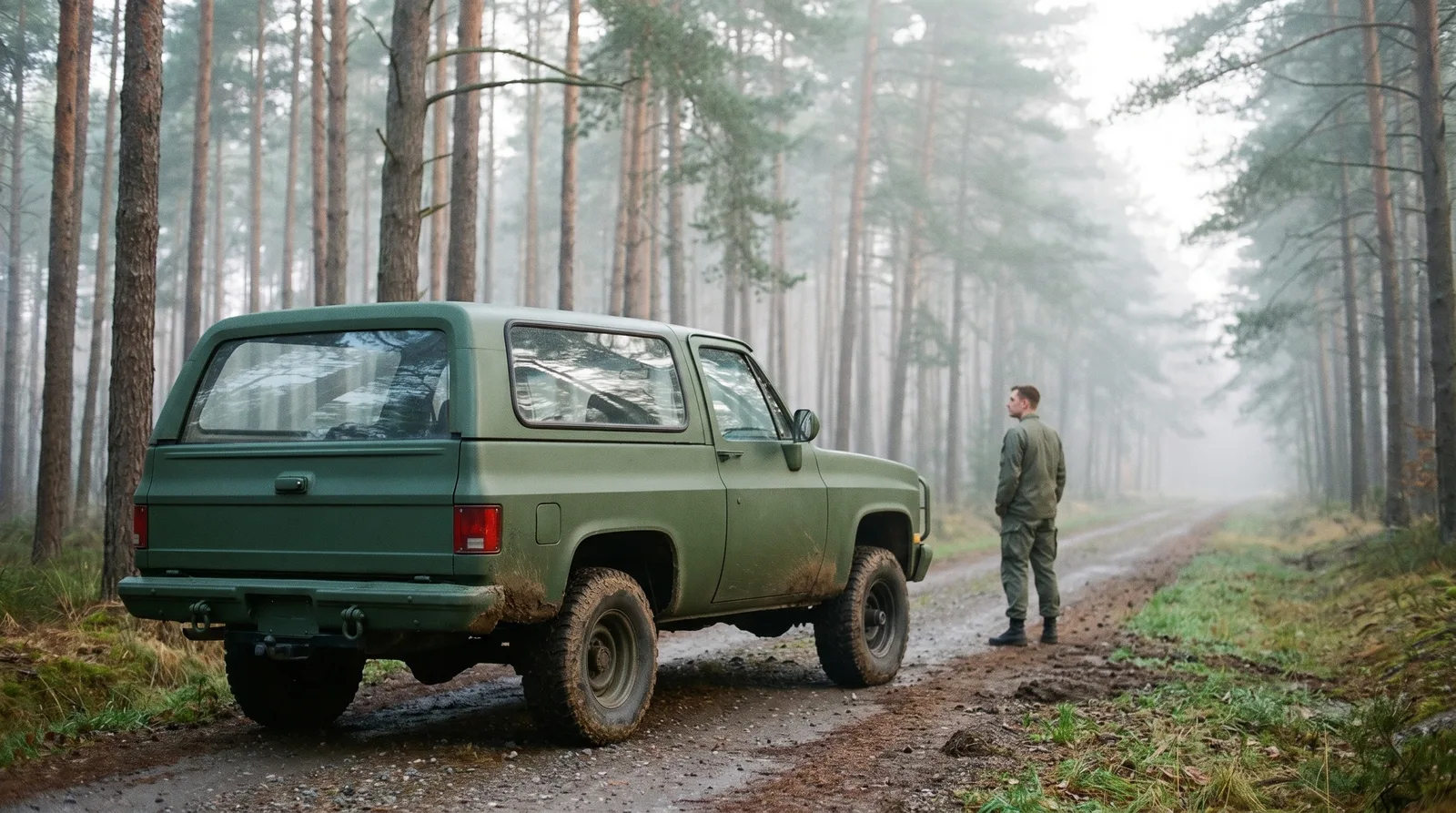
Picture a Cold War motor pool somewhere in the early 1980s, rows of matte olive drab trucks lined up under fluorescent hangar light, and somewhere in that formation, a K5 Blazer that does not look anything like the one your neighbor drives to the lake. No chrome, no two-tone paint, no removable top nostalgia. Just a stripped, diesel-powered utility vehicle wearing a designation most civilians have never heard: M1009. The m1009 cucv blazer is the K5's strangest and most overlooked chapter, a truck built not to impress anyone but to survive a war that, fortunately, never came the way planners expected.
Car Features
6 min read
The M1009 CUCV: The Military K5 Blazer
The M1009 CUCV Blazer traded chrome and comfort for a 6.2L diesel and a military service record, and it is now one of the K5 platform's most undervalued chapters.
What CUCV actually stood for
CUCV is short for Commercial Utility Cargo Vehicle, a U.S. military procurement program launched in the early 1980s to replace aging Vietnam-era light vehicles with off-the-shelf commercial trucks modified for service use. Rather than engineer a bespoke military vehicle from scratch, the Department of Defense went to Chevrolet and ordered variants of its existing K-series trucks, built to military specification but sharing the bulk of their mechanical DNA with the civilian squarebody line already rolling off the same production lines. The M1009 designation specifically applies to the CUCV Blazer variant, distinct from the M1008 pickup and other CUCV derivatives built for cargo and ambulance duty.
For the full arc of how the K5 platform got to this point, and what came before and after the military contract years, our gmc jimmy retrospective traces the badge's civilian and cross-brand history from the 1969 introduction onward.
Diesel power and stripped utility
Every M1009 left the factory with a 6.2L diesel V8, chosen for its fuel efficiency, torque characteristics, and relative simplicity compared to a turbocharged or electronically managed alternative, qualities the military valued far more than outright speed. Inside, the truck was about as far from a consumer SUV as GM's assembly line could produce: vinyl seating, blackout lighting for tactical night driving, a hybrid 24-volt electrical system, built from dual 12-volt batteries to support the NATO slave receptacle and military communications equipment, and none of the trim or comfort options that defined a civilian Silverado-era Blazer. These were tools first, and every design choice reflects that priority. There was no CST package, no woodgrain dash appliqué, nothing that suggested the truck's civilian cousin was being built on the very same line.
Life after the military
The CUCV program's real second act happened decades after these trucks left active service. Starting in the 1990s and accelerating through the 2000s, the federal government began releasing surplus CUCVs through public auction channels, and a genuinely enthusiastic subculture of buyers picked them up for a fraction of what a comparable civilian diesel K5 would cost. Prepper communities, off-road enthusiasts, and diesel loyalists all found something to like: a mechanically simple, torque-rich truck with a documented, no-nonsense history and a price point that undercut nearly everything else on the used market. That demand shaped how these trucks are perceived today. An M1009 is not chasing the same buyer as a restored CST Blazer with a matching-numbers 350. It is chasing someone who wants proof their truck actually did something before it ended up in a driveway.
| Spec | M1009 CUCV Blazer |
|---|---|
| Engine | 6.2L diesel V8 |
| Electrical | Hybrid 24V system (dual 12V batteries) |
| Interior | Vinyl, blackout lighting, no comfort trim |
| Service era | Early 1980s through the early 1990s |
| Surplus availability | Public auction release beginning in the 1990s |
The collector's angle: originality over polish
Restoring an M1009 the way you would restore a civilian K5 misses the point entirely, and most serious CUCV collectors know it. The trucks that command real respect in this niche are the ones that keep their original olive drab or CARC paint, their data plates, their tactical markings, and their period-correct equipment, even when that means living with a Spartan interior and a top speed that will not win anyone a stoplight race. Originality is the currency here, not shine. A CUCV that has been civilianized, chromed out, and stripped of its military identity has arguably lost the exact thing that made it worth owning in the first place.
"You meet a certain kind of guy at a swap meet standing next to an M1009, and he's not there to talk paint codes. He's there because that truck did a job most people never think about, and he wants you to know it."
- Patrick Walsh
Why the values still lag behind civilian trucks
Despite the growing appreciation for CUCVs among diesel and military-vehicle enthusiasts, M1009 values have historically trailed well-kept civilian K5 Blazers, and that gap says something about how the collector market assigns worth. A restored CST or Silverado-trim Blazer appeals to a much broader buyer pool built around nostalgia, comfort, and visual presence. The M1009 appeals to a narrower, more specific audience that values history and mechanical honesty over curb appeal. That narrower demand keeps prices lower even as interest grows, which is exactly why longtime CUCV collectors describe the segment as undervalued relative to what the trucks represent. A clean, documented M1009 with its original equipment intact is, mechanically speaking, every bit as durable and interesting as a civilian diesel Blazer from the same years. It simply has not caught up in the market's eyes yet, and that gap is part of what keeps drawing new buyers into the niche every year.
Where the CUCV fits in the wider K5 story
It is easy to treat the M1009 as a footnote next to the flashier civilian Blazers that dominate auction coverage and magazine features, but that undersells what the military contract actually represents. For roughly a decade, a meaningful share of K5 platform production was going straight to the Department of Defense rather than a dealership lot, and that chapter shaped both the truck's engineering reputation for durability and, eventually, its second life as an affordable, mechanically honest project vehicle for a new generation of owners. The CUCV did not get a magazine spread when it was new. It got a motor pool assignment. Its story only got interesting decades later, once surplus buyers realized what they were actually looking at.
Buyers curious about where a genuine CUCV or a civilian squarebody sibling fits into their own garage should look at what is currently available. Interested shoppers can browse K5 Blazers for sale now and compare a stripped military-spec build against the civilian trucks it shared a factory floor with.
Sources and notes
Related Reading

About the author
Patrick Walsh
Automotive journalist covering classic car shows, events, and the enthusiast community across North America.
Related Listings - Chevrolet Blazer




Comments
Be the first to comment on this article.