
My grandfather kept his GMC Jimmy's top off from May through September, every year, without fail, and I did not understand until I was much older why that mattered to him so much. It was not about the weather, not really. It was about the specific pleasure of a truck that could become an entirely different vehicle in the space of an afternoon, something he had chased since he was young and something Detroit had only briefly, imperfectly, made possible.
Car Features
7 min read
The Full Convertible Top on the Early GMC Jimmy
Between 1970 and 1972, the GMC Jimmy offered a fully removable roof unlike anything Ford or International sold. A personal look at what made it special, and why it never came back.
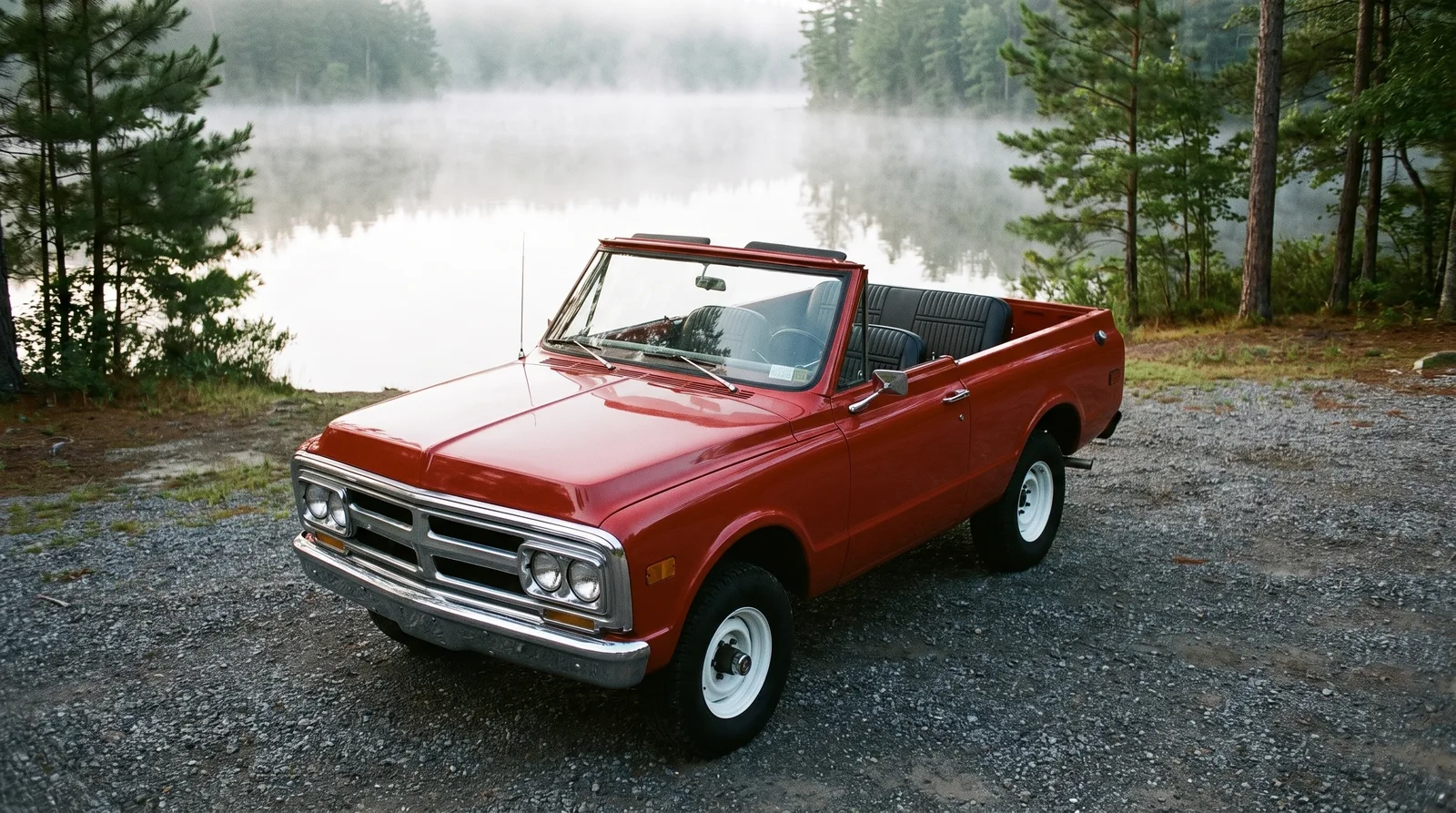
The early GMC Jimmy, built from the 1970 debut through the 1975 model year on the same platform Chevrolet used for the K5 Blazer, offered something almost no other American truck of the era did. A full removable top, the whole roof structure, not just doors or a folding canvas section, that could come off entirely and turn a hardtop truck into something close to an open-air vehicle. It sounds simple now. It was not simple in period, and it did not last as a factory feature in its purest form, GM dropped it after 1975, largely over rollover-safety concerns, and replaced it with a fixed half-cab roof starting in 1976.
What made the early top genuinely different
Ford's Bronco also had a removable hardtop, but on a much smaller compact truck. International's Scout had its own approach, distinct from GM's solution. What GM did with the early Jimmy and Blazer was structurally more ambitious: the entire hardtop roof section could be unbolted and lifted off, transforming the truck from a fully enclosed cab into something with no roof at all, not just an open cargo area. A canvas soft top was also available for buyers who wanted weather protection without the full hardtop, giving the truck a third configuration between fully open and fully enclosed.
That flexibility came at a real engineering cost. A vehicle designed around a removable roof section needs a frame and body structure rigid enough to hold its shape without the roof contributing to overall stiffness, which is a harder problem than designing a body that assumes the roof is permanently attached. GM solved it well enough to bring the truck to market, but the compromise shows up in how these early trucks have aged, particularly around water sealing where the removable section met the body.
Living with one, then and now
For an owner like my grandfather, the appeal was seasonal and almost ceremonial. Taking the top off at the start of summer was an event, something that took real effort with the tools of the time, and putting it back on before the weather turned was its own small ritual marking the end of the season. That is a different relationship with a vehicle than most people have today, where convertibles fold themselves at the touch of a button and nobody thinks twice about it.
The practical reality for a modern owner is more complicated than nostalgia suggests. A fifty-year-old removable top assembly, along with its mounting hardware and weather seals, is exactly the kind of component that suffers from decades of exposure, storage, and, in a lot of cases, simple neglect once an original owner stopped bothering with the seasonal ritual and left the top on year round. Finding a truck with a complete, correctly fitted, and properly sealed original top assembly is genuinely harder than finding one with a sound drivetrain, since the top components were never as robust as the frame and running gear underneath them.
"He would take that top off like it was the first warm day of his whole life, every single year. I did not get it as a kid. I get it now. There is nothing else quite like driving one of these with the roof gone completely."
- Nora Beckett
What replacing or restoring one actually involves
My grandfather never had to think about restoring his top, because it was simply the truck he drove, cared for as a matter of routine rather than as a restoration project. Owners today are rarely in that position. Most surviving early Jimmys have a top assembly that has seen decades of sun exposure, imperfect storage, and, in more cases than anyone would like, outright neglect by an intermediate owner who never bothered with the seasonal removal ritual at all and simply left the truck sealed up year round, weather seals slowly failing the whole time.
A correctly restored top on one of these trucks means sourcing hardware that has not been reproduced with the same volume or consistency as mechanical parts for this platform, fitting it properly so the water sealing actually works rather than just looking right in photos, and understanding that the fit and finish of this system was never as forgiving as a fixed roof would have been even when new. It is a genuinely specialized corner of this truck's restoration, one that a shop experienced with pickups and Blazers from the same era might still find unfamiliar if they have not specifically worked with an early removable-top example before.
For buyers, this means the top assembly deserves the same scrutiny as the frame or the drivetrain, not an afterthought behind a walk around the exterior paint. A truck that looks complete with the top installed can still be hiding a compromised seal system that has already done quiet damage to the structure underneath.
Why this matters to how the truck is remembered
The fully removable top is arguably the single most distinctive feature of the early Jimmy and Blazer generation, more than any engine option or trim package. It is the feature that separated this platform from the Bronco and the Scout in the most visible, tangible way, and it is the feature that later squarebody trucks, for all their improvements in comfort and reliability, never fully recaptured. Owners chasing an authentic early example are, more often than not, chasing that top specifically, not just an old truck with four-wheel drive.
I think about my grandfather's ritual every time I see one of these trucks parked at a show with the top on, even in warm weather, and I wonder whether the owner ever takes it off at all. Some do not, either out of concern for the hardware's condition or simply because the truck has become more of a display piece than a driver. I understand the caution. But there is something quietly sad about a truck built around that seasonal transformation sitting closed up year round, keeping the one feature that made it different from every other truck on the platform permanently out of use.
For anyone trying to understand how this early open-top design fits into the Jimmy's broader story, from its 1970 debut through the eventual shift away from this configuration, our team has covered the background on the full production run. If reading about the top has put you in the market for a truck that still has it, current find a classic K5 Blazer listings are worth checking, though a genuinely complete original top assembly is one of the harder things to find intact after all these years.
Sources and notes
Related Reading

About the author
Nora Beckett
Automotive features writer and photographer who tells the human stories behind the cars, from show fields to cross-country road trips.
Related Listings - Chevrolet Blazer




Comments (1)
R
Randy
11 hours ago
Reckon even a Ford man has to admit that roofless Jimmy looks right.