
The k5 blazer squarebody 350 is not a mystery engine. It is the small-block that most squarebody Blazers left the factory with, and it is the reason so many of them are still running forty and fifty years later. No trick history, no asterisk. Just a 350 cubic inch V8 doing the job it was built for, in a truck that outlived its warranty by decades.
Car Features
7 min read
The Small-Block 350 and the Squarebody K5
The 350 small-block was the default engine in most squarebody K5 Blazers, and its unremarkable reliability is exactly why so many are still on the road.
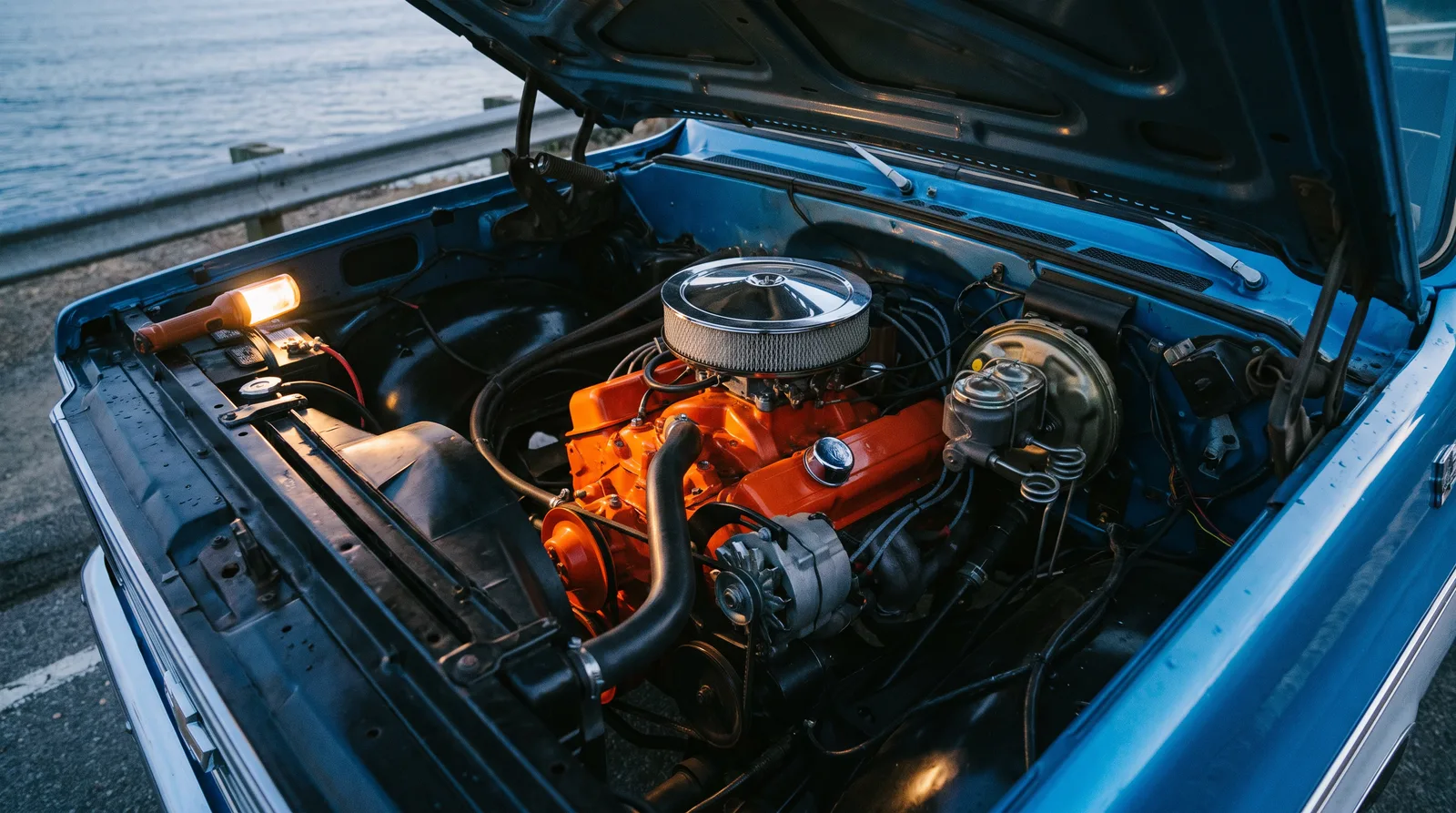
The number that matters: how many 350s actually went into K5 Blazers
Chevrolet did not build one 350 for the squarebody Blazer. It built several, spread across two decades of production from 1973 to 1991. The base two-barrel 350, badged L65 in some years, was the volume engine for mid-trim Blazers and Cheyennes. A four-barrel version, the L48, showed up in higher-output configurations and later became the standard 350 once GM simplified its truck engine lineup in the 1980s. Horsepower ratings moved with emissions rules, not with marketing. Early-to-mid 1970s two-barrel 350s in trucks are commonly cited in the 145 to 165 horsepower range as emissions rules tightened, while the later fuel-injected TBI 350 (the L05, arriving toward the end of squarebody production) pushed output back up into the low 200s. That is not a straight line of progress. It is a truck engine reacting to a decade of tightening regulations, then clawing horsepower back once fuel injection let engineers stop choking the carburetor to pass a test.
The result is that "the 350" in a K5 Blazer conversation can mean three or four different engines depending on the model year. Anyone shopping a squarebody Blazer on the 350's reputation alone should ask which 350, not just whether it has one.
Why the 350 beat the 305 and the 400 for buyers
Chevrolet also offered a 305 cubic inch small-block and a 400 cubic inch small-block in the same trucks. The 305 was smaller and thriftier on paper, but it never built a following in the Blazer, mostly because buyers cross-shopping a two-and-a-half-ton 4x4 wanted torque, not fuel economy. The 400 leaned the other way, more low-end grunt but a reputation for running hot, a story covered in more detail in a related story on this site. The 350 sat in the middle. Enough displacement to move the truck without strain, a design GM had already proven in cars and vans, and a parts network so large that keeping one running never required a special trip. That combination, not any single dyno number, is what made the 350 the default choice for most K5 buyers between 1973 and 1991.
What the 350 actually does in daily use
Owners who tow, plow, or off-road their squarebody Blazers describe the 350 the same way generation after generation: unremarkable, in the best sense. It idles fine. It pulls a trailer without drama. It does not demand premium fuel or a specific tune to stay happy. Compression ratios dropped through the 1970s to meet unleaded fuel requirements, which cost some power but bought reliability on regular gas, a fair trade for a truck meant to work rather than race. Cooling capacity in the K5 is generous relative to the engine bay, which is part of why the 350, unlike the 400, rarely shows up in forum threads about chronic overheating.
None of this makes the 350 exciting. It makes it durable, and durability is the entire case for the engine forty-plus years later. A running 350 with a clean maintenance history is one of the lowest-risk drivetrains in the used truck market, full stop.
How the 350 compares on the used market today
Pricing data for squarebody K5 Blazers rarely breaks out by engine alone, since condition, rust, and originality drive most of the spread. Still, a documented, numbers-matching 350 tends to hold value better than an unknown swap, because buyers researching these trucks want the drivetrain history to line up with the rest of the truck's paperwork. A seller who can produce a build sheet or a broadcast sheet confirming the original 350 configuration has a stronger selling point than one who simply says "it's got a 350 in it," even if the two engines perform identically on the road.
That documentation gap explains a lot of the price variance seen in listings. Two visually similar trucks with the same displacement badge can sell tens of percentage points apart once buyers factor in whether the drivetrain history is verifiable. The 350's ubiquity works against rarity-driven pricing, but it works in favor of predictable ownership costs, and for most buyers that trade is the right one to make.
Maintenance habits that keep a 350 alive for decades
Longevity on these engines rarely comes down to luck. The trucks still running strong after fifty years almost universally share a pattern: regular oil changes on a real schedule rather than a guessed one, coolant flushed before it turns to sludge, and a carburetor or throttle body that has been rebuilt or cleaned rather than ignored until it fails outright. None of that is exotic maintenance. It is the same basic care that keeps any carbureted or early fuel-injected V8 healthy, and the 350's simplicity means an owner willing to do that work rarely needs a specialist to help.
Ignition timing and vacuum advance settings matter more on these engines than newer owners sometimes expect, since a 350 running slightly off spec will still run, just poorly and with worse fuel economy, masking a problem that would otherwise be obvious. Owners who keep timing and vacuum lines in proper order tend to report smoother idle, better mileage, and fewer mystery issues than owners who let a "good enough" tune stand for years at a stretch.
What to check before trusting a 350 badge
A 350 emblem on the fender does not guarantee a factory 350 is still under the hood. Decades of engine swaps mean plenty of squarebody Blazers now run a later 350 crate engine, a Vortec out of a 1990s truck, or a mildly built 350 from a completely different vehicle. That is not automatically bad. A well-documented swap can be more reliable than a tired original. But it changes the value case and the parts compatibility, and a buyer treating "it's got a 350" as a single fact is skipping the real question, which is which 350, installed when, and by whom.
| 350 variant | Approx. years in K5 Blazer | Induction | Notes |
|---|---|---|---|
| L65 | 1973 to early 1980s | 2-barrel carburetor | Base volume engine, torque-tuned |
| L48 | Mid-1970s through 1980s | 4-barrel carburetor | Higher-output option, later became standard |
| L05 | Late 1980s to 1991 | Throttle body fuel injection | Improved cold starts and output |
"People ask me what's special about the 350 in these trucks. Nothing is special about it. That's the point. It doesn't need to be special to still be running."
- Dan Reeves
The bottom line on the 350
The 350 is not the reason to buy a squarebody K5 Blazer, and it does not need to be. It is the reason a lot of squarebody K5 Blazers are still around to buy. Parts availability alone settles most arguments in its favor: forty years after the last one left a factory floor, a rebuild kit, a set of heads, or a whole crate replacement for a 350 is a phone call away, not a search through swap meets. Compare that to a big block or a diesel and the 350 wins on convenience every time, even if it loses on bragging rights.
For a wider look at how the second-generation Blazer came together as a platform, not just an engine choice, our square body blazer retrospective covers the full picture. And for buyers who have read enough history and want to see what is actually on the market, K5 Blazers for sale now is the next stop.
The verdict on the 350 does not need dressing up. It was the safe choice in 1975 and it remains the safe choice today. Trucks built around it tend to have longer service histories, cheaper repair bills, and fewer surprises than the ones built around bigger, thirstier, or more exotic engines. That is a fine legacy for an engine nobody ever called glamorous.
Sources and notes
Related Reading
Have a
Chevrolet Blazer
for Sale?
Reach thousands of serious classic car collectors across the US.
Sell It Here →
Selling a classic? Here's how: the best sites to sell a classic car
Are You a Classic Car Dealer?
List your full inventory and connect with targeted classic car buyers.
Join as a Dealer →

About the author
Dan Reeves
Performance engine builder from North Carolina's motorsports corridor, focused on swaps, forced induction and making real, repeatable power.
Related Listings - Chevrolet Blazer
Comments
Be the first to comment on this article.