
Not every squarebody K5 Blazer that mattered ended up on a stage at a concours. Some of the most legendary squarebody K5 Blazers earned their reputation in a rescue squad garage, a movie studio backlot, or the driveway of an owner who simply refused to let a truck go even when everyone told them it made no sense to keep it. Those are the stories that give this generation its texture, the ones that go beyond spec sheets and into what the trucks actually did.
Car Features
7 min read
Legendary Squarebody K5 Blazers
From military CUCV Blazers to decades-long single-family trucks, the most notable squarebody K5 Blazers earned their reputation through documented history, not just looks.
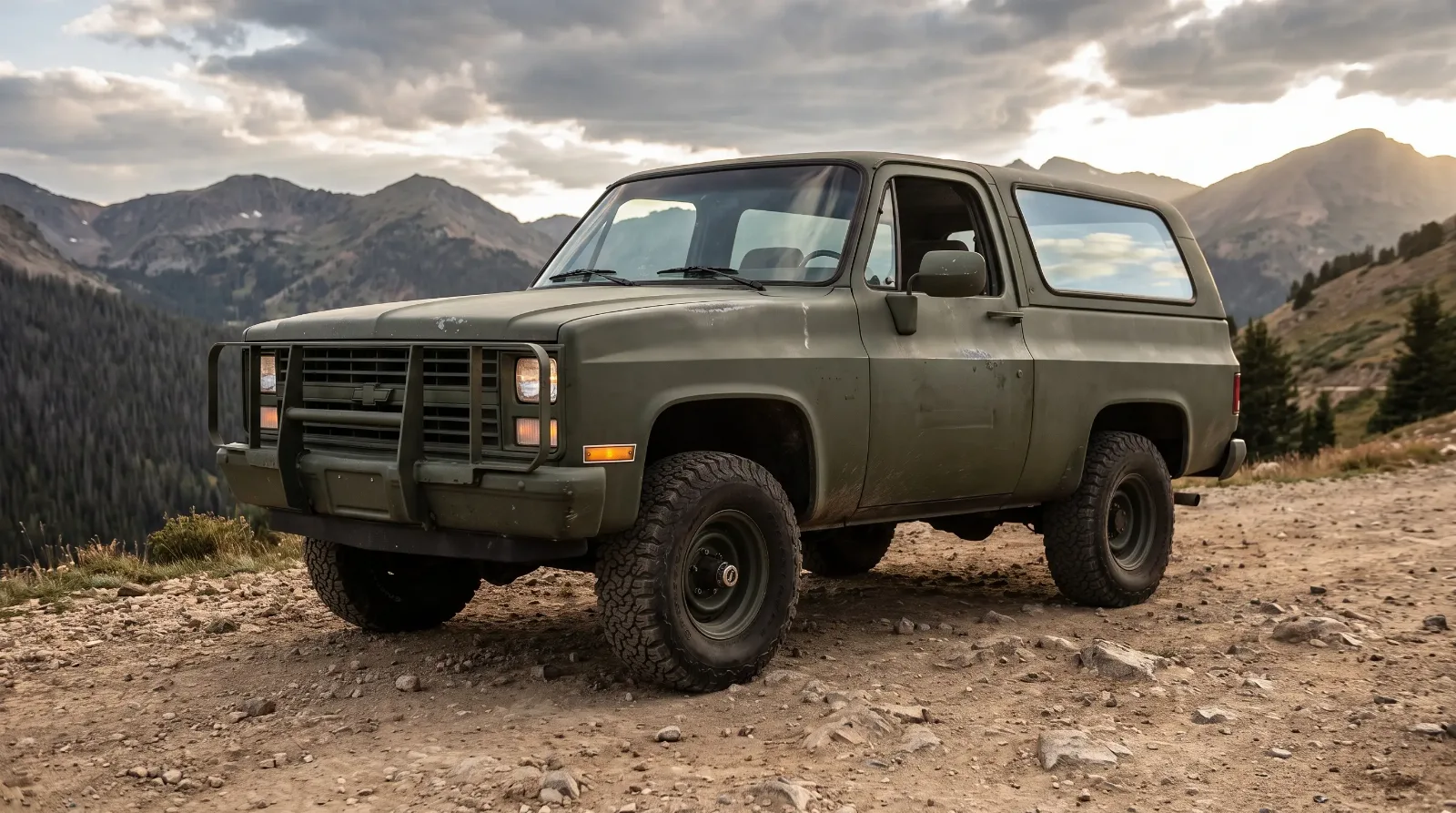
The military CUCV Blazers
Among the most historically significant squarebody Blazers are the M1009 Commercial Utility Cargo Vehicles built for the United States military in the 1980s. Adapted from the civilian platform with a diesel engine, blackout lighting, and other field-specific modifications, these trucks served in support roles and eventually filtered into civilian ownership as military surplus. Roughly 70,000 CUCVs across all body styles, including the M1009 Blazer, were built from 1983 to 1986 for the 1984-1987 model years, and many were later released through military surplus channels into civilian hands. A documented, unmodified M1009 carries a different kind of significance than a civilian truck of the same year, it is a piece of verifiable service history rather than just a used vehicle, and collectors who specialize in military vehicles treat them with the same seriousness other collectors reserve for numbers-matching muscle cars.
First responder and public service trucks
Beyond military use, the squarebody Blazer served extensively in fire department, search and rescue, and rural law enforcement fleets across the country during its production years and well beyond, thanks to its four-wheel drive capability and generous cargo space. Surviving examples still wearing original department livery, even repainted or partially restored, carry a documented working history that appeals to a specific segment of collectors interested in preserving public service vehicles rather than personal trucks. These examples rarely command headline auction prices, but they hold a genuine place in the story of what this truck was actually built to do.
Long-term single-family ownership trucks
Some of the most compelling notable examples are not famous for any dramatic history at all, they are famous for the opposite, decades in the hands of one family, driven, maintained, and never significantly modified. These trucks show up at estate sales and family transfers with complete maintenance records, original window stickers, and sometimes even the original sales paperwork still tucked in a glovebox. That unbroken chain of ownership and documentation is worth more to a serious collector than almost any cosmetic feature, because it answers every question a buyer would otherwise have to guess at.
These trucks rarely generate headlines when they change hands, but within the community that tracks this generation closely, word travels fast when a genuinely documented, single-family K5 comes up for sale.
"The truck with a shoebox full of receipts going back to 1979 is worth more to me than a truck that just looks perfect in photos. History you can hold in your hand does not lie the way a fresh coat of paint can."
- Nora Beckett
Builder showcase trucks
The restomod and custom truck scene has produced its own category of notable squarebody examples, builds that became widely recognized within the community for the quality of their fabrication rather than any factory rarity. These trucks earn their reputation through craftsmanship, a particularly clean engine bay, a suspension setup other builders reference, an interior conversion that set a new standard for what a modernized squarebody cabin could look like. Word of mouth and social media coverage have made certain individual builds almost as recognizable within enthusiast circles as any factory-original example, a newer kind of notability that did not really exist for this platform a generation ago.
Trucks tied to specific working landscapes
A category that gets less attention than it deserves is the squarebody Blazer that spent its working life tied to a specific piece of land, a ranch, a hunting outfit, a utility company service territory. These trucks rarely have a dramatic single story, but they accumulate a different kind of value, decades of use in a specific climate and terrain that shows in honest wear patterns rather than accident damage or neglect. Buyers who understand what to look for can read a lot from that wear, which parts of the truck saw real use, which stayed protected, and that reading tells a story just as legitimate as any paperwork trail.
Owners who eventually sell these working trucks often have decades of informal knowledge about the vehicle that never made it into any written record, which gearbox was replaced and when, which repairs were done in-house versus at a dealer. A buyer willing to sit down with that kind of seller before a sale, rather than just inspecting the truck cold, often comes away with a far more complete picture than paperwork alone would ever provide.
Why these stories matter to the wider hobby
Notable examples do more than fill out an interesting list, they set reference points the rest of the hobby measures against. A documented military CUCV establishes what genuine, verifiable history looks like. A long-term family truck establishes what unbroken ownership and paperwork are worth. A standout restomod build establishes what quality fabrication can achieve on this platform. Every one of these reference points helps buyers, sellers, and restorers calibrate their own expectations when they are evaluating a truck that does not come with a dramatic story attached, which describes the vast majority of squarebody Blazers still on the road today.
How to evaluate a claimed notable history
Enthusiasm for a good story can outrun good judgment, and this category of truck attracts more than its share of embellished claims. A seller describing a truck as a former fire department vehicle or a family heirloom deserves a polite but firm request for something to back it up, a title chain, a bill of sale, department records, photographs with dates. Absence of documentation does not automatically mean the story is false, plenty of genuine history simply was not written down at the time, but it does mean the story should not carry weight in the price until something more concrete surfaces.
The trucks that hold up best under this kind of scrutiny tend to be the ones where the seller volunteers documentation before being asked, rather than leading with the story and producing paperwork only when pressed. That small difference in how a seller presents a truck's history is often the clearest signal of how much weight the story actually deserves.
For the fuller history of how this generation of Blazer earned the reputation that makes these individual stories matter, the square body blazer story covers the whole arc from introduction through the end of production. If one of these categories has you thinking about your own search, you can browse classic K5 Blazers on the market and start looking for the documentation and history that separates a truly notable example from an ordinary one.
Sources and notes
Related Reading
Have a
Chevrolet Blazer
for Sale?
Reach thousands of serious classic car collectors across the US.
Sell It Here →
Selling a classic? Here's how: where to sell your classic car online
Are You a Classic Car Dealer?
List your full inventory and connect with targeted classic car buyers.
Join as a Dealer →

About the author
Nora Beckett
Automotive features writer and photographer who tells the human stories behind the cars, from show fields to cross-country road trips.
Related Listings - Chevrolet Blazer
Comments
Be the first to comment on this article.