
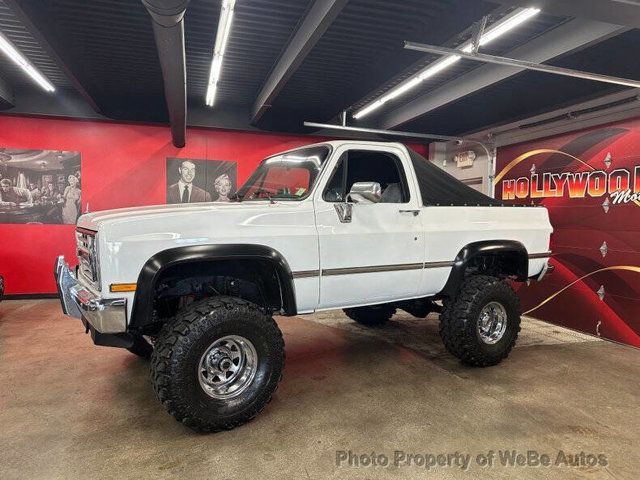
There is a photograph that circulates in K5 Blazer owner groups every so often, a teenager leaning against the fender of a squarebody Blazer in a gravel driveway sometime in the late 1970s, sunglasses pushed up on his head, one boot on the bumper. Nobody seems to know who he is or where the photo came from originally, but it keeps getting reposted because it captures something true about squarebody styling that is hard to put into words otherwise. The truck in that picture does not look styled at all. It looks like it was simply built the way a truck should look, flat panels, a straight beltline, a grille that says exactly what it is without decoration. That plainness is precisely why K5 Blazer squarebody styling has aged into something people now call iconic.
Why Squarebody Styling Defined a Generation
How a cost-driven redesign became one of the most recognizable and enduring truck shapes in American memory.
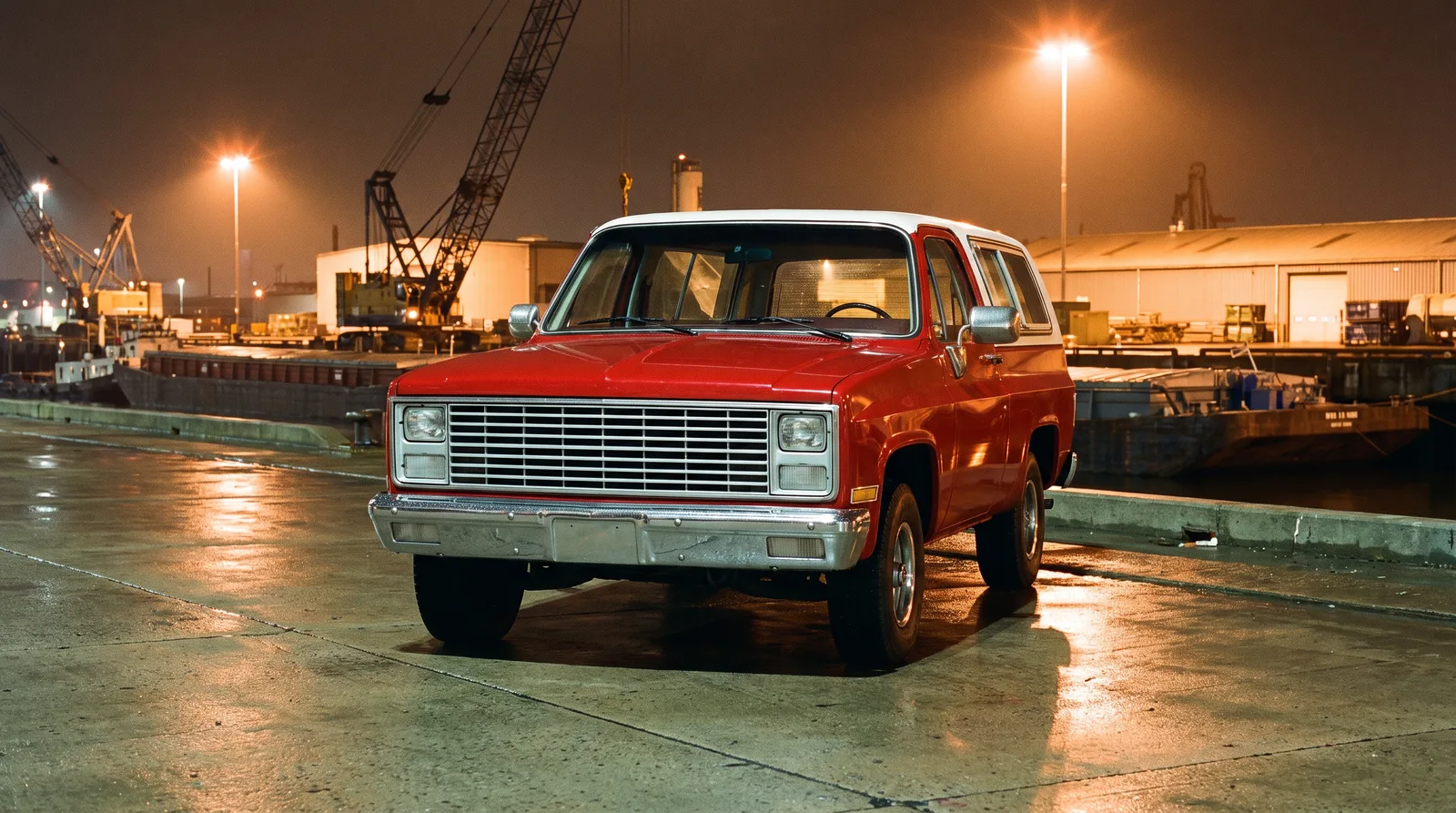
A shape born from restraint, not ambition
Look closely at how the squarebody K5 Blazer sits next to trucks from competing manufacturers of the same period and the restraint becomes even more obvious. Where some competitors were experimenting with sculpted body sides and more aggressive character lines, Chevrolet's full-size trucks kept the surfaces flat and the transitions simple. That decision reads today as confidence, but at the time it was almost certainly closer to pragmatism, a large manufacturer building trucks by the hundreds of thousands could not afford the tooling complexity that more dramatic styling would have required. The Blazer inherited that pragmatic design language wholesale from the pickup line it shared a platform with, and it wore the shape just as well, if not better, given the truck's shorter proportions and taller stance.
When Chevrolet redesigned its full-size trucks for 1973, the goal was not to make a statement. It was to make the cab bigger, the panels easier and cheaper to stamp, and the whole truck more practical to build and repair. The flatter body sides and squared-off proportions that gave the generation its "squarebody" nickname were an engineering decision before they were ever a styling one. What is interesting is how that restraint produced a shape with a kind of quiet confidence that a more deliberately styled truck often lacks. There is nothing on a squarebody K5 Blazer that is trying to convince you of anything. The hood is flat because a flat hood is easier to stamp. The fenders are square because square fenders use less material efficiently. And somehow, decades later, that honesty reads as good design.
Contrast that with the trucks that came immediately before and after. The 1969-72 Blazer had rounder, softer lines that feel distinctly of their moment. The trucks that replaced the squarebody in 1992 leaned into aerodynamics and curved glass, chasing a very different design language. The squarebody sits between those two eras like a plain sentence between two paragraphs full of adjectives, and that plainness is exactly what keeps drawing people back to it.
How the shape changed as the years passed
Squarebody styling was not frozen for its entire eighteen-year run. The earliest trucks, built through 1975, carried a removable steel hardtop and simpler trim that many owners consider the purest expression of the look. When the roof became fixed for 1976, the truck gained a more substantial, settled presence without losing the flat-panel honesty that defined the generation. The bigger visual shift came in 1981, when Chevrolet squared off the front fenders further and updated the grille, moving the truck's face toward the boxier look most people picture when they hear the word squarebody today. Owners who grew up around a specific window of this run tend to feel loyal to that exact face, the round headlights of the early trucks or the more angular front clip of the 1981 and later models, and conversations about which era looks better can get surprisingly personal at truck shows.
Why the plain shape became a canvas
Part of what makes squarebody styling so enduring is how well it works as a starting point for someone else's vision. The flat panels that made the truck cheap and simple to build in 1973 also make it an unusually good surface for custom paint, for lowering, for lifted off-road builds, and for the growing restomod scene that treats the body as a shell around modern power. A curved, heavily sculpted truck fights a custom paint scheme. A squarebody welcomes one. That versatility is a quiet reason the shape has stayed relevant across so many different corners of the truck hobby, from lowrider culture to overlanding builds to concours-level restorations that change nothing at all.
Talk to enough owners and a pattern emerges. People rarely describe falling for the K5 Blazer because of a spec sheet. They describe a specific memory, a grandfather's work truck, a first vehicle bought cheap in high school, a truck spotted at a gas station that stuck in their head for years before they finally bought one of their own. The styling is doing quiet work in every one of those stories, giving the memory a shape simple enough to recognize instantly, decades later, in a parking lot or a photograph passed around online.
"Nobody remembers a curve. They remember a straight line and a flat hood catching the evening light in a driveway they haven't seen in thirty years."
- Nora Beckett
Color, chrome, and the small details people remember
Squarebody styling is not just about the panels, it is also about the paint and trim choices Chevrolet offered against that flat canvas. The two-tone paint schemes common through the 1970s, a body color paired with a contrasting roof or lower accent stripe, gave owners a way to personalize a shape that was otherwise identical from truck to truck. Chrome trim around the grille, mirrors, and wheel openings caught the light in a way that plain paint alone could not, and those details are often what people remember most vividly when they describe a specific truck from childhood. The color of a grandfather's Blazer, the particular shade of a two-tone paint job, tends to stick in memory longer than any spec sheet detail ever could.
Interior colors followed the exterior's straightforward honesty, with vinyl and cloth options in a handful of period-appropriate shades that now read as unmistakably of their era. Restorers chasing an authentic look spend real effort matching these original color combinations, not because the colors themselves were groundbreaking, but because getting them right is what makes a restoration feel true to the truck's actual history rather than a modern reinterpretation of it.
A shape that outlasted its own era
Design trends usually date themselves. Squarebody styling somehow did not, or at least not in the way that makes people wince at old photographs. The plainness that came from stamping efficiency and cost control in 1973 turned out to be timeless in a way no designer could have planned for at a drafting table. Readers who want the fuller model history behind this look can find our complete history of the squarebody generation, tracing how the truck evolved from that first 1973 redesign through its final year in 1991. And for anyone who has been carrying around their own version of that gravel-driveway photograph in their memory, waiting for a reason to finally go looking, it might be time to find a classic K5 Blazer of their own.
Sources and notes
Related Reading


Automotive features writer and photographer who tells the human stories behind the cars, from show fields to cross-country road trips.
Related Listings - Chevrolet Blazer
Comments
Be the first to comment on this article.