
Ask most people what makes a luxury car interior and they will say leather. It is the shorthand, the thing a salesman points to first. But the truth of the classic luxury cabin is more complicated, because for long stretches of the twentieth century the most expensive American cars were trimmed in cloth, and the wood you admired on the dashboard was very often not wood at all. The interior of a fine automobile is a story about materials, and about the gap between what the material actually is and what the buyer was meant to believe.
Car Features
6 min read
Leather vs. Woodgrain: The Truth About Luxury Car Interiors
The truth about classic luxury car interiors, from wool broadcloth and real veneer to printed woodgrain, and how to read them before you buy.
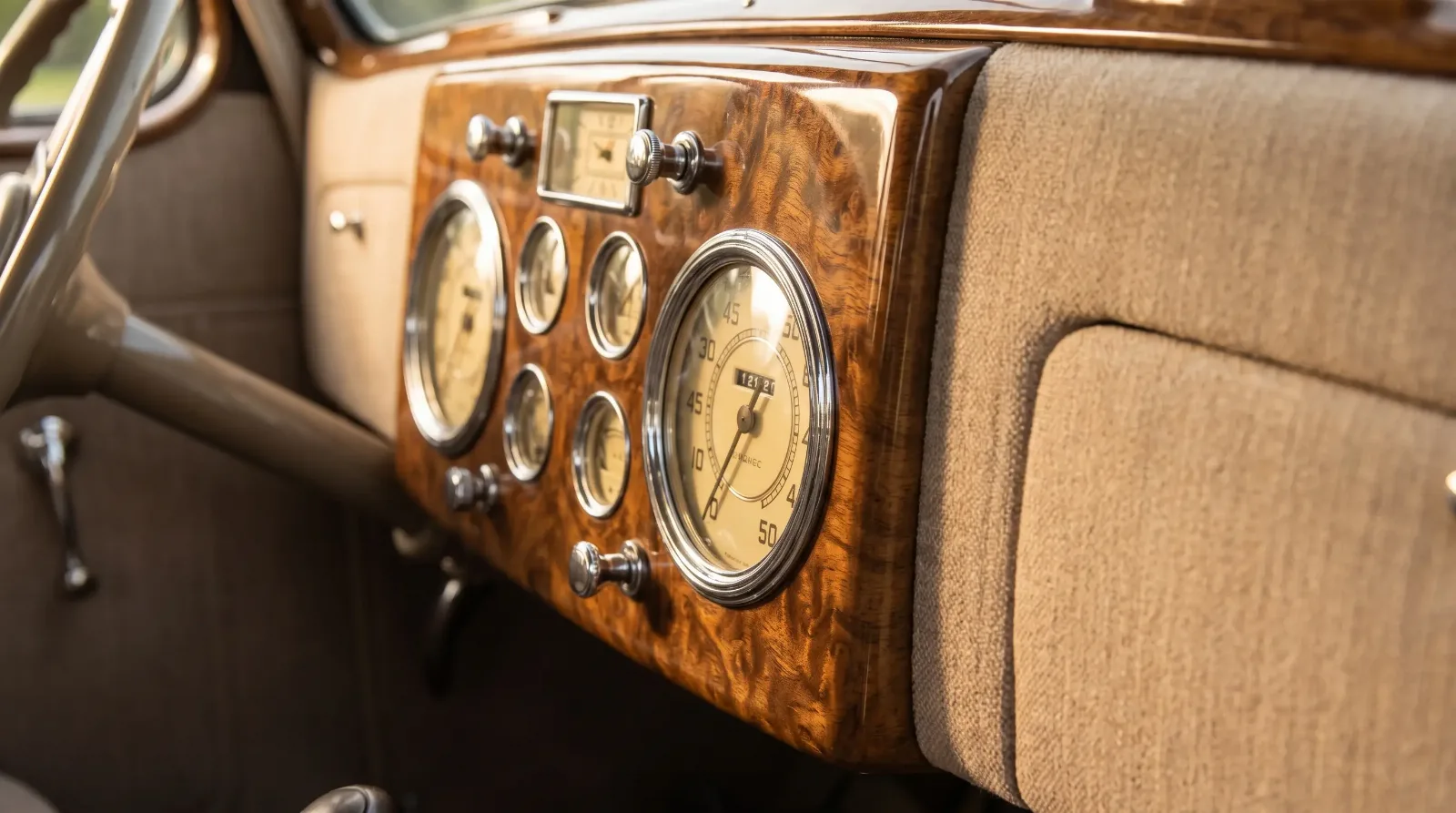
This matters because interiors are where these cars are won and lost today. A tired cabin is one of the most expensive things to put right, and originality inside is harder to fake than a fresh coat of paint. To understand why makers chose the trim they did, it helps to read the full design story first, since interior materials followed the same logic of signaling that governed the sheet metal.
When cloth outranked leather
Here is the detail that surprises new collectors. In the pre-war and early postwar era, the top American luxury cars frequently reserved leather for the front compartment of a chauffeur-driven car, while the owner rode in back on fine broadcloth, mohair, or Bedford cord. Leather was durable and easy to wipe down, which made it the servant's material up front. The wool cloths were softer, warmer in a cold climate, and considered more genteel, so they went where the owner sat.
Packard, Cadillac, and Lincoln all followed this convention on their formal bodies. A closed limousine or town car might show leather only where the driver worked, and a full leather interior throughout was, oddly, the mark of an open car or a sporting body rather than the grandest sedan. The idea that leather is automatically the premium choice is a later, largely postwar development, driven by convertibles and by changing tastes about what felt rich.
The woodgrain that was never wood
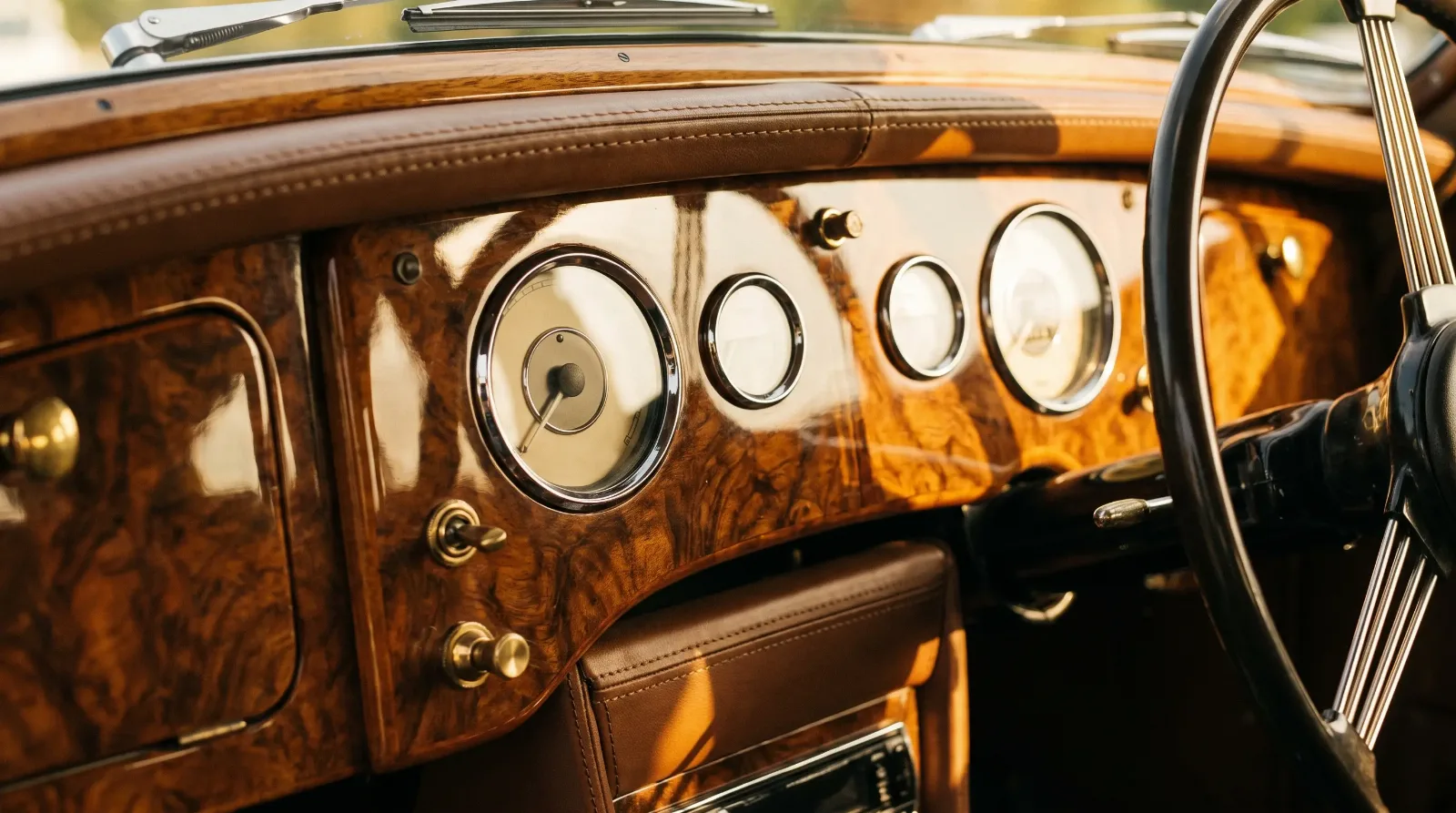
The other great interior illusion is the wood. Real hardwood veneer, cut from walnut, burl, or elm and finished under lacquer, is one of the true glories of the coachbuilt car. Rolls-Royce and Bentley cabinetry, and the dashboards of the finest Packards and Duesenbergs, used genuine figured veneer laid over a stable substrate, and a good original set of that woodwork is worth serious money to restore correctly.
But most cars that appeared to have wood did not. From the 1930s onward, manufacturers reproduced woodgrain on painted steel using a process often called Di-Noc, in which a printed film or a grained paint pattern imitated walnut or mahogany on a metal dashboard. It was convincing at arm's length and vastly cheaper than the real thing. By the 1950s and 1960s, the woodgrain on a mainstream American luxury dash was almost always this printed or painted imitation, and the same technique later covered the flanks of station wagons. Learning to tell the two apart, by weight, by grain repetition, by how the finish ages, is one of the first skills a serious buyer develops. If you are shopping the market, browse the range of classic luxury cars for sale with the interior in mind, because that is where condition claims most often fall apart.
How to read a luxury interior
Genuine and imitation age differently, and that is your tell. Real veneer checks and cracks along the grain, lifts at the edges, and the lacquer over it yellows and crazes. Printed woodgrain on steel does not crack in the same way. It scratches, dulls, and can bubble where moisture gets under the film, but it never shows the fine splits of drying timber. Leather develops a patina and stiffens where it dries out. The wool cloths fade, thin at the wear points, and are almost impossible to source correctly today, which is why an unmolested cloth interior is often rarer and dearer to conserve than a leather one.
What the materials tell you now
For a collector, the interior is a document. It records what the original buyer chose and what the class of car was meant to be. A formal sedan in correct broadcloth is telling you it was built to be ridden in, not driven. A convertible in full hide is telling you it was built to be seen in. Reproduction woodgrain is not a defect on a car that left the factory with it, and replacing it with real veneer, however tempting, is a mistake that a knowledgeable judge will catch.
"People come to these cars assuming leather and real wood everywhere, and the cars themselves tell a subtler story. The most correct interior is the one the factory actually built, printed woodgrain and wool cloth included. Upgrading to materials the car never had is not restoration. It is redecoration, and it quietly lowers the car in the eyes of anyone who knows what to look for."
Sarah Whitfield
The material inside a classic luxury car was never a simple question of leather being best. It was a coded system, cloth for the owner and hide for the help, real veneer for the coachbuilt few and printed grain for everyone else. Read it correctly and the cabin tells you what the car was for and how honestly it has been kept. From the surfaces you touch, the story moves to the small metal object that told the world which marque you had chosen, which is next: Luxury Car Badges and the History Behind the Emblems. For the wider context, the classic luxury car story ties the interior back to the whole.
Related Reading

Have a
Classic Car
for Sale?
Reach thousands of serious classic car collectors across the US.
Sell It Here →
Are You a Classic Car Dealer?
List your full inventory and connect with targeted classic car buyers.
Join as a Dealer →

About the author
Sarah Whitfield
Third-generation classic car collector specializing in pre-war American and European coachbuilt automobiles. Researcher and concours enthusiast.




Comments
Be the first to comment on this article.