
The dashboard is the one piece of a luxury car the owner actually lived with. The grille and the fins impressed the neighbors, but the instrument panel was what the driver looked at every single mile. That makes it the most honest record of what a luxury car was supposed to feel like in any given decade. Follow the dashboard from the 1930s to the 1980s and you get a clear reading of how ideas about wealth, safety, and modernity kept shifting, decade by decade.
Car Features
6 min read
Luxury Car Dashboard Design Through the Decades
Classic luxury car dashboard design from machined metal and jet-age chrome to walnut veneer, woodgrain plastic, and the first digital clusters.
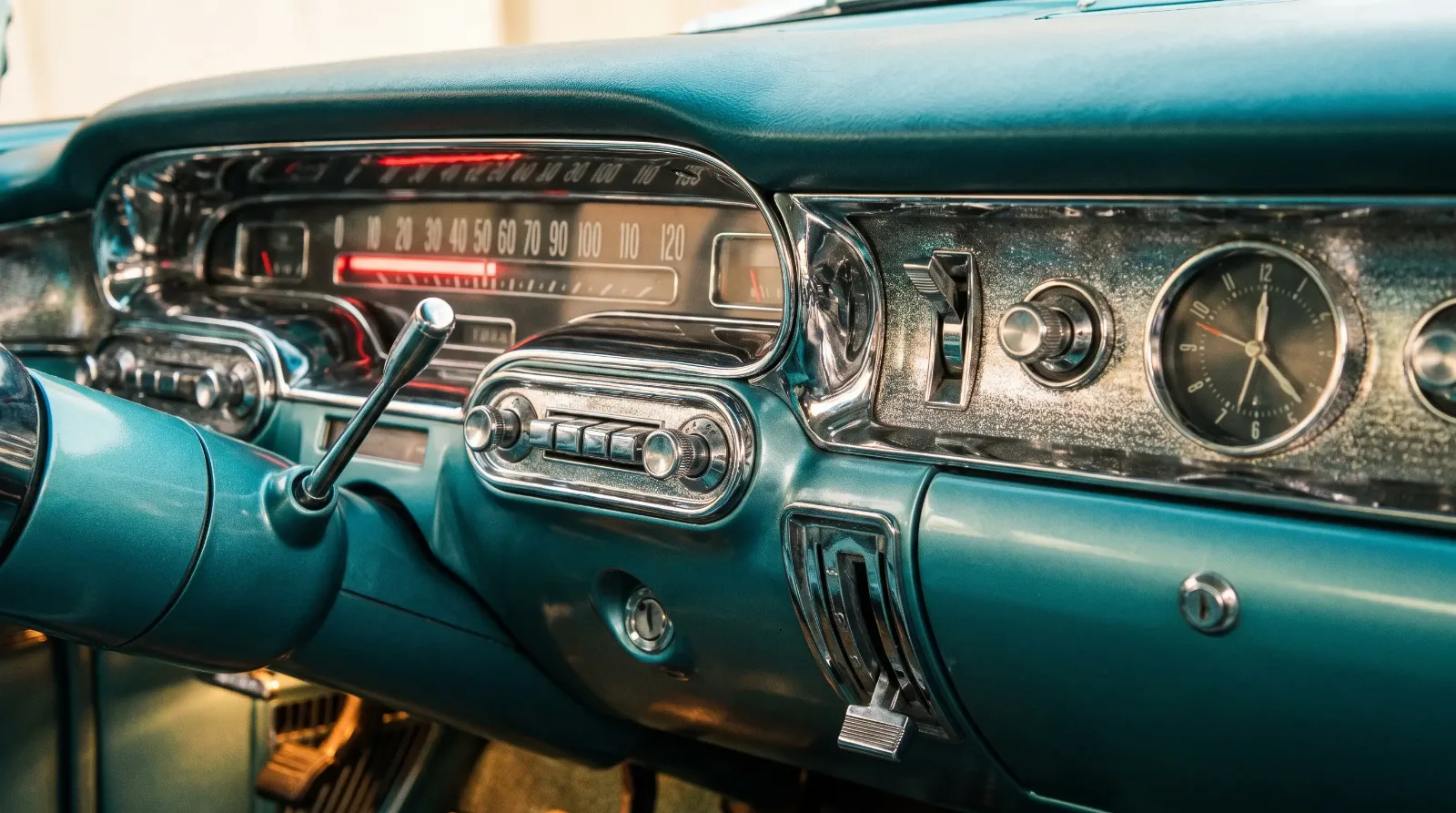
What is striking, studying these panels closely, is how quickly the definition of luxury inside the cabin changed. Engine-turned metal that read as the height of sophistication in 1935 looked cold and industrial by 1955. Real wood that meant craftsmanship in 1965 was faked in plastic by 1975. The dashboard never stopped chasing a moving target.
The machined-metal era of the 1930s
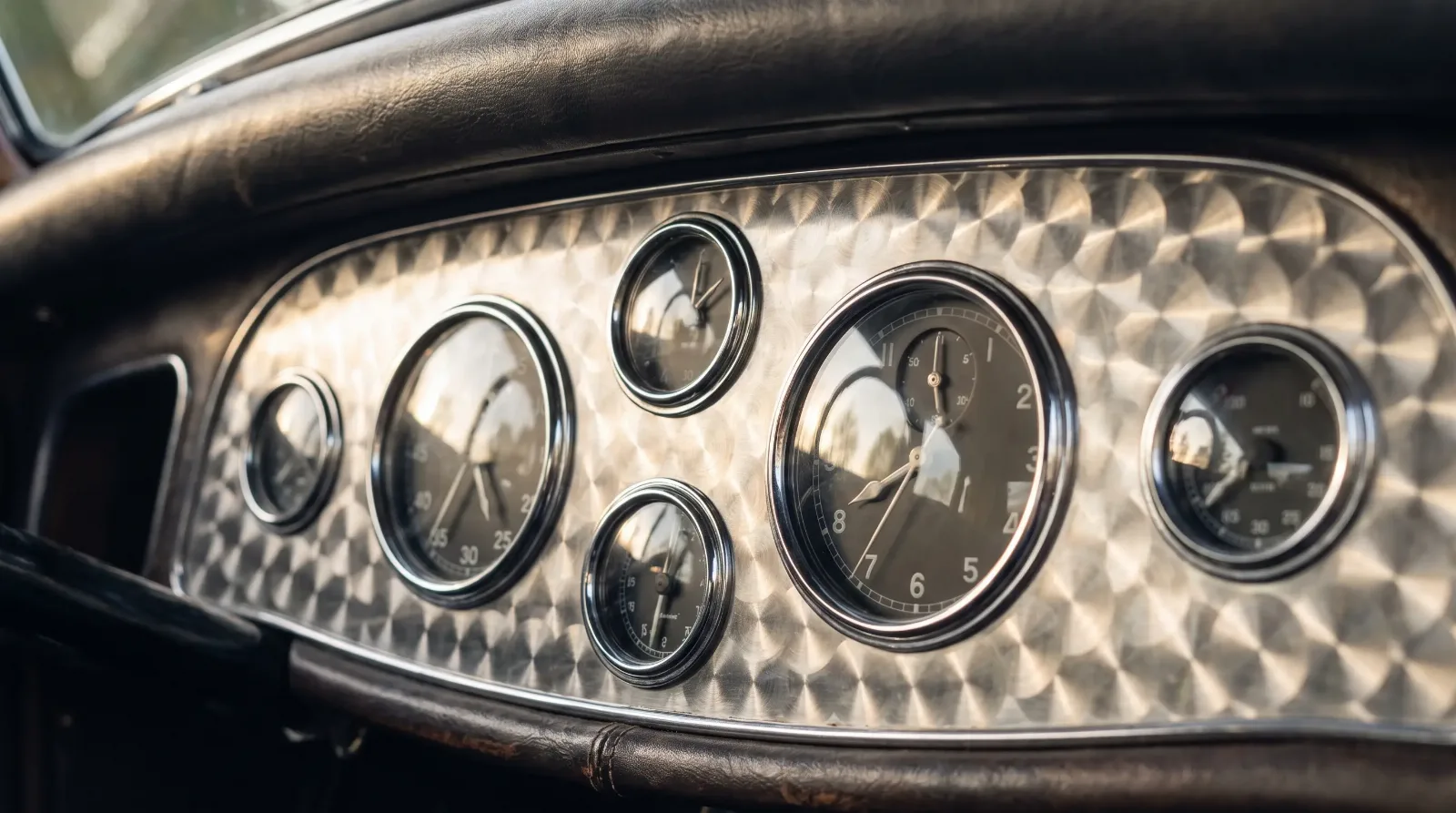
In the classic prewar period, the finest dashboards were metal, and the mark of quality was engine turning, also called machine turning or jeweling, a pattern of overlapping swirls cut into the panel that caught light in a way plain paint never could. A Duesenberg or a top Packard instrument panel used it, along with a bank of large, clearly legible gauges housed in a symmetrical layout. Bakelite and other early plastics appeared for knobs and trim. The look was precision-instrument, closer to an aircraft cockpit or a fine watch than to furniture.
This was luxury as engineering made visible. The buyer of a coachbuilt classic wanted to see that money had bought accuracy and mechanism. The gauges themselves were often supplied by specialist instrument makers and framed in nickel or chrome bezels, and on the grandest cars the panel might carry a clock, an altimeter, and a brake-pressure gauge alongside the usual dials. That instinct, luxury signaled through visible craft, runs right through the era and connects to the broader visual grammar covered in the design language hub.
Chrome, color, and the jet age
After the war the dashboard changed character completely. The 1950s brought chrome, and lots of it, plus color-keyed painted metal panels that matched the exterior two-tone schemes. Symmetry gave way to sweep. Speedometers stretched into horizontal ribbons and dials borrowed styling cues from the era's fascination with aviation and rockets. A 1957 Cadillac or a mid-decade Chrysler let its instrument panel glitter, with bright metal surrounds and pushbutton controls that felt futuristic to a buyer who had grown up with knobs.
The problem, and it was a real one, is that a chrome-heavy metal dashboard in bright sun threw blinding reflections into the windshield, and a hard metal panel was brutal in a collision. Both of those facts would drive the next decade's changes.
Wood, warmth, and the 1960s idea of class
By the 1960s the luxury dashboard turned away from metal glitter and toward the drawing room. Real wood veneer, walnut and burl, appeared across the finest American luxury cars, echoing the coachbuilt tradition and the British saloons that were the aspirational benchmark. A Lincoln Continental or a top Cadillac used wood, or a convincing facsimile, to say that this was a refined, quiet place rather than a rocket ship. The instruments grew more restrained, the layout more horizontal and calm.
Safety pressure reshaped the panel at the same time. Padded upper surfaces, recessed controls, and softer edges came in, partly from regulation and partly from a genuine shift in taste toward comfort over spectacle. The result was a dashboard that felt insulated and serene, which was exactly the mood the luxury buyer of the decade wanted.
"A dashboard tells you what a maker believed luxury was in a given year. The engine-turned panel prized precision, the chrome era prized spectacle, and the wood-lined cabin of the sixties prized serenity. Reading them in sequence is like reading a diary of changing taste, written in materials rather than words."
Sarah Whitfield
Woodgrain plastic and the digital dawn
The 1970s is where honesty in materials frayed. Real wood was expensive and hard to certify for safety, so makers turned to woodgrain appliqué, printed plastic film that imitated walnut over a padded vinyl panel. From the driver's seat it looked warm and expensive. Up close it was a picture of wood, not wood. This mirrors what happened all over the luxury car of the period, where the appearance of craft was reproduced cheaply for a mass market, a shift traced through the story of the classic luxury car.
By the early 1980s the dashboard took its next leap, into electronics. Digital instrument clusters with glowing numeric speedometers and bar-graph gauges arrived on flagship luxury cars, presented as the new frontier of sophistication. The needle and the wood veneer suddenly looked old-fashioned against a green or orange digital readout. Whether that was genuine progress or a passing gimmick is still argued, but it marked the end of the classic dashboard as a purely mechanical, hand-finished object.
What the panels tell us now
Trace the sequence and the pattern is unmistakable. The luxury dashboard began as visible precision, became visible spectacle, softened into visible warmth, and finally dematerialized into printed grain and glowing pixels. Each stage reflected what its era wanted wealth to look and feel like from the driver's seat, and each one now dates a car as reliably as its fins or its grille.
For the collector, the dashboard is also a condition tell. Cracked padded tops, faded woodgrain film, and failed digital clusters are among the hardest and most expensive interior items to restore correctly, so an original, unmarred panel is worth seeking out. The next shift, away from ornament entirely as regulation and economics reshaped the whole luxury car, is the subject of next: The Death of Chrome.
Related Reading
Have a
Classic Car
for Sale?
Reach thousands of serious classic car collectors across the US.
Sell It Here →
Are You a Classic Car Dealer?
List your full inventory and connect with targeted classic car buyers.
Join as a Dealer →

About the author
Sarah Whitfield
Third-generation classic car collector specializing in pre-war American and European coachbuilt automobiles. Researcher and concours enthusiast.
Comments
Be the first to comment on this article.