
Ford never put a big model-year badge on the Model A. The car stayed a Model A from the first one in December 1927 to the last ones in 1932, and Ford changed parts whenever a better part was ready, not when the calendar flipped. That is why model a year differences confuse people at swap meets. Some are obvious from fifty feet. Some live on a pedal pad or a part number. Here is what changed, year by year, and how to tell which car is sitting in front of you.
Car Features
6 min read
Model A Changes Year by Year, 1928 to 1931
What Ford changed on the Model A in 1928, 1929, 1930 and 1931, and how to tell the years apart from wheels, cowl, pedals and engine number.
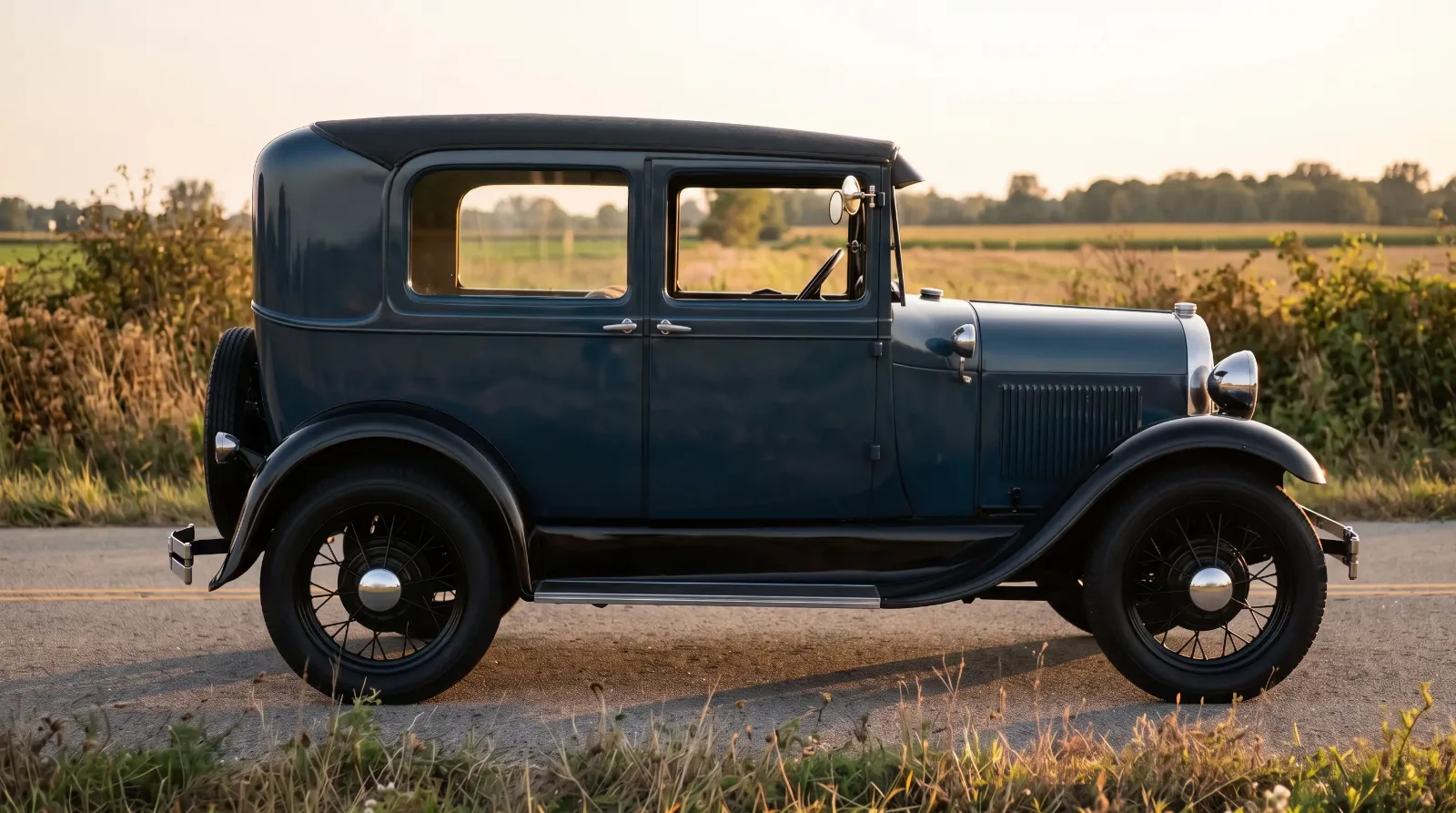
The big picture of the car and the company is covered here. This piece stays on the hardware.
1928: the early cars and the running changes
The Model A went on sale on December 2, 1927, sold as a 1928 model. Production had started on October 20, 1927. The first year was a rolling development program, and Ford changed a lot of parts in the first six months.
Collectors call the earliest cars "AR." Ford never did. The term comes from the parts books, where early 1928 parts that were later replaced carried an "R" suffix. A good example is the brake lever: A-2236-AR for the early single rear brake setup, A-2236-B for 1929 to 1931.
The early cars had a hand brake lever on the left side and a single rear brake system. Owner records collected by MAFCA put the changeover between June 10 and June 22, 1928, somewhere between engine numbers A-155,000 and A-177,486, on US passenger cars. Other early tells:
- Flat bumpers with open ends and a round center clamp in the Model T style.
- Smooth clutch and brake pedals on roughly the first 70,000 to 80,000 cars.
- A smooth running board apron with no bump for the brake rod.
- A deeper recess for the radiator cap.
Under the hood, the 1928 cylinder head ran 4.3:1 compression. From 1929 the figure was 4.22:1. Early 1928 cars also used a 3.70:1 rear axle ratio, which Ford dropped in favor of the standard 3.78:1 (a March 1929 Service Bulletin covers it). The 1928 car rode on 21 inch wire wheels with 4.50 tires, carried 10 gallons of fuel in the cowl, and steered at 11.25:1.
Prices for 1928 ran from $385 for the Roadster to $570 for the Fordor, f.o.b. Detroit. Ford built 633,594 US passenger cars that calendar year. Chevrolet still outsold it.
1929: same car, more bodies
Mechanically, 1929 is the quiet year. The 4.22:1 head became standard and the AR parts were gone. Visually, a 1929 car looks a lot like a late 1928 car. The Tudor still used the 55-A body with the curved cowl, just like 1928.
What changed was the catalog. Ford added body styles fast in 1929, including the 68-A Cabriolet, the 150-A Station Wagon, the 135-A Taxi and the 155-A and 155-B Town Sedan. The Town Car sat at the top of the price list at $1,200. The Phaeton listed at $440, the Roadster at $435, and the Tudor at $500.
It was the best year Ford had with the Model A. The company built 1,507,132 US passenger cars and took the sales lead back from Chevrolet, which built 1,328,605. The one millionth Model A came on February 4, 1929. The two millionth followed on July 24.
1930: the restyle you can see from the street
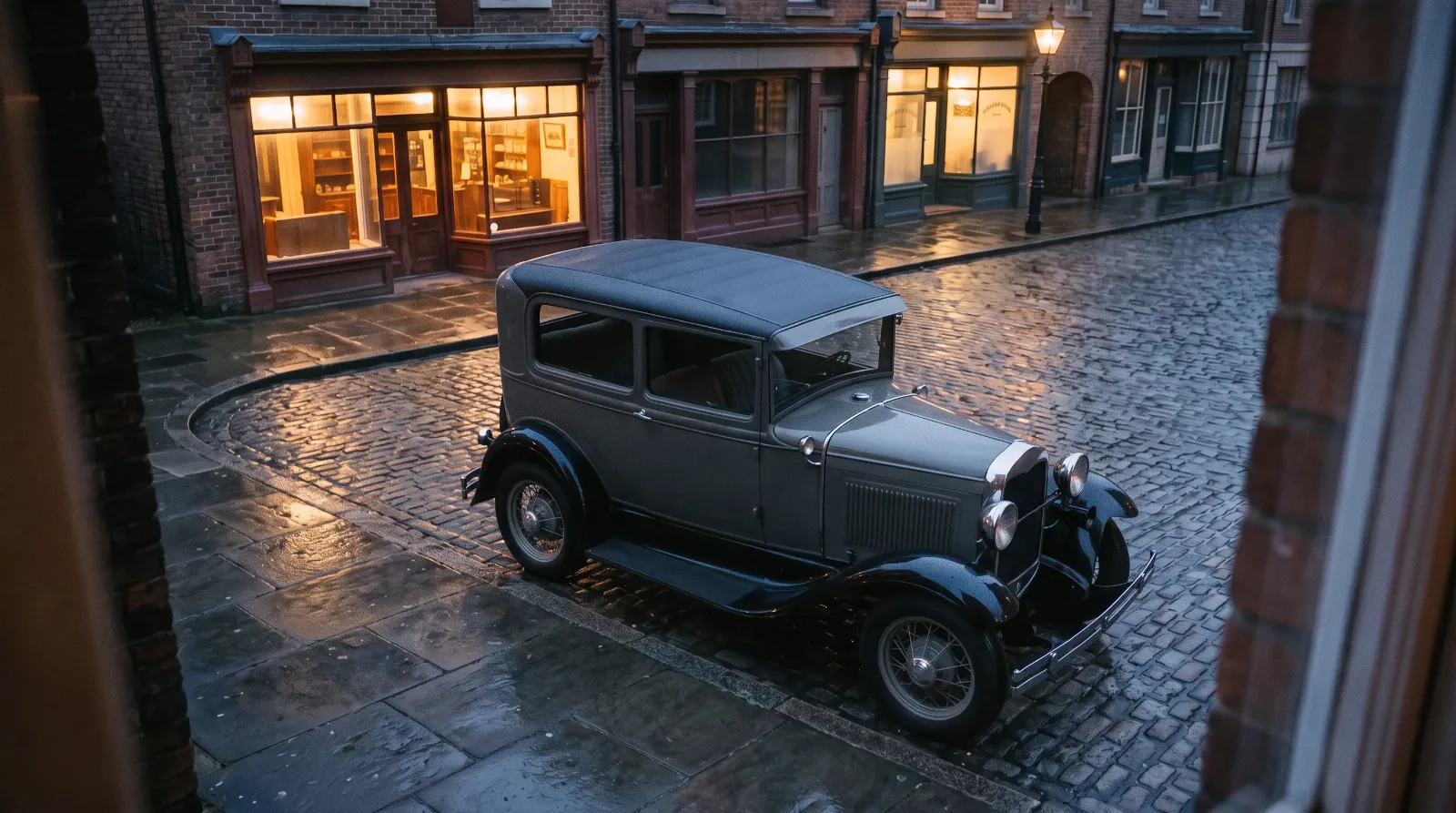
This is the one year change most people can spot without opening anything. For 1930, Ford raised the hood and radiator and switched the radiator shell to stainless steel. The cowl got taller, and the taller cowl made room for an 11 gallon tank instead of 10.
The wheels dropped from 21 inches to 19, and the tire section grew from 4.50 to 4.75. The car sat lower and rode better. If you see a Model A on 19 inch wheels with the stock look, you are almost certainly looking at a 1930 or 1931 car (or somebody swapped wheels, which happens).
Other 1930 changes:
- The Tudor moved to the 55-B body with a straight cowl.
- Steering went from 11.25:1 to 13:1, which made it lighter at parking speed.
- Roadsters and Phaetons got fold-down windshields.
- The Victoria arrived in November 1930, with a slanted windshield and a bustle back. Auction catalogs put late 1930 output at roughly 6,300 to 6,400 cars.
US car output fell to 1,155,162. The Depression was on, and the A was already three years old.
1931: last year, small fixes
The 1931 car is a 1930 car with details sorted out. The stainless radiator shell got a body-color accent. Splash shields became one-piece. A new instrument panel came in April 1931. Brake drums went to cast iron.
The body list kept growing even as sales fell. The slant windshield Fordors (160-A, 160-B and 160-C) are 1931 only. The 400-A Convertible Sedan showed up in May 1931, the last body style added. A DeLuxe Tudor on the 55-B body arrived in June 1931. From July 1931 a Tacoma Cream stripe replaced the earlier stripe on several styles.
On April 14, 1931, the 20 millionth Ford rolled off the Rouge line: a black Model A Town Sedan with the slant windshield. Henry Ford drove it, with Edsel beside him.
US car output fell to 541,615. Prices ran from $430 for the Roadster up to $640 for the Convertible Sedan. The 1931 model year was the last for the Model A. Final assembly ran into March 1932, mostly in Canada, and the total landed at about 4.85 million cars. Why Ford walked away from it after four years is the subject of this piece.
"Don't date a Model A by the title. Titles lie, and fifty years of swapping parts lies louder. Look at the cowl, the wheels and the pedals, then check the engine number."
Mike Sullivan
Model A year differences at a glance
| Item | 1928 | 1929 | 1930 | 1931 |
|---|---|---|---|---|
| Wheel size and tire | 21 in, 4.50 | 21 in, 4.50 | 19 in, 4.75 | 19 in, 4.75 |
| Fuel tank | 10 gal | 10 gal | 11 gal | 11 gal |
| Steering ratio | 11.25:1 | 11.25:1 | 13:1 | 13:1 |
| Compression | 4.3:1 | 4.22:1 | 4.22:1 | 4.22:1 |
| Radiator shell | Not stainless | Not stainless | Stainless | Stainless, body-color accent |
| Tudor body | 55-A | 55-A | 55-B | 55-B |
| US cars built | 633,594 | 1,507,132 | 1,155,162 | 541,615 |
The production figures are US-built passenger cars by calendar year. Trucks are counted separately.
Start with the engine number. It tells you when the engine was built, which gets you close. Then check whether the body agrees with it, because engines got swapped constantly.
Last thing: a lot of what people use to date a car was never factory. Trunks, mirrors, quail caps and step plates got bolted on for decades. Before you call something wrong for the year, read up on the period accessories that dealers and owners added. Plenty of "wrong" parts were right in 1930, just not from the factory.
Sources and notes
Related Reading

Have a
Ford Model A
for Sale?
Reach thousands of serious classic car collectors across the US.
Sell It Here →
Selling a classic? Here's how: compare the places to sell classic cars
Are You a Classic Car Dealer?
List your full inventory and connect with targeted classic car buyers.
Join as a Dealer →

About the author
Mike Sullivan
Detroit-area muscle car enthusiast and restoration specialist with three decades of hands-on experience working on American iron.
Related Listings - Ford Model A


More in Car Features
Comments
Be the first to comment on this article.