
"Any color so long as it is black" is the most quoted line in the history of the Model T, and it is accurate for a shorter stretch than most people assume. Ford sold the Model T only in black from about 1914 to 1925. Before that, the cars came in gray, green, blue and red. After it, color came back. So the honest answer to why Model T only black is a narrower question than it sounds: why black, and why only for those twelve or so years?
Car Features
7 min read
Any Color So Long as It's Black: The Truth About Model T Paint
The Model T was black only from about 1914 to 1925. Earlier cars were gray, red, green or blue, and the fast-drying paint story lacks evidence.
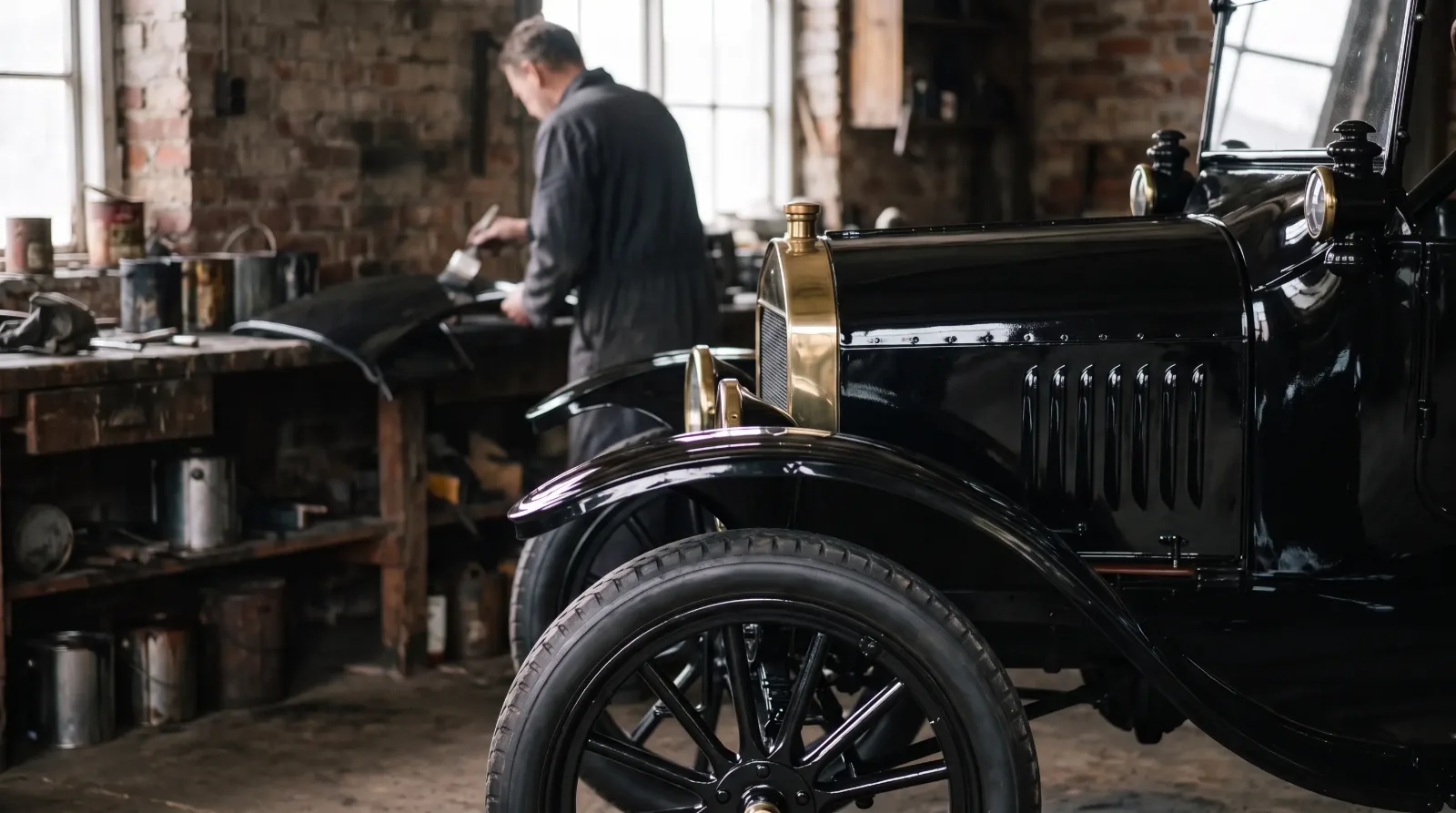
The records answer the first half well and the second half less well. What follows sorts the documented from the repeated. For the production story around it, the full story sits elsewhere.
The colors that came first, 1908 to 1913
The earliest Model Ts were not black. For the 1909 model year, runabouts were mostly gray, touring cars mostly red, and town cars and landaulets green. Red was dropped after June 1909. Over the next few seasons the palette narrowed, and by 1912 all cars were midnight blue with black fenders.
That last detail is worth holding on to. Black was already on the car before the black era began, on the fenders. The change that came around 1914 was less a sudden decision than the end of a narrowing that had been underway for years.
| Period | Body colors | Note |
|---|---|---|
| 1909 model year | Gray (mostly runabouts), red (mostly touring cars), green (town cars, landaulets) | Red dropped after June 1909 |
| 1908 to 1913 | Gray, green, blue and red | By 1912, midnight blue with black fenders |
| About 1914 to 1925 | Black only | Ford's own dates for the black-only period |
| 1926 to 1927 | Fawn Gray, Royal Maroon, Highland Green on closed cars | Black fenders kept |
Why Model T only black? The explanations on record
The explanation repeated most often is that black paint dried faster than any other color, so it kept pace with the moving assembly line. It is a tidy story. It has a problem: nobody has produced good evidence for it. One widely read history says plainly that there is no evidence black dried faster, and points instead to two duller reasons, low cost and durability. The black paint was gilsonite-based, and it wore well.
The fast-drying version persists because the dates line up so neatly. Ford's first moving line, for flywheel magnetos at Highland Park, started around April 1, 1913. The black-only period began about a year later. Ford car output went from 202,667 in the year to July 1914 to 308,162 in the year to July 1915 and 501,462 in the year to July 1916. A company growing that fast had every reason to cut choices out of the process, and one paint is simpler to buy, store and apply than four. That much is reasonable inference. The leap from "simpler" to "black dried fastest" is the part the record does not support.
That detail does more damage to the fast-drying story than any argument. If Ford had picked black purely to speed up one finishing step, it would be odd to end up with more than 30 kinds of it. The likelier picture is a factory that standardized the color, not the paint.
"The fast-drying story is not a lie. It is a guess that got repeated until it sounded like a record. The production figures and the paint count are the record."
Tom Ramirez
Where the famous line comes from
The phrase comes from Ford's 1922 memoir, My Life and Work, written with Samuel Crowther. Ford writes that "in 1909 I announced one morning, without any previous warning" that the company would build only one model, the Model T, on a chassis that would be the same for every car. Then comes the line itself, in the book's own spelling: "Any customer can have a car painted any colour that he wants so long as it is black." He adds that nobody agreed with him; the sales staff wanted more models, not fewer.
Notice the date problem. If Ford said it in 1909, he said it in a year when Model Ts were being sold in gray, red and green. The line reads better as a statement of philosophy than as a description of the paint shop. Ford was saying the customer would get one car, built one way, and the color was his example. By the time the memoir appeared in 1922, the cars had been black for years, and the remark fit the cars perfectly. Readers have been backdating the black era to 1909 ever since.
Some retellings simply attach the quote to 1914, the year the black-only policy actually took effect. That is the year that matches the cars, but it is not the year Ford himself gave.
When color came back in 1926 and 1927
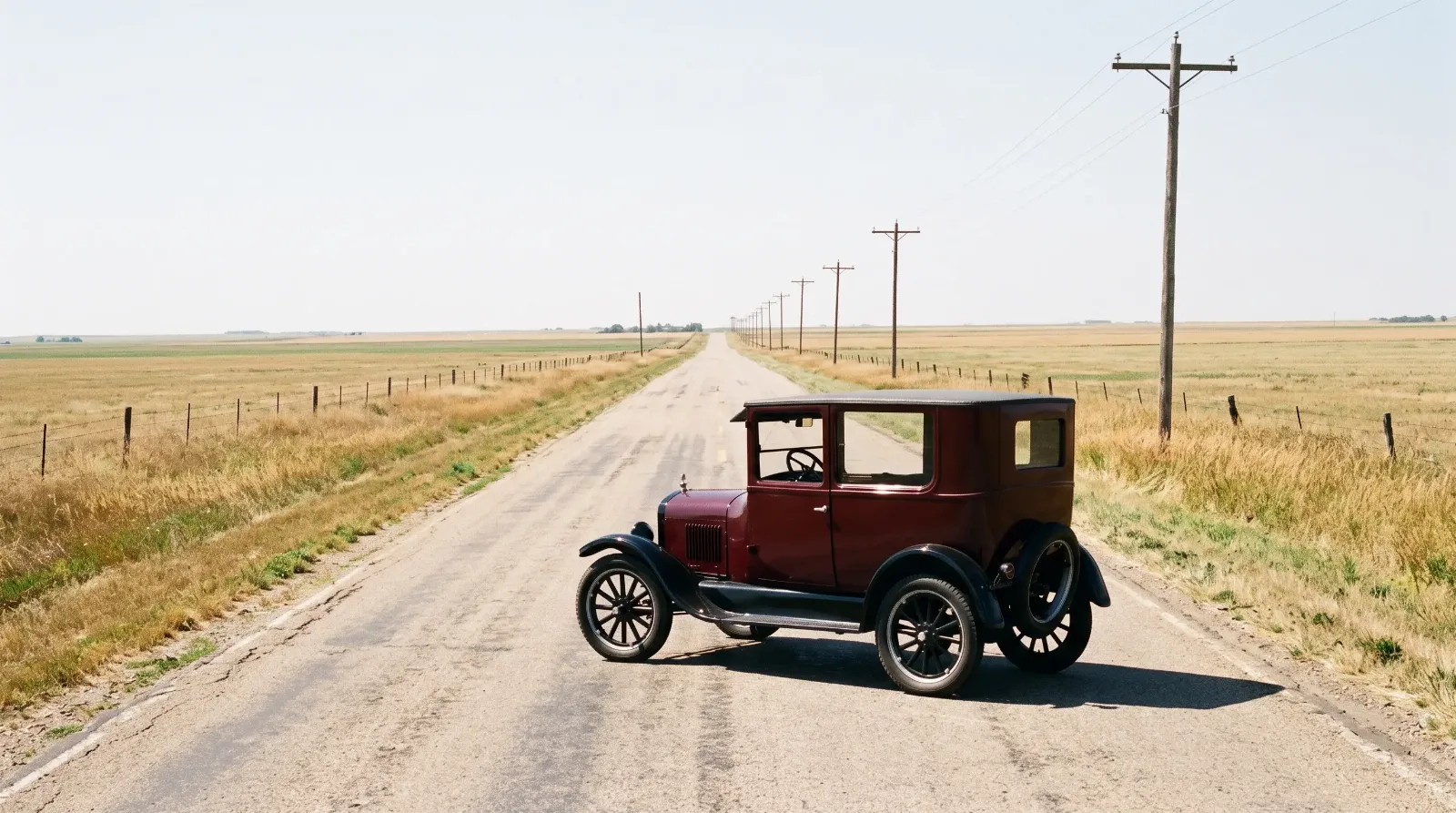
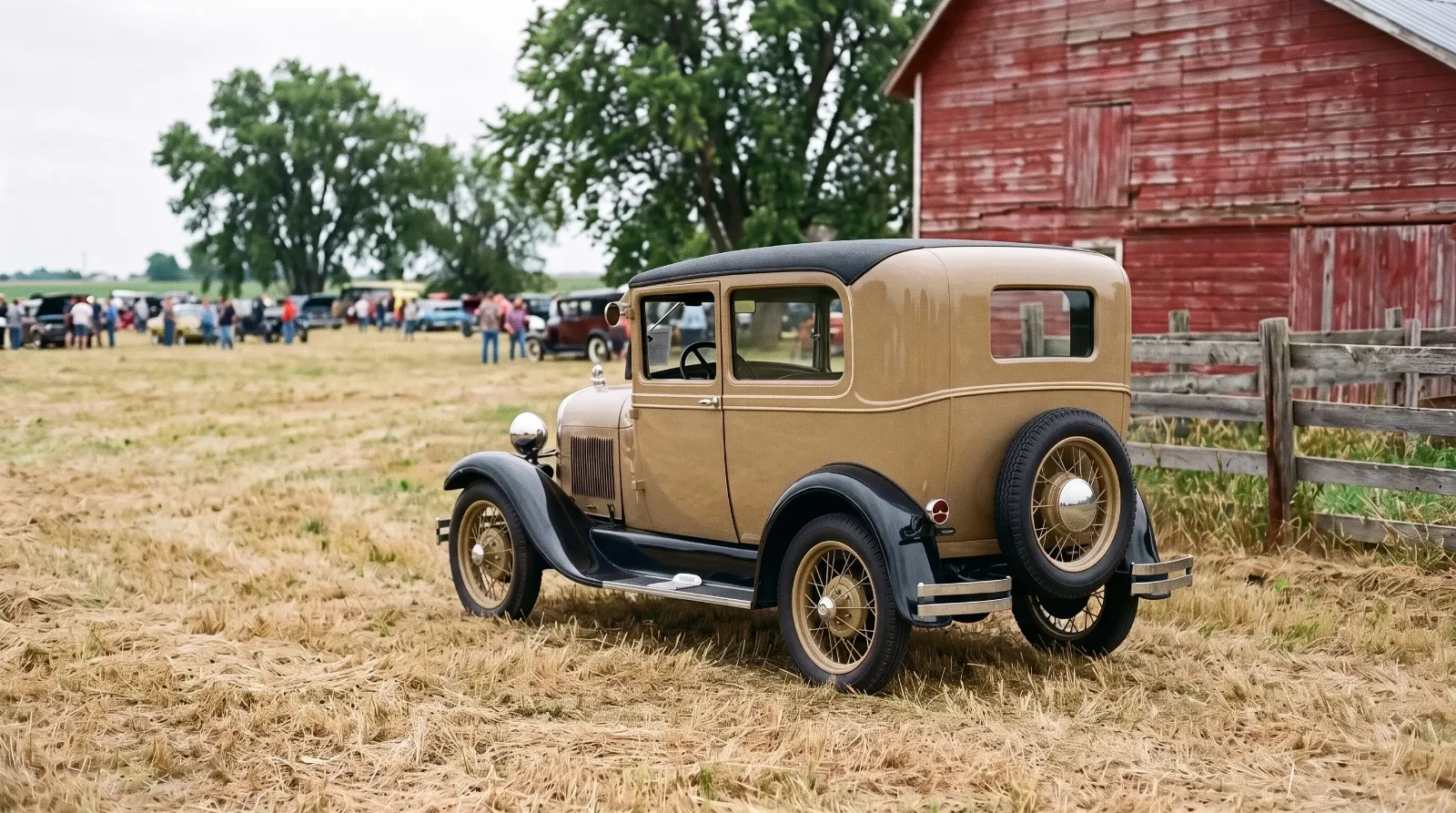
The black era ended the way it began: gradually, and under pressure. Edsel Ford urged styling changes on the Model T in 1923 and again in 1925, and Henry eventually allowed colors back. For 1926 and 1927, closed cars were offered in Fawn Gray, Royal Maroon and Highland Green, still with black fenders. Wire wheels were offered in Straw, Casino Red Orange and Emerald Green.
The first colors came a little earlier and under other names. Ford's own advertising in early 1926 showed a coupe in deep Channel Green and a Fordor sedan in Windsor Maroon. Owner research holds that these early cars were finished in enamel and that Ford moved to pyroxylin lacquer later in 1926, around the time the Fawn Gray, Royal Maroon and Highland Green palette appeared. The lacquer date rests on club research rather than a factory document, so treat it as a lead for anyone researching a specific car.
The return of color did not save the Model T. Production ended in May 1927. Its successor, the Model A, launched in four standard colors, and the black era became a period that owners now date their cars by.
What the black era tells us about Ford
The paint is a small window onto a larger policy. During the black years Ford was cutting the price of the car almost every season. A runabout cost $825 in 1909, $440 in 1914 and $260 in 1925. Fewer choices on the line meant fewer costs, and the savings went into how the price kept falling.
Seen that way, black was not a whim and not a quirk of chemistry. It was one more option removed from a car whose whole argument was that it did not need options. That argument worked for more than a decade. By 1923 even Edsel Ford was pushing for change. How the Model T gave way to the Model A is the whole story, and the paint shop is a small, telling part of it.
Sources and notes
- Henry Ford with Samuel Crowther, My Life and Work (1922), Project Gutenberg text
- Wikipedia: Ford Model T (colors, gilsonite paint, 30 types of black)
- Ford Motor Company: The Model T
- Old Cars Weekly: Car of the Week, 1909 Ford Model T
- Mac's Motor City Garage: Tin Lizzie's last stand, the 1926-27 Model T
- Ford Model T advertising art, 1926 (Channel Green and Windsor Maroon)
Related Reading
Have a
Ford Model T
for Sale?
Reach thousands of serious classic car collectors across the US.
Sell It Here →
Selling a classic? Here's how: sell my classic car
Are You a Classic Car Dealer?
List your full inventory and connect with targeted classic car buyers.
Join as a Dealer →

About the author
Tom Ramirez
Corvette researcher and historian based in Bowling Green, Kentucky. Two decades documenting Corvette production history from original factory records.
Related Listings - Ford Model T

Comments
Be the first to comment on this article.