
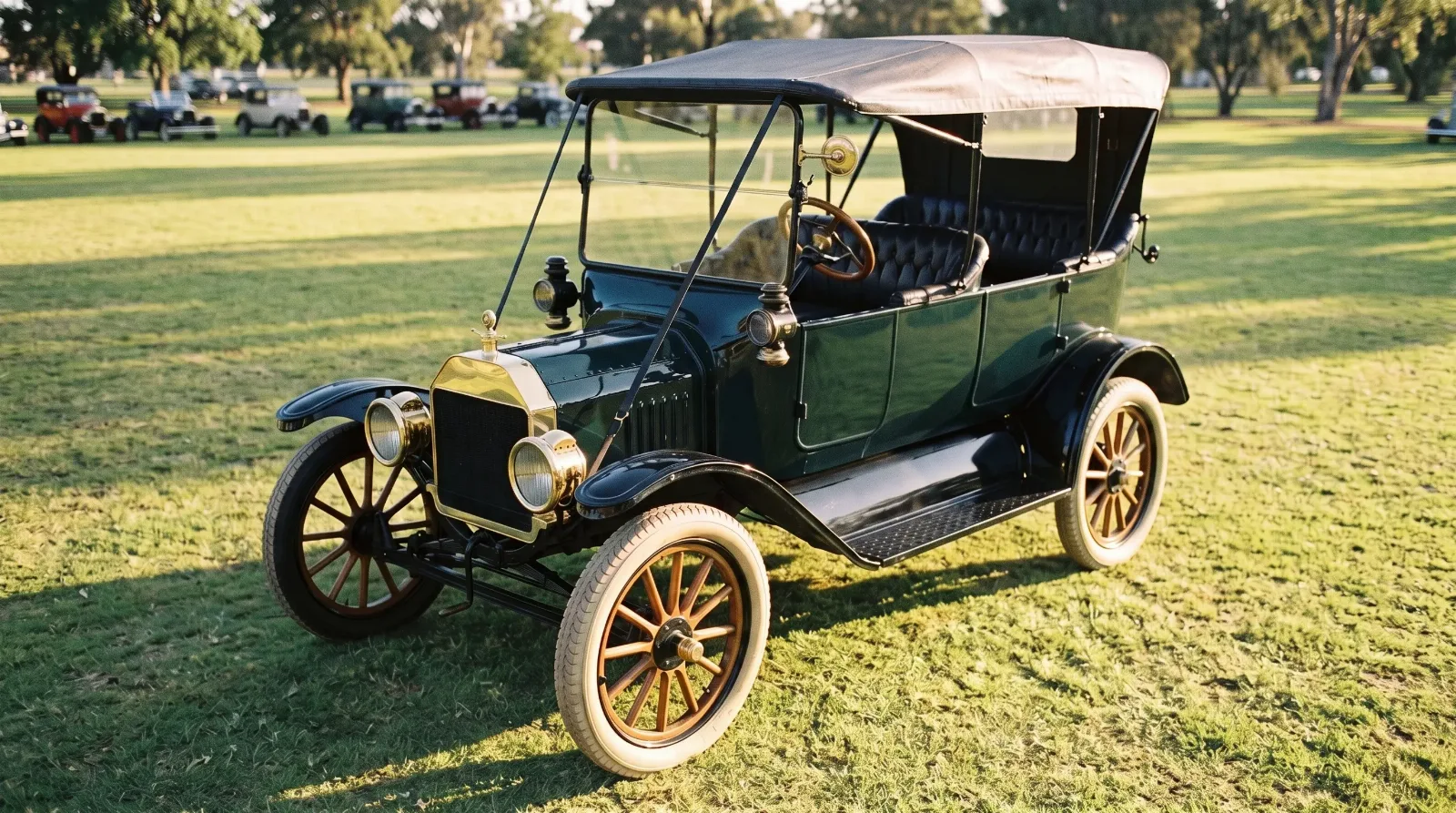
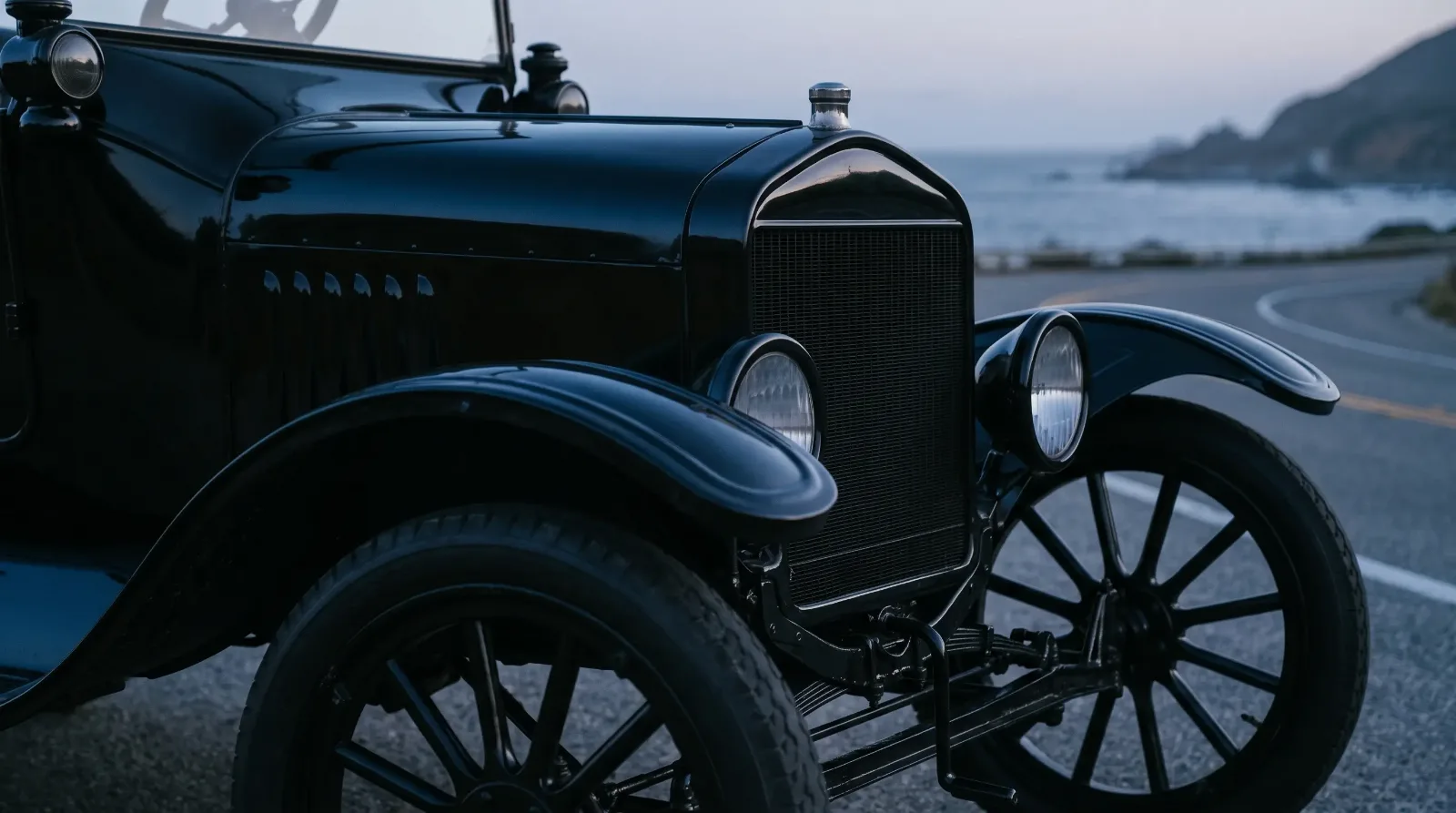
Collectors divide the Model T into two families, the "Brass T" and the "Black T," and the dividing line is the 1917 model year. A brass era Model T, built from the 1909 model year through the 1916 model, wears a brass radiator and brass trim. Cars built from August 1916 onward, sold as 1917 models, have a black-painted sheet-metal radiator shell, crowned and curved fenders, painted steel lamp bezels, and very little brass anywhere. The engine and chassis carried on much as before. The change was in the face of the car, and it is the most visible break in the whole production run.
Car Features
6 min read
Brass Era vs Black Era Model T: What Changed After 1916
Brass T or Black T: the 1917 model year swapped the brass radiator for a black shell. What changed, and why black paint alone proves nothing.
The production history and dates sit in the Model T history. This piece is about the two families themselves: what separates them, why "black" in this sense does not refer to paint, and how to tell one from the other on sight.
What "brass era" means on a Model T
The term is a collector's term, not a factory one. It describes the trim, not the paint. Brass era Model Ts carry a polished brass radiator, and brass on lamps and fittings, which is what gives them their look on a show field. The 1917 change replaced that radiator with a sheet-metal shell painted black and swapped brass lamp bezels for painted steel.
This is where the vocabulary trips people up. The all-black paint period of the Model T runs from about 1914 to 1925. So a 1915 car is a brass era Model T and also an all-black one. Its body and fenders are black, and its radiator is brass. The "Black T" name refers to the brass going away in 1917, not to the paint arriving in 1914. The history of the paint has its own story, and it explains why they all turned black three years before the brass did.
Before 1914 the paint was varied. Gray, green, blue and red all appear between 1908 and 1913, and by 1912 every car was midnight blue with black fenders. The earliest cars of the run, whose launch is covered here, came in colors matched to the body style.
Brass T and Black T side by side
| Feature | Brass era (1909 to 1916 models) | Black era (1917 models on) |
|---|---|---|
| Radiator | Brass | Black-painted sheet-metal shell |
| Fenders | Earlier pattern | Crowned and curved |
| Lamp bezels | Brass | Painted steel |
| Other trim | Brass fittings | Most brass dropped |
| Body paint | Colors to 1913, black only from about 1914 | Black only to 1925; colors returned on closed cars for 1926 to 1927 |
| Runabout price | $345 in 1916 | $500 in 1917 |
The price line is worth noticing. The runabout fell year after year through the brass era, to $345 in 1916, and then rose to $500 for 1917, where it stayed through 1919.
What else changed after 1916
The 1917 change is the sharpest single break, but it is not the only one, and dating a car by its radiator alone can mislead.
Electric lighting arrived in 1915, so the later brass era cars already carried electric lamps run off the flywheel magneto. The electric starter came for the 1919 model year, first on the sedans, together with demountable rims, and on open cars it was a $75 option. That means a 1917 or 1918 Black T, without a starter, is still a hand-cranked car, while a 1919 or later example may or may not have one. Fitting the starter took a new engine block, transmission cover and flywheel, which is why a starter on a car of these years is a matter of record and not just of accessories.
The black era also has its own late variant. The 1926 and 1927 cars have an enlarged "high hood" and a longer cowl, and some collectors treat them as a third visual era. Closed cars of those years came again in colors, Fawn Gray, Royal Maroon and Highland Green, with black fenders kept, and a nickel radiator shell was standard on the coupe, Tudor and Fordor.
Reading a car on the show field
The radiator is the starting point, not the conclusion. Radiators, lamps and fenders are bolt-on parts, and over a century many cars have been updated, backdated or assembled from parts of several years. A brass radiator on a later chassis, or a black shell on an early one, is entirely possible and proves nothing until the rest of the car is checked.
Consistency is what a careful eye looks for. On an original brass era car, the radiator, lamps and fittings should agree with each other and with the serial. On a black era car, the painted shell, crowned fenders and painted bezels should all be present together. A car where these features disagree is not necessarily a bad car, but it is a different object from an original one, and it should be described that way.
"The brass is what draws people across the lawn, but a radiator is the easiest part on the car to change. I would rather see a plain black car whose parts all agree than a bright brass one whose parts tell three different dates."
Sarah Whitfield
Which era to look for
The two families attract different owners. The brass era cars are fewer and come from years when Ford was building far fewer cars: Ford's own production department counted 34,858 Model Ts in the fiscal year to September 1911 and 501,462 in the year to July 1916, the last brass year. The black era cars were built in far larger numbers, with Ford's count passing 1.8 million for 1923 alone, so they make up the bulk of what the hobby has to choose from.
Neither era is the "right" Model T. They are two documented phases of the same car, and an honest description names the phase and notes any parts from the other. Buyers comparing Model T Fords for sale should judge each car by how well its radiator, fenders, lamps and serial agree, and by the paperwork behind them, before giving weight to the shine of the brass.
Sources and notes
- Ford Model T (Wikipedia): paint periods, prices and 1917 styling change
- Old Cars Weekly: 1909 Ford Model T (early paint colors)
- RM Sotheby's: 1919 Ford Model T (starter, block, cover and flywheel changes)
- RM Sotheby's: 1920 Ford Model T roadster (the 1917 styling change)
- Mac's Motor City Garage: the 1926 to 1927 Model T
- The Henry Ford: 1919 Model T sedan (first starter and demountable rims)
Related Reading
Have a
Ford Model T
for Sale?
Reach thousands of serious classic car collectors across the US.
Sell It Here →
Selling a classic? Here's how: compare the places to sell classic cars
Are You a Classic Car Dealer?
List your full inventory and connect with targeted classic car buyers.
Join as a Dealer →
#ford model t
#Model T history
#Brass era Model T
#Brass T
#Black T
#1917 Model T
#Model T identification

About the author
Sarah Whitfield
Third-generation classic car collector specializing in pre-war American and European coachbuilt automobiles. Researcher and concours enthusiast.
Related Listings - Ford Model T
Comments
Be the first to comment on this article.