
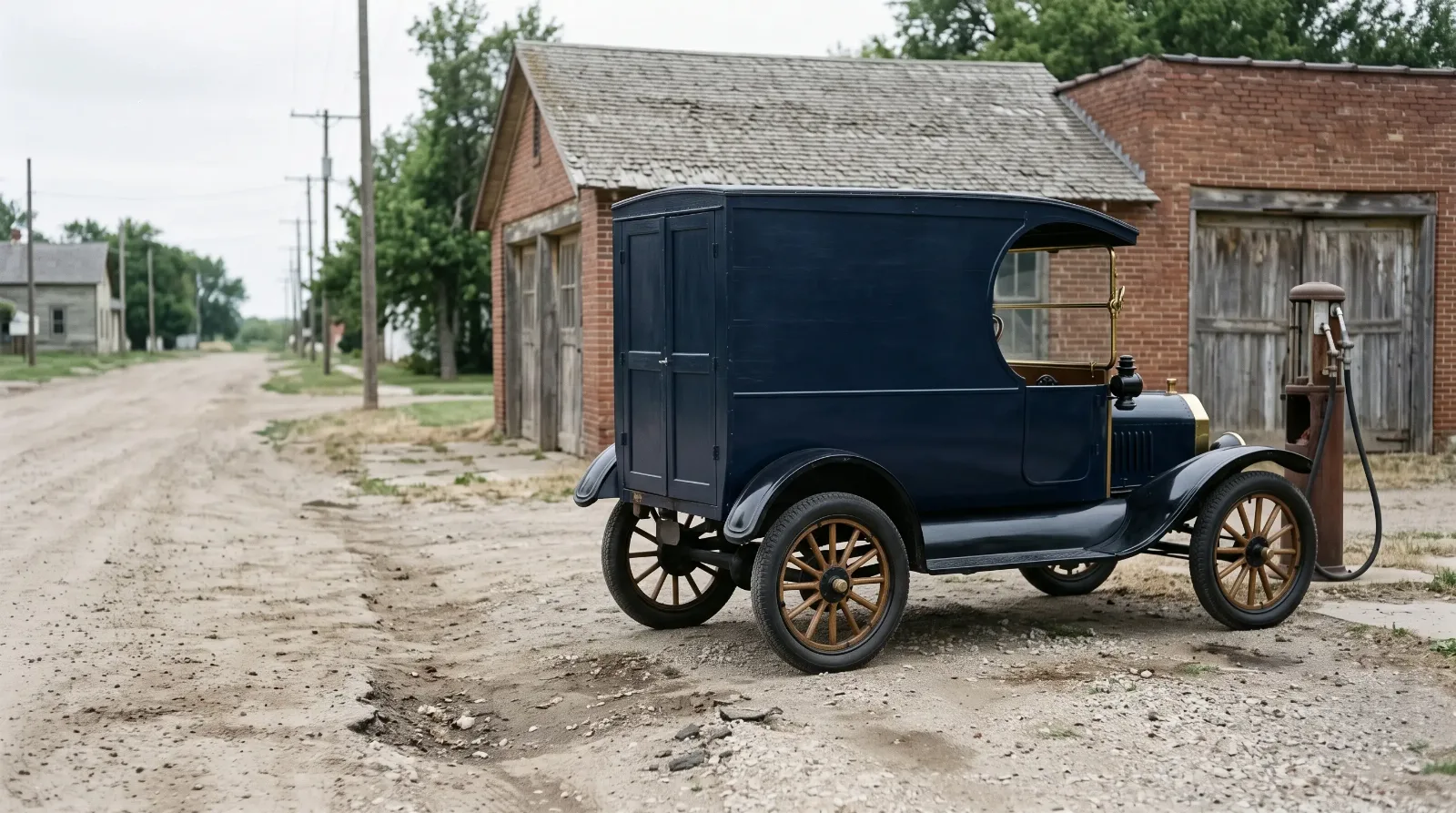
Look at a Model T C-cab from the side and the name explains itself. The front of the cab curves back from the roof, down past the driver, and forward again toward the floor, a cutout shaped like the letter C. That opening is the door, the window and the ventilation all at once. Behind it sits a tall wooden box with doors at the back. It is about as plain as a vehicle gets, and for a grocer, a baker or a laundry in the 1910s it did the job a horse and wagon had done, faster and without the feed bill. This piece looks at what the Model T C-cab was, who built them, how they carried freight, and what it takes to keep one working today.
Car Features
7 min read
The Model T C-Cab Delivery Van
Ford's 1912 delivery car, the builder-bodied C-cabs that followed on T and TT chassis, and what to check before you buy one today.
Where the Model T C-cab came from
Ford sold a factory delivery car on the Model T chassis for the 1912 model year. It listed at $700, and that price bought a fully equipped vehicle: brass windshield, speedometer, gas headlamps and tools. Some hobby sources date its introduction to October 1911, which fits the usual autumn launch of a new model year. Wikipedia's list of Model T body styles names a "C-cab wagon (1912)," and the delivery cars of that period are the ones collectors most often tie to the C-cab name.
The factory run was short. RM Sotheby's, describing a 1912 example, gives the delivery car's production as 1,825, built in 1912 and 1913 before Ford dropped it. The same source says a factory delivery body returned in 1921. Under the box it was a regular Model T: the 176.7 cubic inch four rated at 20 bhp, the two-speed planetary transmission and a 100 inch wheelbase. Nothing about the drivetrain was special. The body was the whole product.
You will also hear the C-cab called a "pie wagon." That nickname turns up in the reproduction trade, but I have not found it in any Ford document of the period. Use it in conversation if you like; don't put it on a show card.
Who built the bodies
Here is the part that confuses people at swap meets. Most C-cabs you see were not built by Ford at all. Ford's factory delivery car lasted two seasons. After that, the C-cab shape lived on because local body builders kept making it. A merchant bought a Ford chassis and had a carriage shop or wagon maker put a cab and cargo box on it, the same way hotels had wood bodies built for their depot hacks.
When Ford's one-ton truck chassis, the Model TT, arrived for 1917, it sold as a bare chassis at $600 and the buyer supplied the body. Many C-cab and express bodies went onto TT chassis that way. Ford did not offer a factory-built truck body until 1924, and a closed cab came in 1925. Before then, nearly every commercial body on a Ford was somebody else's work. For how that grew into Ford's own trucks and pickups, see our look at Ford pickups of the 1920s.
| Item | 1912 delivery car (Model T chassis) | Model TT chassis |
|---|---|---|
| Price new | $700, fully equipped | $600 bare chassis (1917); $325 (1926) |
| Wheelbase | 100 in | 124 to 125 in |
| Engine | 176.7 cu in four, 20 bhp | Same four |
| Final drive | Bevel gear, 3.63:1 | Worm drive, 7.25:1 standard |
| Body | Factory delivery body | Supplied by outside builders until 1924 |
The practical result for a buyer today: two C-cabs that look alike from across a field can be completely different vehicles underneath. One may be a car chassis with a 100 inch wheelbase. The other may be a TT with a long frame and a worm-drive rear axle. Check the frame and the axle before you check the paint.
Working life: what a C-cab actually carried
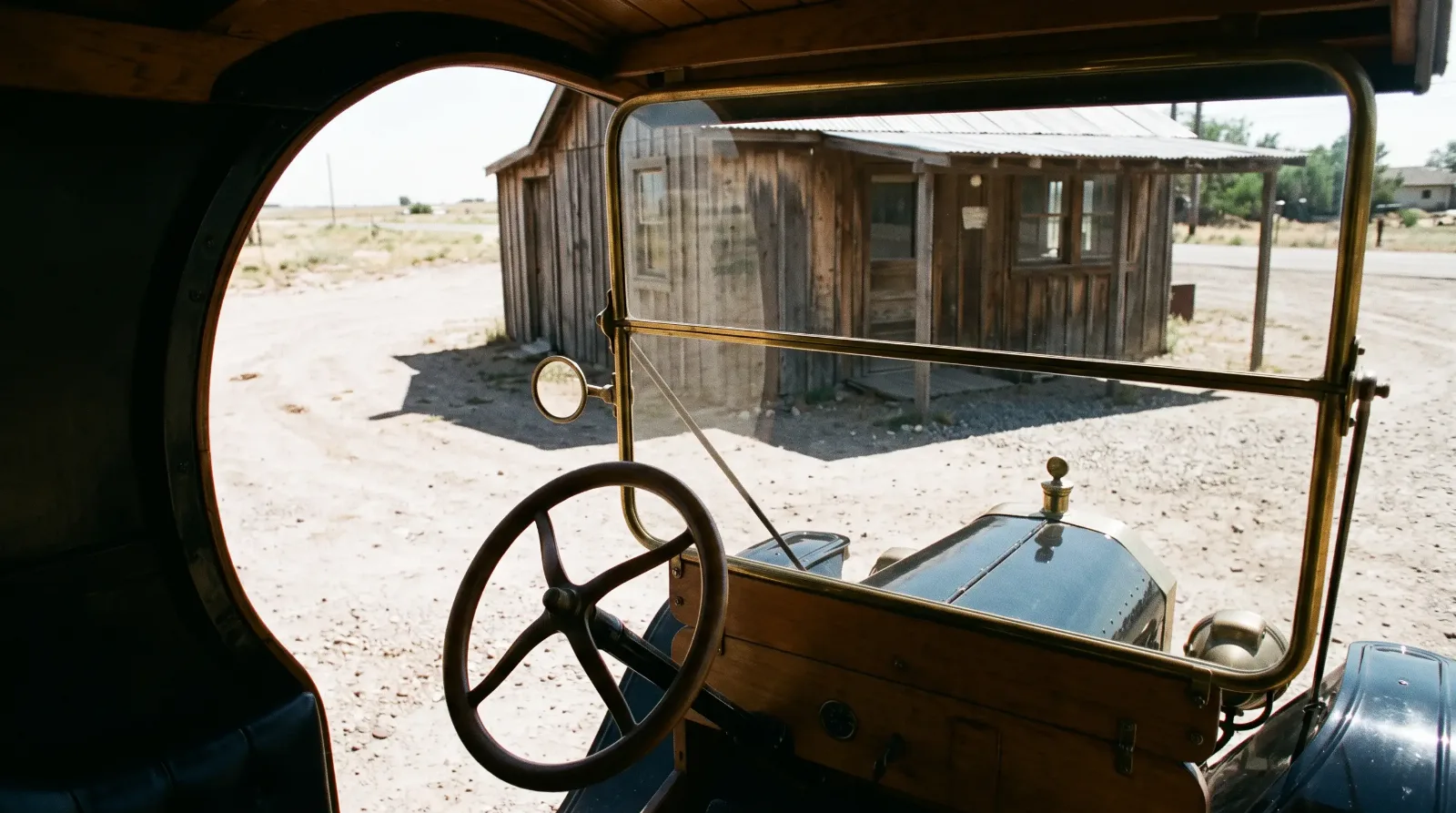
The C-cab was a town truck. Merchants used them for short daily routes where the load was light and the stops were many. The open cab meant the driver could step out and back in all day without fighting a door. In winter that same opening let the weather straight in.
Speed was never the point. A TT with standard gearing topped out just under 20 mph, and Ford recommended no more than 15 mph. A car-chassis delivery wagon could go faster, around 40 mph, but with a tall box and a load inside, nobody sensible did. Some owners added a Ruckstell two-speed rear axle or a Jumbo auxiliary gearbox to give the planetary transmission an in-between ratio for hills.
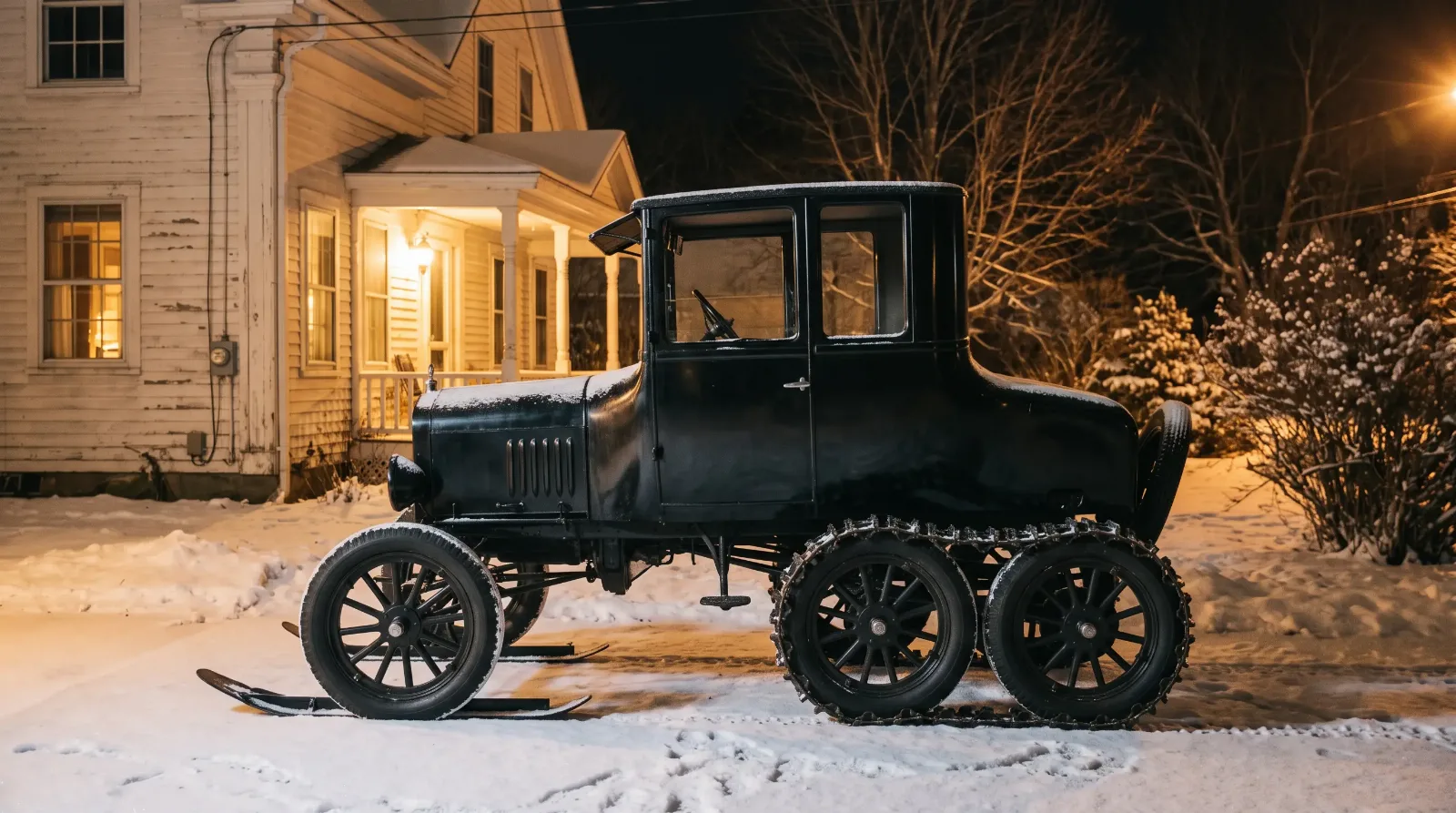
Rural routes asked for something else. Mail carriers in snow country fitted skis and tracks to their Fords, and if you want that side of the story, read about the snowmobiles. The C-cab stayed mostly on paved and graded town streets, where its narrow tires and short wheelbase made sense.
Buying and restoring a C-cab today
Start with the chassis, because it is the only part you can assume is Ford. Engine, transmission, axles and running gear are Model T or TT parts, and that is good news. Mechanical parts for the four-cylinder T are still made, and a C-cab costs no more to keep running than a touring car on the same chassis.
The body is where the money goes. A wooden C-cab body is a carpentry job, not a sheet-metal job. Original bodies were built by local shops to no national pattern, so there is no factory drawing to restore to. If the wood is rotten, you are building a new body, and the honest way to describe the result is a reproduction body on an original chassis. Plenty of nice C-cabs are exactly that. The problem starts when a seller calls one "original" without proof.
"Buy the chassis and price the body as if you'll rebuild it. If the wood turns out sound, you got lucky. If it doesn't, you didn't overpay."
Robert Halloran
What the Model T C-cab is worth
Real factory delivery cars are rare, and the market treats them that way. A 1912 Ford Delivery Car sold for $52,800 at RM Sotheby's Hershey sale in 2012, lot 152. That figure is fourteen years old and tied to a documented early car, so it is not a price guide for every C-cab with a lettered box. Builder-bodied C-cabs and reproductions are priced on the quality of the body and the paperwork behind it, so compare recent sales of similar trucks before you make an offer.
My view is simple. A C-cab is one of the cheapest ways into an early Ford commercial vehicle that still draws a crowd, as long as you pay for what is there and not for the story painted on the side. It hauled bread and laundry for a living. Keep it running and it will still haul a picnic. For where it fits among Ford's cars and trucks over two decades, there is the Model T and Model A story.
Sources and notes
Related Reading
Have a
Ford Model T
for Sale?
Reach thousands of serious classic car collectors across the US.
Sell It Here →
Selling a classic? Here's how: compare the places to sell classic cars
Are You a Classic Car Dealer?
List your full inventory and connect with targeted classic car buyers.
Join as a Dealer →

About the author
Robert Halloran
Texas-based classic truck enthusiast with decades of experience buying, restoring, and writing about American pickups from the 1940s through the 1980s.
Related Listings - Ford Model T




Comments
Be the first to comment on this article.