
On December 18, 1999, at an awards gala in Las Vegas, the motoring world got its answer. The finalists were a British city car, a French sedan that looked like it had landed from orbit, a German people's car and a German sports car. The winner was a Ford that had last rolled off an American line 72 years earlier. The Model T car of the century award went to the oldest of the five finalists, and the margin was not close.
Car Features
7 min read
Why the Model T Was Named Car of the Century
In 1999 a jury of 133 journalists picked the Ford Model T over the Mini, DS, Beetle and 911. Here is how the vote worked and why it won.
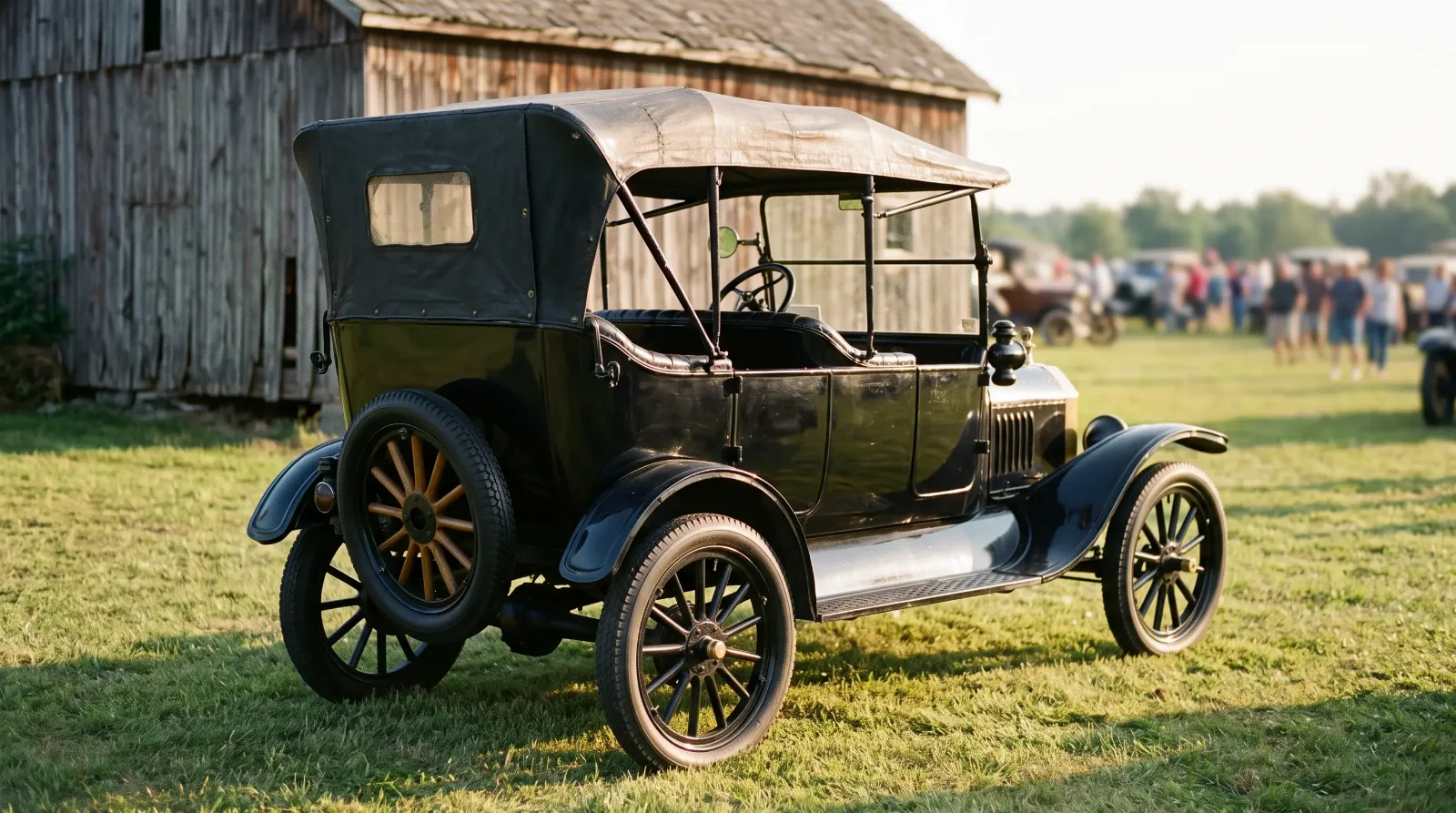
Why that result? The short answer is that the jury was asked to judge influence over a hundred years, and no other car changed as many lives as early as the Model T did. The longer answer sits in the vote itself, in the price tags of the 1910s, and in the way the car was built and sold. If you want the full arc first, the Model T story covers the run from 1908 to 1927. Here the question is narrower: what did the jury see, and were they right?
How the Model T car of the century vote worked
The award came from the Global Automotive Elections Foundation, and it took more than three years to settle. The process opened in October 1996 with a list of about 700 candidates. It was cut to 200 in February 1997 at the AutoRAI show in Amsterdam, then to 100 at Frankfurt in September 1997. At Geneva in March 1999 the field shrank to 26 (25 jury picks plus the AC Cobra, added by a public internet vote), and at Frankfurt in September 1999 it came down to five finalists.
The final jury was made up of 133 automotive journalists from 33 countries, presided over by Lord Montagu of Beaulieu. Those were people who had spent their working lives arguing about cars, and they did not all come from the same tradition. That matters, because a jury of Americans alone could have been accused of voting for the home team.
| Finalist | Final-round points |
|---|---|
| Ford Model T | 742 |
| Mini | 617 |
| Citroen DS | 567 |
| Volkswagen Beetle | 521 |
| Porsche 911 | 303 |
The regional split tells its own story. The Model T came first in three of the five voting regions. The Mini won the United Kingdom, and the Citroen won middle and southern Europe. In other words, the places with a strong car of their own leaned toward it, and the rest of the world leaned toward Ford. A 125-point lead over the Mini is a long way in a field of five.
A car that working families could buy
Start with the money, because the jury surely did. The Model T touring car was listed at $850 for its first model year, with the runabout at $825. That was not a rich man's price, but it was not a farmhand's price either. Then Ford kept cutting. By 1914 the runabout was $440. By 1916 it was $345. In 1925 it reached its low point of $260, with the touring car at $290.
Think about what that curve means at a kitchen table. A car that cost $850 when it appeared became, a decade and a half later, something a farmer, a country doctor or a factory hand could plan for. The Beetle and the Mini later did the same job for their own generations, and they did it well. The Model T did it first, and it did it at a scale nobody had imagined.
That scale is the second reason. By 1918, half of all cars in America were Model Ts, and in the early 1920s more than half of the registered cars in the world were Fords. When production ended in May 1927, Ford counted more than 15 million Model Ts. No other single model came near that total for more than four decades.
The assembly line the whole industry copied
The jury was voting on a car, but it was also voting on a way of making things. Ford's first moving line, for flywheel magnetos, started around April 1, 1913, at Highland Park. Workers who had spent about 20 minutes on each magneto were soon doing the job in about five. The moving chassis line followed, with a trial in August 1913 and the commonly cited start on October 7, 1913. Within a year, the labor to build a chassis had fallen from about 12.5 hours to 93 minutes.
Those minutes are why the prices fell. The moving line cut the cost of every car, and Ford passed much of the saving on to the buyer. Every carmaker on the 1999 shortlist, from Longbridge to Wolfsburg, built its cars on lines that trace back to that factory floor in Michigan. A jury looking back from the end of the century could not judge the Mini or the Beetle without seeing the Ford method underneath them.
"The other four finalists were great cars. The Model T was the reason there could be great cars for ordinary people at all, and I think the jurors knew it the moment they sat down."
Patrick Walsh
A world car before the phrase existed
It would be easy to treat the Model T as an American story, and the regional results show why that misses something. The car was assembled far from Detroit. In Britain it was the best-selling car in 1913, with about 30 percent of the market, and the first British moving line opened in 1914 at a pace of 21 cars an hour. By 1919, 41 percent of British-registered cars were Fords, and about 150,000 Model Ts were built at Trafford Park in all. The very last Model T came from Cork, Ireland, in December 1927, months after the American line had stopped. There is more on Model Ts built abroad and how Ford spread the car through branch plants.
That reach explains why jurors from 33 countries could agree. Many of them came from places where the first motor car anyone saw on a village road was a Ford. The Mini and the DS were national heroes. The Model T was a shared memory.
Was the jury right?
There is a fair argument against the result. The Model T was crude even by the standards of its own time: two forward speeds, a planetary gearbox worked by pedals, no brakes at the front wheels (the foot brake was a band inside the transmission), and a design that Ford kept largely unchanged long after rivals had moved on. Chevrolet caught it in the 1920s precisely because buyers wanted more than the T offered. A jury judging engineering elegance would probably have picked the Citroen. A jury judging joy behind the wheel might have picked the 911.
But that was not the question. The award asked which car mattered most across a century, and on that score the Model T has no real rival. It made car ownership normal for working people, it set the production method that every finalist used, and it did so on several continents before the 1920s were out. Ford's own decision to end it in 1927 and start again with the Model A is part of the wider story, and it shows that even Ford knew the car had run its course. The jurors were not saying it was the best car ever built. They were saying it was the one the century could not have done without, and on the evidence, that is hard to dispute.
The car that took the prize that night in Las Vegas had been out of production for more than seven decades. Its owners had mostly been farmers, salesmen, doctors and young couples who had never owned anything with an engine before. Most of them were gone by 1999. The vote, in a quiet way, was for them too.
Sources and notes
- Car of the Century: process, jury and final points (Wikipedia)
- Ford Model T named Car of the Century (Auto123)
- The Model T: prices, production and world share (Ford, From the Road)
- Ford in Britain: Trafford Park output and market share (Grace's Guide)
- Ford's Model T and the moving assembly line (Michiganology)
- Ford Model T: production, prices and the Beetle record (Wikipedia)
Related Reading
Have a
Ford Model T
for Sale?
Reach thousands of serious classic car collectors across the US.
Sell It Here →
Selling a classic? Here's how: compare the places to sell classic cars
Are You a Classic Car Dealer?
List your full inventory and connect with targeted classic car buyers.
Join as a Dealer →

About the author
Patrick Walsh
Automotive journalist covering classic car shows, events, and the enthusiast community across North America.
Related Listings - Ford Model T

Comments
Be the first to comment on this article.