
Twenty horsepower. That is the headline, and it holds up: the Model T four was rated at 20 hp from 177 cubic inches, and it moved a car of 1,200 to 1,650 pounds at up to about 40 to 45 mph. Those are the Model T engine specs in one line. The rest of this piece is about what sits behind each number, which ones are solid, which ones wander, and why a low-revving 2.9 liter four was the right engine for a car that had to be cheap, simple and impossible to kill.
Car Features
6 min read
Inside the Model T Engine: 177 Cubic Inches and 20 Horsepower
177 cubic inches, 20 hp, 83 lb-ft: the Model T engine specs checked number by number, including the 22 hp early rating and what the engine left out.
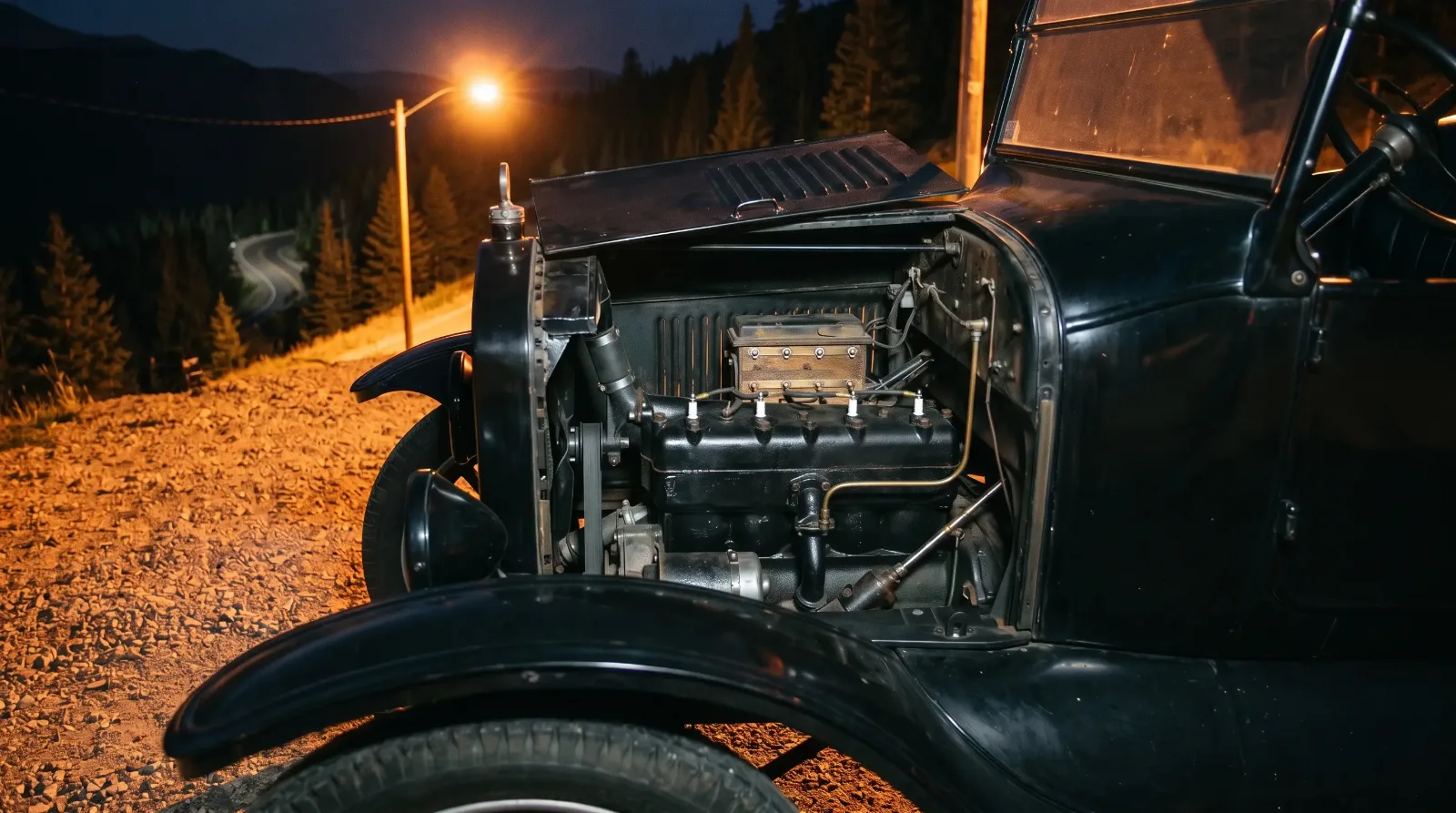
The Model T engine specs at a glance
Start with the hard numbers. Most of them come from Ford's own literature and survive cross-checking. A few carry an asterisk, and I will tell you which.
| Item | Figure | How solid |
|---|---|---|
| Layout | Inline four, side valve (L-head) | Solid |
| Displacement | 177 cu in (2.9 L) | Solid |
| Bore x stroke | 3.75 in x 4.0 in (95.25 x 101.6 mm) | Solid |
| Rated power | 20 hp; some early cars listed at 22 hp | 20 solid, 22 for early cars |
| Torque | 83 lb-ft | Single main source |
| Compression ratio | 3.98:1 on most engines; about 4.5:1 on the earliest | Varies by period |
| Construction | Cast-iron monobloc, detachable cast-iron head, 3 main bearings | Solid |
| Lubrication | Splash, no oil pump, oil shared with the transmission | Solid |
| Cooling | Thermosiphon, no water pump (after the earliest 1909 cars) | Solid |
| Fuel | 10 gal tank, gravity feed, no fuel pump | Solid |
| Fuel economy | 13 to 21 mpg (Ford figure) | Ford's claim |
Run the arithmetic on the bore and stroke and you get 176.7 cubic inches. Ford rounded up to 177, and the math agrees. The stroke is longer than the bore, so this is an undersquare engine built for pulling at low speed, not for revving.
Twenty horsepower, or twenty-two?
The 20 hp figure is the standard rating and the one to quote. It is a brake horsepower number from the period. There is no SAE net figure for the Model T, because that measurement did not exist yet, so do not compare it straight against a modern engine's rating.
The 22 hp figure is not a typo. Some listings for early cars quote 22 bhp, and The Henry Ford's own 1909 touring car, built at Piquette, is recorded at 22 hp at 1,600 rpm. The early engines also ran a bit more compression, about 4.5:1 against 3.98:1 later, which fits a slightly higher rating. Later engines settled at 20 hp. A 1922 Model T in a museum collection is listed at 20 hp at 1,600 rpm.
Do the specific-output math and you see what Ford was after. Twenty horsepower from 2.9 liters is under 7 hp per liter. That is a modest figure, and it was deliberate. A lazy engine at 1,600 rpm wears slowly, tolerates bad fuel and forgives an owner who never reads the manual.
Torque: the number that actually moved the car
Horsepower sells. Torque pulls. The Model T engine made 83 lb-ft, and one museum record puts that peak at 900 rpm. Treat the exact rpm as a single-source figure, but the shape is right: the T made its useful pull just off idle.
That matters because the car had only two forward speeds through its planetary transmission. With a 3.64:1 standard rear axle, a long-stroke engine that pulled from low rpm was what let a two-speed car climb hills and drag through mud. A peaky engine with the same 20 hp would have been miserable in that chassis.
Put it against the car's weight and the numbers are honest. Twenty horsepower for 1,200 to 1,650 pounds is roughly 60 to 83 pounds per horsepower. Slow, but the T was light, and light is the cheapest performance there is.
"Twenty horsepower sounds like nothing until you check what it had to move. The T was light, geared low and torquey off idle. The spec sheet is modest. The result was a car that went almost anywhere a horse could."
Dan Reeves
What is missing: no pumps, no battery, one adjustment
The spec list is as interesting for what the engine lacked. There was no oil pump: the flywheel and moving parts splashed oil around, and the engine shared its oil with the transmission. There was no water pump after the earliest cars. There was no fuel pump either: a 10 gallon tank under the front seat fed the carburetor by gravity, until 1926 moved it into the cowl on most models.
The carburetor itself was a single side-draft, single-venturi unit, made by Holley, Zenith or Kingston depending on the year. The manual describes it as having "but one adjustment", the gasoline needle valve, worked from the dash. Ignition came from a flywheel magneto, a timer on the front of the camshaft and a coil box, with a 28-notch spark quadrant under the steering wheel at about 2.85 crankshaft degrees per notch. Each of those systems has its own story, and there is more on that here.
Fewer parts meant fewer failures and cheaper repairs. It also meant the driver did some of the engine management by hand. That was the trade.
A run that outlasted the car
Ford built the engine from September 27, 1908, and did not stop when the car did. Model T engines kept coming until August 4, 1941, almost 170,000 of them after car production ended, for service and industrial use. Racers used the block too: Cragar, Navarro and Frontenac all built speed parts around it.
Production efficiency was part of the engine's story. When Ford put engine assembly on a moving line in November 1913, assembly time fell from 594 minutes to 226. Precision machining was good enough that Ford could skip testing the engine before it went into a chassis.
The replacement was a different engine altogether. The 1928 Model A got a 200.5 cubic inch four rated at 40 hp at 2,200 rpm, with 4.22:1 compression on most years, a water pump and an oil pump. No engine parts interchange between the two. For the full breakdown of the Model A four, see its own article. The short version: double the power, from only 23.5 more cubic inches, and one more lesson that 20 horsepower was a choice, not a limit.
Sources and notes
Related Reading
Have a
Ford Model T
for Sale?
Reach thousands of serious classic car collectors across the US.
Sell It Here →
Selling a classic? Here's how: sell my classic car
Are You a Classic Car Dealer?
List your full inventory and connect with targeted classic car buyers.
Join as a Dealer →

About the author
Dan Reeves
Performance engine builder from North Carolina's motorsports corridor, focused on swaps, forced induction and making real, repeatable power.
Related Listings - Ford Model T
More in Car Features



Comments
Be the first to comment on this article.