
Here is the headline: the Ford Model A engine made twice the power of the Model T engine it replaced, from only about 13 percent more displacement. Forty horsepower from 200.5 cubic inches against twenty from 177. Ford did not get there with exotic parts. It got there by fixing what the T had skipped: a water pump, an oil pump, a battery ignition and a better breathing four. This is a look at what was inside, what the numbers really mean, and where the catalog figure and the real engine part company.
Car Features
6 min read
Inside the Model A Engine: 201 Cubic Inches and 40 Horsepower
Twice the Model T's power from 13 percent more displacement: what was inside the 200.5 cubic inch Ford Model A four, and what 40 hp really meant.
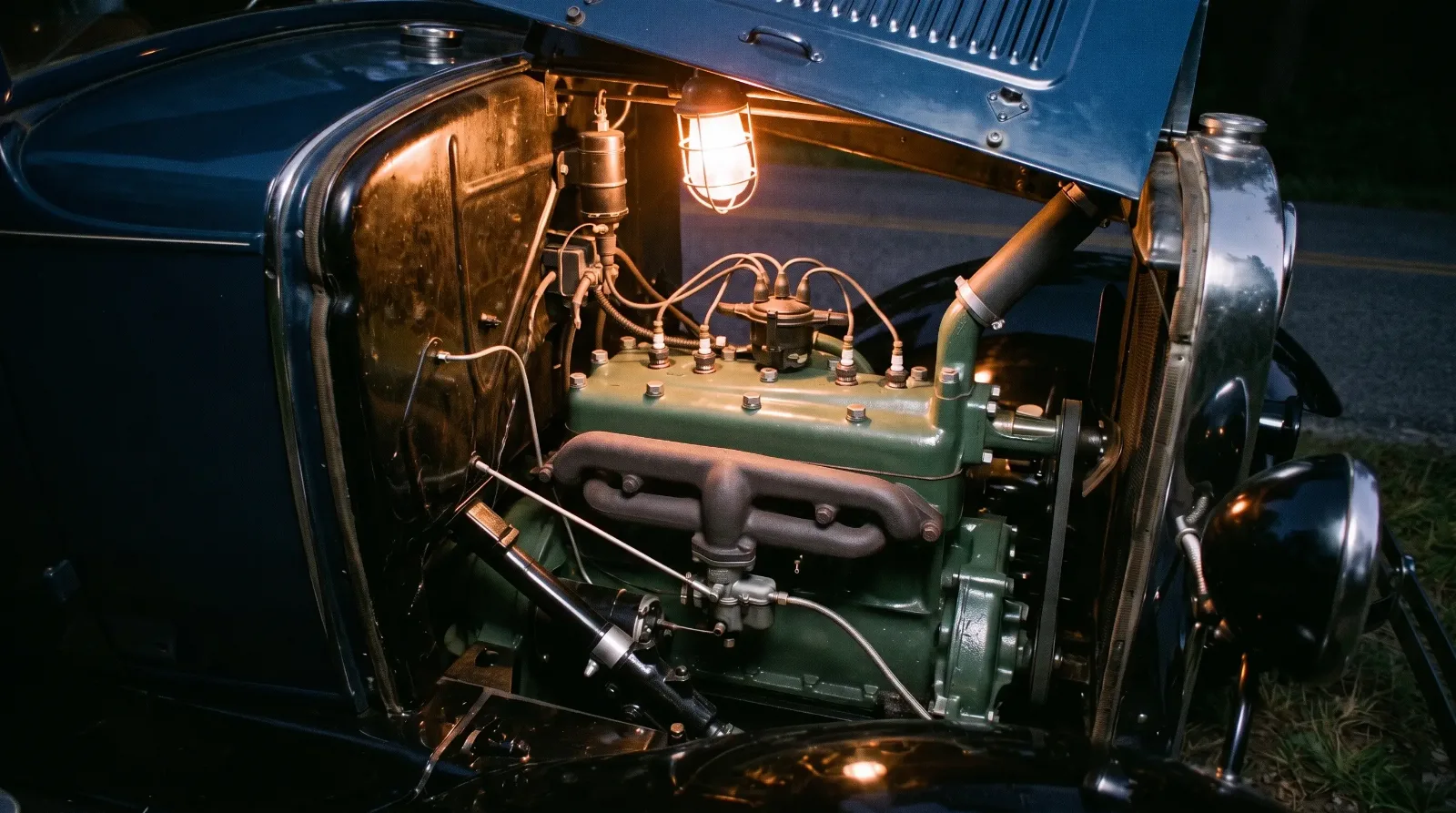
For the broader picture of both engines and how they evolved, see our engines story. Here we stay with the A.
The Ford Model A engine by the numbers
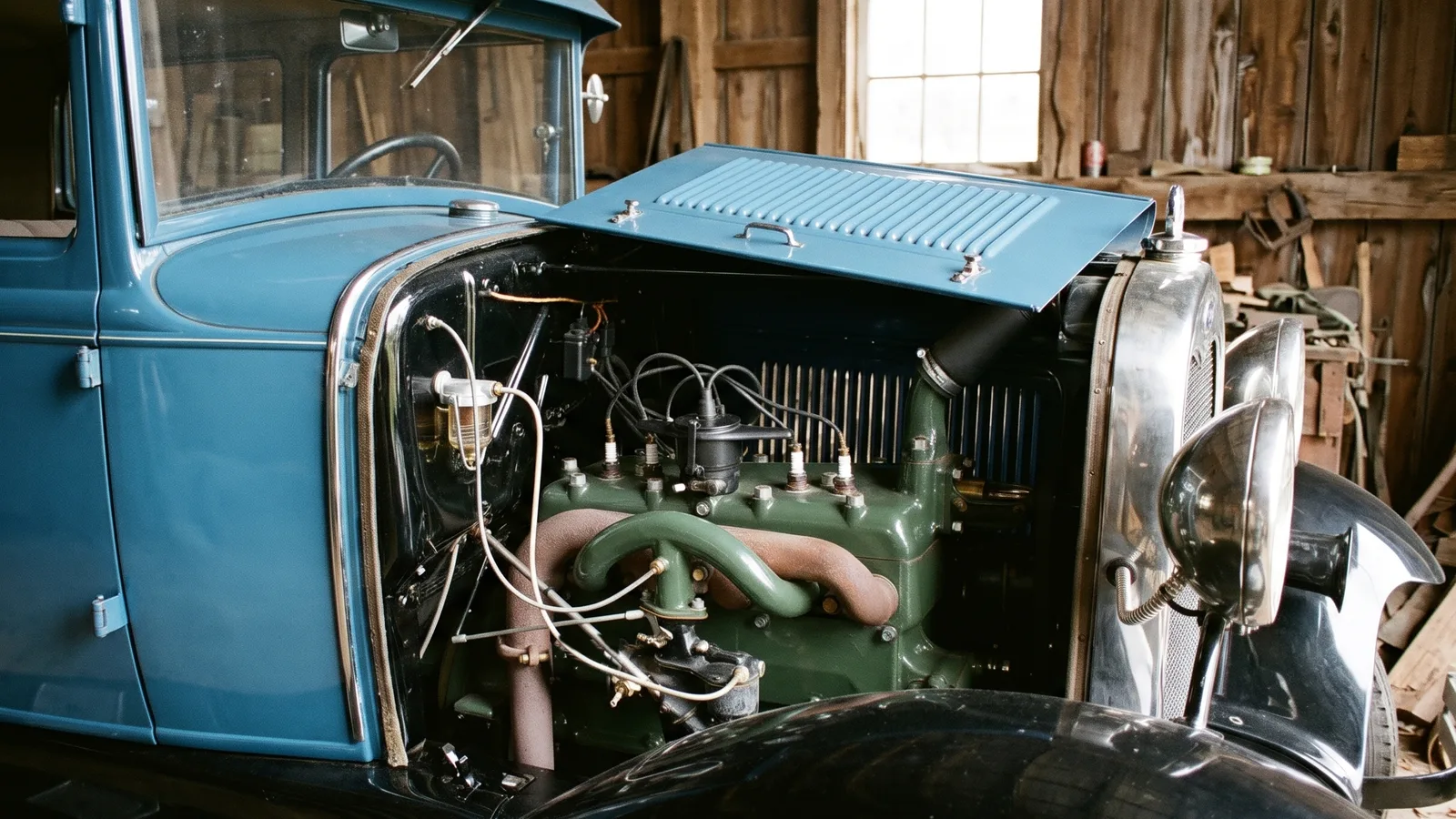
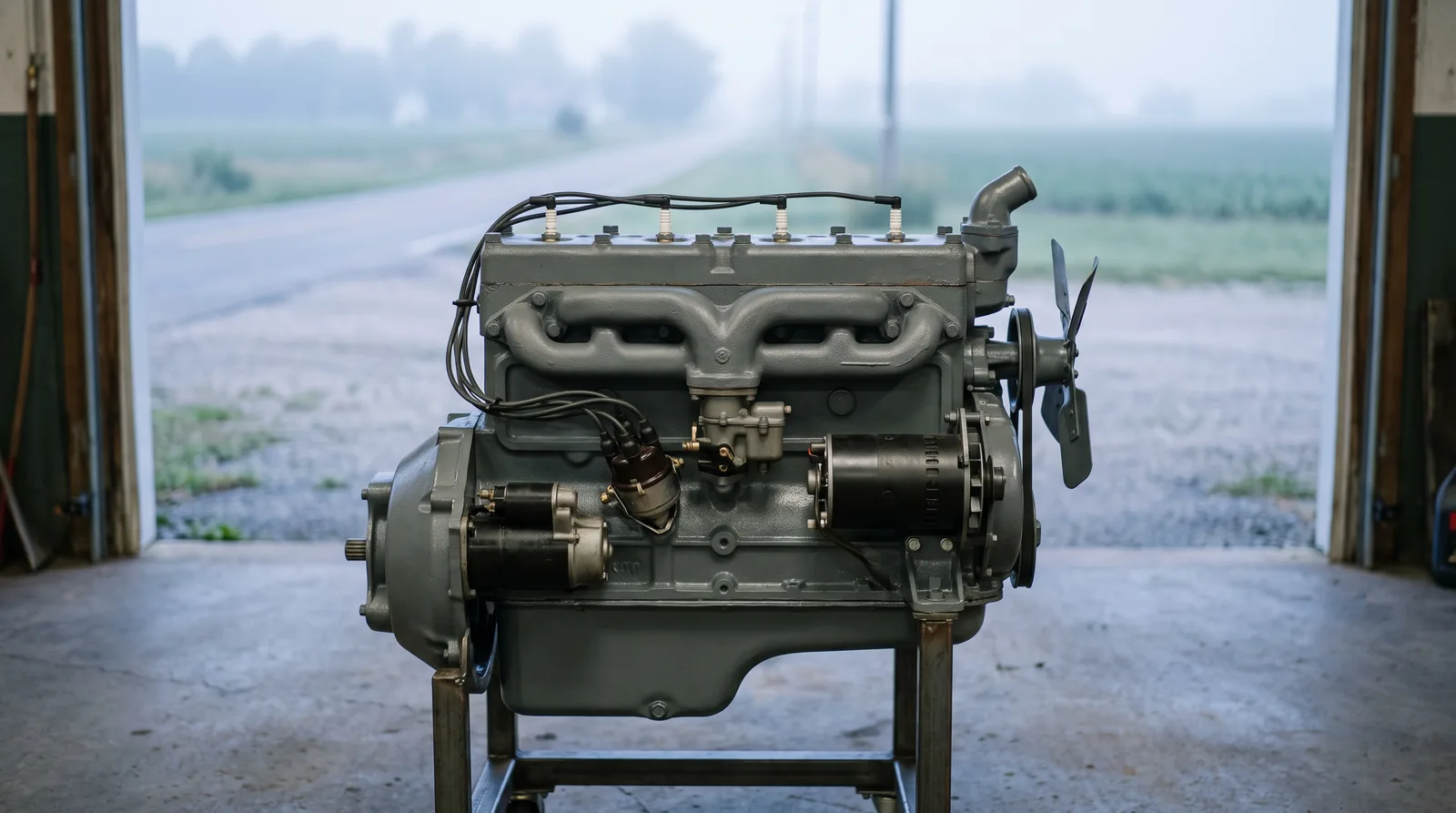
The basics: an L-head inline four, cast iron, 200.5 cubic inches, or 3,283 cc. Ford people round it to 201, which is where the title figure comes from. Bore is 3.875 inches and stroke is 4.25 inches. You will find a 4.125 inch stroke quoted in some places. Do the arithmetic and it fails: 3.875 by 4.125 by four cylinders gives about 194.6 cubic inches, not 200.5. The 4.25 inch stroke is the one that adds up.
| Spec | Model A (1928 to 1931) | Model T |
|---|---|---|
| Layout | L-head inline four | L-head inline four |
| Displacement | 200.5 cu in (3,283 cc) | 177 cu in (2.9 L) |
| Bore x stroke | 3.875 x 4.25 in | 3.75 x 4.0 in |
| Rated power | 40 hp at 2,200 rpm | 20 hp |
| Torque | About 128 lb-ft at 1,000 rpm | 83 lb-ft |
| Compression | 4.3:1 (1928 head); 4.22:1 (1929 to 1931) | 3.98:1 (most engines) |
| Main bearings | 3 | 3 |
| Oil capacity | 5 quarts | Shared with transmission |
| Cooling | Water pump, about 3 gallons | Thermosiphon, about 3 gallons |
| Engine weight | About 350 lb | Not listed here |
The ratio that matters: about 0.20 hp per cubic inch for the A against about 0.11 for the T. That is the real story of the engine. Displacement grew a little. Output per cubic inch nearly doubled.
Forty horsepower: catalog figure or real?
The 40 hp rating at 2,200 rpm is the period's gross, advertised number. It is not a modern SAE net figure, and no period test converts it to one. Treat it as Ford's advertised rating rather than what an installed engine delivered at the wheels.
The torque number is softer still. The figure most often quoted is about 128 lb-ft at 1,000 rpm. Another respected source gives 120 lb-ft. Call it 120 to 128 and you are honest. Either way, the peak arrives at 1,000 rpm, which tells you what kind of engine this is: a low-speed puller built to move a car of about 2,265 to 2,465 pounds away from a standstill in high gear without fuss.
On the road, the result was a car good for about 65 mph flat out, with 45 to 50 mph as a comfortable cruise. Sources range from about 60 to nearly 70 for a new car, which is the spread you expect from tired and fresh engines, different axles and different bodies.
"Forty horsepower is a brochure number. One hundred twenty-plus pound-feet at a thousand rpm is the number you feel. That is why a Model A pulls away from a stop sign in a way no T ever did."
Dan Reeves
What changed inside: pumps, a battery and a distributor
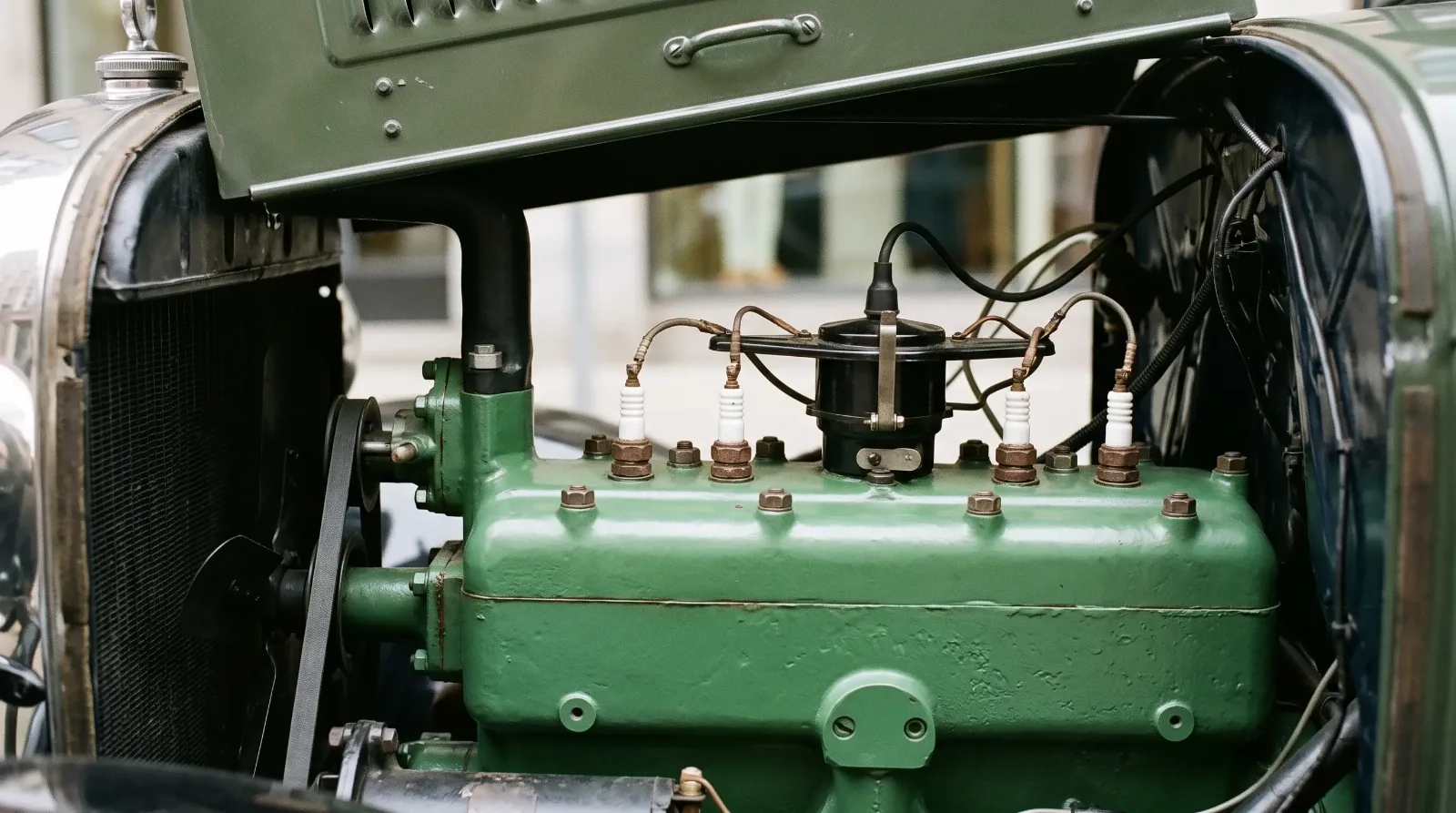
The Model T ran on splash oiling, a thermosiphon radiator and a flywheel magneto. The A threw out all three. The full comparison is in our Model T vs Model A piece, but the engine changes are the core of it.
- Cooling. A centrifugal water pump sits on the cylinder head. The T had none. The system holds about 3 gallons and runs unpressurized.
- Oiling. A pump lifts oil to the valve chamber. From there it runs by gravity to the three main bearings, and the rods get theirs by splash. Capacity is 5 quarts. It is not full pressure lubrication, but it is a long step up from the T.
- Ignition. A 6-volt battery, generator, coil and breaker-point distributor replaced the T's magneto and trembler coils. Positive ground. Firing order 1-2-4-3. Spark timing is manual, with 20 degrees of advance under the driver's control.
- Fuel. A Zenith carburetor, with a control rod from the driver's seat that works both the choke and the gas adjusting valve. The details are in our piece on the Zenith carburetor.
Compression was modest even for the period: 4.3:1 with the 1928 head and 4.22:1 from 1929.
Who built it, and how many
The engine was chiefly the work of Laurence Sheldrick and Harold Hicks, with Charles Sorensen and Peter Martin handling production. According to Sorensen, Edsel Ford spotted a deficiency in the intake manifold during development, and fixing it gave a significant power gain. That is the rare case where the styling chief found horsepower.
Volume was enormous. Ford built 4,830,806 production engines between October 1927 and November 1931, passing the first million by February 1929. None of it shared engine parts with the Model T. The A was larger in every dimension that mattered, and nothing interchanged. For how this engine fits the larger switch from T to A, see the main story.
The verdict on the 201
The numbers make the case. Double the power, about 54 percent more torque on the commonly cited figure, a real cooling system, an oil pump and battery ignition, all in a 350 pound package that Ford built nearly five million times. It was not a high-performance engine. It was a durable, low-revving four that made a cheap car feel like a modern one.
Its limits showed fast. When the Model B arrived for 1932, the same basic four was rated at 50 hp, and the new V8 beside it at 65. The 40 hp A engine was the base the next step was built on.
If you are shopping, an original engine matters to judges and to buyers, and so does its condition: low compression and splash-fed rods are forgiving, but they do wear. Start with Model As with original engines, and look at the engine number and the paperwork before you look at the paint.
Sources and notes
- Mac's Motor City Garage: Power to the People, the Ford Model A engine, 1928 to 1931
- The Henry Ford: Henry Ford with the first 1928 Ford Model A engine, October 1927
- Wikipedia: Ford Model A engine
- Wikipedia: Ford Model A (1927 to 1931)
- MAFCA, The Restorer: Introduction of the New Ford
- Model A Ford Club of Great Britain: specifications
Related Reading

Have a
Ford Model A
for Sale?
Reach thousands of serious classic car collectors across the US.
Sell It Here →
Selling a classic? Here's how: where to sell your classic car online
Are You a Classic Car Dealer?
List your full inventory and connect with targeted classic car buyers.
Join as a Dealer →
#ford model a
#vintage engines
#Model A engine
#Model T vs Model A
#Ford four cylinder
#Model A specs

About the author
Dan Reeves
Performance engine builder from North Carolina's motorsports corridor, focused on swaps, forced induction and making real, repeatable power.
Related Listings - Ford Model A
More in Car Features



Comments
Be the first to comment on this article.