
Picture a picture postcard on a drugstore rack around 1915. On the front, a cartoon Ford rattles down a rutted road, small and upright and a little ridiculous, while the caption takes another poke at it. Somebody buys it, scribbles a line on the back and mails it to a cousin who also drives one. That is how most Model T jokes traveled: by hand, by mail, and by word of mouth at the feed store. They were everywhere in the 1910s, and the strange thing about them is how fond they were. America laughed at the car it could not stop buying.
Car Features
8 min read
Model T Jokes: How America Laughed at the Tin Lizzie
Postcards, joke books and a carmaker who laughed along: what Model T jokes mocked, what they quietly praised, and why Ford welcomed them.
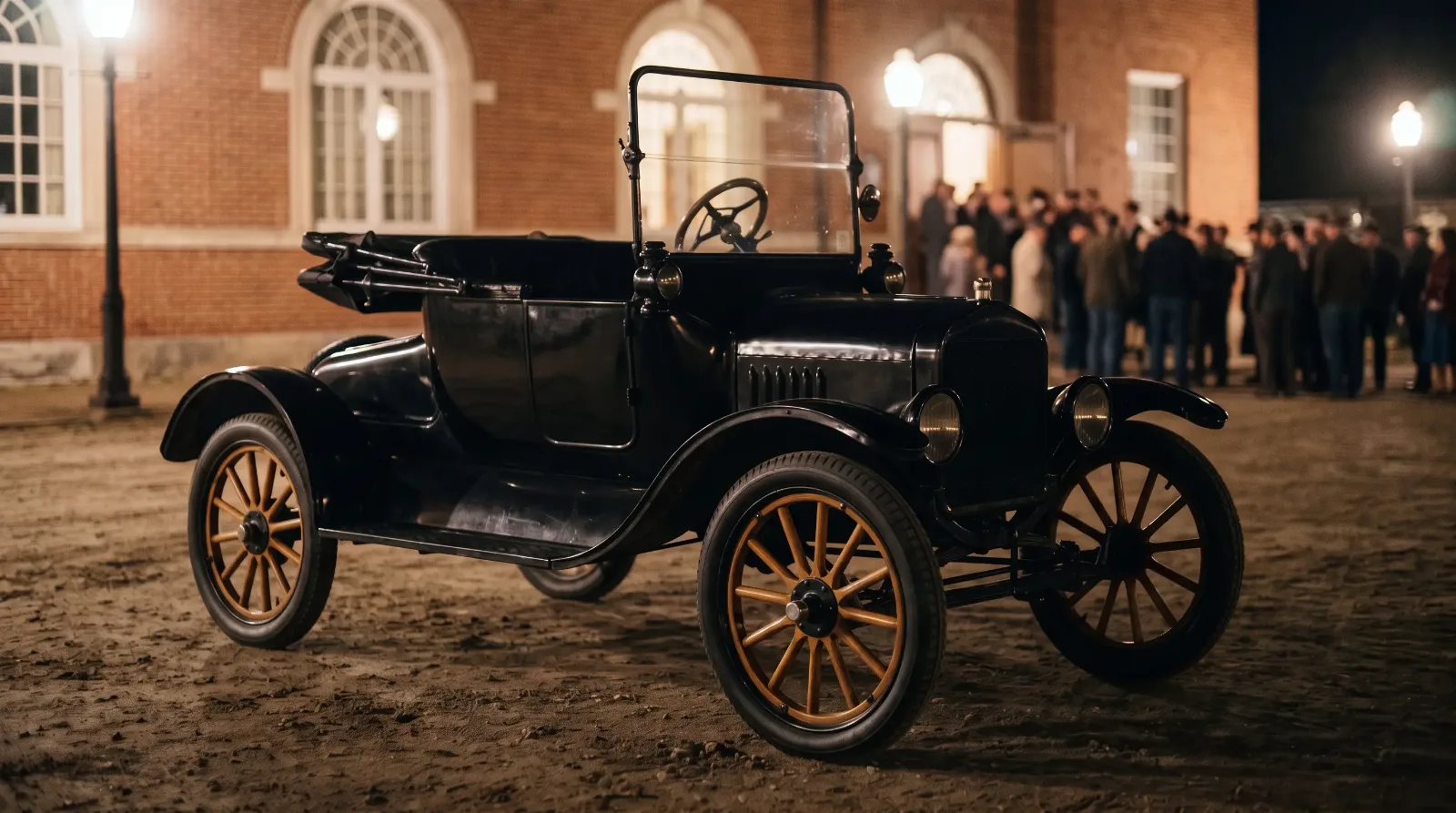
The nickname came first, or at least alongside. Dictionaries date "tin lizzie" in print to about 1915, the same years the jokes were peaking, and the full story of that name is told in our piece on the Tin Lizzie Ford. This article is about the laughter itself: what people joked about, where the jokes were printed, and why the man who built the car seemed to enjoy them more than anyone.
Why the Model T made such an easy target
A joke needs a shared reference, and by the middle of the 1910s almost every American had seen a Model T up close. Prices kept falling as the assembly line sped up. The runabout cost $825 in 1909 and $440 by 1914; by 1925 it bottomed out at $260. A car that cheap reached people who had never owned anything with an engine. Farmers had one. The doctor had one. The fellow who fixed the church roof had one.
The car also had obvious features to poke at. It was tall and narrow, it came only in black from about 1914 to 1925, and its body panels rattled on the rough roads of the day. "Tin lizzie" was slang for a small, cheap, worn-out car, and "flivver" meant something of inferior quality. Both words carried a joke inside them before anyone told one. Yet the same car climbed hills and crossed mud that stopped heavier machines, and owners knew it. That tension, cheap and tinny but nearly impossible to kill, is what gave the humor its bite and its warmth.
The Henry Ford notes that cartoons about Ford and the Model T were most common from 1914 to 1920, the same stretch in which production and sales rose year after year. The more cars on the road, the bigger the audience for a gag about them.
The classic Model T jokes and what they really said
The Henry Ford museum, which holds examples in its collection, sums the genre up neatly: thousands of jokes praised the car's durability while mocking its looks and its rattles. Read a handful in a row and the same few themes come back again and again. The jokes below are paraphrased, because the printed versions varied from book to book and postcard to postcard.
| Joke theme | The setup, paraphrased | What it mocked | What it quietly praised |
|---|---|---|---|
| Size | A Cadillac owner keeps a Ford in his toolbox, in case of emergencies | How small and light the car was | That it was useful enough to want along |
| Tin body | A man mails a tin roof to the factory and gets a letter back saying his car was badly wrecked but would be repaired | The thin, rattling sheet metal | Nothing, this one stings a little |
| Toughness | A farmer asks to be buried in his Ford, because it has pulled him out of every hole so far | Rural roads and rural owners | The car's ability to get anywhere |
| Politics | Will Rogers joked about Henry Ford running for president | Ford's fame and ambitions | How large the man and the car loomed |
Notice the shape of the farmer joke. The punchline only works if the listener already believes the car is nearly unstoppable. You cannot mock a car's reputation for toughness unless it has one. The toolbox joke runs the same way: it is a dig at the size, but the Cadillac owner wants that Ford along. Very few of these gags say the car is bad. They say it is cheap, small, homely and loud, and then admit, in the last line, that it works.
The word "flivver" even spilled into politics. A 1916 cartoon called "Ford's Flivver Cure" mocked Henry Ford's peace ship, his private attempt to help end the war in Europe, and Theodore Roosevelt called the voyage a "jitney peace junket." By then the car's slang had become a handy way to take a shot at its maker.
Postcards, joke books and the Little Blue Books
The jokes did not stay oral for long. Printers saw a market. The Henry Ford holds a joke postcard from around 1915 with artwork credited to Cobb & Shinn and printing by the Commercial Colortype Co. Cards like it were cheap to make, cheap to buy and cheap to mail, which suited a joke about a cheap car.
Then came the books. "Funny Stories About the Ford," Volume I, carries a 1915 copyright from the Presto Publishing Co. of Hamilton, Ohio. The "Volume I" on the cover tells you the publisher expected to need more than one. Later, the editor George Milburn compiled "A Book of the Best Ford Jokes" as Little Blue Book No. 1214 for Haldeman-Julius, the publisher of the Little Blue Book series. Library catalogues list it without a year, but the fact that the Model T earned its own number in a mass-market series says plenty about how far the genre had spread.
The humor also crossed into other forms. Sheet music made the car sound indestructible, and silent film comedians found plenty to do with a Ford that would not quit; we cover the songs it inspired in a separate piece. Even after the car was gone, writers kept the gag going. John Steinbeck's "Cannery Row" (Viking Press, January 1945) joked that most babies of the period were conceived in Model Ts.
"Every Ford joke sold a car": Henry Ford laughs along
A company could have treated all this as an insult. Ford, by the account of The Henry Ford museum, was amused instead and liked to say that "every Ford joke sold a car." The line is attributed rather than documented in a single dated source, so treat the wording with a little caution. The attitude behind it fits the record, though. Ford did not need to buy as much attention as his rivals did. Every postcard and every gag at a lodge supper put the name of his car in front of somebody new.
"The best Model T jokes are love letters in disguise. Strip away the punchline and nearly every one of them says the same thing: this car is cheap and homely, and it will get you home."
Patrick Walsh
There was a practical logic to it as well. A joke about a rattling body is also a reminder that the body is easy to fix. A joke about a small car is also a reminder that it fits in a narrow barn and costs little to run. The humor sold the Model T as approachable. Owners could laugh at their own car because they were not afraid of it, and that ease was a big part of what Ford was selling.
What the jokes tell us now
The humor faded with the car. When the Model A arrived in December 1927, a 1928 song cheerfully announced that Henry had made a lady out of Lizzie, and the age of the rattling flivver was over. A new car with a smoother, more stylish body did not invite the same kind of teasing.
Read today, Model T jokes work as a kind of social history. They show who owned the car (farmers, clerks, small-town doctors), what roads were like (deep holes, deep mud) and what people expected from a machine (toughness first, looks a distant second). They also show a public that felt it owned a piece of the joke along with the car.
For anyone who owns or restores one of these cars, the jokes are worth knowing. They are part of the car's provenance in the broadest sense: the reason a stranger at a gas station still grins and says "tin lizzie" when a Model T rolls in. For the wider story of how the T and the Model A shaped American life, start at our early Ford hub.
Sources and notes
- The Henry Ford: Ford Model T joke postcard, circa 1915
- The Henry Ford: Model T cartoon postcard, circa 1915, and the 1914 to 1920 peak of Ford cartoons
- CSU Northridge: George Milburn, ed., A Book of the Best Ford Jokes, Little Blue Book No. 1214
- Dictionary.com: tin lizzie, first recorded 1910 to 1915
- Wikipedia: Ford Model T (prices, colours, production)
Related Reading
Have a
Ford Model T
for Sale?
Reach thousands of serious classic car collectors across the US.
Sell It Here →
Selling a classic? Here's how: the best sites to sell a classic car
Are You a Classic Car Dealer?
List your full inventory and connect with targeted classic car buyers.
Join as a Dealer →

About the author
Patrick Walsh
Automotive journalist covering classic car shows, events, and the enthusiast community across North America.
Related Listings - Ford Model T
Comments
Be the first to comment on this article.