
Most people who drive a Model T for the first time assume the strange pedals are a quirk of design. They are not. They are the direct, almost literal controls for a gearbox that works on a different principle from the sliding-gear transmissions that followed it. The Model T planetary transmission had two forward speeds and a reverse, all of its gears stayed in mesh all the time, and you chose a gear by squeezing a steel drum to a stop. Once you understand that one idea, every pedal on the floor makes sense.
Car Features
7 min read
How the Model T Planetary Transmission Worked
Two speeds, a reverse and gears that never slid: how the Model T planetary transmission turned pedals into gear ratios.
Ford called it a "three speed" at the time, counting reverse. It ran from 1908 to 1927 with the same basic layout, and C. Harold Wills, Ford's chief designer and metallurgist, is the engineer most often credited with it. Here is how it worked, from the gears outward to your feet.
Why a planetary gearbox at all
In 1908, shifting a sliding-gear transmission meant pushing one spinning gear into mesh with another. Done badly, it chipped teeth. Done by a farmer who had never driven anything but a horse, it was done badly often. A planetary set avoids the problem entirely, because nothing ever slides into mesh. The gears are permanently engaged, and the driver changes ratios by holding one part of the set still while the others keep turning.
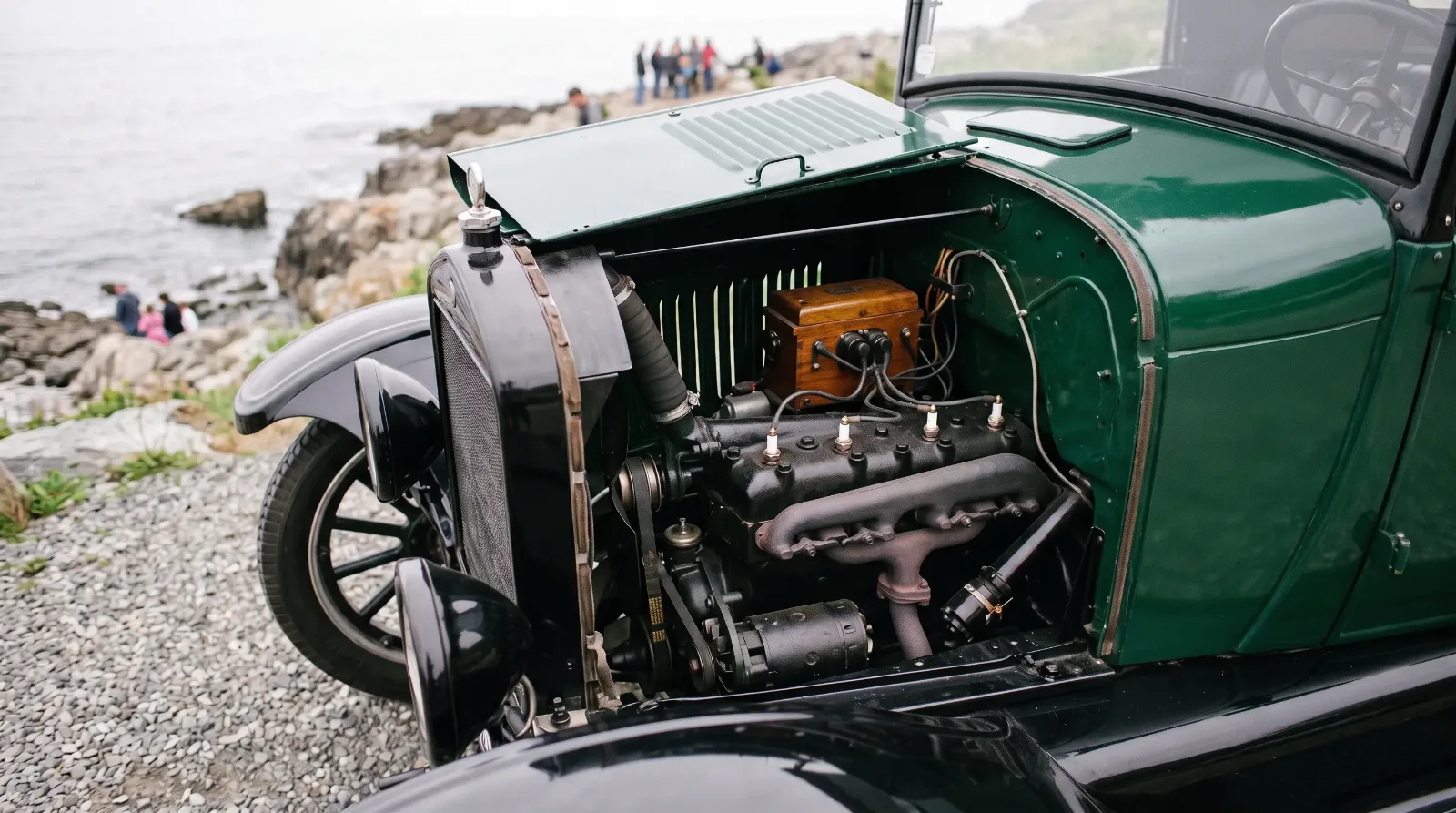
That made the car easier to learn and harder to break, two things that mattered more to Ford's buyers than smoothness or a third forward gear. It also kept the gearbox compact enough to sit inside the engine's own housing. The transmission shared the engine's oil, splashed around by the flywheel, with no separate pump and no separate sump. If you are curious how that fits with the rest of the design, the overview of the Model T and Model A engines covers the lubrication side.
Inside the Model T planetary transmission
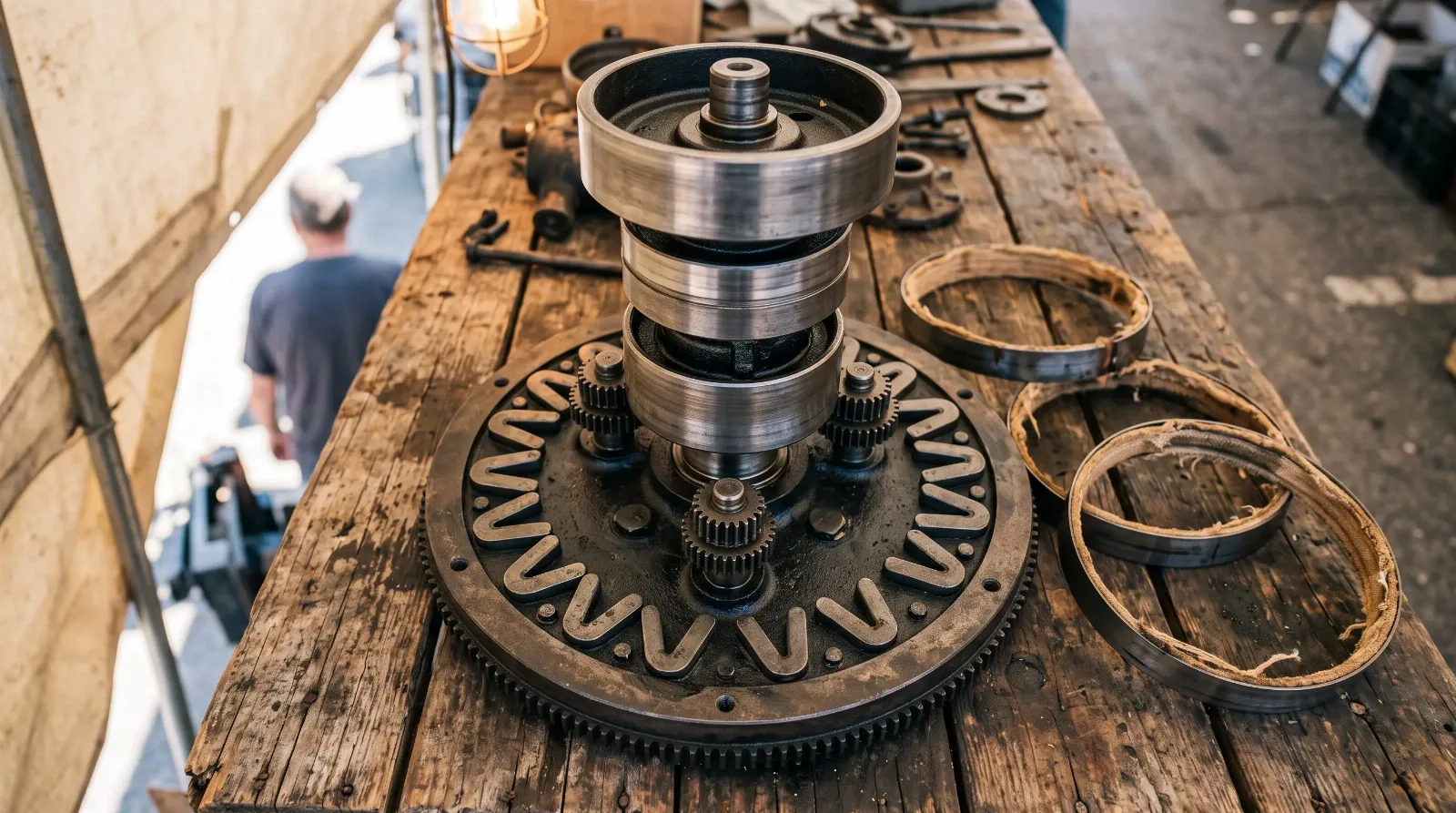
Start with the flywheel, bolted to the back of the crankshaft. Mounted on it are three sets of triple gears: three planetary clusters, each with three sets of teeth cut on one piece. As the engine turns, these clusters ride around with the flywheel like planets around a sun, which is where the name comes from.
Each set of teeth on a triple gear meshes with a different central gear. One central gear connects to the output, the shaft that ultimately drives the rear wheels. The other two are attached to drums: one for low speed and one for reverse. A third drum sits on the output side and is the brake drum. Around each drum is a band, a steel strap lined with friction material, and each band is tightened by one pedal.
The key principle is simple. In a planetary set, if you hold one member still, the others are forced to turn at a fixed ratio to each other. Release everything and the set spins freely without passing power. Lock everything together and it turns as one solid unit. The Model T's four driving states are just those options, chosen by a band or a clutch.
| Control | What it does inside | Result |
|---|---|---|
| Left pedal pressed fully | Low band stops the low-speed drum | Low gear |
| Left pedal halfway | Clutch released, no band applied | Neutral |
| Left pedal released, lever forward | Multi-disc clutch locks the gear set together | High gear, direct drive |
| Center pedal | Reverse band stops the reverse drum | Reverse |
| Right pedal | Brake band stops the output drum | Braking through the driveline |
Low, high and reverse, one at a time
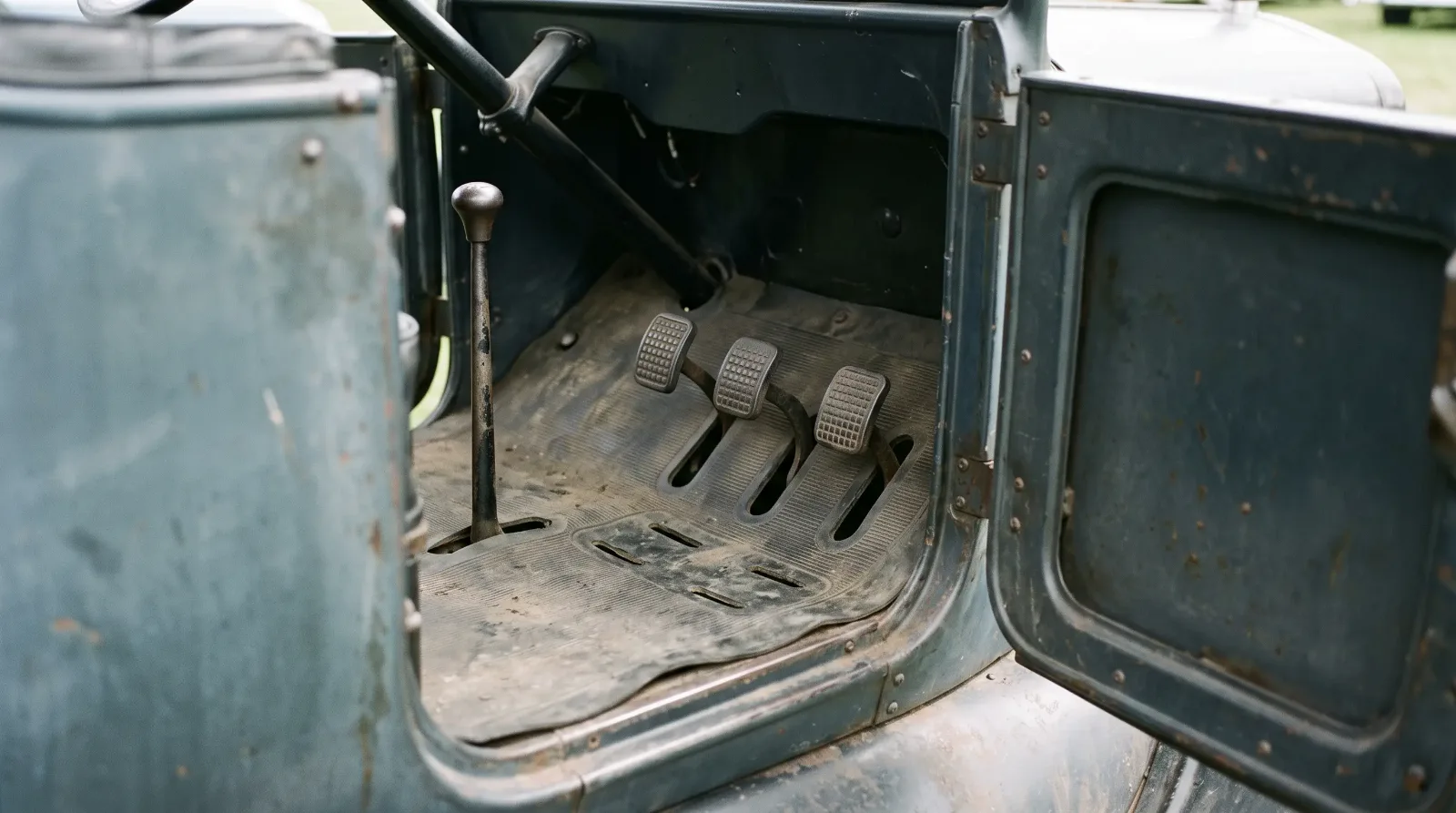
Low. Press the left pedal to the floor and the low band clamps the low-speed drum. With that drum held still, the triple gears are forced to walk around it, and they turn the output gear more slowly than the engine. That gear reduction is low. With 21 teeth on the low-speed gear and 33 on the triple gear that meshes with it, the arithmetic gives 2.75:1 in the transmission, or about 10:1 at the rear wheels through the standard 40:11 axle.
High. Let the left pedal all the way up, with the hand lever forward, and a spring-loaded wet multi-disc clutch of 25 thin plates engages. It locks the gear set so it can no longer turn relative to itself. Engine and output now spin together at one to one. No band is doing any work in high, which is why a well-adjusted T in high gear is quiet and efficient.
Neutral. Hold the left pedal halfway and the clutch is released but the low band is not yet applied. Nothing is held, so the planetary set freewheels and no power reaches the wheels. Pulling the hand lever fully back also holds the clutch out and sets the rear-wheel brakes, which is how you park.
Reverse. Press the center pedal and the reverse band stops the reverse drum. The triple gears now drive the output backward. Reverse works out to 4:1, lower than low, which is one explanation offered for why drivers sometimes backed up steep hills, though it is not the only one.
"People call the Model T crude. The gearbox is not crude. It is a planetary set with the controls bolted straight to the physics. You press a pedal, a drum stops, the ratio changes. There is no linkage left to misunderstand."
Emily Chen
The right pedal: a brake inside the gearbox
The Model T had no service brakes on its wheels in the modern sense. The right pedal tightened a band around a drum in the transmission, and since that drum was tied to the output, stopping it slowed the driveshaft and with it the rear wheels. The hand lever worked separate brakes on the rear drums for parking and emergencies.
This is clever packaging and a real limitation. Every stop put load through the same band system that handled low and reverse, and the bands all wore. Band adjustment became a routine chore for owners. It is the part of the design that later drivers and engineers criticize most, and with reason.
What the design gave up, and why it lasted
Two forward speeds is not many. On the flat, high gear did nearly everything, and low was for starting off and climbing. Owners who wanted more bought aftermarket gearing: the Ruckstell two-speed rear axle, common on Model TT trucks and also sold for cars, or auxiliary gearboxes such as the Jumbo, built from 1923, which added in-between ratios. The planetary design itself never changed in kind through 19 years of production.
When Ford finally replaced the T, the Model A of 1928 got a three-speed unsynchronized sliding-gear transmission with a conventional clutch, and the pedal layout most drivers know today. Edsel Ford is credited with persuading his father to accept the change. By then the planetary box had done its job: it let millions of first-time drivers move a car without grinding a single gear. If you want to feel how it all comes together on the road, the guide to driving one picks up where this leaves off, and the wider arc of Henry Ford's Model T story explains why simplicity won out for so long.
Sources and notes
- SAHB Technical Talk 14: The Ford Model T (gear teeth, 2.75:1 low, 4:1 reverse, 25-disc clutch)
- Model T Central: Model T Ford transmission (triple gears, drums and bands)
- Model T Central: period accessories (Jumbo auxiliary transmission)
- Wikipedia: Ford Model T (transmission, pedals, first 800 cars)
- SlashGear: What kind of transmission did the Ford Model T have?
Related Reading
Have a
Ford Model T
for Sale?
Reach thousands of serious classic car collectors across the US.
Sell It Here →
Selling a classic? Here's how: sell my classic car
Are You a Classic Car Dealer?
List your full inventory and connect with targeted classic car buyers.
Join as a Dealer →
#ford model t
#planetary transmission
#Model T pedals
#transmission bands
#Model T mechanics
#vintage car engineering

About the author
Emily Chen
Bay Area engineer with a deep focus on vintage Japanese and European performance cars. Approaches classic car research and restoration with an analytical eye.
Related Listings - Ford Model T
Comments
Be the first to comment on this article.