
Open the hood of almost any Model T and look for the water pump. You will not find one. The Model T cooling system moved its water with no moving parts at all, relying on the plain fact that hot water is lighter than cold water. It is called thermosiphon cooling, and Ford used it on every Model T built after the spring of 1909. The short version of why: it worked well enough, it cost nothing to run, and there was nothing in it to wear out.
Car Features
7 min read
Thermosiphon Cooling: Why Most Model Ts Had No Water Pump
How the Model T cooling system moved water with no pump, why the first 2,447 cars had one, and why the Model A brought the pump back.
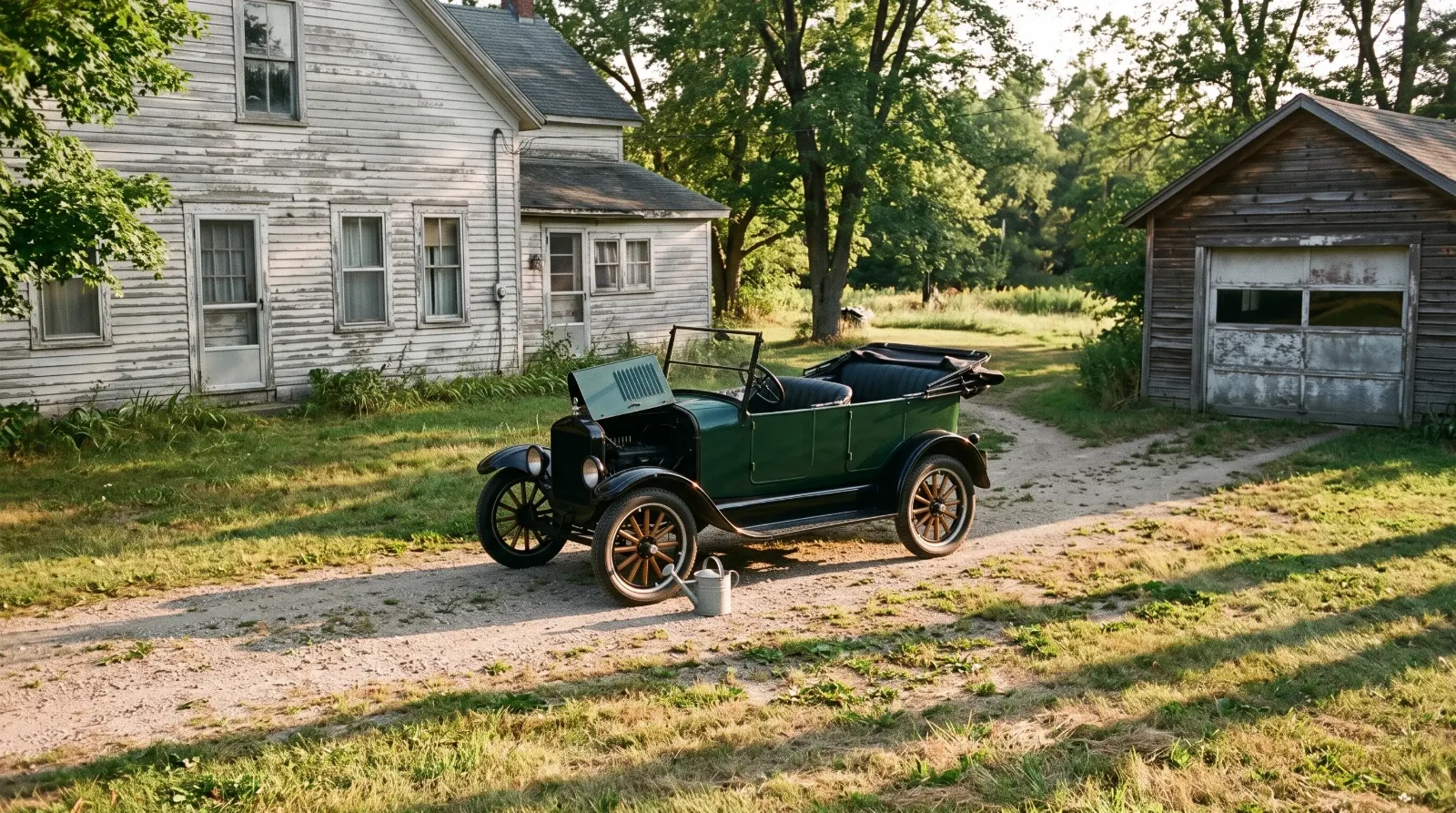
The longer version is more interesting, because a pumpless system has rules a pumped one can ignore. Those rules shaped how the car was built and how owners still look after it. This piece sits inside the larger Model T engine story; here we stay with the water.
How the Model T cooling system moves water without a pump
Start with the principle. Water expands slightly as it heats, so a given volume of hot water weighs less than the same volume of cold water. In a closed loop with a heat source low down and a cooler higher up, that difference in density is enough to set the water circulating on its own.
On the Model T, the heat source is the engine's water jacket, wrapped around the cylinders. The cooler is the radiator, mounted in front and set high. As the water in the jacket heats, it rises through the upper hose into the top tank of the radiator. Air flowing through the core takes heat out of it. The cooled water, now denser, sinks to the bottom of the radiator and returns through the lower hose to the bottom of the engine, where the cycle starts again.
Ford's own 1919 instruction book describes it in just those terms: no water pump, hot water rising to the radiator, cooled water sinking back. The same manual notes that circulation begins at around 180 degrees Fahrenheit. Below that, the water mostly sits and warms. Once the engine is hot enough, the loop runs on its own for as long as the engine produces heat.
That last point is the elegant part. A pump moves water at a rate set by engine speed, whether the engine needs it or not. A thermosiphon moves water at a rate set by heat. Climbing a long grade at low speed, where a pump would be turning slowly, the thermosiphon is actually working harder, because the engine is producing more heat. The system matches its effort to the load without any control at all.
The first 2,447 cars that did have a pump
The title says "most" Model Ts for a reason. The earliest cars were built with a water pump. According to the most specific figure available, the first 2,447 engines used one, and thermosiphon cooling began with engine number 2,448, built on April 22, 1909. Old Cars Weekly notes that the old and new designs overlapped briefly, so a few cars built before about number 2,500 may not follow the rule exactly.
Another reference says only "the first few hundred" cars had pumps. The more precise count is the better-supported one, but neither rests on a factory production record that has been published, so I treat 2,447 as the best figure rather than a certainty.
| Engine | How water moves | Capacity | Years |
|---|---|---|---|
| Earliest Model T | Water pump | Not recorded | 1908 to April 1909, about 2,447 engines |
| Model T, later | Thermosiphon, no pump | About 3 gallons | From engine 2,448 (April 1909) to 1927 |
| Model A | Centrifugal pump on the cylinder head, unpressurized | About 3 gallons | 1928 to 1931 |
Why drop a pump that already worked? The record does not give Ford's reasoning in writing, so any answer is an engineering inference. The obvious ones are cost and simplicity. A pump is a part to machine, a shaft to seal and a bearing to wear. Removing it took cost and a failure point out of a car built in the millions.
What thermosiphon cooling asks of the owner
A pump can push water around a system that is a little low or a little restricted. A thermosiphon cannot. Its driving force is small, so anything that interrupts the loop stops circulation, and the engine heats quickly once that happens.
The capacity is about 3 gallons, according to the 1919 manual. A 1923 dealer data book quoted in owner forums gives 2 gallons and 7.5 pints, which is essentially the same number. Whatever the exact figure, the level matters more than the total. If the water drops below the point where the upper hose enters the radiator, the hot water rising from the engine has nowhere to go, and circulation simply stops.
The pumpless system also interacts with how the car was driven. On a steep grade, the engine works hard at low road speed, and there is less air moving through the radiator. Drivers learned a number of tricks for steep hills, including backing up hills, though that habit was mostly about fuel feed and gearing rather than cooling.
"People call thermosiphon primitive. I'd call it honest. It does exactly what the physics allows and nothing more, so when it fails, it fails for a reason you can find with your eyes and a flashlight."
Emily Chen
Why the Model A brought the pump back
When Ford replaced the Model T with the 1928 Model A, the new engine got a centrifugal water pump mounted on the cylinder head. The system held about 3 gallons, like the Model T's, and it was still unpressurized. In layout it kept the thermosiphon arrangement of a high radiator and a natural rising flow; the pump was added to it rather than replacing it.
The reason is in the numbers. The Model T's 177 cubic inch four was rated at 20 horsepower. The Model A's 200.5 cubic inch four made 40 horsepower at 2,200 rpm. Twice the power means roughly twice the heat to reject through a system of about the same size. A pump guarantees a minimum flow at speed, which a pure thermosiphon cannot, and the Model A was a more powerful car meant to be driven harder.
Seen from that angle, thermosiphon cooling was not an oversight in the Model T. It was a good match for a low-output engine that rarely ran fast for long. When the engine outgrew it, Ford added the pump back. Engineers would call that sizing the system to the load. Model T owners would call it one less thing to fix on the side of the road.
Sources and notes
- Ford Manual for Owners and Operators of Ford Cars and Trucks (1919), Project Gutenberg
- Old Cars Weekly: Car of the Week, 1909 Ford Model T
- Wikipedia: Ford Model T
- Wikipedia: Ford Model A engine
- Model A Ford Club of Great Britain: specifications
- Mac's Motor City Garage: the Ford Model A engine, 1928 to 1931
Related Reading

Have a
Ford Model T
for Sale?
Reach thousands of serious classic car collectors across the US.
Sell It Here →
Selling a classic? Here's how: compare the places to sell classic cars
Are You a Classic Car Dealer?
List your full inventory and connect with targeted classic car buyers.
Join as a Dealer →

About the author
Emily Chen
Bay Area engineer with a deep focus on vintage Japanese and European performance cars. Approaches classic car research and restoration with an analytical eye.
Related Listings - Ford Model T
More in Car Features



Comments
Be the first to comment on this article.