
The Model T center door sedan is the oddest silhouette in the Ford catalog of the 1910s: a tall, upright box with one door on each side, set squarely in the middle of the body rather than at the front or the rear. Ford built it from the 1915 model year until the summer of 1923, and for most of those years it was the only true sedan a Ford buyer could order. It was also, at its introduction, the most expensive Model T on the price list.
Car Features
6 min read
The Model T Center Door Sedan
Ford's first true Model T sedan, built 1915 to 1923: its price, its 1915 build figure, the aluminum question and how the Tudor replaced it.
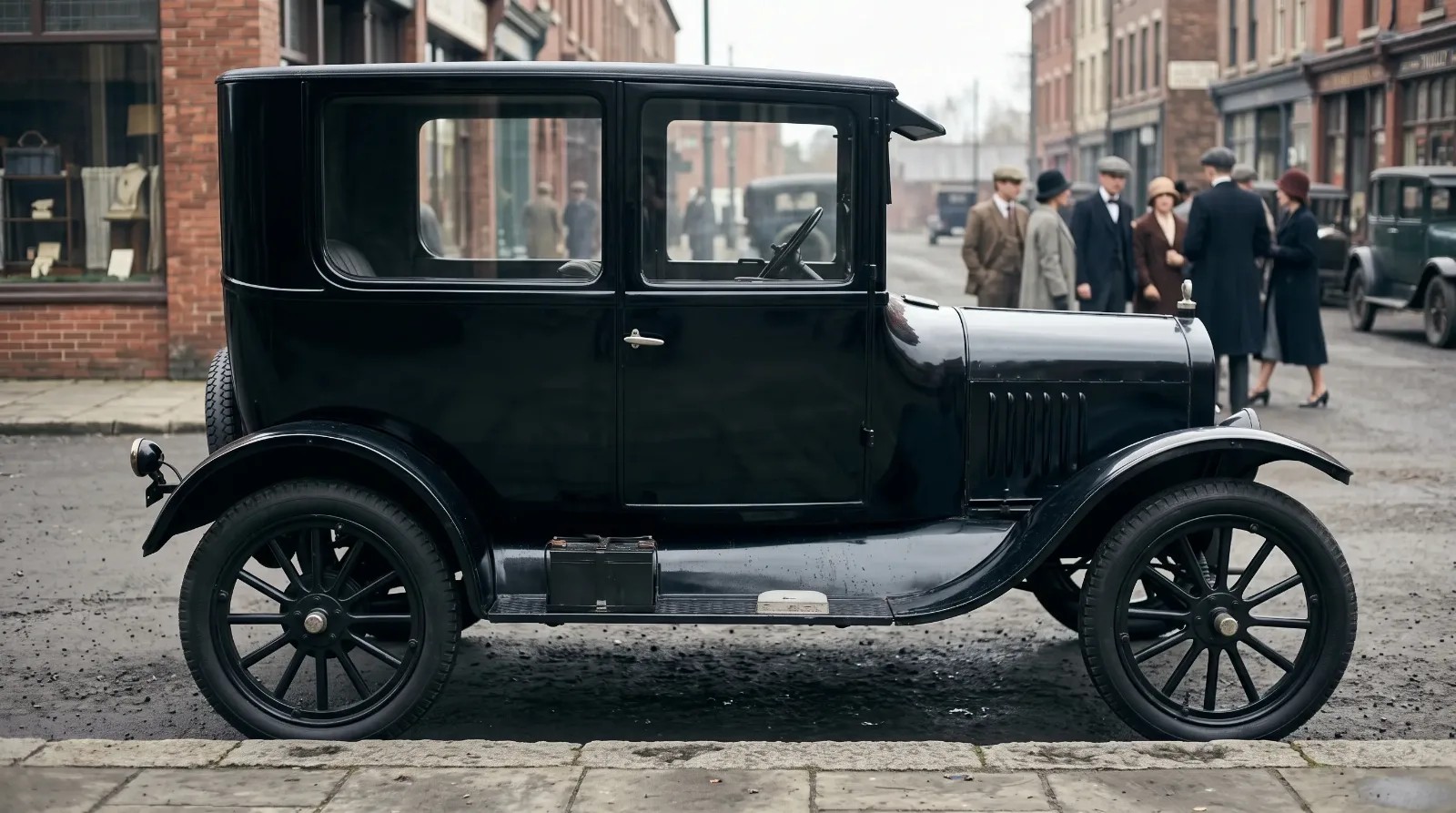
This article looks at that one body: when it was offered, what it cost, how its construction is documented and where the record goes quiet. The Model A bodies that followed it are covered here, and the closed Model T bodies that came after it, the Tudor and Fordor, belong to a different chapter.
What the Model T center door sedan was
The name describes the car exactly. A single door on each side opened at the middle of the body, between the front and rear seats. One opening served both rows. The body was fully enclosed, with glass all round and a fixed roof, at a time when nearly every Ford on the road was an open car with a folding top.
That last point matters for anyone reading the car as an artifact. The open touring car and the runabout were the Model T's bread and butter, and the difference between those two is a story of seats and doors on its own (see touring vs runabout). Touring and runabout bodies made up the bulk of Model T sales by far, and closed cars caught on only later. The center-door sedan was a minority body from first to last.
| Model T closed or semi-closed body | Years offered (US) |
|---|---|
| Town Car | 1909 to 1918 |
| Coupe | 1909 to 1912, then 1917 to 1927 |
| Coupelet (folding top) | 1915 to 1917 |
| Center-door sedan | 1915 to 1923 |
| Fordor sedan | 1923 to 1927 |
| Tudor sedan | 1924 to 1927 |
Years, prices and the 1915 car
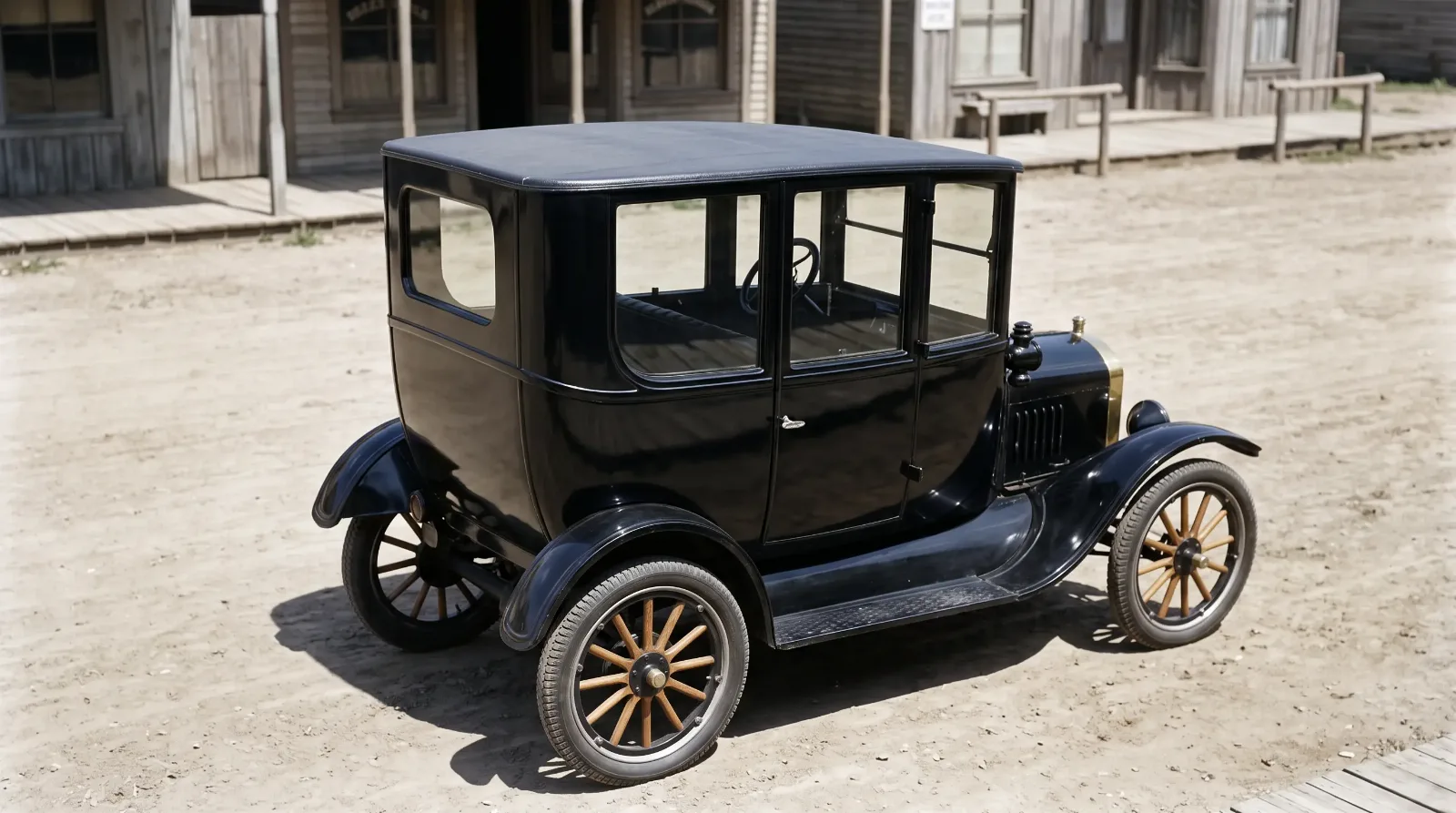
Ford introduced the sedan in September 1914 as a 1915 model. That first year it sat at the very top of the range. In 1915 the five Model T body styles ran from $440 to $975, and the $975 belonged to the sedan. The Model T Ford Club of America credits Ford with building 989 of them that year. Set beside 244,181 touring cars and 47,116 runabouts in the same season, that is a rounding error, and it explains why a 1915 sedan is a rare sight today.
The sedan's price came down as the whole line got cheaper. By 1919 it listed at $875. That was also the model year when the electric starter arrived, first on the sedans, along with demountable rims. Sources disagree on whether those items were standard on the 1919 sedan or extra cost, so the safe reading is that the sedan was among the first Fords to offer them. By 1923, starters were standard on the closed cars and $65 extra on the open ones.
Coachwork and the question of the doors
Two construction details come up whenever a center-door sedan crosses an auction block, and neither is well documented. The first is body material. Model T reference pages describe the 1915 sedan as having aluminum body panels and say the 1916 sedan was redesigned with steel ones, while forum posts put the switch in mid 1915. Neither account has been traced to a Ford record, so the date of the change is not established. For a related Ford closed body, the Fordor, the lower panels are recorded as changing from aluminum to steel in the June 1923 restyling, which shows that Ford did use aluminum on sedan panels in this period. It does not prove the date for the center-door car.
The second detail is the doors themselves. Why put them in the middle? The usual answer is easier entry to both seats from a single opening, but that claim comes only from auction copy and has not been traced to a Ford source. It is a sensible explanation. It is not yet a documented one.
"With a car this scarce, the temptation is to fill every gap with a confident sentence. Better to say plainly what is known: the years, the price, the 1915 build figure. The rest should stay a question until a Ford record answers it."
Sarah Whitfield
Paint, by contrast, is simple. The center-door sedan's entire run, 1915 to 1923, falls inside the period of about 1914 to 1925 when the Model T was offered only in black. Over 30 types of black paint were used on different parts of the car, so "black" on a correct restoration means several finishes, not one. Color returned to the closed Fords only for 1926 and 1927, long after the center-door body was gone.
Replaced by the Tudor and the Fordor
The end came in two steps. For the 1923 model year Ford added a four-door sedan, the Fordor, and 1923 became the only year a buyer could choose between the center-door car and a four-door Ford sedan. Then, in August 1923, the Tudor sedan replaced the center-door sedan outright, with its doors moved to the front of the body. Ford called the Tudor a 1924 model.
The 1923 price list shows where the market was heading. The Coupe listed at $530, the Tudor at $595 and the Fordor at $725, while the runabout cost $269. A closed car still cost about twice as much as an open one, but buyers were starting to pay it, and the company now had three closed bodies instead of one.
The center-door sedan had been the experiment that proved a closed Ford could sell. The Tudor took its two-door layout and made the entry conventional; the Fordor gave rear passengers their own doors. Both names carried straight into the Model A in 1928.
Reading a center door sedan today
For a researcher, the car poses familiar questions with fewer answers than usual. Start with the paperwork and the engine number, which can date the chassis. Then look at the body itself: panel material, door hardware, glass and upholstery, and whether they agree with each other and with the year claimed. A center-door body on an early chassis is the combination that will draw the most scrutiny, given how few 1915 cars were built.
Ford also sold a bare chassis in every year of the Model T for outside coachbuilders, so not every enclosed Model T body came from Ford. The body maker question is just as live on the next generation of Fords, where the records are better, and the Briggs and Murray story of the Model A is worth reading next.
The center-door sedan rewards patience. Its numbers are small, its documentation thin, and its shape unlike anything Ford built before or after.
Sources and notes
- Ingenium (Canada Science and Technology Museum): Ford Model T center door sedan
- RM Sotheby's: 1915 Ford Model T Coupelet (1915 model line history)
- The Arsenale: 1915 Ford Model T (1915 prices and production)
- Mac's Motor City Garage: 1923, the Model T Ford's biggest year
- The Henry Ford: 1919 Ford Model T sedan
- Wikipedia: Ford Model T
Related Reading

Have a
Ford Model T
for Sale?
Reach thousands of serious classic car collectors across the US.
Sell It Here →
Selling a classic? Here's how: the best sites to sell a classic car
Are You a Classic Car Dealer?
List your full inventory and connect with targeted classic car buyers.
Join as a Dealer →

About the author
Sarah Whitfield
Third-generation classic car collector specializing in pre-war American and European coachbuilt automobiles. Researcher and concours enthusiast.
Related Listings - Ford Model T


Comments
Be the first to comment on this article.