
Before social media, a magazine cover was the highest honor a lowrider build could earn. Getting a Monte Carlo onto the cover of a publication like Lowrider Magazine meant a car had been judged against every other submission that month and won, not just among Monte Carlos but among every make and body style builders were sending in. We still hear builders talk about a cover shoot decades later the way other people talk about a championship, because in a real sense, that is exactly what it was.
Car Features
7 min read
The Monte Carlos That Made the Magazine Covers
What it took for a Monte Carlo lowrider to land a magazine cover, and why documented feature history still shapes collector value today.
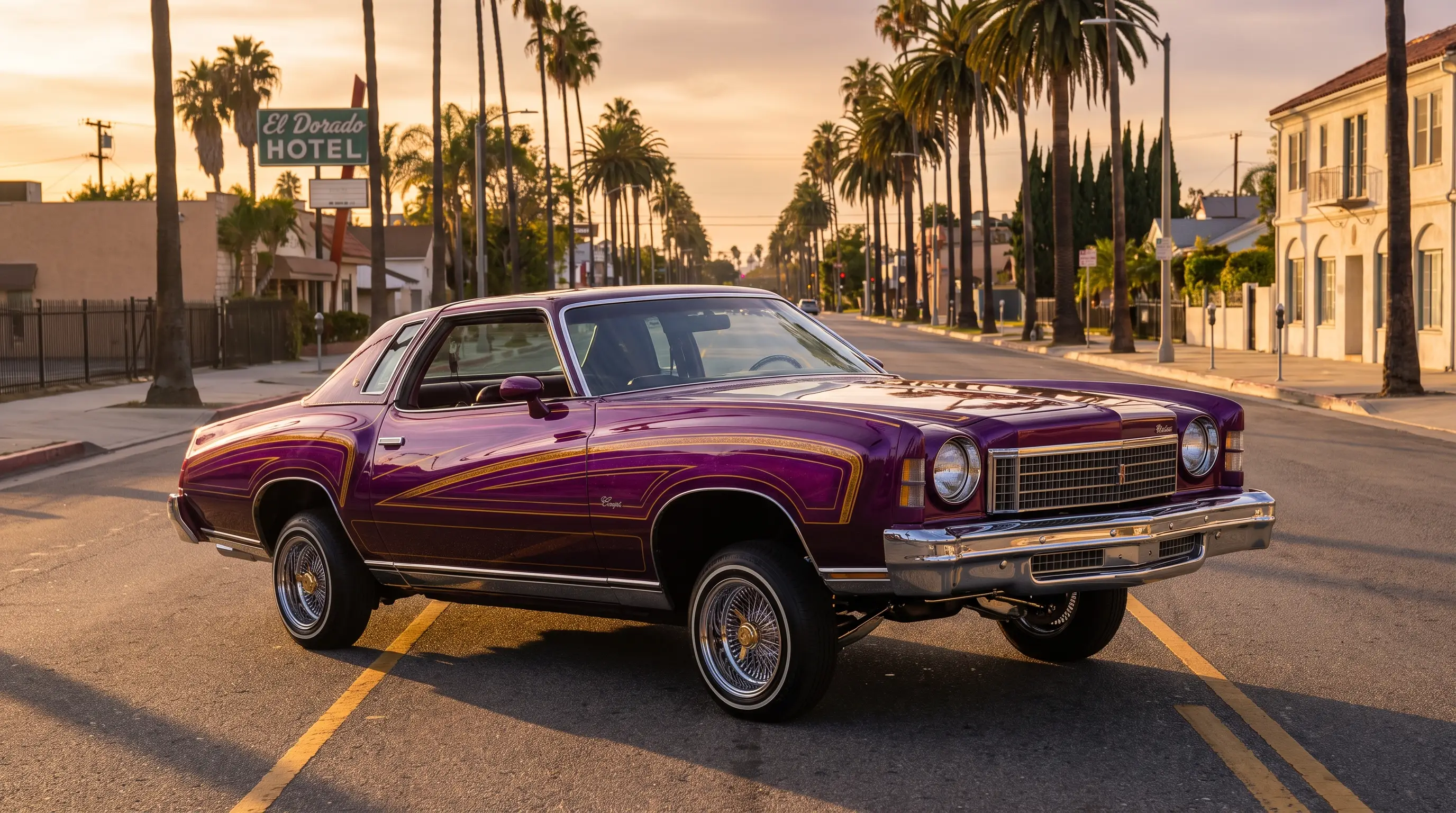
What it actually took to get there
A cover-worthy Monte Carlo needed more than good paint. Magazine editors and photographers looked for a complete package, a car that photographed well from every angle, that told a visual story through color and pattern choices, and that represented genuine originality rather than repeating a look readers had already seen a dozen times that year. Builders who landed a cover often describe months of additional refinement after their car was already show-ready, chasing details that would only matter under a photographer's studio lighting or a carefully composed outdoor shoot.
Interior work mattered just as much as the exterior for a cover shoot, since editors typically wanted at least one interior shot showing off tuck-and-roll upholstery, custom dashboard work, or a hydraulic trunk display. A Monte Carlo with a stunning paint job but a mediocre or unfinished interior rarely made the final cut, no matter how good the exterior photography turned out.
"A cover is not really about the one photo everybody sees. It is about proving your car holds up under every angle a photographer can find."
- Hector Morales
The role of the builder's reputation
Magazine editors did not discover most cover cars cold. They worked relationships with established car clubs and respected builders who had a track record of producing show-quality work, which meant a builder's reputation, built over years of consistent output, often opened the door to consideration in the first place. That is not to say new or unknown builders never broke through. Some of the most memorable Monte Carlo cover features are described by builders as first-time submissions that simply could not be ignored once editors saw the photos, suggesting the door was never fully closed to newcomers who did exceptional work.
Still, the relationship between the magazine industry and established clubs created a kind of informal pipeline, where clubs with strong reputations got their members' cars considered more readily, and a rising builder often benefited from mentorship by someone who already had cover experience, learning what editors responded to before ever submitting their own work.
How cover status changed a car's value
A documented magazine feature does something permanent to a Monte Carlo's history. Even decades later, a car that can be traced back to a specific cover or feature spread carries a kind of provenance that raw craftsmanship alone cannot replicate, because it represents third-party validation from the era's most respected editorial gatekeepers rather than just the owner's own claims about the car's significance. Serious collectors specifically hunt for cars with this kind of documented history, sometimes tracking down old magazine issues to confirm a seller's claims before committing to a purchase.
What owners did after the feature ran
Landing a cover or feature spread changed an owner's relationship to their own car in ways that went beyond simple pride. Some owners chose to essentially freeze their Monte Carlo in the exact state it appeared in the magazine, treating any further modification as a betrayal of the moment that had already been documented and celebrated. Others saw the feature as validation to keep pushing further, using the credibility of a magazine appearance to justify an even more ambitious next phase of work, sometimes returning for a follow-up feature years later showing how far the car had evolved since its first appearance.
Either path came with its own risks. A frozen-in-time show car could feel dated within a few years as trends shifted, while a car pushed into constant evolution risked losing the specific combination of elements that made the original feature-worthy version so memorable in the first place. There was no universally correct choice, and builders who lived through this decision point often describe it as one of the harder calls in their whole career in the culture.
Why so few Monte Carlos got there
Competition for magazine cover space was fierce across every make and model in the culture, and the Monte Carlo, despite its popularity, was competing against Impalas, Cadillacs, Regals, and Cutlasses all vying for the same limited number of cover slots each year. A Monte Carlo that broke through had to distinguish itself not just from other Monte Carlos but from an entire field of exceptional builds across the whole platform spectrum, which is part of why the cars that succeeded still get discussed with real reverence among people who followed the magazines closely during that era.
Understanding the whole picture of how the Monte Carlo fit into that broader competitive landscape helps explain why cover status means something specific and earned, not just a lucky submission that happened to land at the right moment.
Behind the scenes of an actual shoot
A magazine cover shoot itself was a production in its own right, often requiring the featured Monte Carlo to be transported, sometimes across state lines, to a location the photography team felt suited the car's theme, whether that meant a dramatic desert backdrop, an urban setting that matched a mural's imagery, or a controlled studio environment for the most technically demanding shots. Owners frequently took time off work, coordinated with their car club for help with transport and touch-up detailing on site, and treated the entire day with a seriousness that matched the honor of being selected in the first place.
Photographers working these shoots developed their own specialized techniques for lowrider vehicles specifically, understanding how to light chrome without harsh glare, how to time a hydraulic hop for the exact right moment of suspension in the air, and how to compose a shot that let a mural's detail read clearly even in a small printed reproduction. That specialized skill set meant certain photographers became almost as closely associated with the culture's visual identity as the builders themselves, their work instantly recognizable to longtime readers even without a byline.
Chasing that same standard today
The magazine landscape has changed considerably since the peak years of print lowrider publications, with social media now serving much of the function covers once did, spreading a standout build's reputation instantly to a much wider audience than any print run could reach. But the underlying standard those old covers set, complete execution across paint, interior, hydraulics, and presentation, still defines what serious builders aim for today. If that history inspires you to start your own project, you can find a classic Monte Carlo and begin working toward whatever standard matters most to you, whether that is a magazine-caliber show build or simply a clean, honest driver with its own story to tell.
Sources and notes
- Chevrolet Monte Carlo, Wikipedia
- The History of Lowrider Cars, Gauge Magazine
- Amigos Car Club Collection, University of San Diego Lowrider Archival Project
- Carros y Cultura: Lowriding Legacies in Texas, Texas Standard / Bullock Texas State History Museum
- 1972 Monte Carlo Becomes a Nationwide Lowrider Showstopper, Motorious via Yahoo Autos
Related Reading
Have a
Chevrolet Monte Carlo
for Sale?
Reach thousands of serious classic car collectors across the US.
Sell It Here →
Selling a classic? Here's how: compare the places to sell classic cars
Are You a Classic Car Dealer?
List your full inventory and connect with targeted classic car buyers.
Join as a Dealer →

About the author
Hector Morales
East LA lowrider builder and lifelong member of the car-club scene, writing lowrider culture, hydraulics and custom paint from the inside.
Interior shot always made or broke it. Respect to the builders.
Sergio, you are right about the interior. When my Mustang was photographed for our club calendar, the photographer spent twice as long inside the car and had me redo a door panel I thought was fine. He was right, of course. Linda K.