
I get asked the monte carlo ss vs chevelle ss identity question a lot in the shop, usually from someone who just found out both cars could carry the same 454 in 1970 and wants to know which one is the "real" muscle car. Short answer: neither one is faking it, they just were not built for the same guy. Long answer takes the rest of this article.
Car Features
7 min read
Monte Carlo SS vs Chevelle SS - Two Very Different Super Sports
Both cars could carry the same 360-horsepower LS5 454 in 1970, but the monte carlo ss vs chevelle ss identity question comes down to intent, ride, and who each car was built for.
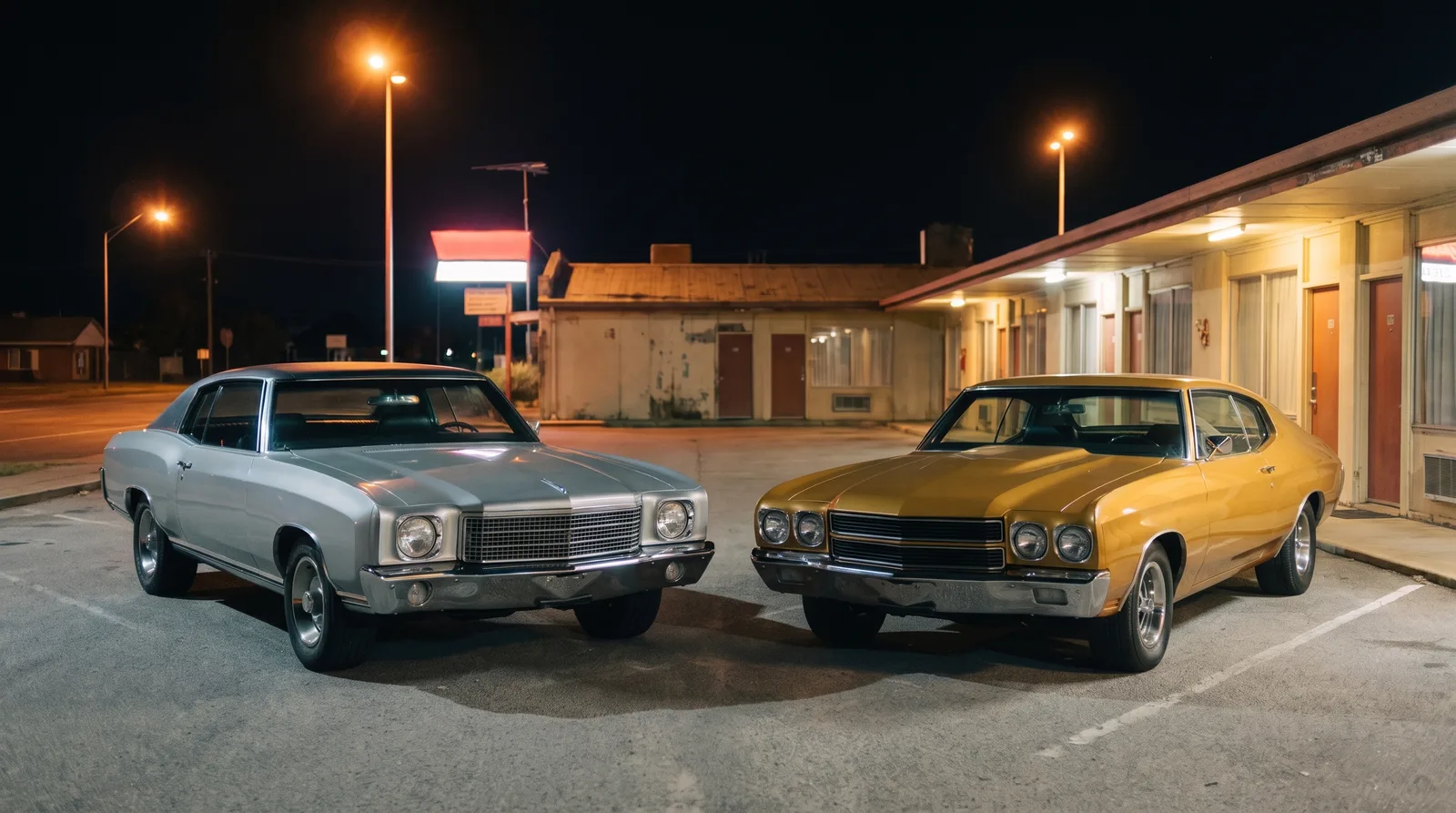
Same engine, different intent
Chevrolet dropped the LS5 454 into both the Chevelle SS and the Monte Carlo SS for 1970, rated at 360 horsepower and 500 lb-ft, so on paper you could argue they are the same car wearing different sheet metal. That is where a lot of people stop thinking and get it wrong. The Chevelle was built as a mid-size muscle car from the ground up, stiffer springs, a more aggressive stance, and a target buyer who wanted to know his quarter mile time. The Monte Carlo started life as a personal luxury coupe and had the big block grafted onto that foundation, not the other way around.
You feel the difference the second you drive both back to back. The Chevelle SS is tauter, more willing to be thrown into a corner, less forgiving over broken pavement. The Monte Carlo SS454 rides softer, isolates more road noise, and generally behaves like the luxury car it started as, right up until you put your foot into it and remember there is a 454 under that formal hood.
Styling tells you everything about who each car was for
Look at the two side by side and the intent is obvious before you ever pop a hood. The Chevelle has hard creases, a long hood-short deck proportion, and a stance that reads aggressive from thirty feet away. The Monte Carlo has a formal roofline, a longer wheelbase relative to its overall size, and softer detailing everywhere, chrome trim, a padded vinyl top option, an interior clearly designed around comfort rather than a business-like cockpit feel.
Neither approach is wrong. The Chevelle was chasing the same buyer as the Road Runner and the GTO. The Monte Carlo was chasing the same buyer as the Grand Prix and the Thunderbird, just with the option to make that buyer's coupe genuinely quick if he checked the right box. That is a fundamentally different sales pitch even with an identical engine sitting between the fenders.
Which one holds up better as a daily driver today
Here is where I will give you an actual opinion instead of hedging. If you want something to drive regularly, the Monte Carlo SS454 is the easier car to live with. The ride quality is better, the interior is quieter, and the whole car was engineered around comfort first, so thirty-plus years of aging components have not turned it into a punishing experience the way a stiffly sprung muscle car can become. The Chevelle rewards you more on a back road, but it asks more of you too, and that math changes depending on what you actually want out of ownership.
Neither car is the wrong answer if you are chasing performance history and collector value. But if someone tells you the Chevelle is automatically the more legitimate muscle car because it looks the part, remind them the Monte Carlo was carrying the exact same 500 lb-ft of torque with a softer touch. Legitimacy is not just about styling aggression, it is about what is actually happening at the crank.
"People walk into the shop wanting me to tell them the Chevelle is the real one. I tell them the Monte Carlo has the same torque figure and rides better on a bad road. Both things are true at the same time."
- Mike Sullivan
What this means for buyers weighing the two today
If you are cross-shopping these two, decide first what kind of ownership experience you actually want, then let the badge follow that decision instead of the other way around. Someone chasing maximum quarter mile bragging rights and a firmer, more communicative chassis should lean Chevelle. Someone who wants big block torque without giving up ride comfort, and who values a rarer sleeper reputation, has good reason to lean Monte Carlo. You can read the background on how the Monte Carlo SS badge developed across its full history if you want the complete picture before deciding, and if you are curious how Chevrolet later blended luxury and muscle even further, worth a look too covers that angle directly.
Either way, verify the drivetrain before you buy either car. Cloned SS badges exist on both platforms, and a small block Monte Carlo or Chevelle dressed up with SS trim is a completely different purchase than a documented 454 car, no matter how good the paint looks. When you are ready to compare real inventory instead of theory, shop classic Monte Carlo listings and check the build sheet against every SS claim you see.
Parts, shop time, and what ownership actually costs
From a wrench-turning standpoint, both cars share enough GM corporate parts that maintenance is not the deciding factor most people assume it is. Suspension bushings, brake components, and plenty of driveline hardware overlap between the A-body Chevelle and the Monte Carlo's shared platform, so a competent shop can service either one without hunting down obscure parts. Where they diverge is trim and interior pieces. The Monte Carlo's more upscale cabin, with extra brightwork, unique door panels, and that padded vinyl roof option, means trim replacement parts run scarcer and pricier than the more mass-produced Chevelle interior pieces.
Body panels tell a similar story. Chevelle sheet metal has been reproduced extensively for decades because the aftermarket demand for that model has always run hotter. Monte Carlo owners searching for a full quarter panel or a correct grille often have a thinner reproduction market to work with, which pushes some restorations toward good used parts instead of new stampings. None of that makes the Monte Carlo harder to own day to day, it just changes what a full restoration budget looks like if you are starting from a rougher car.
On resale, the Chevelle SS454 generally commands a stronger premium than the equivalent Monte Carlo, purely because more buyers are chasing that specific badge. That price gap is exactly why some shrewd buyers target the Monte Carlo instead. You get the same drivetrain, arguably a more comfortable ownership experience, and a lower entry price, at the cost of a smaller resale ceiling if you ever decide to sell.
My honest take after years of having both on the lift: buy whichever one matches how you actually want to spend your weekends. If you want to chase corners and bragging rights, get the Chevelle and accept the higher price of entry. If you want a big block that rides like a couch and turns fewer heads until you plant the throttle, the Monte Carlo will not disappoint you, and your wallet will thank you at purchase time even if it does not thank you quite as much when you sell.
Sources and notes
- Curbside Classic: 1970 Monte Carlo SS454 period road test
- MotoGallery: 1970-1972 Chevelle SS 454 specs and history
- ClassicCars.com Journal: LS5 engine code history
- Hagerty: 1970-72 Chevy Monte Carlo buyer's guide
- Wikipedia: Chevrolet Monte Carlo
- First Generation Monte Carlo Club: SS454 resource page
Related Reading
Have a
Chevrolet Monte Carlo
for Sale?
Reach thousands of serious classic car collectors across the US.
Sell It Here →
Are You a Classic Car Dealer?
List your full inventory and connect with targeted classic car buyers.
Join as a Dealer →

About the author
Mike Sullivan
Detroit-area muscle car enthusiast and restoration specialist with three decades of hands-on experience working on American iron.
Related Listings - Chevrolet Monte Carlo
Comments
Be the first to comment on this article.