
An appraiser eventually stops thinking about muscle cars as an engineering story and starts thinking about them as an actuarial one, because that's really what killed the segment. Not the government, not directly anyway, and not a sudden loss of buyer enthusiasm. It was a rating table sitting on an insurance underwriter's desk, and by the early 1970s that table had the early-70s GTO priced almost out of reach for the exact buyer it was built for.
Car Features
7 min read
How Insurance Surcharges Started Strangling the GTO in 1971
Insurance rating tables, not government regulation, did the most damage to GTO sales in the early 1970s, and the effect still shapes values today.
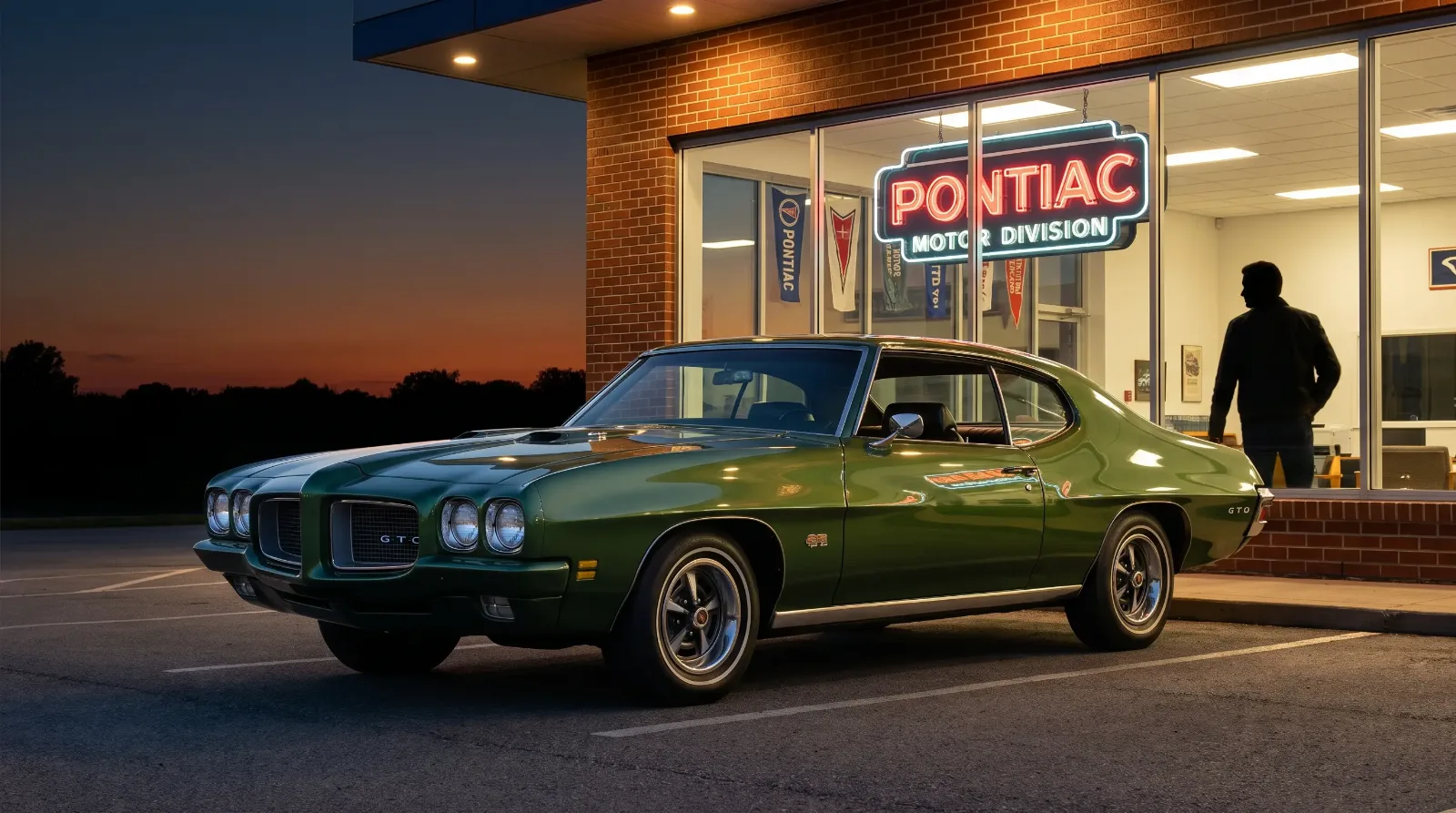
How the surcharge system actually worked
Insurers in the late 1960s started building statistical categories around specific vehicles rather than pricing purely on driver age and record, and high-output engines paired with light body styles landed squarely in the worst of those categories. A GTO with a big-block or a high-compression 400 under the hood, driven by a buyer under twenty-five, could face a premium that ran a large multiple over a comparably priced sedan with a modest six-cylinder, a gap that period reporting put at hundreds of dollars a year on a car that itself cost only a few thousand. The logic wasn't unreasonable from the insurer's side, claims data on high-horsepower cars driven by young owners genuinely supported higher loss ratios, but the effect on the market was brutal regardless of whether the underwriting was fair.
What made this different from an ordinary cost increase is that it targeted exactly the buyer the GTO had been built to sell to from the start. Pontiac's whole strategy under John DeLorean back in 1964 had been putting a genuinely quick car within financial reach of a young, single buyer. The insurance surcharge system undid that math from the other direction, keeping the sticker price reasonable while making the ongoing cost of ownership punishing for the demographic most likely to want the car in the first place.
The numbers a young buyer actually faced
A prospective GTO owner in 1971 wasn't just comparing monthly loan payments anymore. They were comparing loan payment plus a surcharged insurance premium that could rival or exceed the payment itself, and that combined number pushed plenty of otherwise willing buyers toward a Grand Prix, a LeMans with a smaller engine, or a competitor's mid-tier model that didn't trigger the same rating class. Dealers felt this directly. A salesman could still move a GTO off the lot, but the financing conversation now included an insurance quote that sometimes talked a buyer out of the deal before the paperwork was even drawn up.
Some buyers found workarounds, insuring the car under a parent's policy, listing themselves as an occasional rather than primary driver, or shopping smaller regional carriers who hadn't fully adopted the strictest rating tables yet. None of those workarounds were sustainable industry-wide, and as more insurers standardized around the surcharge model through the early 1970s, the workarounds dried up along with them.
| Factor | Effect on GTO ownership cost |
|---|---|
| High-performance rating class | Premium surcharge stacked on top of standard auto rates |
| Young, unmarried driver classification | Compounded the performance surcharge further |
| Engine and body style combination | Big-block, light two-door bodies rated worst across insurers |
| Net effect on demand | Buyers shifted toward lower-output options or competing models |
It wasn't the only pressure, but it was the one nobody could engineer around
Insurance wasn't operating alone. Emissions regulation was tightening compression ratios across the industry through this period, and fuel quality was shifting toward unleaded, both of which chipped away at outright horsepower even before insurance entered the calculation. But those were engineering problems, and engineers could partially answer them, different cams, different intake tuning, later the catalytic converter. There was no engineering fix for an actuarial table. Pontiac could build a slightly milder engine to chase a better insurance rating class, and some manufacturers tried exactly that kind of workaround, detuning specific option packages so they'd land in a cheaper bracket. It helped some buyers. It also meant the cars themselves started getting quietly softer, which is its own kind of damage to a nameplate built on outright performance.
"You can restore an engine. You can't restore a market that decided your car was too expensive to insure, and that's really what happened here."
Marcus Feld
How the rest of the industry reacted
Pontiac wasn't alone in watching this play out, and the industry-wide response is instructive for anyone trying to understand why the entire muscle car category, not just the GTO, contracted so quickly through the early 1970s. Manufacturers started marketing "insurance-friendly" trim levels explicitly, milder engine and transmission combinations positioned to dodge the worst rating classes while still wearing a performance nameplate on the fender. It was a marketing answer to an actuarial problem, and it worked well enough to keep some sales moving, but it also diluted what these nameplates had originally promised.
Dealers adapted too, some of them keeping informal notes on which local insurers were quoting the least punishing rates for young buyers and steering customers toward those carriers before they ever sat down to sign paperwork. It was an unofficial, dealership-by-dealership patch on a structural problem, and it only worked as well as the salesman's relationships with local agents happened to be. None of it addressed the underlying rating logic, which kept tightening as loss data accumulated through the early part of the decade.
By the time the broader industry had absorbed emissions rules, lower compression ratios, and a second wave of insurance rate increases later in the decade, the muscle car as a mass-market proposition was effectively over, not because anyone stopped wanting one, but because the combined cost of owning one had climbed well past what the original target buyer could reasonably carry.
What this means for the collector market now
The irony sits right there for anyone appraising these cars decades later. The insurance pressure that thinned out new GTO sales in the early 1970s also thinned out the number of high-output cars that stayed in enthusiast hands long enough to survive into the collector era, since plenty of original buyers traded down to something cheaper to run before the car had a chance to become a keepsake. That scarcity now works in the opposite direction for value, a genuine high-compression, documented GTO from this window carries real weight precisely because so few buyers could afford to keep one on the road at the time.
It's a useful reminder that a car's collector value today is shaped as much by what happened to the market around it decades ago as by anything mechanical. An appraiser who ignores that history and prices a GTO purely on horsepower and sheet metal condition is missing half the reason these specific cars are worth what they're worth now. Scarcity created by economic pressure is still scarcity, and the market has learned to pay for it just the same as it pays for scarcity created by low production runs or a short model year.
To see how that pressure showed up under the hood, in the specific hardware Pontiac was still building even as the insurance math worked against it, read on. And if you haven't read the full arc of how this nameplate got here in the first place, the story of the Goat is worth your time.
Sources and notes
Related Reading
Have a
Pontiac GTO
for Sale?
Reach thousands of serious classic car collectors across the US.
Sell It Here →
Selling a classic? Here's how: sell my classic car
Are You a Classic Car Dealer?
List your full inventory and connect with targeted classic car buyers.
Join as a Dealer →
#muscle car decline
#pontiac gto history
#1971 gto
#muscle car insurance
#gto insurance surcharge
#gto collector value

About the author
Marcus Feld
Accredited collector-car appraiser who reads the market through hammer prices, condition tiers and risk.
Related Listings - Pontiac GTO



Comments
Be the first to comment on this article.