
Here's a fact that surprises people who assume every GM muscle car under the sun ran a Chevy small-block: for most of the first decade of Firebird production, the engine under the hood was Pontiac's own design, not Chevrolet's. The pontiac vs chevy engine question isn't really about which was faster. It's about two different engineering philosophies built inside the same corporation, and why the Firebird eventually ended up with both.
Car Features
6 min read
Pontiac vs Chevy Big-Block
Two GM divisions, two competing engine philosophies, one platform. Here's what actually separates a Pontiac big-block from a Chevy big-block in a Firebird.
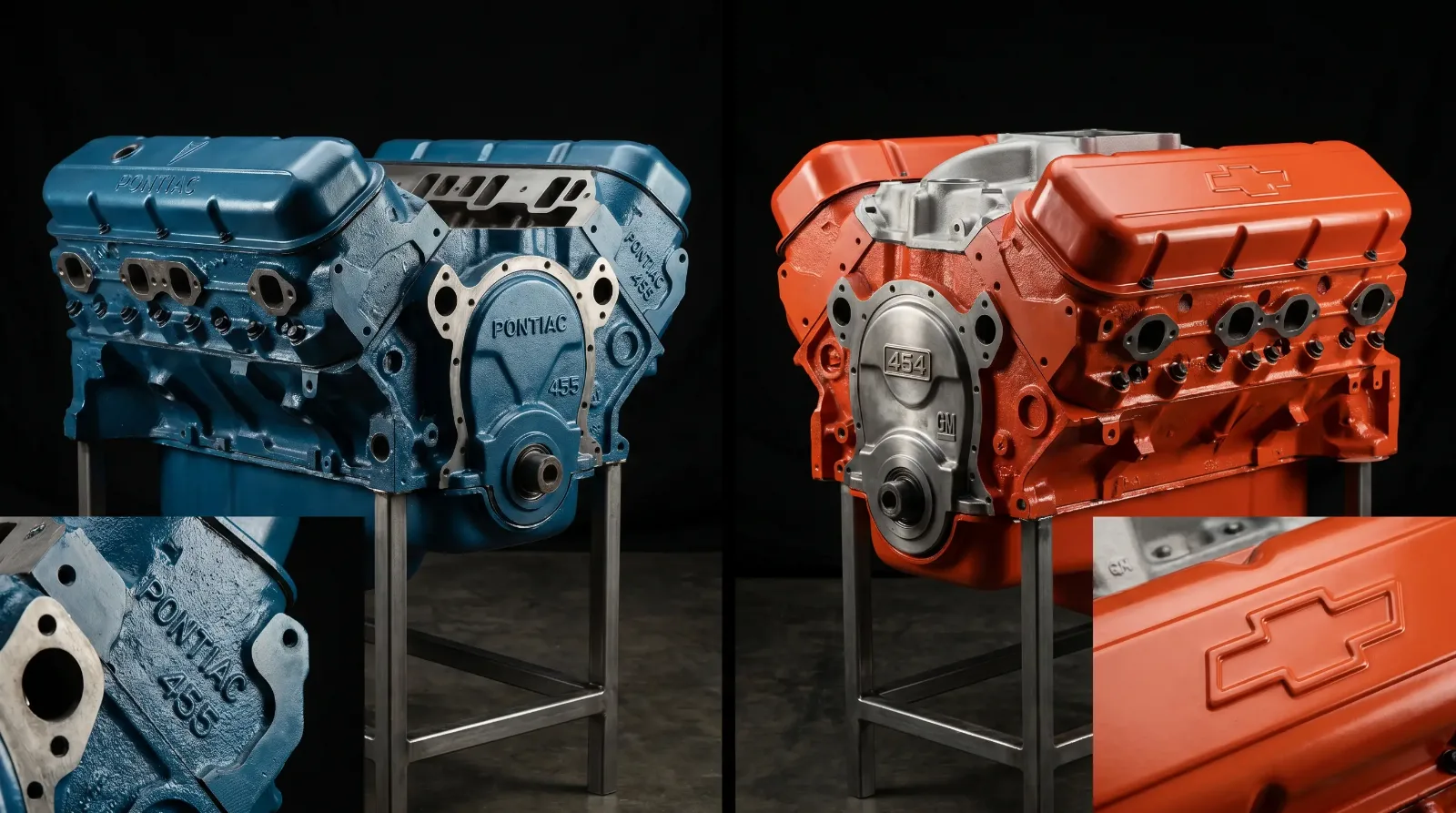
Two engine families, one corporation
Pontiac's V8 family, the 326 through 455, was Pontiac's own design, developed and built by Pontiac's engineering division with its own casting numbers, its own bore and stroke combinations, and its own parts interchange rules that don't cross over to a Chevrolet engine despite both wearing a GM badge. Chevrolet's small-block, the 283 through 400, and its big-block, the 396 through 454, were an entirely separate lineage developed by Chevrolet's own engineers. These weren't badge-engineered versions of the same hardware. They were competing designs inside the same company, and for years GM let its divisions compete against each other almost as much as against Ford and Chrysler.
That internal competition is exactly why the Firebird's early engine lineup looked the way it did. Pontiac built the car, so Pontiac's engines went in it first, the same way a Chevy Camaro got Chevrolet engines despite the two cars sharing a platform.
Weight, torque curves, and how each engine actually drives
The philosophical difference between the two engine families comes down to how each one makes power. Pontiac's big-inch engines, particularly the 400 and 455, lean on long stroke and big displacement to make torque low in the rev range, and despite the large displacement they are typically no heavier, and sometimes lighter, than a comparable Chevy design. Chevrolet's small-block philosophy went the other direction: lighter castings, shorter stroke, a design built to rev rather than lug, which is part of why the small-block Chevy became the engine of choice for so many later engine swaps regardless of what the car originally came with.
Chevy's big-block, the 396 and 454, split the difference, closer to Pontiac's torque-first approach, though the Chevy 454 actually runs heavier than a Pontiac 455, at roughly 685 pounds against the Pontiac's roughly 640. On paper the numbers between a 455 Pontiac and a 454 Chevy in similar states of tune land close to each other. Behind the wheel, the Chevy tends to feel a shade quicker to rev and the Pontiac tends to pull a hair harder right off idle, though the gap is small enough that gearing and compression ratio matter more than the badge on the intake.
| Trait | Pontiac 400/455 | Chevy 396/454 |
|---|---|---|
| Design origin | Pontiac engineering division | Chevrolet engineering division |
| Approach | Long stroke, torque-first | Shorter stroke, revs a bit more freely |
| Typical weight | ~640 lb (455), no heavier than Chevy | ~685 lb (454 big-block) |
| Parts interchange | Pontiac-only, no cross-brand swap | Wide aftermarket, huge parts base |
| Firebird use | Standard through early 1970s | Phased in as Pontiac engines were discontinued |
Why the Firebird ended up with both
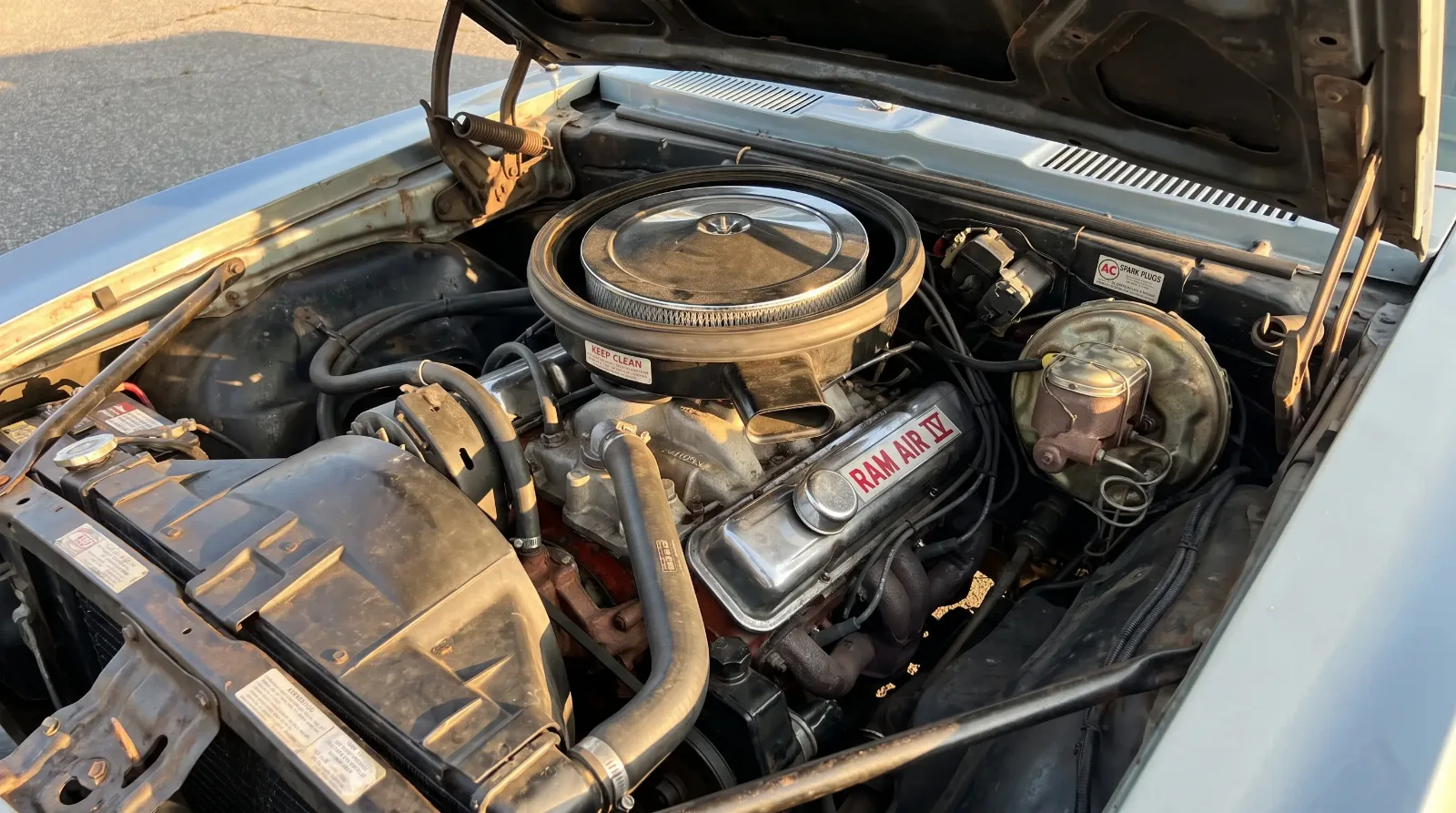
By the mid-to-late 1970s, GM was consolidating engine production across divisions to cut costs and simplify emissions certification, and Pontiac's own big-inch V8s were on their way out. Firebirds built later in the decade and into the following years increasingly used Chevrolet-sourced small-block engines rather than Pontiac's own designs, a shift driven by corporate cost decisions rather than anything wrong with Pontiac's engineering. For a car whose whole identity had been built on a Pontiac engine under the hood, that transition changed what "correct" meant depending on the exact model year you're looking at.
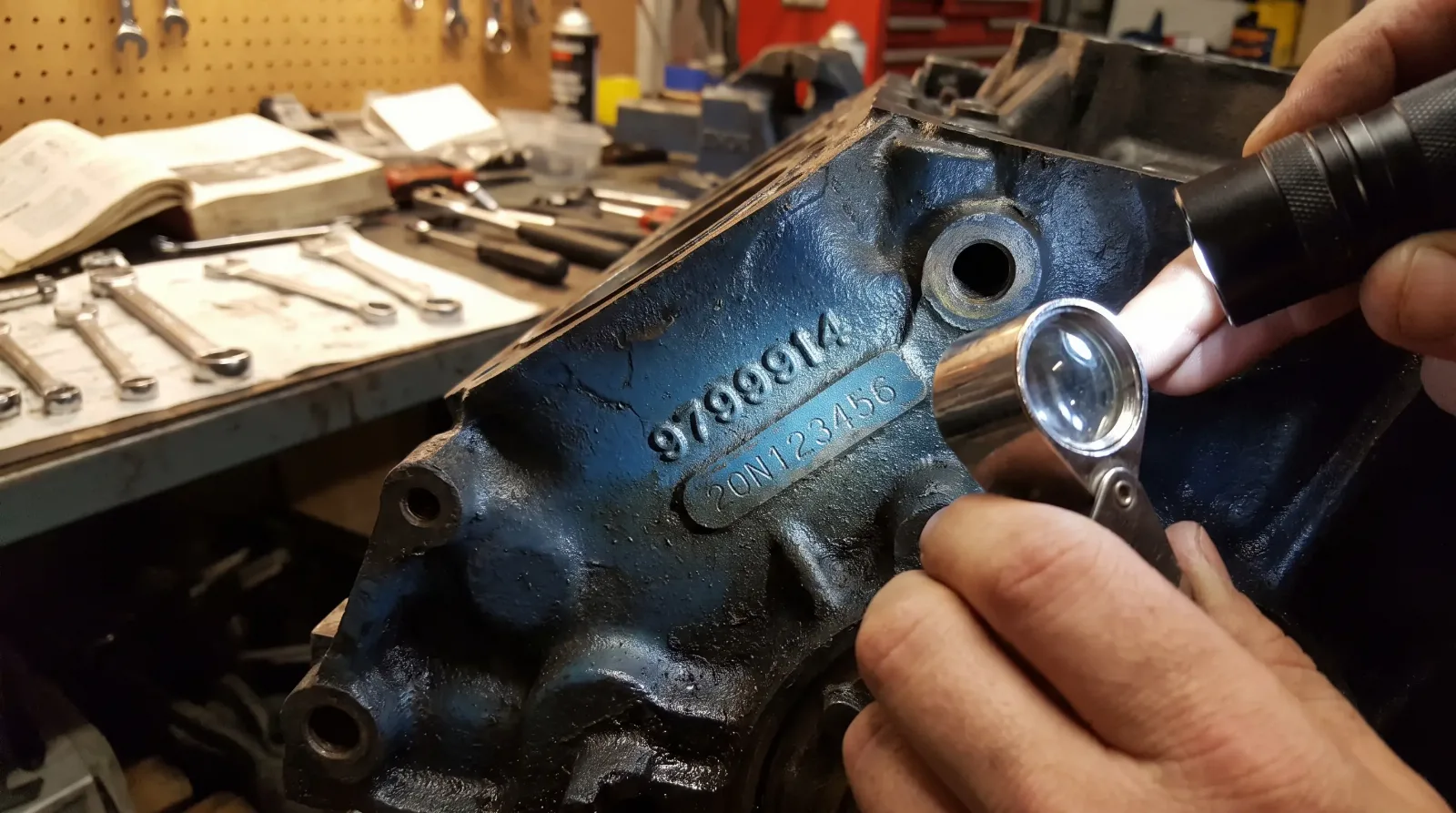
This matters enormously for buyers today. A Firebird from the Pontiac-engine years and a later Firebird with a Chevrolet-sourced engine are both legitimate, factory-correct cars for their respective years, but they're not interchangeable in terms of what parts fit or what a numbers-matching judge expects to see under the hood. Know which era you're looking at before you assume the engine bay tells you anything about the car's authenticity, since the Pontiac engine story on this site covers the full Pontiac V8 lineup in more depth if you want the specifics on displacement and casting numbers year by year.
What it means for buyers and builders today
If you're shopping for a Firebird with either engine family, the practical difference shows up in parts availability more than performance. The Chevy small-block and big-block aftermarket is enormous, decades deep, and cheap by comparison. The Pontiac aftermarket is smaller, more specialized, and often pricier for equivalent components, which is the tradeoff you accept for keeping a car factory-correct to its Pontiac-powered years. Neither choice is wrong. It depends on whether you're building for originality or for ease of ownership.
If you're looking at big-block Firebirds for sale right now, pay attention to which engine family is actually under the hood and whether it matches what the car left the factory with. That single detail affects both value and the parts bill you'll be paying for the life of ownership.
There's also a weight distribution angle that gets overlooked, though it cuts the other way from what most people assume. A Pontiac 455 is not the heavy iron anchor its reputation suggests, at roughly 640 pounds against the Chevy 454's roughly 685, so a Pontiac-powered Firebird is not automatically the nose-heavier car of the two. A Firebird set up for autocross or road course work still tends to favor the small-block Chevy simply because it is lighter than either big-inch option, while a car built purely for straight-line torque and period-correct restoration keeps whichever big-inch engine matches what it left the factory with. Neither approach is wrong, but assuming the Pontiac casting is always the heavier one is how builders get the math wrong before they even start.
"People argue Pontiac versus Chevy like it's a religious question. It's not. It's a parts bill and a torque curve. Pontiac pulls harder at idle, Chevy revs easier and costs less to keep running, and both numbers are real. Pick based on what you actually want to do with the car."
Dan Reeves
Verifying a Firebird's numbers-matching status regardless of which engine family it carries is the paperwork question every serious buyer eventually has to answer, and the next story in this set covers exactly that. For the full arc of how the model evolved across both engine eras, Pontiac's Firebird history lays out the years and trims where each engine family showed up.
Sources and notes
Related Reading
Have a
Pontiac Firebird
for Sale?
Reach thousands of serious classic car collectors across the US.
Sell It Here →
Are You a Classic Car Dealer?
List your full inventory and connect with targeted classic car buyers.
Join as a Dealer →

About the author
Dan Reeves
Performance engine builder from North Carolina's motorsports corridor, focused on swaps, forced induction and making real, repeatable power.
Related Listings - Pontiac Firebird




Comments
Be the first to comment on this article.