
Here's the number that ends most bar arguments about this topic: zero. That's how many parts interchange between a Pontiac V8 and a Chevrolet small-block or big-block. Not the block, not the heads, not the intake, not the water pump. People throw around the phrase "GM V8" like it describes one engine family with different badges bolted on, and that is flat wrong. Pontiac engineered its own V8 architecture, built it in its own plant, and kept it that way for the engine's entire production run. If you own a GTO or you're shopping for one, this distinction is not trivia. It affects what parts fit, what a rebuild costs, and how you evaluate a car that's been modified.
Car Features
8 min read
Why Pontiac V8s Are Different from Every Other GM Engine
Pontiac's V8 shares a manufacturer with Chevrolet's small-block and nothing else. Zero parts interchange, and that fact matters a great deal to anyone buying or rebuilding a GTO.
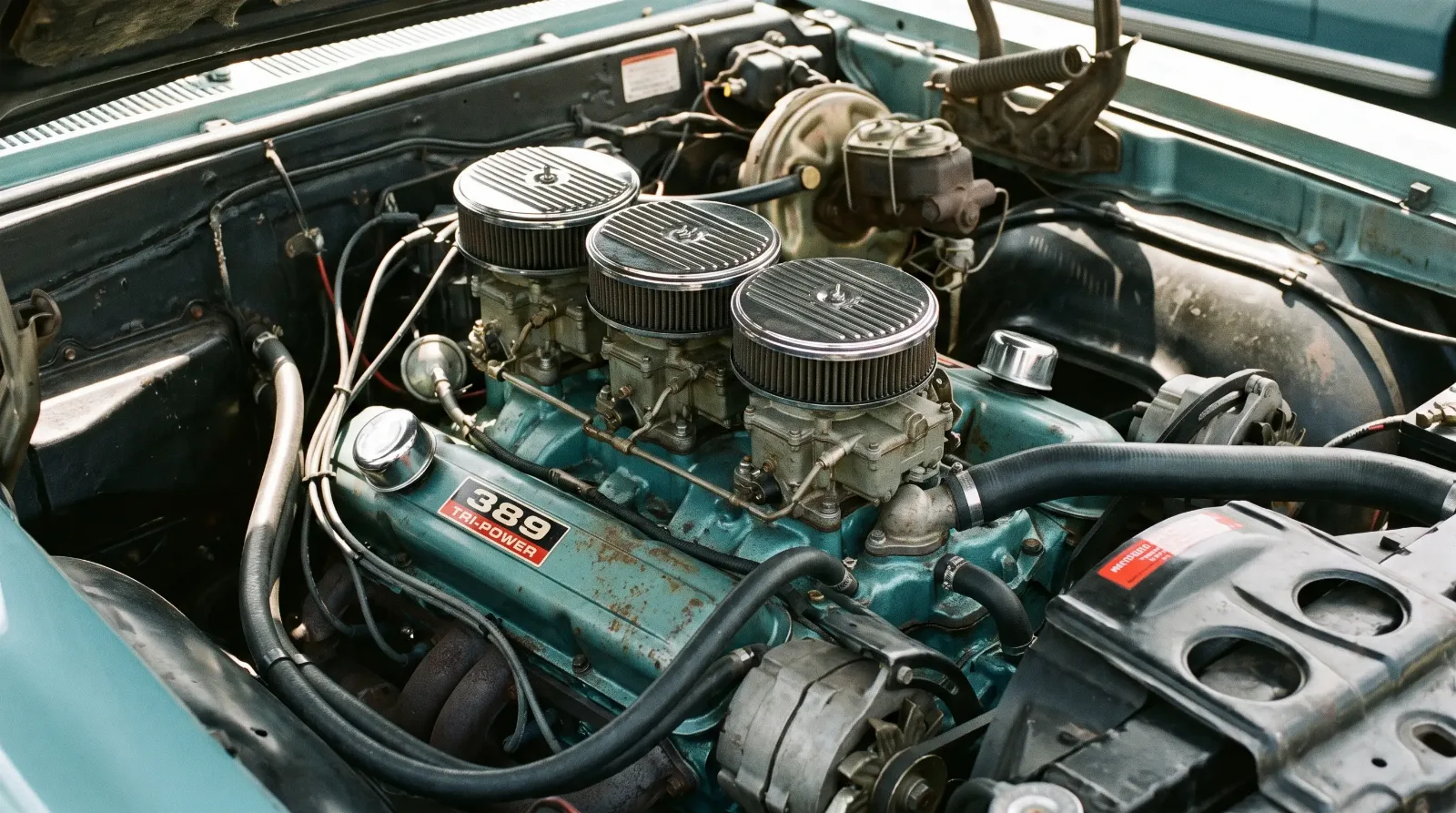
The corporate structure that made this happen
General Motors in the 1950s and 1960s operated its divisions, Chevrolet, Pontiac, Oldsmobile, Buick, and Cadillac, with a level of engineering independence that looks strange by modern corporate standards. Each division largely designed and built its own engines, competed internally against the other divisions for sales, and took real pride in doing things its own way rather than sharing components across the corporate family. That structure is exactly why Pontiac's V8, introduced for the 1955 model year and carried forward through multiple displacement increases into the engines that powered the GTO, shares essentially no interchangeable parts with the Chevrolet small-block that debuted the same year.
The GTO itself is one of the clearest products of that competitive divisional culture, an engine and chassis combination Pontiac's own engineers pushed through specifically to give the division something Chevrolet did not have. The origin of that push, including the internal GM displacement politics the GTO package worked around, is the full story behind how the GTO began, and it explains a lot about why Pontiac's engineers were so committed to keeping their V8 architecture distinct from Chevrolet's in the first place.
What's actually different, part by part
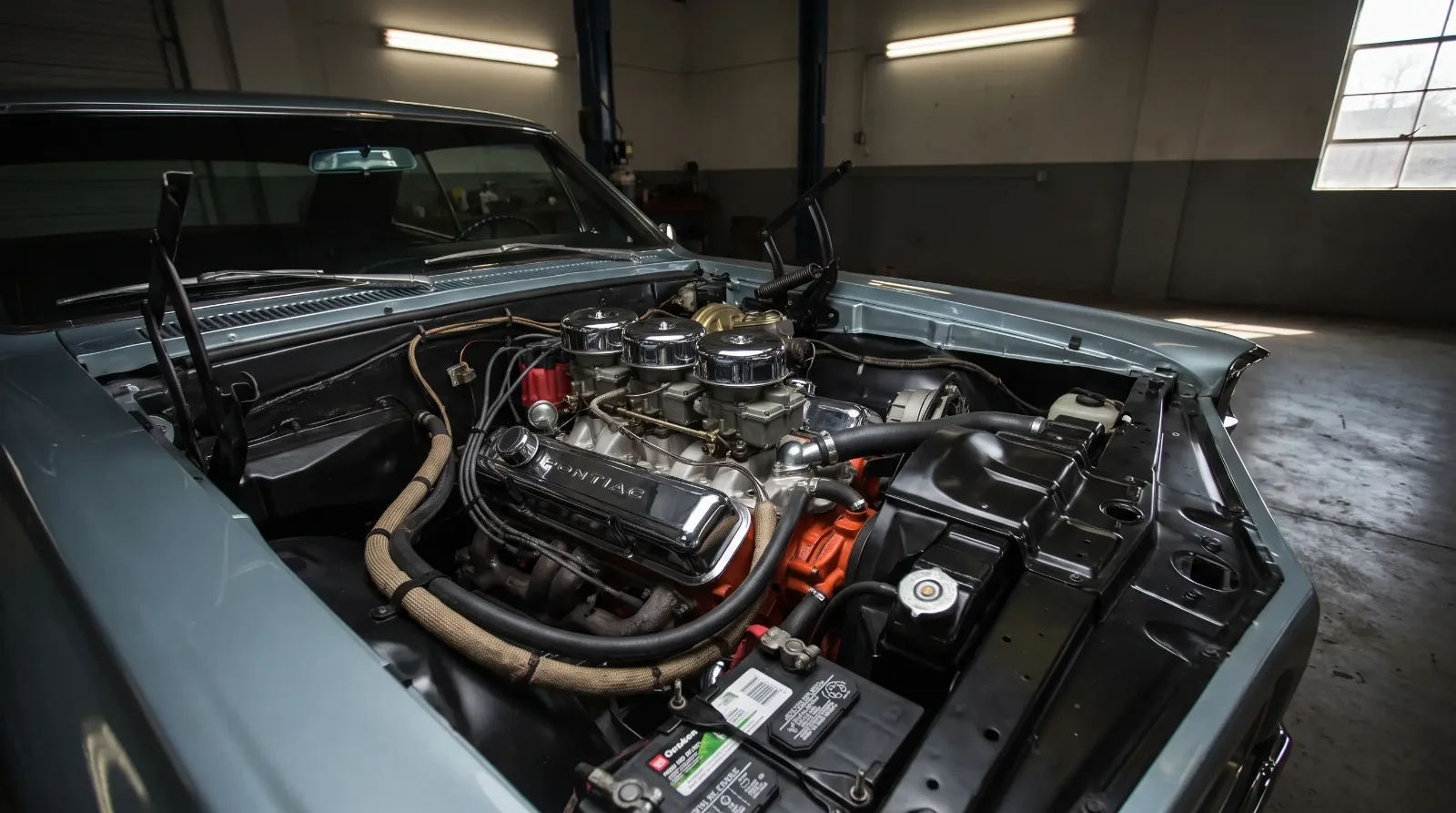
Start with the block. Pontiac's V8 uses a different bore spacing, different deck height, and a different bellhousing bolt pattern than Chevrolet's small-block or big-block engines, which alone rules out swapping heads, intake manifolds, or transmissions between the two families without an adapter or extensive machine work. The cylinder heads follow a different port design and combustion chamber shape. The rocker arm arrangement differs. Even the accessory drive and motor mount positions are different enough that a Pontiac engine will not simply drop into a chassis engineered around a Chevrolet mounting pattern.
| Component | Interchangeable between Pontiac and Chevrolet V8? |
|---|---|
| Engine block | No, different architecture entirely |
| Cylinder heads | No, different port and chamber design |
| Intake manifold | No, matched to Pontiac-specific head design |
| Bellhousing bolt pattern | No, requires an adapter for cross-brand swaps |
| Firing order | Different from small-block Chevrolet |
Even the firing order is different, a detail that trips up mechanics who cut their teeth on small-block Chevys and assume the same wiring pattern applies. Get the firing order wrong on a Pontiac distributor cap and the engine will not run correctly no matter how well everything else was assembled. It is a small thing that causes a surprising number of headaches for a shop unfamiliar with the platform.
Why this matters when you're buying or restoring
This is not academic trivia. It has real consequences for anyone shopping for parts, evaluating a used GTO, or planning a rebuild. A shop that primarily works on Chevrolet engines and tells you a Pontiac rebuild is "basically the same job" either does not know the platform or is being loose with the truth. Machine work, gasket sets, and internal components are Pontiac-specific, and while the aftermarket support for these engines is solid thanks to decades of enthusiast demand, it is a narrower supply chain than the enormous Chevrolet small-block aftermarket, and prices for some Pontiac-specific parts reflect that narrower supply.
There's also a documentation angle worth understanding here. Because the Pontiac V8 architecture is so distinct, casting numbers, date codes, and engine identification stamps unique to the Pontiac plant are a reliable way to verify whether a GTO carries its original engine or a later replacement, and whether that replacement is at least a correct-type Pontiac engine or something swapped in from an entirely different GM division out of convenience or cost. Reading those numbers correctly is its own skill, covered in full in the GTO engine story, and it is worth learning before you take a seller's word for what is actually sitting between the fenders.
The performance case, stated plainly
None of this is a knock on the Chevrolet small-block, which earned its reputation honestly and remains one of the most versatile and well-supported engine families ever built. But the Pontiac V8, particularly in the displacements that powered the GTO, made real torque low in the rev range in a way that suited a heavier mid-size performance car well, and Pontiac's engineers tuned the entire package, from the intake design to the exhaust routing, around that torque character rather than chasing high-rpm horsepower the way some competing engines did. Judging a Pontiac V8 by small-block Chevy benchmarks misses the point of what the engine was actually engineered to do.
Anyone who tells you a GTO's engine is "just a Pontiac Chevy" either has not opened the hood on both platforms or is repeating something they heard secondhand without checking it. The two engines share a manufacturer and not much else, and understanding that distinction is one of the fastest ways to tell a buyer who actually knows this platform from one who is reciting generic muscle car talking points.
The swap question people ask anyway
None of this stops people from asking whether a Chevrolet engine can go into a GTO chassis or vice versa, and the honest answer is yes, it can, with the right motor mounts, a bellhousing adapter, and enough patience to sort out the accessory drive and exhaust routing. Hot rodders have been doing exactly this kind of cross-brand swap for decades, and there is nothing inherently wrong with it on a car being built as a driver rather than a numbers-matching restoration. What matters is being honest about what the car becomes once that swap happens. A GTO chassis with a small-block Chevy under the hood is a fine car to build and drive, but it is not a numbers-matching GTO anymore, and pricing it or selling it as one is where people get themselves into trouble.
I bring this up because the confusion between "GM engine" and "Pontiac engine" is exactly what leads some sellers, more out of genuine misunderstanding than intent to deceive, to describe a swapped car in language that implies more originality than the car actually has. A buyer who understands the real architectural gap between these engine families is far less likely to get talked into paying a numbers-matching premium for a car that no longer has a numbers-matching engine under the hood, swapped in at some point by a previous owner chasing parts availability or cost over correctness.
What this independence cost Pontiac in the long run
There is a less flattering side to this story worth acknowledging honestly. Maintaining a separate engine architecture across five GM divisions was expensive duplicated engineering effort, and by the late 1970s and into the 1980s, GM corporate leadership pushed hard toward shared engine platforms across divisions specifically to cut that duplicated cost, which is part of why the era of a distinctly Pontiac V8 eventually came to an end. The same divisional independence that gave engineers like the ones behind the GTO room to build something genuinely different from Chevrolet is also, in a broader corporate sense, part of why that independence did not survive indefinitely. It is worth remembering that the engine under a GTO's hood exists specifically because of a period in GM's history that did not last forever, which is one more reason these cars are worth understanding on their own terms rather than through a generic GM lens.
"I've had guys try to bolt small-block Chevy heads on a Pontiac block out of sheer confusion about how GM worked back then. Zero parts interchange. Zero. Learn the difference before you buy parts, not after."
Dan Reeves
The engine's full engineering arc, from the original 389 through Tri-Power and Ram Air variants to the later 455, is covered start to finish in the GTO engine story, and it is the essential companion reading to everything above for anyone serious about understanding what actually sits under a GTO's hood.
Sources and notes
Related Reading
Have a
Pontiac GTO
for Sale?
Reach thousands of serious classic car collectors across the US.
Sell It Here →
Selling a classic? Here's how: where to sell your classic car online
Are You a Classic Car Dealer?
List your full inventory and connect with targeted classic car buyers.
Join as a Dealer →

About the author
Dan Reeves
Performance engine builder from North Carolina's motorsports corridor, focused on swaps, forced induction and making real, repeatable power.
Related Listings - Pontiac GTO


Comments
Be the first to comment on this article.