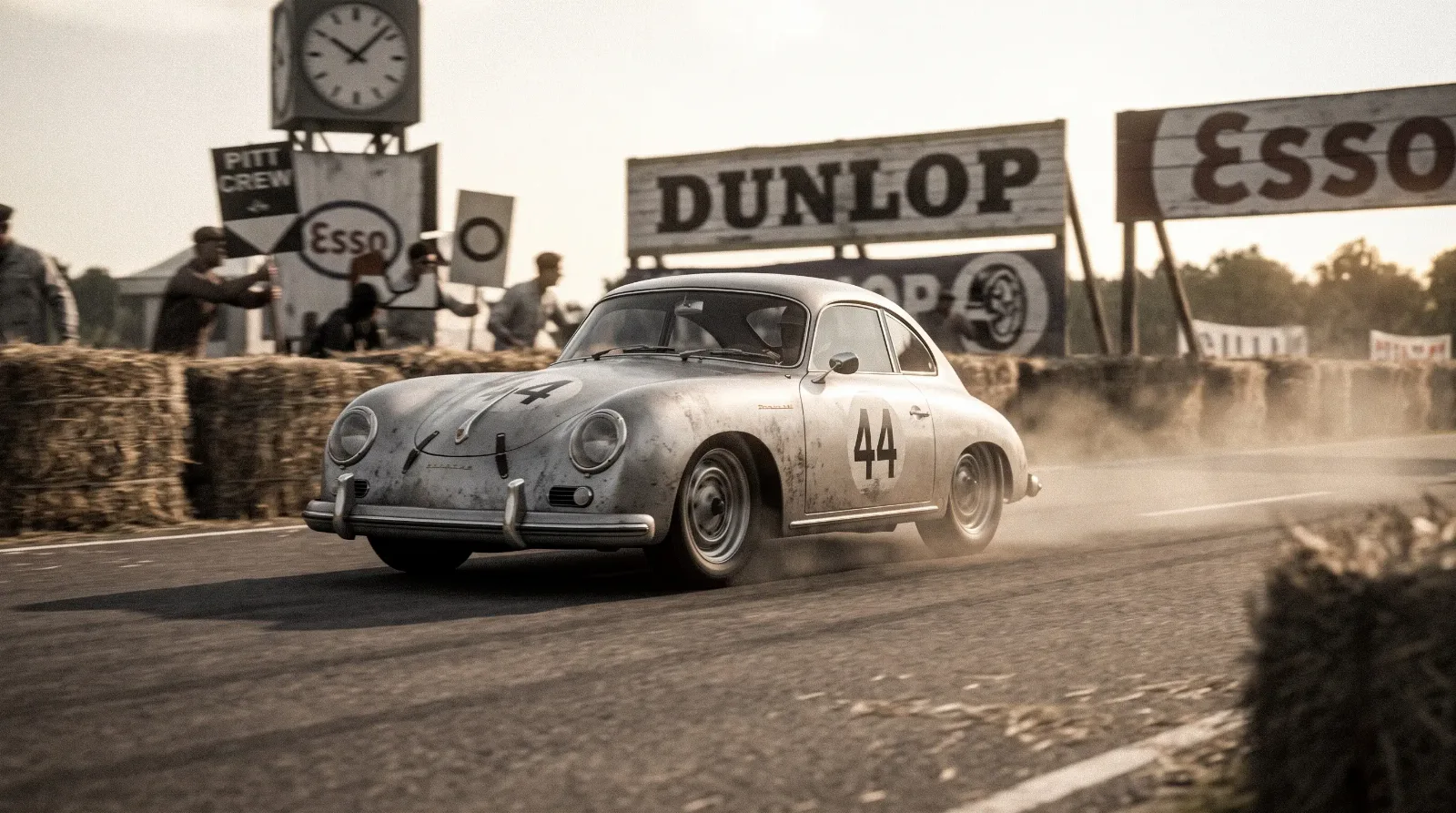
Porsche 356 racing history begins with a car that had no business beating what it beat. A 1,100cc coupe with an air-cooled engine derived from a Volkswagen was never going to out-power the larger machinery it lined up against at Le Mans, the Carrera Panamericana, or the Mille Miglia. It won anyway, repeatedly, inside its class, and that pattern is what earned the 356 its giant-killer reputation before Porsche had built a single dedicated race car.
The first Le Mans class win and the giant-killer reputation
Porsche entered a 356 SL at the 24 Hours of Le Mans in 1951, driven by Auguste Veuillet and Edmond Mouche, and the car won its 1,100cc class outright while finishing the full twenty-four hours reliably, a result that mattered as much for what it proved about durability as for the class trophy itself. Endurance racing in this era rewarded cars that survived as much as cars that were fast, and the 356's simple, well-cooled flat-four and light unibody construction meant it rarely broke where larger, thirstier machinery did. That single result set the tone for the next decade: the 356 would not win overall against Jaguars and Ferraris, but inside its displacement class it was close to unbeatable.
The Carrera Panamericana and the birth of a name
The Carrera Panamericana, a punishing point-to-point road race across Mexico, gave Porsche the name it would use for its fastest production 356s for the rest of the decade. Works and privateer 356s ran the Panamericana through the early 1950s, taking repeated class victories against far larger-displacement opposition on a route that punished suspension, brakes, and driver alike over thousands of miles of mountain roads. Porsche liked the association enough to attach the Carrera name permanently to its four-cam models, and that naming decision alone tells you how much marketing value the factory placed on a result most casual buyers never saw firsthand.
The four-cam Carrera engine
Where the racing history gets technically serious is the engine Ernst Fuhrmann designed for competition use, a quad-camshaft flat-four that shared its architecture with the 550 Spyder's racing unit rather than the pushrod engine in the standard road car. Fitted to the 356 Carrera from 1955 onward, the 1.5-liter version produced around 100 hp at 6,200 rpm, well ahead of the roughly 75 hp made by the standard pushrod 1600 S of the same era, and it was expensive and labor-intensive to build and maintain, requiring far more precise machining than Porsche's normal production line handled. Owners who bought a Carrera-engined 356 were buying a race engine with license plates, and it showed in both the performance and the maintenance bills. Reading back to [where Porsche began], the leap from a Volkswagen-derived pushrod four to a hand-built four-cam racing engine in under a decade says as much about Porsche's ambitions as any single race result.
| Event | Era | Result type |
|---|---|---|
| 24 Hours of Le Mans | 1951 onward | Repeated class wins, 1100cc and later classes |
| Carrera Panamericana | 1952-1954 | Class victories against larger-displacement rivals |
| Liège-Rome-Liège Rally | Mid-1950s | Overall and class results for works-supported entries |
| Sebring 12 Hours | 1950s | Class wins, strong index-of-performance results |
| Targa Florio | 1950s-1960s | Class wins on a course that rewarded reliability |
The America Roadster and privateer racing culture
Not every 356 that raced came from the factory's competition department. The America Roadster, a small run of lightweight aluminum-bodied cars built in the early 1950s specifically for the American market, gave privateer racers on the East and West coasts a stripped platform to campaign in SCCA club events. These cars were spartan even by Speedster standards, with minimal weather protection and trim removed wherever weight could be shaved, and they fed a grassroots racing culture in the United States that ran parallel to Porsche's factory-backed European efforts. Club racers who could never afford a works car could still buy into the same fundamental formula: light weight, a reliable air-cooled four, and a chassis that rewarded a smooth driver over a hard one.
"What strikes me looking at the entry lists from this period is how often the same names appear across completely different events, Le Mans one month, a Mexican road race the next, an American club meet after that. The 356 was not raced by a single dedicated works effort so much as by a loose network of privateers and factory-supported drivers who all understood the same thing: this car won by finishing, not by out-powering anything."
— Sarah Whitfield
The racing legacy into the 911 era
Huschke von Hanstein, who ran Porsche's competition department through much of this period, understood the value of a class win better than most team managers of his generation. He kept factory cars entered in events where an overall win was never realistic, because a class trophy photographed the same way in a newspaper and cost far less to chase. That approach shaped how Porsche allocated its limited competition budget for most of the 1950s: fewer cars entered against the fastest opposition, more cars entered where a 356 could realistically finish first in its bracket. It is a strategy that looks obvious in hindsight and was not obvious at all to rivals still chasing outright victories with bigger, thirstier cars.
By the time Porsche retired the 356 in 1965, its racing program had already handed off to the 911 and the mid-engine 904 and 906 competition cars, but the fundamentals proven on the 356, a light unibody, a reliable air-cooled flat engine, and a willingness to let class wins do the marketing work that overall victories could not, carried directly into everything that followed. The 356's competition record rarely made headlines the way a Le Mans overall win would have, but it built the reputation for durability and giant-killing that Porsche has traded on ever since. For readers who want to see how that reputation eventually turned this platform into a six-figure collector car, [a related deep-dive] traces the value side of the same history.