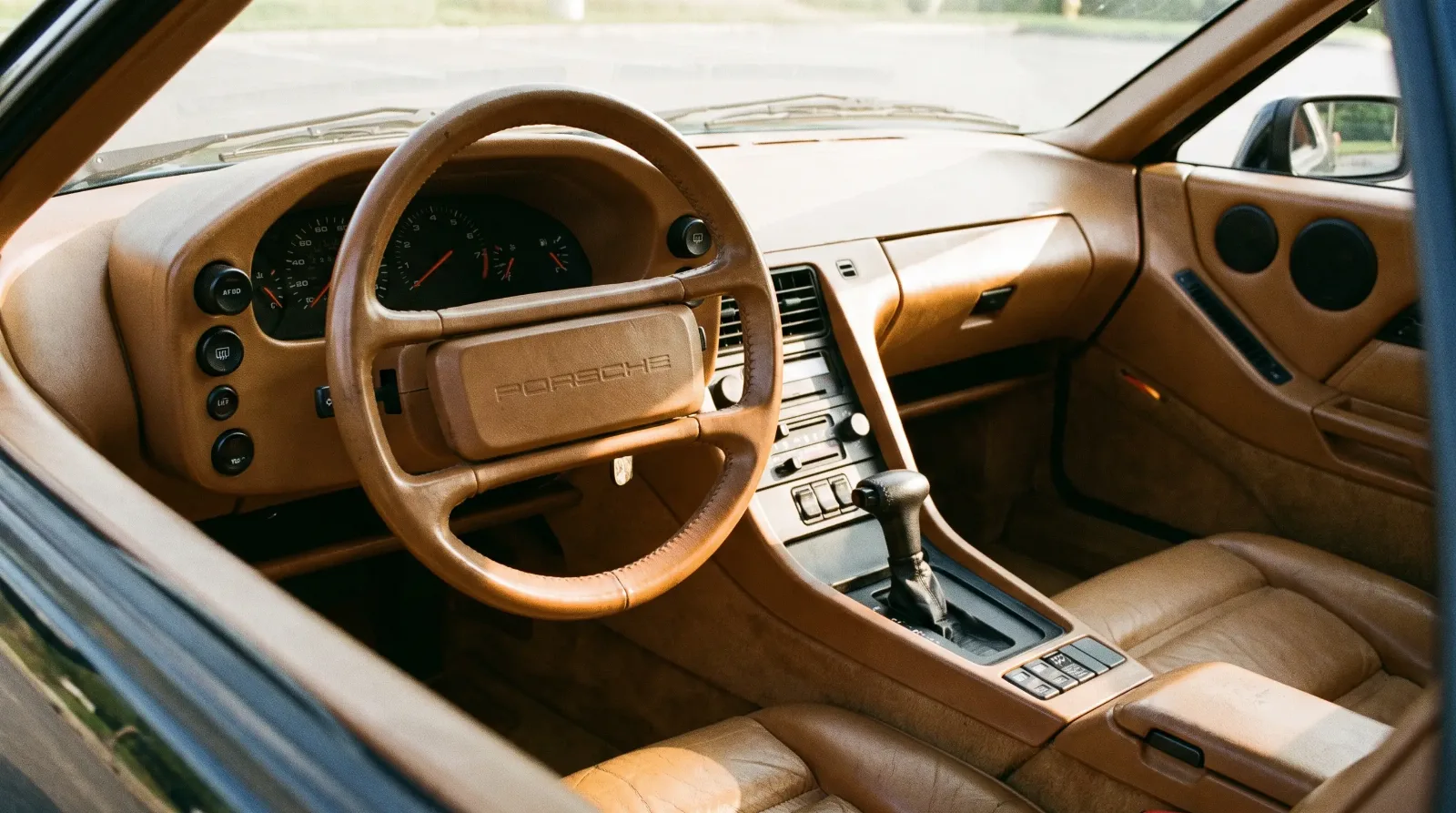
Sit in a Porsche 928 interior for the first time and the first thing that gets you is the instrument binnacle. It moves. Tilt the steering wheel to your preferred position and the whole gauge cluster tilts with it, staying square to your eyeline no matter how you have the wheel set. It sounds like a small thing until you have used it, and then it is hard to understand why more cars never bothered to copy it.
A dashboard built around the driver, not the styling brief
The 928's cabin was designed at the same time as the exterior, under the same Style Porsche direction that gave the car its shark-nosed body, and the interior carried the same forward-looking approach. Rather than treat the dashboard as a place to arrange gauges and switches conveniently, the team built the whole binnacle to move with the tilt-adjustable steering column, so the driver's view of the instruments stayed consistent regardless of seating position. That level of ergonomic thinking was unusual for a production car in the late 1970s, when most manufacturers treated the dashboard as fixed architecture and left the driver to adapt to it.
The climate controls and switchgear were laid out with a similar logic, grouped and angled toward the driver rather than spread flat across the dash the way a lot of contemporary cars did. It read as a genuinely different philosophy from the 911's cabin of the same era, which leaned on a more traditional, upright gauge layout.
Materials and details that set the tone
Inside, the 928 leaned into a mix of leather, brushed trim, and, on higher trims, genuinely comfortable four-place seating that positioned the car as a grand tourer rather than a stripped-out sports car. Later cars, particularly the S4 and the flagship GTS that closed out the model's run, pushed the comfort equipment further with better seats and more complete climate control, while the manual-focused GT trimmed some of that back deliberately in the name of a more purist driving experience.
| Element | What made it notable |
|---|---|
| Instrument binnacle | Tilts with the steering column so the gauge cluster stays aligned to the driver's eyeline |
| Seating layout | Genuine four-place cabin on most trims, positioning the car as a grand tourer |
| Climate and switchgear | Angled toward the driver rather than laid flat across the dash |
| Trim variation | GT stripped back comfort items in favor of a lighter, purist-focused cabin |
How the cabin changed across the model's run
The cabin did not stay static across eighteen years of production, and the differences matter to anyone shopping across model years rather than focusing on a single trim. Early cars carried simpler cloth or leatherette options alongside leather, with switchgear and climate controls that were advanced for 1977 but grew dated as the run continued. By the time the S4 arrived, Porsche had revised the center console and upgraded the sound and climate systems to match buyer expectations that had moved on considerably since the car's debut.
The GTS, as the final flagship, represented the most complete version of the cabin Porsche ever built for the model, combining the tilting binnacle and driver-focused layout with the best seats, sound insulation, and switchgear the platform received. The GT, released shortly before it, went the opposite direction on purpose, trimming comfort items to keep weight down and reinforce its manual-only, purist positioning. Comparing a GT interior to a GTS interior side by side makes it obvious how differently Porsche was willing to interpret the same basic cabin architecture depending on what kind of driver it was building for. Neither approach was wrong. They were simply built for two different owners with two different priorities behind the wheel.
How the pop-up headlights connect to the cabin experience
The exterior's pop-up headlights and the cabin's forward-thinking dashboard were not separate design exercises. Both came out of the same studio, working from the same brief to build something that felt genuinely modern rather than an evolution of what Porsche had already built. Understanding where that whole design language originated makes the interior easier to appreciate, and that background is covered in full in the 928 story, the piece this article builds directly on.
Why the cabin still holds up for buyers today
A used-market buyer looking at a 928 today needs to pay attention to interior condition the same way they would check any mechanical system, since worn seat bolsters, cracked dash plastics, and a sagging headliner are common on cars that were treated as cheap transportation during the model's undervalued years. A well-preserved cabin, with the tilting binnacle still functioning correctly and the seats intact, is a meaningfully different buying proposition than a car with a torn interior needing a full retrim.
"People walk up expecting a typical 1970s dashboard and then they tilt the wheel and the whole gauge cluster moves with it. That is the moment most folks at the club meets stop talking about the engine for a second and start talking about the cabin instead."
— Wayne Coburn
The interior is also where the model's broader reputation has shifted the most. What used to be dismissed as dated 1970s design is now recognized as some of the more thoughtful ergonomic work of its era, and that recognition has followed the same arc as the rest of the classic Porsche story, where cars once overlooked have steadily earned a second look. Anyone shopping the model today can find a range of classic Porsche 928 for sale with interiors spanning from tired originals to fully restored cabins, and it is worth budgeting time to sit in more than one before deciding. For the rest of what makes this generation of 928 worth collecting, keep reading the series. Sit in one before you decide anything else about the car. The cabin tells you more about what Porsche was trying to do than a spec sheet ever will.