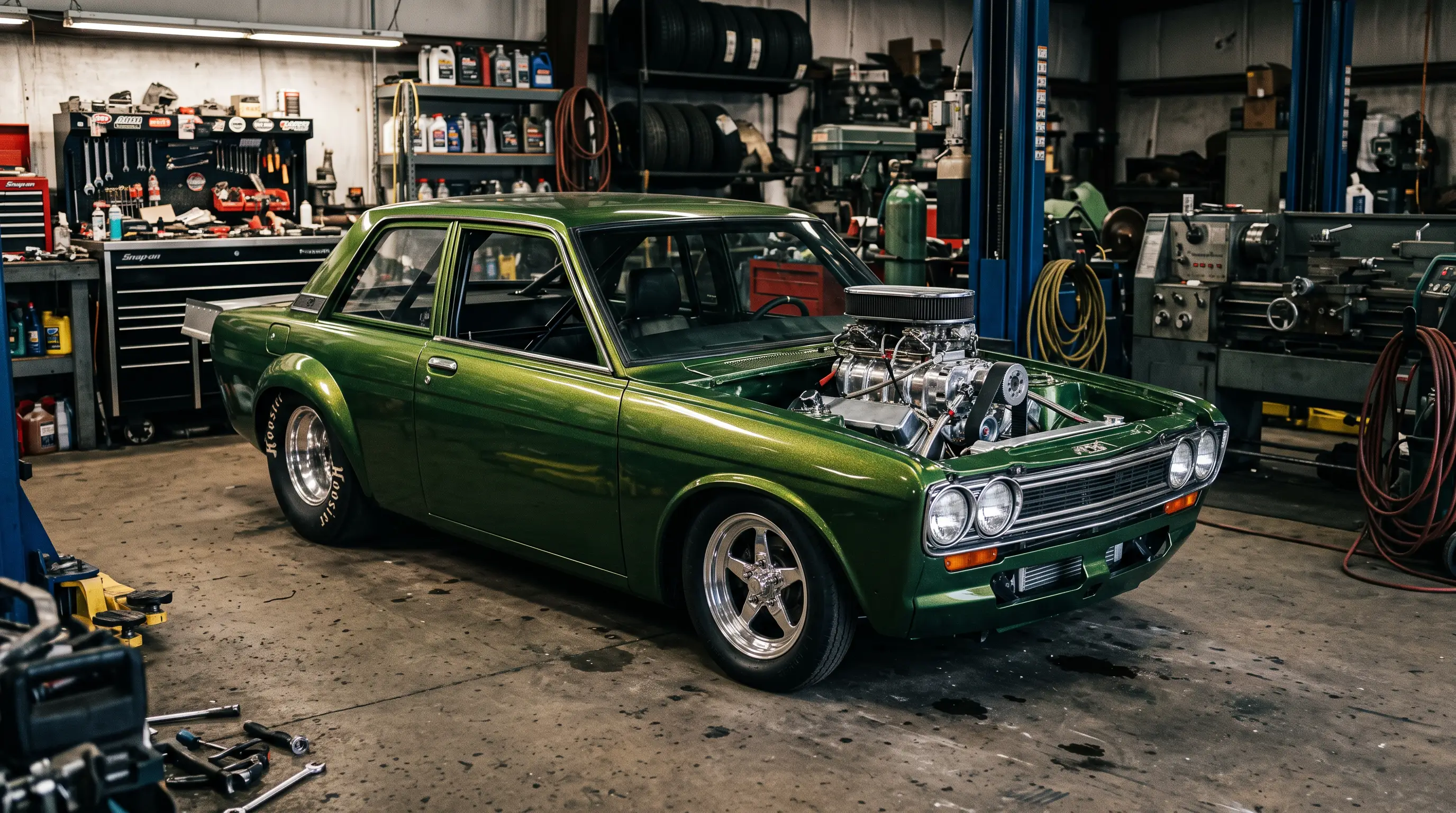
A friend of mine ran a small speed shop in the early 1990s and used to keep a photo taped to the register of a Datsun 510 sitting on a set of massive slicks, tubbed out and running a small block Chevy where the little four cylinder used to live. Customers would ask if it was a joke. It was not. That car ran mid tens at the local strip and became something of a local legend, the kind of car people still bring up thirty years later when the subject of pro street imports comes up. It was never a common sight, but it was never forgotten either.
How an American movement found its way onto Japanese metal
Pro Street grew up around domestic muscle, Chevelles, Novas, Camaros, and Mustangs, cars with plenty of room under the hood and a rear structure that could take a serious tub job without a fight. Import cars were a different animal, small, light, and originally built around economical four cylinder engines rather than V8 muscle. But that same light weight is exactly what made a handful of builders look at a Datsun 510 or a first generation Celica and see potential rather than an odd fit. Drop a small block Chevy into a car that weighs two thousand pounds and the power to weight numbers get interesting fast.
The 510 in particular already had a racing reputation from SCCA competition in the late 1960s and early 1970s, so it was not a total stranger to serious performance work when Pro Street builders started looking at it in the 1980s and 90s.
The engineering headache of an American swap
Fitting a domestic V8 into a car designed around a small inline engine is never simple, and doing it while also tubbing the rear for slicks multiplies the difficulty. Engine bays needed to be widened or reshaped, transmission tunnels cut and reworked, and the rear structure strengthened well beyond what the factory ever engineered for. Builders who took on a pro street imports project were often working without a roadmap, since there were no kits or established procedures the way there were for a Chevelle or a Nova. Every import build was closer to a one off engineering project than a bolt together job.
| Detail | Typical Pro Street import build |
|---|---|
| Common donor cars | Datsun 510, early Celica, first generation RX-7 |
| Typical swap engine | Small block Chevy V8 |
| Original curb weight | Often under 2,300 pounds |
| Build era | Mostly late 1980s through the 1990s |
| Rarity today | Very low survival rate compared to domestic builds |
How the mainstream scene reacted
Reaction from the broader Pro Street community was mixed when import builds first started showing up at shows and strips in the 1980s. Some traditionalists dismissed them outright, arguing a car needed a V8 heritage from the factory floor to belong in the conversation at all. Others found the whole idea fascinating precisely because it broke the unwritten rule, and those builders tended to become the loudest advocates for import projects at regional events. Over time, the novelty factor worked in the imports' favor. A well executed Datsun or Celica build stood out simply by being different, drawing a crowd that had already seen a hundred variations on the same handful of domestic platforms that afternoon.
Magazine coverage of these builds was sparse compared to what a Nova or Camaro received, which paradoxically makes the surviving photographs and articles more valuable to historians and collectors today. A handful of regional publications ran features on notable import builds through the late 1980s and 1990s, and those clippings have become prized possessions among the small circle of enthusiasts who track this specific niche within Pro Street history.
A small but stubborn corner of the culture
These builds never represented more than a small slice of the overall Pro Street scene, and that has not changed. Most of the movement's history runs through domestic muscle, and it always will. But the import builders who did take on the challenge tended to be some of the most technically minded people at any show, since they had to solve problems nobody else in the parking lot had faced. I have judged shows where a single Datsun with a V8 swap and a full tub job pulled more curious onlookers than the entire row of Chevelles beside it, simply because people had never seen anything like it.
"An import Pro Street car is not a copy of anything. Every one I have ever seen was its own solution to a problem nobody had written a manual for."
- Wayne Coburn
What builders learned that others borrowed later
Some of the fabrication techniques worked out by early import swap builders eventually filtered into the wider hot rod and drag racing world, since solving the specific problem of fitting a large V8 into a small, tight engine bay is not unique to Japanese economy cars. Custom header design, tight fitting exhaust routing, and creative motor mount solutions developed on a Datsun or Celica project sometimes ended up informing later work on other small, cramped platforms. That kind of quiet cross pollination rarely gets credited properly in hot rod history, but people who were actually in the shops at the time remember exactly where certain solutions first got worked out.
Finding one, and understanding why they are rare
If you go looking for a genuine Pro Street import build today, be prepared for a long search. Survival rates are low because these were niche builds even in their own era, and many were parted out or scrapped once the original builder moved on. If you want read the background on how the wider truck and oddball side of Pro Street took shape, the same spirit of taking an unlikely platform seriously runs through both stories. It is worth understanding the movement as a whole before chasing something as specific as an import build.
Anyone serious about tracking one down should also find a classic Pro Street car through regular listings, since import builds rarely get advertised specifically and often surface mixed in with more common domestic offerings. My friend eventually lost track of that Datsun from the speed shop photo. He still wonders where it ended up, and honestly, so do I.