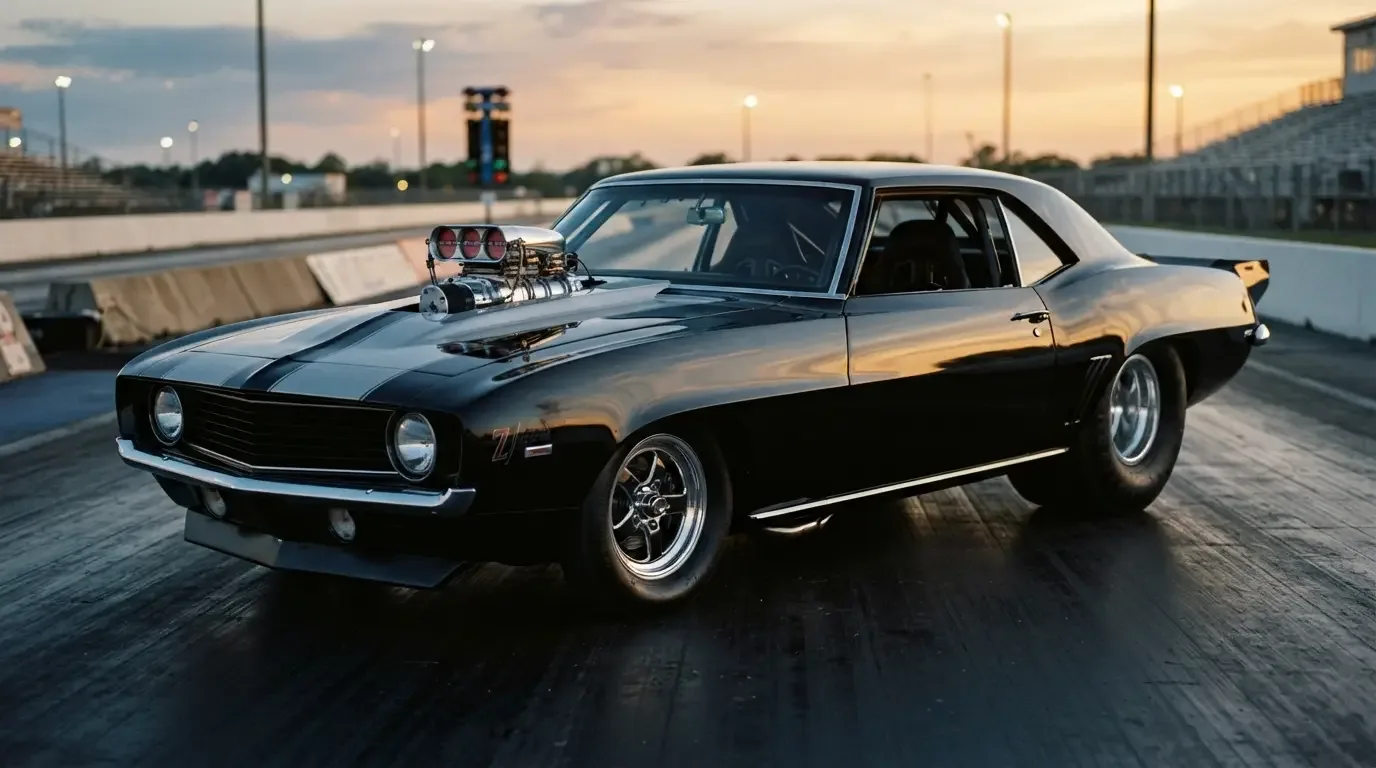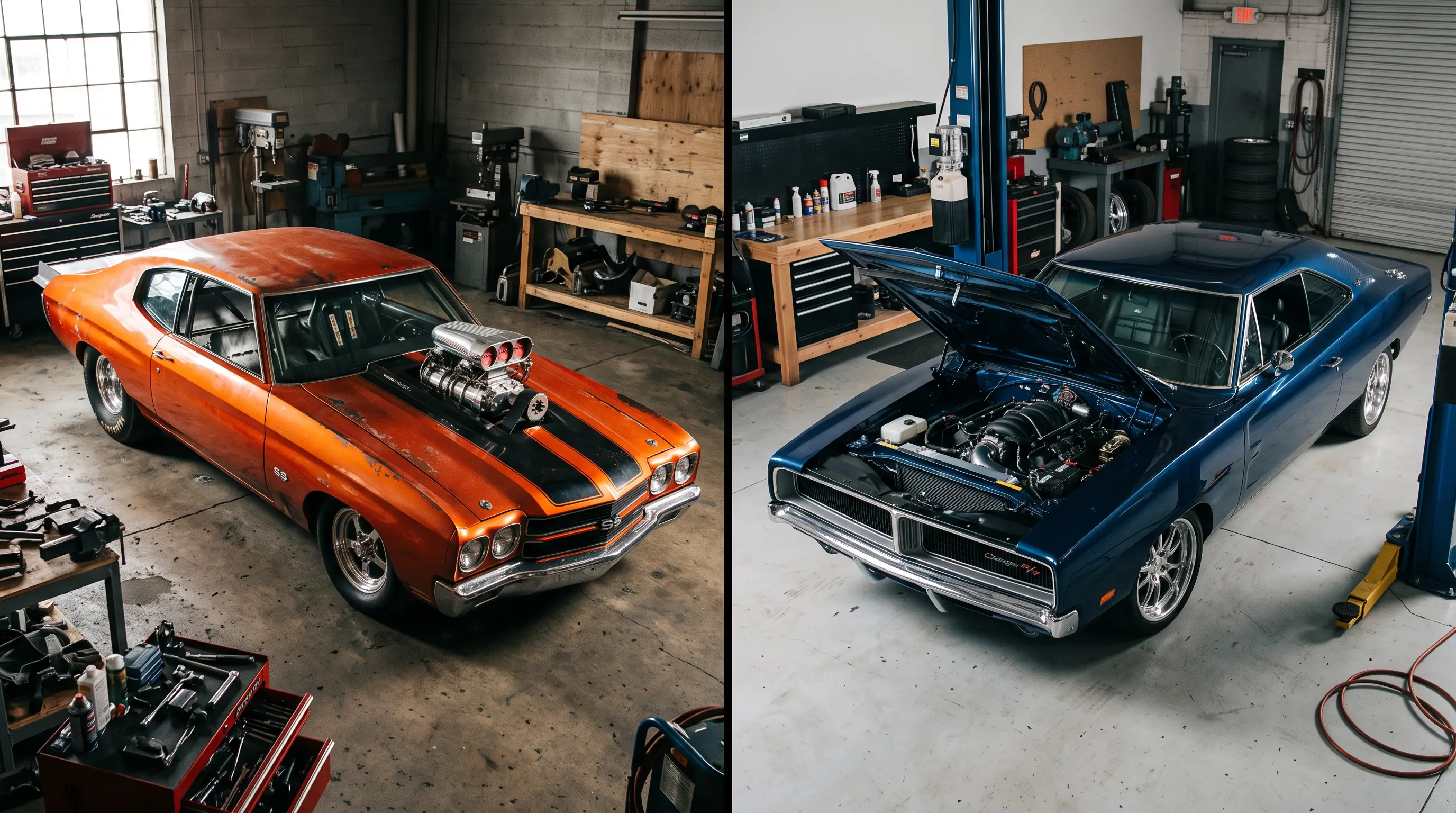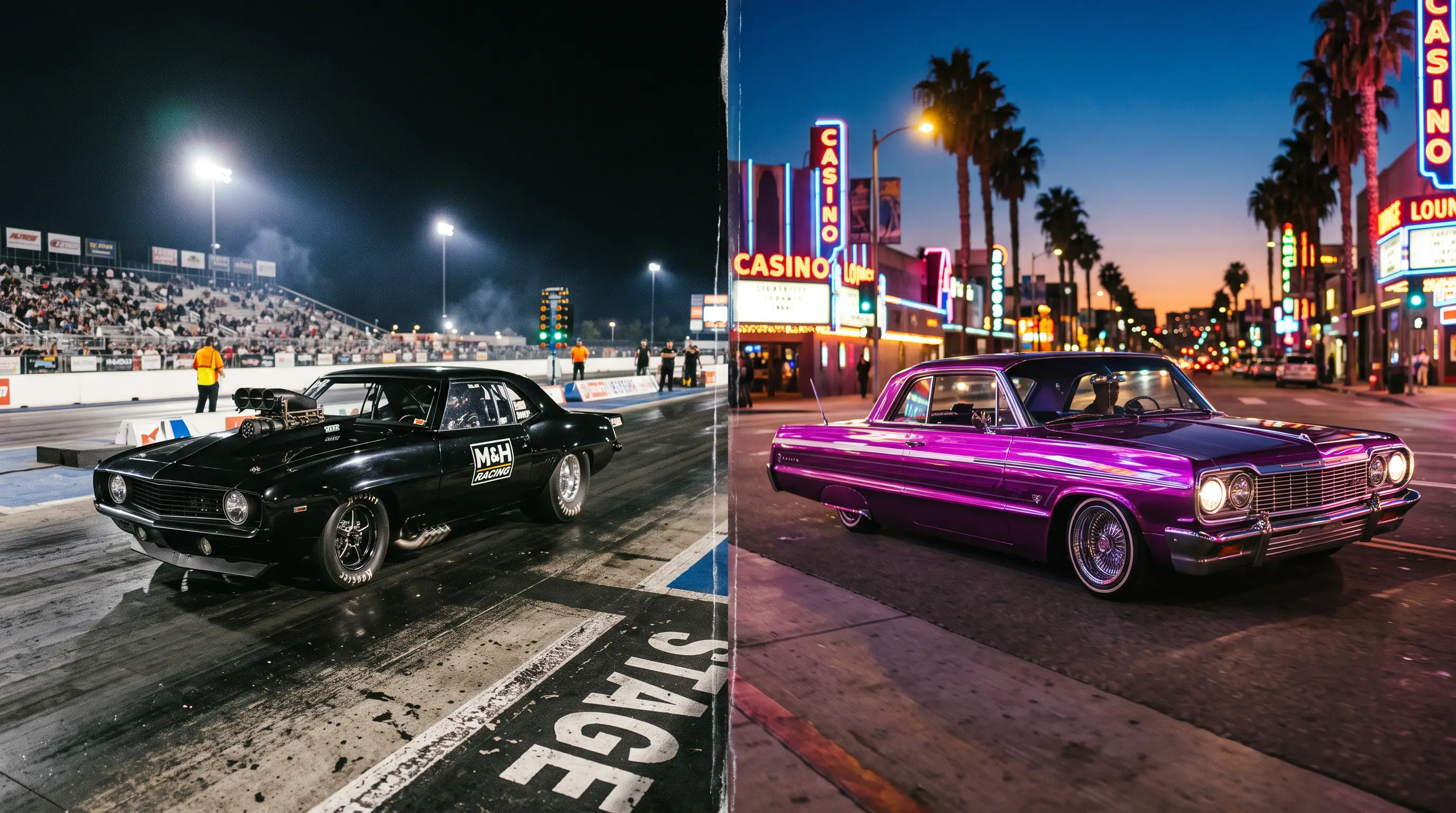
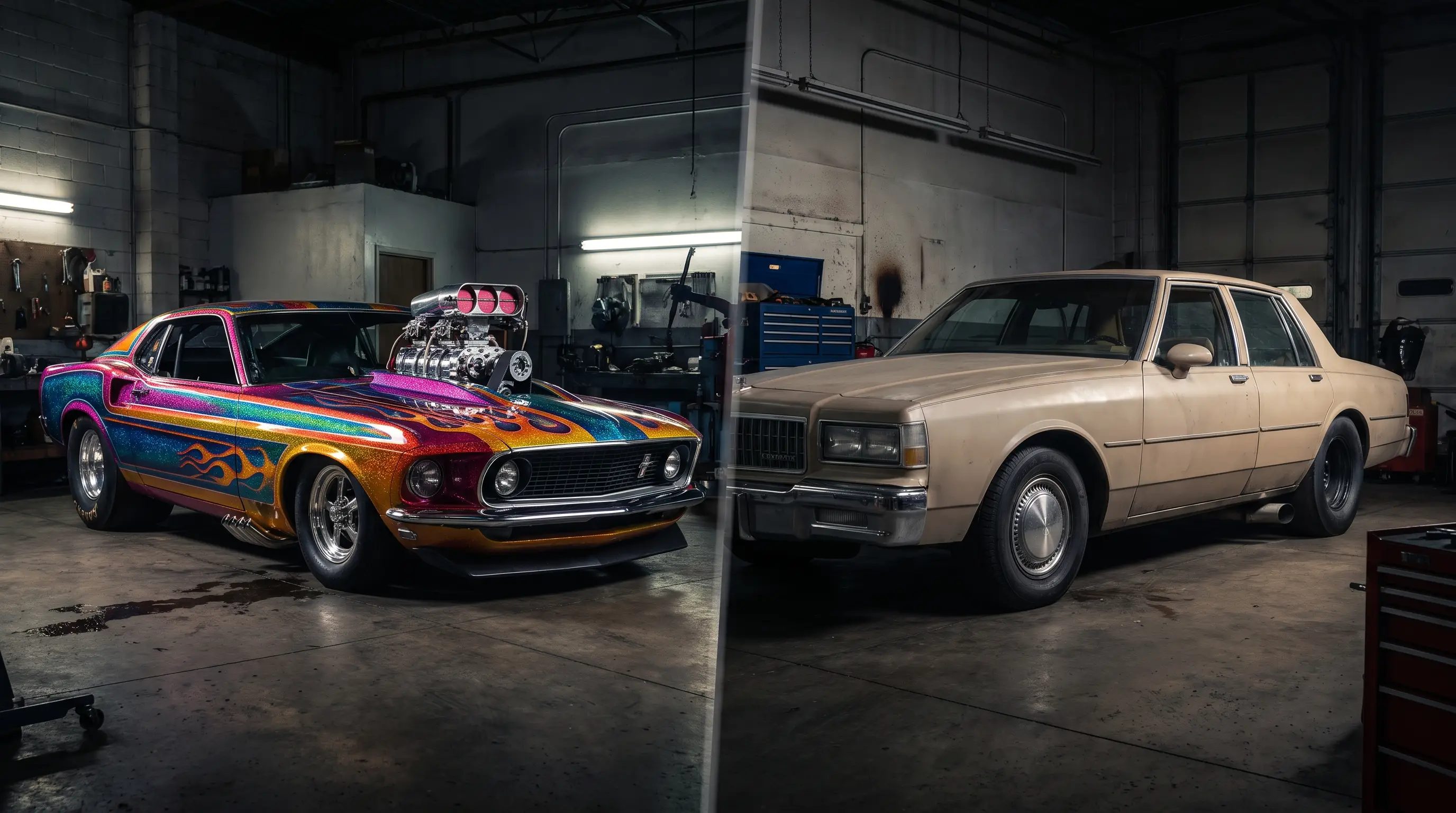
Pro Street and sleeper builds sit at opposite ends of the same drag strip family, and any guy who has spent time around both will tell you the split comes down to one question: does the car want to be noticed. A Pro Street build screams for attention before it even fires up. A sleeper wants to be invisible right up until it isn't. Both grew out of the same muscle-car era and the same street-versus-strip mentality, but the intent behind each one could not be more different.
Pro street vs sleeper, put simply
The Pro Street look came together in the late 1970s and carried through the 1980s and 90s, borrowing straight from Pro Stock drag cars. Tubbed rear wheel wells, a fat rear tire, a narrowed rear end, sometimes a straight front axle, all of it visible from across a parking lot. Nobody built a Pro Street car to blend in. The whole point was letting people know what they were looking at before the engine ever turned over. For the full breakdown of that movement and how it split from other hot rod styles of the same period, the full story is worth reading.
Sleepers hide everything on purpose
A sleeper does the opposite job. Stock-looking wheels, factory paint or something close to it, a body that gives away nothing about what's under the hood. The whole build exists to set up one moment: pulling up next to somebody who has no idea what they're about to see at the next light. Sleepers pull from the same muscle car and hot rod platforms as Pro Street builds, Novas, Camaros, Chevelles, but every visual decision runs backward from what a Pro Street builder would choose. Where Pro Street tubs the rear and shows the tire, a sleeper keeps the stock wheel wells and hides the extra rubber, or skips the big tire altogether and puts the money into the drivetrain instead.
| Trait | Pro Street | Sleeper |
|---|---|---|
| Exterior goal | Aggressive, obviously modified | Stock or near-stock appearance |
| Wheel wells | Tubbed, huge rear tire visible | Stock dimensions, tire tucked in |
| Where the money shows | Stance and body | Nowhere, it's all under the hood |
| The payoff | Immediate visual impact | The surprise at the stoplight |
Building a sleeper is honestly the harder job
Anybody can bolt on scoops and paint a car loud. Building a real sleeper takes more restraint than most guys have. You've got serious horsepower crammed into a body that has to look boring, which usually means smaller tires than you'd want, a suspension that has to work harder to put power down without the extra rubber a Pro Street car gets to run, and a driver who has to actually be good behind the wheel because there's no visual intimidation doing any of the work for you. A sleeper wins on substance. A Pro Street car wins on presence and then backs it up.
"A Pro Street car tells you it's fast before it ever moves. A sleeper lies to your face right up until it doesn't. Both take real work, just aimed at different results."
- Mike Sullivan
The parts money goes toward completely different things
On a Pro Street build, a huge chunk of the budget goes into fabrication that has to look good under scrutiny. Tubbing the rear frame rails takes real skill because it has to hold up structurally and still look clean when a judge or a fellow builder leans in for a closer look at a show. On a sleeper, that same money moves into the engine bay and drivetrain. A stronger transmission that can handle the power without giving away the game through noise or shifting behavior, a rear end built to survive launches without a telltale sound, an exhaust that stays quiet enough at idle to not tip anybody off. Neither build is cheap. The money just points in opposite directions depending on what the car is trying to prove.
Interior choices give away the philosophy too
Sit inside a period Pro Street car and you'll usually find a stripped-down cabin built for weight savings and drag strip focus, sometimes with a roll bar visible right behind the front seats, an obvious signal that this car means business. A sleeper's interior tells the opposite lie. Factory-style seats, a stock-looking dash, carpet that matches what left the factory, nothing to suggest the car underneath has been touched at all. Owners who take sleeper building seriously will even go out of their way to keep factory badging intact, because a missing emblem or an aftermarket gauge cluster is exactly the kind of small detail that gives a sleeper away to somebody who knows what to look for.
Reliability tells a different story too
A Pro Street car built right in period still needed to survive real street use, cold mornings, stop and go traffic, the occasional cop wondering what exactly that huge tire is doing on a public road. A sleeper faces the same demands but with even less margin for error, because a blown head gasket or an overheating engine draws exactly the attention the whole build was designed to avoid. Owners of good sleepers tend to be meticulous about maintenance for that reason. The whole disguise falls apart the moment the car breaks down in a way that gives away what's really under the hood.
Both scenes trace back to the same drag strip roots
It's worth remembering that neither philosophy invented itself out of nowhere. Both came out of a drag racing culture that valued winning over showing off, at least at the actual starting line. Pro Street just chose to advertise that mindset on the outside of the car, while sleeper builders decided the winning part mattered more than anyone knowing about it beforehand. Go back far enough into either scene's history and you'll find the same handful of engine builders, the same speed shops, and often the same street corners where both kinds of cars used to gather on a Friday night, arguing over which approach actually proved more about a builder's skill.
Which build suits your personality
If you like the reaction of heads turning before you've even pulled up, Pro Street rewards that instinct directly, and there's a strong surviving population of period-correct cars for anyone chasing an authentic build from the golden years. If you'd rather let the car do the talking after the fact, a sleeper build asks for more patience and more restraint but pays off in a completely different kind of satisfaction. Either direction starts from the same well of platforms, so if you're hunting for a starting point, browse classic Pro Street car listings and see what's out there before deciding which philosophy fits the way you actually want to drive.