Everybody at the club had a theory until somebody pulled the paperwork, and just like that the bench-racing was over. That's how most conversations about "the rarest Charger option" end up going. Somebody swears their car has the rarest combination anyone's ever seen, three other guys swear theirs is rarer, and it takes an actual broadcast sheet on the table to settle who's right.
I've sat through enough of these arguments over the years to know the Hemi engine option isn't usually where the real rarity hides. Everybody already knows the Hemi cars are scarce and expensive, so that story gets told constantly. The genuinely rare stuff tends to be quieter options that never made it into the magazine ads, things that show up on a build sheet and make a documentation guy sit up because he's only seen the combination a handful of times in decades of doing this.
The A833 four-speed paired with unusual rear gear ratios
One combination that comes up at club meets more than people expect is a documented four-speed manual paired with an axle ratio on the steeper end of what Chrysler offered that model year. Most buyers ordering a four-speed performance car went with a middle-ground gear ratio that balanced highway drivability with acceleration. The cars that got the steepest available ratio alongside the four-speed were ordered by buyers who wanted maximum acceleration and didn't care much about highway cruising, and that's a smaller slice of an already small four-speed population.
Finding a car today with the original rear end still intact and matching the broadcast sheet gear code is harder than it sounds, because rear ends got swapped constantly over the decades, either from failure, from an owner wanting a different ratio for daily driving, or from a previous restoration that installed whatever axle happened to be available rather than sourcing the correct original.
| Option combination | Why it's rare | Verification source |
|---|---|---|
| 4-speed with steep axle ratio | Low take rate, frequently swapped later | Broadcast sheet gear code |
| Factory power sunroof (M51) | Genuine factory option, very low take rate | 928-prefix sales order number, Mopar Sunroof Registry |
| Certain interior trim and color combinations | Low order volume for specific pairings | Fender tag trim code |
| Special order exterior colors | Non-standard paint requested through dealer | Factory correspondence, rare to survive |
The factory sunroof: rarer than the Hemi, and fully documented
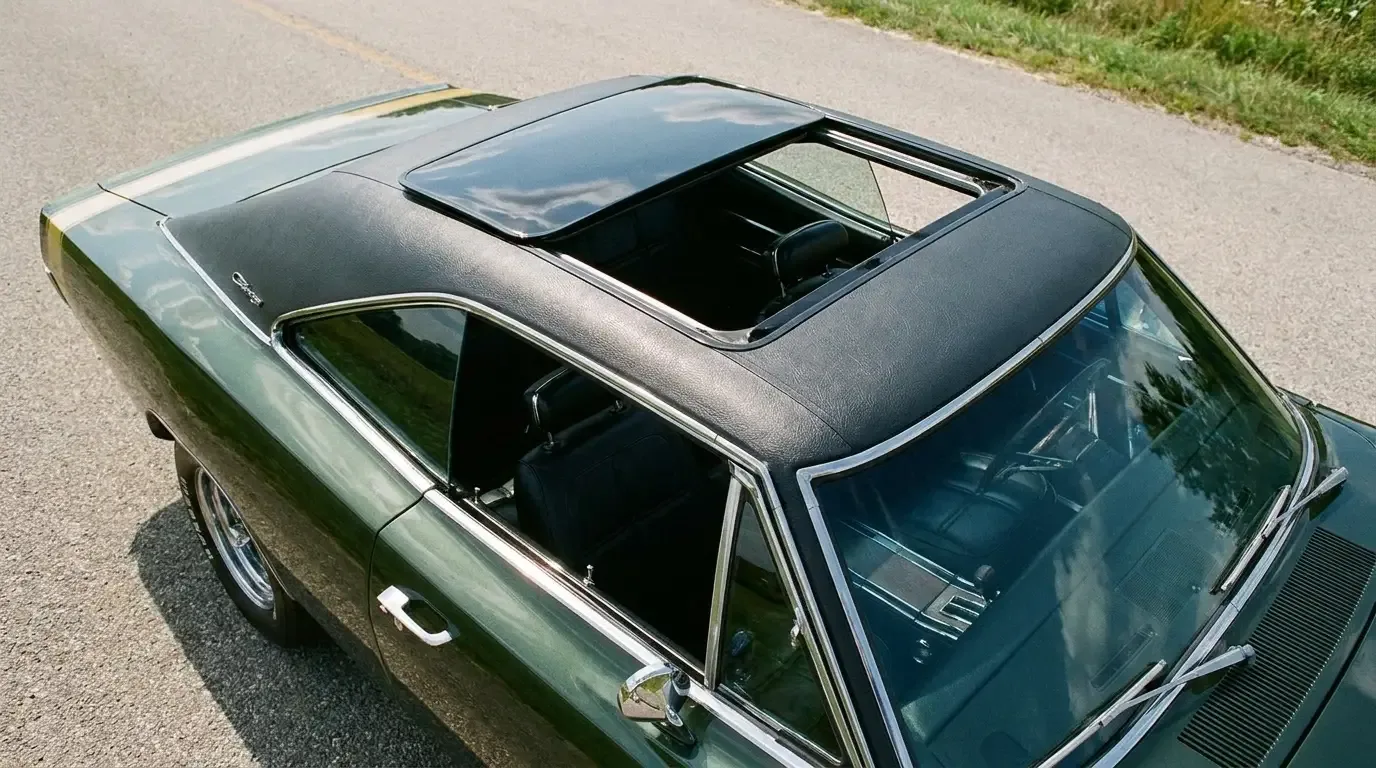
This is the one people argue about the most, usually because they assume a sunroof on a muscle-era Charger has to be aftermarket. It doesn't. Chrysler offered a genuine factory power sunroof, option code M51, and the Mopar Sunroof Registry has been tracking these cars for years. Fewer than 5,000 were installed across all Chrysler lines from 1969 through 1972, and the Charger accounted for more of them than any other single model. For 1969 specifically, roughly 391 Chargers left the factory with the sunroof, split around 260 base cars and 131 R/T models, which is a smaller number than the 426 Hemi's production run that same year.
The catch is documentation, because M51 doesn't stamp onto the fender tag the way most option codes do. Factory sunroof cars instead carry a special six-digit sales order number, and genuine ones begin with 928. If you're looking at a car with a sunroof, that order number and the Registry are what separate a real factory car from a roof somebody cut open decades later, because the mechanism itself is easy enough to fake for someone determined to do it.
Special-order paint and the dealer correspondence problem
Chrysler dealers could, in certain circumstances, special order a paint color outside the standard factory chart for a customer willing to pay for it and wait for it. These cars exist, but proving one is genuine requires something most owners don't have anymore: the actual dealer paperwork or factory correspondence authorizing the special order. Without that paper trail, a non-standard color reads exactly the same as an unauthorized repaint decades later, and there's no way to tell the two apart just by looking at the car.
This is where club knowledge actually earns its keep. Long-time members who've tracked specific cars through multiple owners sometimes hold the missing piece of a puzzle nobody else has, a photograph from a 1971 car show, a mention in an old newsletter, something that corroborates a special-order claim that would otherwise be unverifiable. That's not documentation in the formal sense, but it's better than nothing, and it's the kind of detail that turns up at club gatherings more often than in any official archive.
- Verify a factory sunroof by its 928-prefix sales order number and the Mopar Sunroof Registry, not just the presence of the mechanism.
- Verify axle ratio combinations against the broadcast sheet gear code, since rear ends are commonly swapped over the decades.
- Don't dismiss "boring" trim and color combinations as common. Some of them have lower survival and original documentation rates than flashier options.
- Ask around at club meets and shows. Long-standing members sometimes hold photographic or anecdotal corroboration that formal records don't capture.
"Everybody at the club had a theory until somebody pulled the paperwork, and just like that the bench-racing was over."
— Wayne Coburn
None of these rare combinations replace the value of a documented Hemi or R/T car, and nobody's arguing they should. But if you're chasing something genuinely uncommon and you've already accepted you won't land a numbers-matching Hemi at a price that makes sense, these quieter option combinations are worth understanding, both for what they're worth and for how hard they are to fake convincingly. For the fuller picture of where these options sit within the model's broader history, the second-gen Charger chapter lays out the production context, and read more here on how the 1968 model year set the stage for the option lists that followed.
If you want the complete story of this model from 1966 through 1978, the Charger guide on Classic Cars Arena ties every generation together. And for buyers actually shopping right now, there are 1970 Dodge Chargers for sale representing the final year of this body style's production run, some of which carry exactly the kind of documented rare option combinations discussed here.
Sources and notes
- Mopar Sunroof Registry: 1969 Charger sunroof cars - confirmed the factory power sunroof (code M51) and the roughly 391 1969 Chargers so equipped.
- Autoevolution: 1969 Charger SE factory sunroof - verified the 260 base / 131 R/T split and the 928-prefix order-number identifier.
- Mopar Connection: factory sunroof Charger - background on how M51 is documented and why it's easily faked without the paperwork.
- Allpar: Dodge Charger 1968 - 74 - reference on the A833 four-speed, axle-ratio options, and SE trim.
- Wikipedia: Dodge Charger (1966 - 1978) - context on option availability across the second-generation years.