
Every club has a fellow who brings a Mach 1 to the spring meet and tells you, before you have finished your coffee, that it is the real thing. Sometimes it is. Sometimes the stripes are right, the hood pins are right, the honeycomb panel is right, and the car still started life as a plain SportsRoof with a six. The way to settle it is the same every time: put the paperwork on the hood and read it. A real Mach 1 Mustang tells you who it is in a handful of stamped codes, and a tribute car, however honest its owner, cannot match all of them at once.
Car Features
8 min read
Real Mach 1 or Tribute? What the Paperwork Shows
Real Mach 1 or tribute? VIN body codes 02 and 05, door-tag codes 63C and 63R, engine letters, and what a Marti Report can and cannot prove.
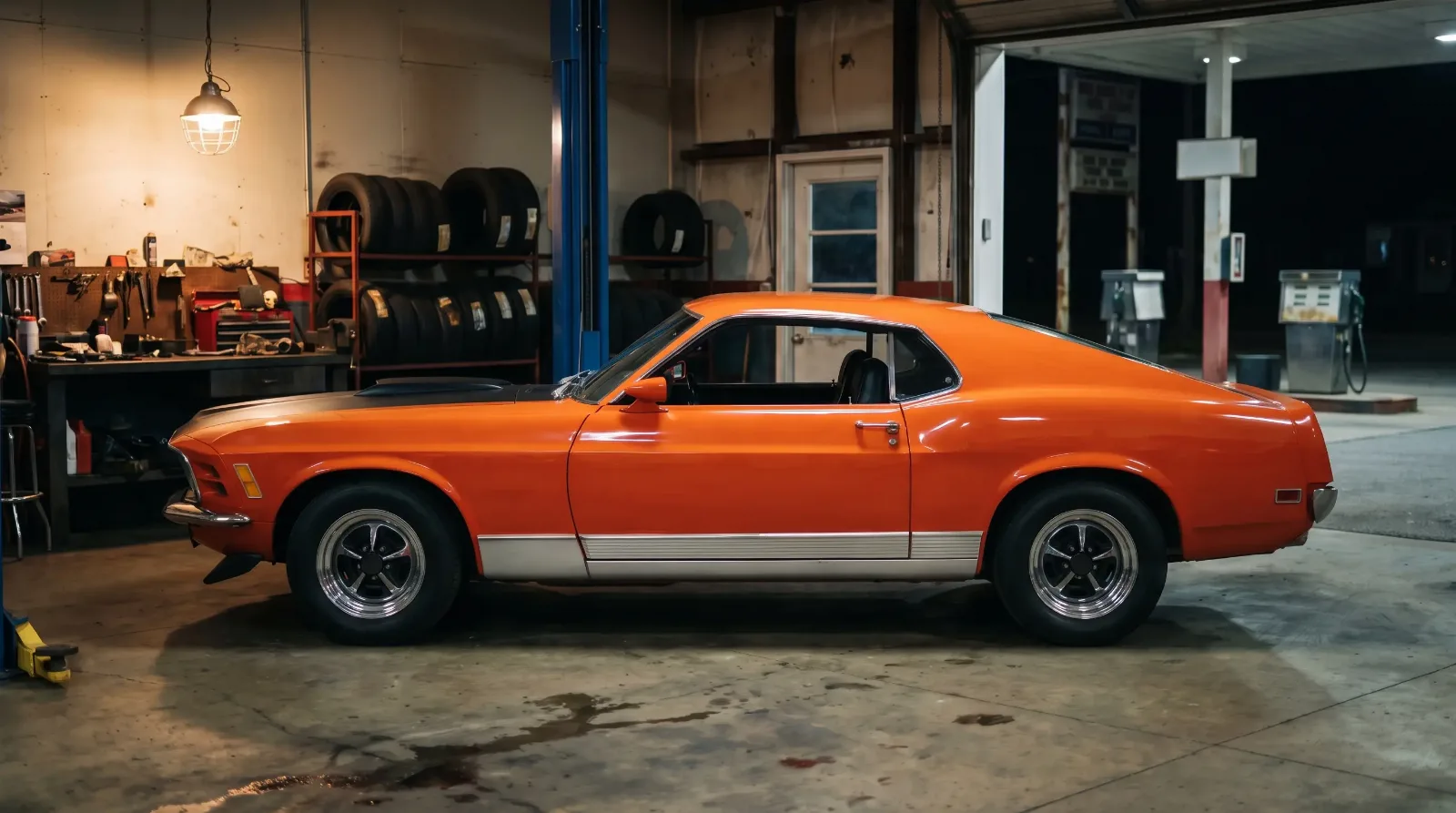
None of this is a knock on tributes. Plenty of handsome cars wear Mach 1 trim with nobody pretending otherwise, and the hobby is richer for them. The trouble starts when the story and the paperwork drift apart. The general method for reading Ford's codes is laid out in the details of our identification guide. This piece stays on one question: was this car built as a Mach 1?
Why the Mach 1 is such an easy costume
The Mach 1 arrived for 1969 as a SportsRoof-only performance model, and Ford sold it by the tens of thousands: 72,458 in that first year, 40,970 in 1970, 36,499 in 1971, 27,675 in 1972 on the most-cited count and 35,440 in 1973. Every one of them shared its basic body with the plain SportsRoof, a car Ford also built in quantity, 61,980 of them in 1969 counting the Boss cars. That is a deep pool of donor bodies, and the parts that made a Mach 1 look like a Mach 1 were mostly bolted, taped or painted on.
Look at what the cars wore. The 1969 Mach 1 had reflective side stripes, a matte-black hood with hood pins and an optional Shaker scoop. The 1970 car added a grille with two simulated driving lamps, an argent lower body panel with MACH 1 lettering, twist-type hood locks and a black honeycomb rear panel. By 1971 there was a hood with NACA ducts, functional only with Ram Air, and for 1972 the pop-open gas cap gave way to a twist-on one. Every one of those pieces can be bought today, and a tidy weekend with a parts catalog will make a base SportsRoof look right from twenty feet. That is why nobody who judges these cars looks at the stripes first. If it is the car's own history you are after rather than its paperwork, the Mach 1 Mustang story sits with the Boss cars in our performance coverage.
What the VIN says about a real Mach 1 Mustang
Start with the VIN plate on the dash, visible through the windshield on these years. The first character is the model year, the second is the assembly plant, the next two are the body code and the fifth is the engine. On a 1970 to 1973 car the body code does most of the work: a Mach 1 carries 05, and a plain SportsRoof carries 02. A clone builder who wants an 05 has to start altering the VIN itself, which takes the conversation out of the hobby and into a different kind of trouble.
The 1969 car is where the bench-racing gets lively. That year Ford gave the Mach 1 no VIN body code of its own. A 1969 Mach 1 carries 02, exactly like any other fastback, so a 1969 VIN alone cannot prove the car was a Mach 1. It can still rule a car out. The 1969 Mach 1 was a V8 car: the standard engine was the 351 Windsor two-barrel, H-code, rated at 250 horsepower, with the 351 four-barrel, the 390 and the 428 Cobra Jet on the option list. A 1969 SportsRoof with a T or an L in the engine position, meaning a 200 or 250 six, was never a Mach 1.
Always read the letter together with the year. Ford reused engine codes, so R meant the 428 Cobra Jet with Ram Air in 1969 and 1970, the Boss 351 in 1971 and the 351 HO in 1972. A 1971 Mach 1 came standard with the 302 two-barrel, F-code, rated at 210 horsepower, so an F on a 1971 car is perfectly correct. The same F on a 1969 car means a 302 two-barrel, and the 1969 Mach 1 list started at the 351, so that car was not built as a Mach 1. From 1968 on, Ford also stamped a partial VIN on the engine and transmission, which lets you check whether the drivetrain grew up in this body or arrived later.
The door tag: 63C and 63R
Now open the driver's door and read the data plate. This is where the 1969 owner gets his evidence back. The door-tag body code for a 1969 or 1970 Mach 1 is 63C, and for 1971 to 1973 it is 63R. Where the 1969 VIN shrugs, the door tag speaks up.
The catch is that a door tag is riveted to a door, and doors get swapped after accidents. That is why a careful judge never takes one piece of metal on its own. The VIN body code, the door tag, the engine letter and the partial VIN on the engine and transmission should all tell the same story, and when one of them disagrees, that is where the argument starts. The plant letter matters too: it should match on the VIN and the tag, and Ford's plant codes have their own history if you want to read more here. On the 1971 to 1973 cars there is often one more witness, a buck tag fitted before paint, which owners usually find on the radiator support behind a headlight bucket. Decoded examples show the year and plant along with the body code, 63R on a Mach 1, though the layout varies by plant and many tags have gone missing over the years.
| Model year | VIN body code | Door-tag body code | Standard engine | Mach 1 production |
|---|---|---|---|---|
| 1969 | 02 (same as any fastback) | 63C | 351W 2V, H-code, 250 hp | 72,458 |
| 1970 | 05 | 63C | 351 2V (Windsor or Cleveland), H-code, 250 hp | 40,970 |
| 1971 | 05 | 63R | 302 2V, F-code, 210 hp | 36,499 |
| 1972 | 05 | 63R | 302 2V, F-code | 27,675 (some tables swap it with the Grande's 18,045) |
| 1973 | 05 | 63R | 302 2V, F-code | 35,440 |
Marti Reports, build sheets and the paper trail
Then come the documents drawn from Ford's own records. A Marti Report is built from Ford's production database, Marti Auto Works is the only licensee, and coverage runs from the 1967 model year onward, so every first-generation Mach 1 is in there. For a 1969 car with 02 in its VIN, a report showing the Mach 1 is the cleanest proof you can put on the hood.
It helps to know what a Marti Report is and what it is not. It lists the options the car left the factory with. It does not list dealer add-ons, and it does not judge whether the car in front of you is honest or what shape it is in. The report describes a VIN. Tying that VIN to the metal is still your job, and that is where the door tag and the stamped drivetrain come back in.
The paper that turns up by luck can be the most persuasive of all. Build sheets are often found under the carpet or the seats during a restoration, and a folded, greasy sheet has ended more arguments than any amount of talk. The Henry Ford holds no Mustang assembly records, and points owners to the data plate instead. An original window sticker is good evidence too, if it survives.
"I have watched a lot of good arguments end at a door jamb. The stripes start the conversation, the tag finishes it, and the kindest thing you can do for a tribute owner is let the paperwork talk first. After that, you can admire the car for exactly what it is."
Wayne Coburn
When the Mach 1 name moved to the Mustang II
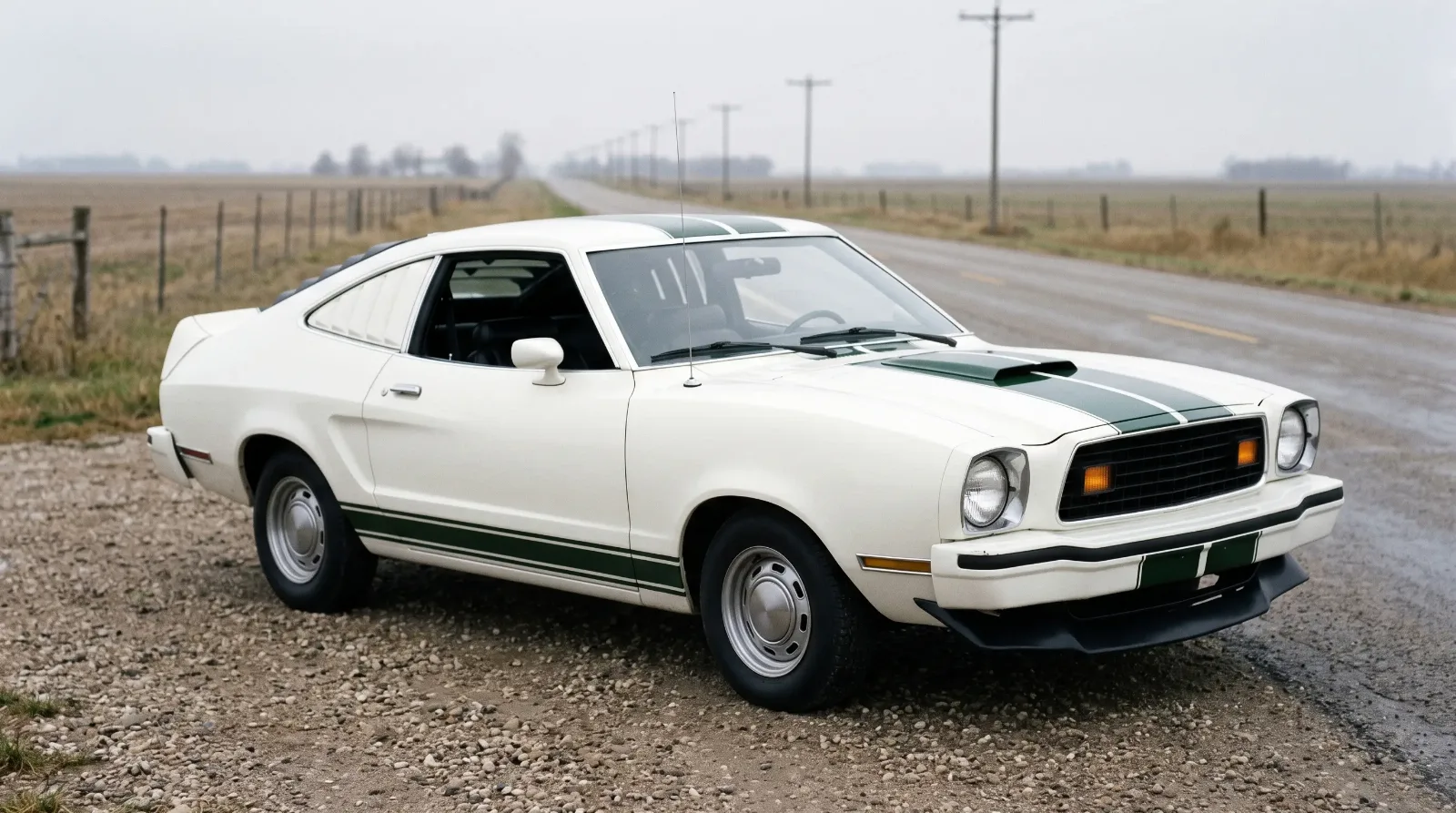
The name did not stop in 1973. The Mustang II carried the Mach 1 from 1974 through 1978 as a hatchback with the 2.8 V6 standard, and Ford built 44,046 of them in 1974 alone. Its VIN uses body code 05 as well. The same habit applies to these cars, read the codes before the decals, but the tags and VINs of the later generations follow their own rules.
Back at the spring meet, the fellow with the Mach 1 usually does not mind the questions. If the car is real, the codes are the best compliment it will ever get. If it is a tribute, a good one is still a fine thing to own, so long as everybody at the table knows which kind of car they are looking at.
Sources and notes
Related Reading

Have a
Ford Mustang
for Sale?
Reach thousands of serious classic car collectors across the US.
Sell It Here →
Selling a classic? Here's how: the best sites to sell a classic car
Are You a Classic Car Dealer?
List your full inventory and connect with targeted classic car buyers.
Join as a Dealer →
#mustang identification
#Ford Mustang
#1969 mustang
#Mach 1
#marti report
#door data plate
#Mustang VIN

About the author
Wayne Coburn
Longtime Corvette owner, judge and club figure who knows the cars, the records and the people behind them.
Related Listings - Ford Mustang

Comments
Be the first to comment on this article.