
Roush Mustang history in the 1990s is mostly written in race results and engineering credits, not on window stickers. That distinction matters if you are buying, because "1990s Roush Mustang" can mean a genuine late-decade Roush car or an ordinary Mustang wearing Roush parts, and the two are priced very differently. Jack Roush's company prepared championship Trans-Am cars, supported Ford's own Mustang engineers and modified the cars that paced the 1994 Indianapolis 500. Its own street cars came only at the end of the decade, as Stage 1, 2 and 3 packages on the SN95 Mustang from about 1997. Ford's in-house tuners and Steve Saleen's shop filled the decade's showrooms, and they get their own treatment in the SVT Cobra and Saleen chapter. This piece covers where Roush actually sat in those years, and what that means for a car's value now.
Roush and the 1990s Mustang Tuners
Roush Mustang history in the 1990s: Trans-Am titles, Team Mustang support and the 1994 pace cars, and why a 1990s Roush street car needs paperwork.
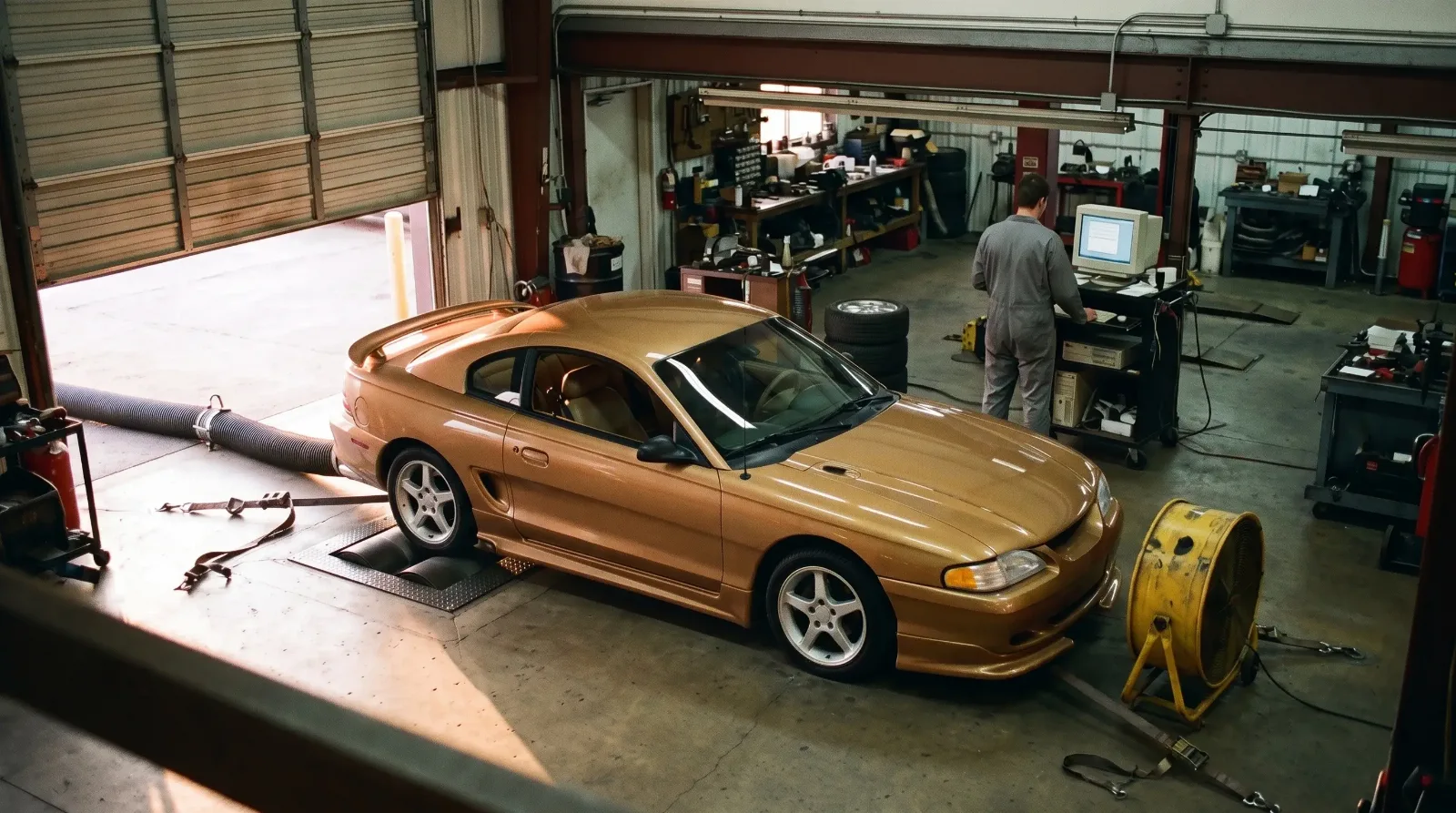
Roush Mustang history begins at the race track
Jack Roush bought his first Mustang in 1964, while he was working at Ford, according to his Mustang Club of America Hall of Fame entry. He went on to field Ford teams in GTX, GTP, IMSA and Trans-Am. That is the frame for everything that follows. Roush entered the 1990s as a racing contractor with deep ties inside the company, not as a consumer brand.
The Trans-Am record is the cleanest paper trail. In 1989 a Roush Mustang driven by Dorsey Schroeder won Ford's first Trans-Am title since 1970. That car was a Fox body, so it sits just before the decade, but it set the pattern. In 1997 Tommy Kendall won the first 11 of 13 rounds in a Mustang, a record run of straight wins, and Ford swept the series. Kendall's 1997 car was Roush-prepared. He had also won Trans-Am titles in 1990, 1995 and 1996, and the 1997 championship was his third in a row.
Those results are well documented. They also do not transfer. A 1997 GT bought new from a Ford dealer has no more connection to Kendall's race car than any other 1997 GT, and a careful seller will say so before you ask.
Inside the program: Roush and Team Mustang
The quieter role is the more interesting one. The MCA Hall of Fame credits Roush's company with working closely with Team Mustang, supporting development of all Mustangs from 1990 to 2004. That window covers the whole SN95 program and the 1999 New Edge cars. It also covers SVT's first four-valve car, the 1996 Cobra, and we tell the full story of that car separately. What the record does not say is which parts or systems Roush engineered on which production cars. Until someone produces a document, treat any "Roush developed" claim about a specific showroom Mustang as unproven.
The one case with real detail is the 1994 Indianapolis 500. Three SVT Cobra convertibles served as the actual track pace cars, and Jack Roush modified them in Allen Park, Michigan. The list reads like a race shop work order: heavy-duty four-speed automatics, 15-gallon racing fuel cells, heavier rear springs to carry the weight of TV cameras, a Halon fire system, a rollbar with built-in strobes and lights in the rear spoiler. Ford also built 1,000 Rio Red Cobra convertible replicas for the public. Nothing on record ties the Roush race equipment to those replicas, so value one as a replica and nothing more.
Roush Performance and the 1995 start
Roush Performance was founded in 1995 by Jack Roush in Livonia, Michigan, and it began as a parts business. Its first product line sold performance parts for Fords. A one-off Roush SN95 development car with its own body kit, side pipes and cowl induction intake was tested by Super Ford magazine in its March 1996 issue, and the first Stage 1 body kit was loosely based on it.
Complete cars followed. From about 1997 Roush offered the SN95 Mustang in three tiers. Stage 1 was mostly appearance: 17-inch wheels, a lowered suspension, side-exit exhaust, a front air dam, side skirts and a rear spoiler. Stage 2 added more suspension work, with uprated springs, bars and dampers. Stage 3 added engine work on the V8. Accounts disagree on when Roush moved the work in-house; one says the earliest packages were fitted by outside shops before Roush began building the cars itself by 1997. They also disagree on how early Stage 3 cars made their extra power, so treat any quoted horsepower figure for a 1990s Stage 3 as something to verify on the car.
The later, better-known editions came after the decade: the 360R of 2002 and the 380R for 2003 and 2004 are the earliest named limited editions listed for the company. For a 1990s car, the Stage packages are the whole story. Because Roush also sold the same kind of parts over the counter, a Mustang wearing Roush pieces is not automatically a Roush-built car. Possibility is not provenance. Until a buyer sees Roush documentation tied to the VIN, it is a Mustang with aftermarket parts, and it should be priced that way.
The recognition came later and is easy to confirm. Jack Roush entered the MCA Hall of Fame in 2002 and the International Motorsports Hall of Fame on April 27, 2006.
Roush beside the other 1990s Mustang tuners
Set Roush next to the decade's other names and the difference is plain. SVT was Ford's own team; its first car, the 1993 Cobra, was shown at the 1992 Chicago Auto Show, and 4,993 were built. Saleen was a separate manufacturer in Corona, California, selling complete cars under its own model names: the S351 from 1994, a supercharged V-6 Sport rated at 220 hp the same year, and the SR from 1995. The MCA calls Saleen the highest-volume niche Mustang manufacturer in the world. Roush, for most of the same years, worked upstream of both, in the race shop and alongside Ford's engineers, and its own Stage cars arrived only late in the decade.
| Name | What it was | 1990s Mustang output on record | What a buyer can document |
|---|---|---|---|
| Roush | Racing contractor and engineering partner; Roush Performance founded 1995 | Roush-prepared Trans-Am cars; the three 1994 Indy track pace cars; Stage 1, 2 and 3 SN95 packages from about 1997 | Race history for specific chassis; Roush paperwork for Stage cars |
| SVT | Ford's in-house Special Vehicle Team | 1993 Cobra (4,993 built); 1995 Cobra R (250); 2000 Cobra R (300) | Factory VIN and production records |
| Saleen | Separate manufacturer, Corona, California | S351 (1994), V-6 Sport (1994, 220 hp), SR (1995) | Saleen's own model names and serials |
The overlap collectors argue about is the 2000 SVT Cobra R. Two enthusiast sources credit Jack Roush with a large hand in its development, fine-tuning and suggesting parts, but neither says which parts, and we found no Ford record of the work. One auction history adds that a Cobra R buyer who had dynoed the project's engines picked his car's engine and drivetrain with Jack Roush after all 300 engines were tested. The car itself is not in dispute: 300 built, 385 hp and $54,995 when new. We cover the 2000 Cobra R in its own piece. Whatever part Roush played, it is an SVT car, documented and priced as one.
Valuing a car with a 1990s Roush story
From an appraiser's chair, the Roush name in this decade is a documentation question first. Condition can be inspected in an afternoon. Liquidity depends on how many buyers believe the story. Documentation decides whether they should, and it is the piece most of these cars are missing.
"A famous name on a car with no paper behind it is a discount, not a premium. Buyers pay for what can be proven, and with 1990s Roush claims, most sellers can prove very little."
Marcus Feld
If a genuine Roush race car or a documented engineering mule surfaces, it is a different asset entirely and deserves an appraiser who knows the team records. For everything else, buy the Mustang in front of you on its own merits: condition, originality and factory paperwork. Most of Roush's 1990s work sits in the Trans-Am results and in the cars Ford built, and the late Stage cars that do exist are only worth a premium with the paper to prove them.
Sources and notes
- Mustang Club of America: Hall of Fame inductees (Jack Roush, Steve Saleen)
- Wikipedia: Ford Mustang SVT Cobra (1994 Indy pace cars, Cobra R production)
- Wikipedia: Roush Performance
- SlashGear: Everything Ford fans should know about Roush Mustangs
- Supercars.net: 1995 Roush Mustang prototype
- MustangSpecs: 2000 Ford Mustang SVT Cobra R
Related Reading

Accredited collector-car appraiser who reads the market through hammer prices, condition tiers and risk.
Related Listings - Ford Mustang
Comments
Be the first to comment on this article.