
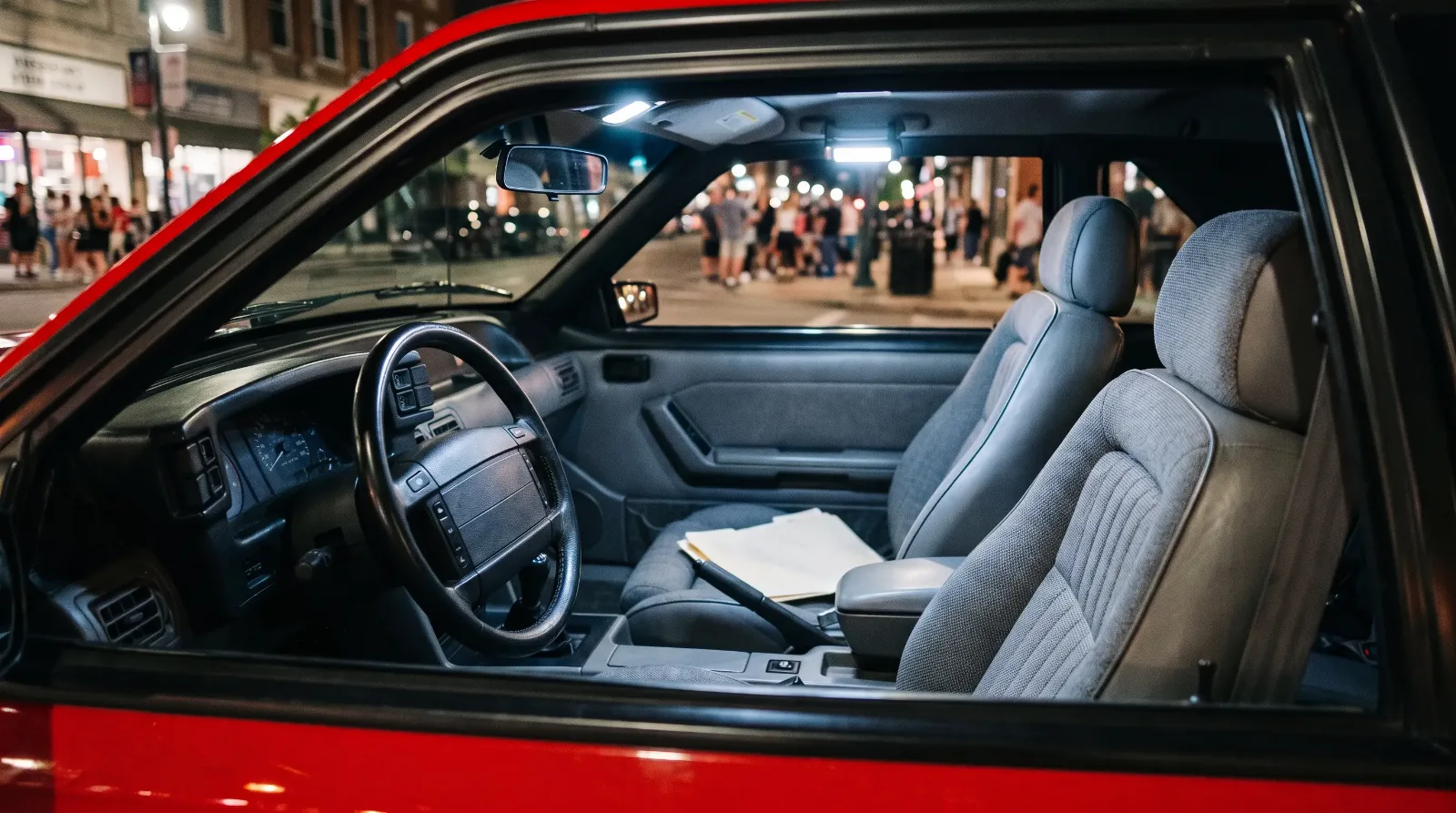
Walk up to an SN95 Saleen at a show and the owner will usually point at two things before the engine: the Saleen serial plate and the folder on the passenger seat. That order is right. The Saleen S351 is a car people love to talk about and a car where the talk runs ahead of the records very quickly. What follows is what the record supports about Saleen's 1994 to 2000 Mustangs, the S351 and the SR, and where the record runs out.
Car Features
6 min read
Saleen's SN95 Cars: The S351 and SR
The Saleen S351 kept a 351 Windsor after Ford moved to the 4.6, and the SR raced at Le Mans. What the records confirm, and what they don't.
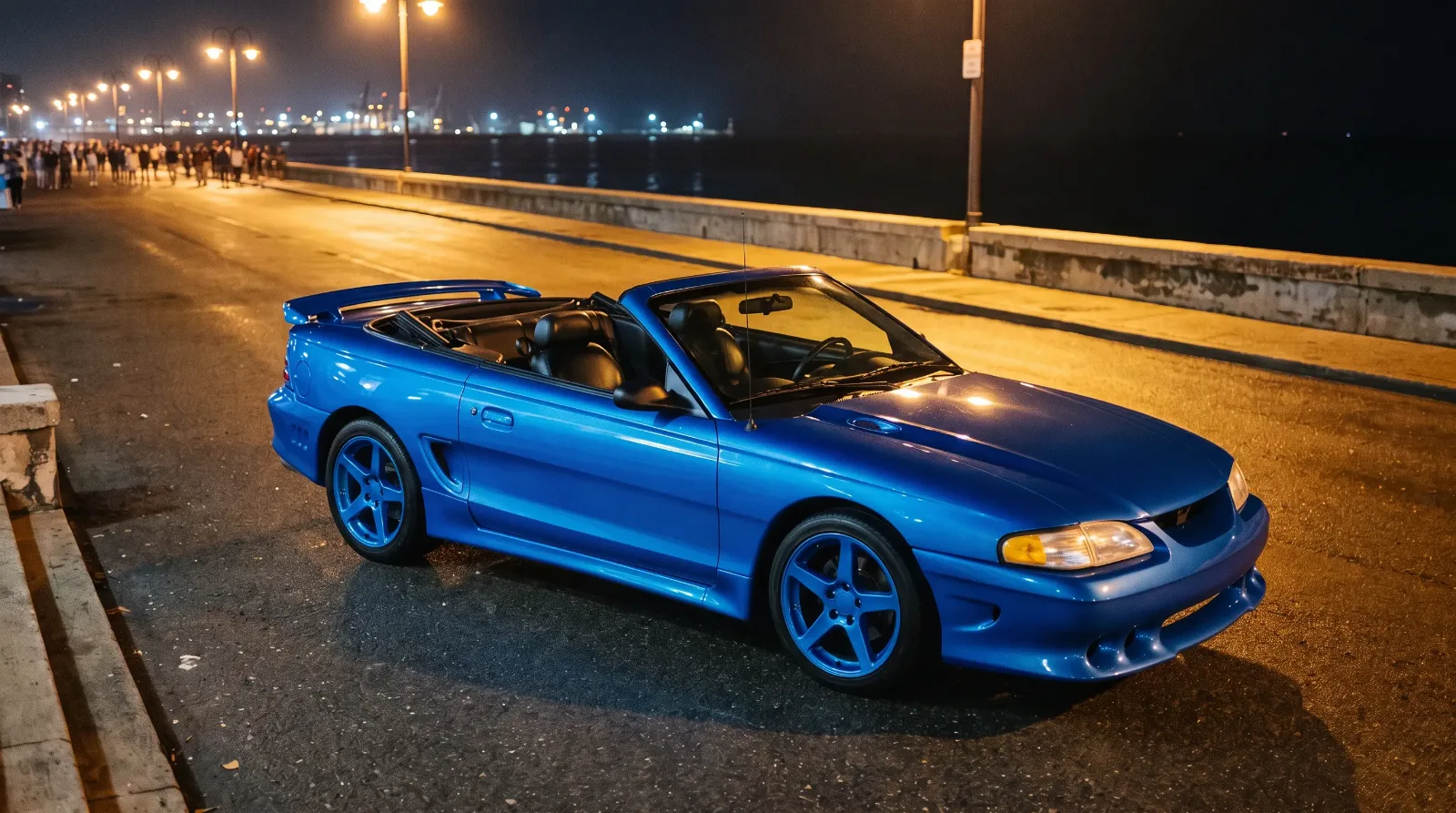
The wider tuner story, from the SVO through the SVT Cobras and Saleen's Fox-era cars, is covered here. This piece stays with the SN95.
Where Saleen stood when the SN95 arrived
By 1994 Saleen was ten years into building Mustangs. Steve Saleen formed Saleen Autosport in 1983 and built his first three cars, all Fox hatchbacks, in 1984. The 1989 SSC had shown how far he would go: 161 cars, rated by Saleen at 292 hp against 225 for the stock 5.0. The company worked out of Corona, California, through the 1990s.
Then Ford changed the car underneath him. The 1994 Mustang was the SN95, and its GT carried a 5.0 rated at 215 hp. Two years later Ford replaced that engine with the 4.6 modular V8. For a tuner whose business rested on the pushrod 302, that was a real problem, and Saleen's answer to it is the reason the S351 exists.
The Saleen S351 and its 351 Windsor
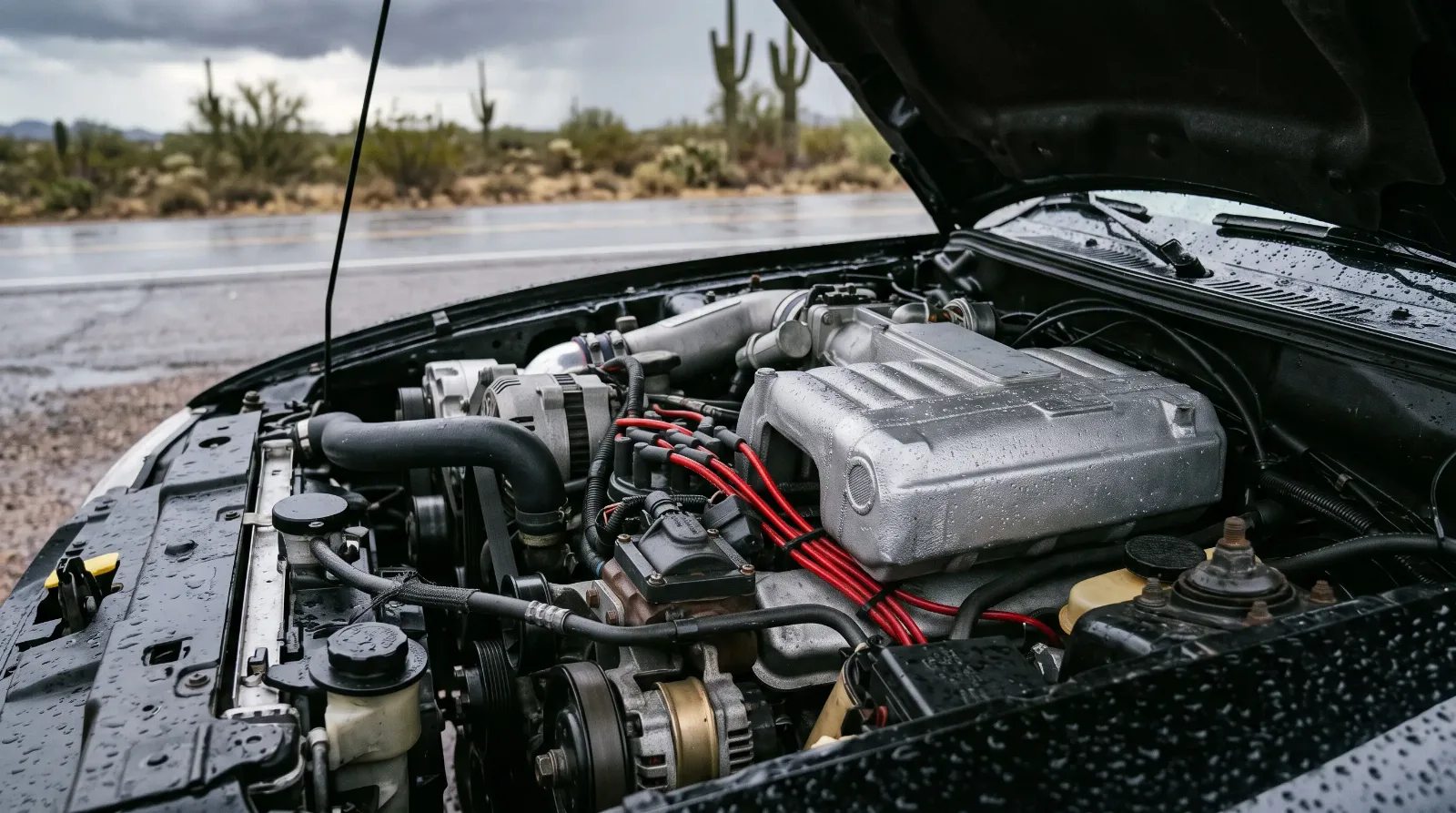
The S351 debuted in 1994 with a Saleen-built 351 cubic inch V8. The name tells you the engine. Rather than tune the 302 that Ford put in the car, Saleen fitted a bigger engine.
The important part comes after 1996. When Ford moved the Mustang GT to the 4.6, Saleen did not follow. It kept developing its own 351 Windsor, and that engine was EPA-certified. That last detail is what separates a production tuner from a shop that swaps engines. As I read it, certification is what let Saleen keep selling new cars with an engine Ford no longer put in the Mustang.
Here is where I have to be straight with you about what the numbers rest on. The figures that hold up come from auction catalogues and club records working from Saleen's own paperwork, not from independent dyno sheets. On that basis, the naturally aspirated S351, with aluminum heads, a hydraulic roller cam, a 65 mm throttle body and ceramic coated headers, is quoted at 370 hp. The R-Code option added a Vortech supercharger, and supercharged cars are quoted at 480 to 495 hp, depending on the source and the year.
They were not cheap. One 1995 S351 convertible carried an original MSRP of $57,266, and the R-Code option alone was listed at $6,244. Production was small. The Saleen Owners and Enthusiasts Club counts 46 S351s for 1994, two of them SRs, and 46 more among the 420 Saleen street cars of 1999. A clean year-by-year total for the whole run has never been published, so treat any other count you are quoted as the seller's figure.
For a sense of scale, there is one Saleen number from 1994 that does hold up. That year Saleen also sold a V-6 Sport with a supercharged V6, rated at 220 hp. That is five more than the stock 1994 GT's V8, from a six-cylinder car.
The SR and the racing that made it
The SR came out of 1995. Saleen developed it alongside a paint partnership with BASF, and it is the car most closely tied to the company's racing program. That same year Steve Saleen formed Saleen/Allen RRR Speedlab with comedian Tim Allen and Bob Bondurant, and the team raced Saleen Mustangs in SCCA World Challenge.
The results came quickly. A Widebody SR won the 1996 SCCA Manufacturers' Championship. In 1998 Saleen took both the SCCA Manufacturers' and Drivers' titles. In between, in 1997, the Speedlab team took a Saleen Mustang SR to Le Mans in the LMGT2 class with a driver lineup that included Price Cobb and Carlos Palau. The car completed 133 laps and did not finish. Palau went on to win the 1999 Spanish GT2 championship with Saleen.
The road-going SR used the supercharged version of the 351, and the stock SR package is quoted at up to 480 hp, with a base price of $49,999 before options. The racing record is solid. The showroom numbers rest on Saleen's literature rather than on independent tests, at least in anything I have been able to check.
| Year | Saleen SN95 milestone |
|---|---|
| 1994 | S351 debuts with a Saleen-built 351; V-6 Sport (supercharged V6, 220 hp) |
| 1995 | SR developed with BASF paint partnership; Saleen/Allen RRR Speedlab formed |
| 1996 | Ford GT moves to the 4.6; Saleen keeps its EPA-certified 351W; Widebody SR wins SCCA Manufacturers' title; Steve Saleen enters MCA Hall of Fame |
| 1997 | Saleen Mustang SR at Le Mans, LMGT2, 133 laps, DNF |
| 1998 | SCCA Manufacturers' and Drivers' titles |
| 1999 | Last S351s: 46 of 420 Saleen street cars; Palau wins the Spanish GT2 title with Saleen |
Checking a Saleen S351 today
This is where the folder on the passenger seat earns its place. A Saleen carries a Saleen registry number alongside the Ford VIN. On the 1989 cars that number uses an 89- prefix, and the SN95 cars follow the same pattern: a two-digit year, a dash and a four-digit number, as on 94-0014 or 95-0030. Either way, a Ford VIN alone proves only that Ford built a Mustang. It says nothing about what Saleen did to it afterward.
The engine adds a second wrinkle. Because the 351 was Saleen's own engine, the Ford VIN describes the car Ford built, not the 351 that went in later. The 1994 coupe 94-0014 carries a VIN that decodes as a 3.8 V6 car, and 95-0030 started life as a five-speed GT convertible whose VIN shows the 5.0. So a VIN that does not show a 351 is not, by itself, a red flag on an S351. A Saleen number with no paper trail behind it is.
"Every S351 I have looked at came with a story about how fast it was. Not one came with a dyno sheet from 1996. The serial plate and the paperwork are what you are buying. The story is free."
Wayne Coburn
Saleen was not the only name building serious SN95 Mustangs. Roush founded its performance business in Livonia, Michigan, in 1995, and the two are often compared. The difference with Saleen's 1990s cars is the 351: after 1996 it set them apart from Ford's own 4.6 GT.
Saleen moved production to a 100,000 square foot facility in Irvine in 2001, after the classic SN95 run had ended. The S351 and SR belong to the Corona years, and the cars that come with their records intact are the ones worth chasing.
Sources and notes
- Saleen (Wikipedia): S351, SR, SCCA titles, Corona and Irvine
- SOEC: First year S351 (94-0014) offered for sale
- SOEC: Closer look, S351 Speedster (99-0012S)
- Hagerty Marketplace: 1995 Saleen S351, serial 95-0030
- Ford Muscle: 1-of-1 yellow Saleen S351 SR
- Carlos Palau (Wikipedia): 1997 Le Mans and 1999 Spanish GT2 title
Related Reading
Have a
Ford Mustang
for Sale?
Reach thousands of serious classic car collectors across the US.
Sell It Here →
Selling a classic? Here's how: where to sell your classic car online
Are You a Classic Car Dealer?
List your full inventory and connect with targeted classic car buyers.
Join as a Dealer →

About the author
Wayne Coburn
Longtime Corvette owner, judge and club figure who knows the cars, the records and the people behind them.
Related Listings - Ford Mustang

Comments
Be the first to comment on this article.