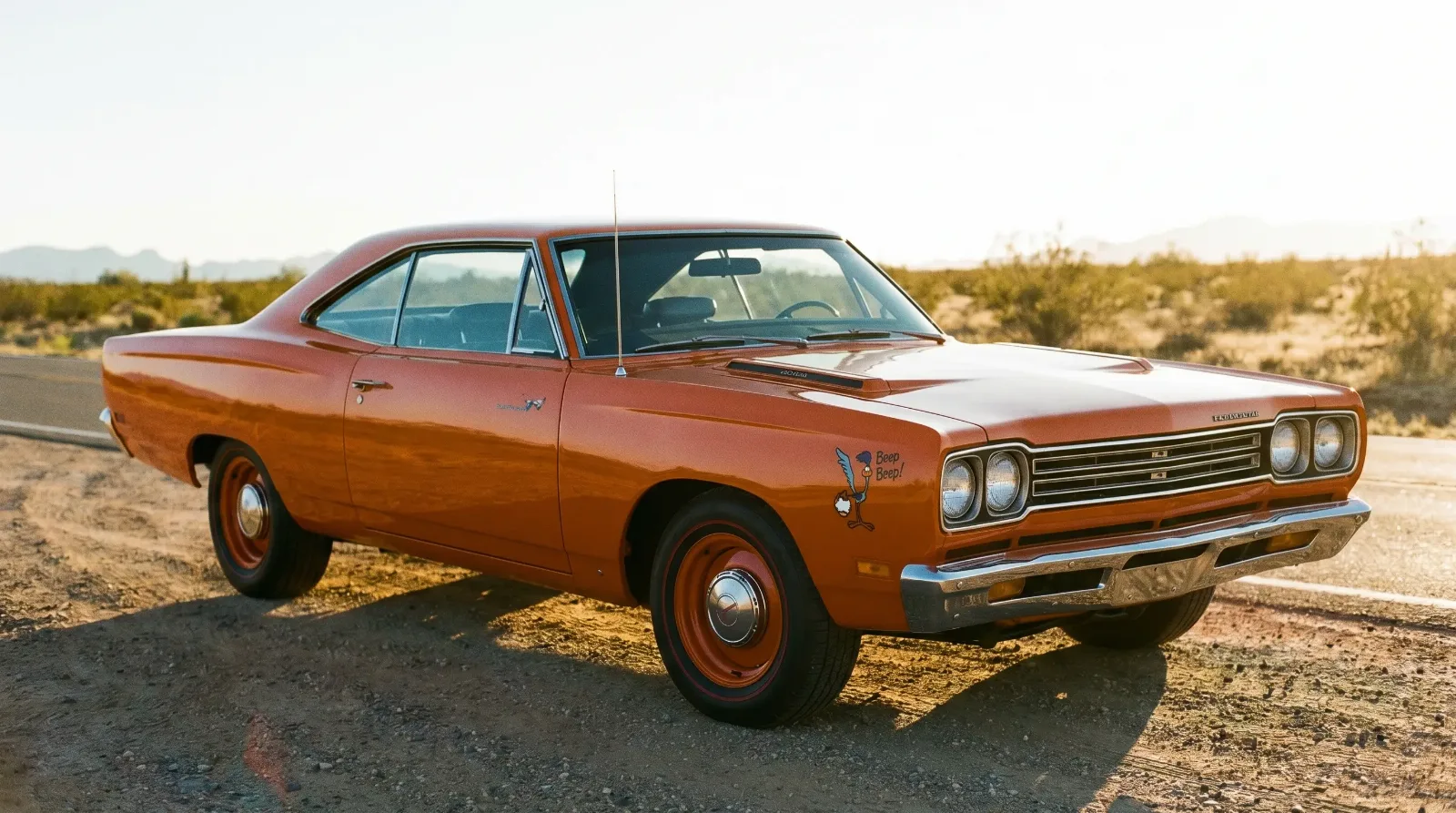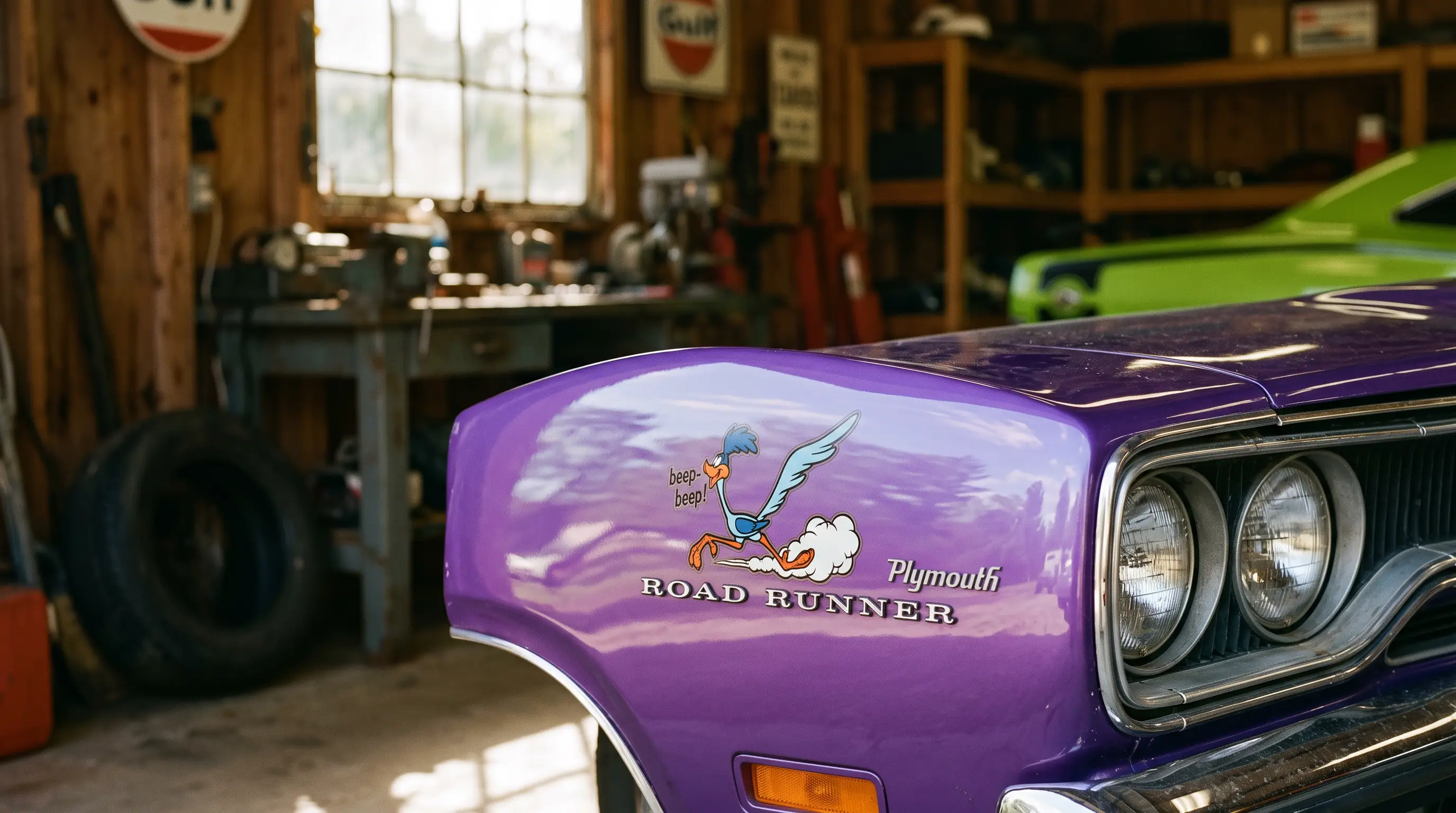
Road Runner advertising from 1968 through the early 1970s is worth studying as a document of its era, not just as nostalgia. Plymouth's campaigns for the car reveal exactly how a manufacturer sold performance to a generation raised on television, and the surviving print ads and commercials hold up as period artifacts every bit as informative as a build sheet or a fender tag.
Establishing the character in print
The earliest 1968 print campaigns had a clear job, introduce a licensed cartoon character in a context most readers had never seen one used before. Plymouth's copywriters leaned on the Road Runner cartoon's established language, the beep beep sound rendered phonetically in headline type, the bird itself often illustrated mid-stride across the page. The tone stayed playful rather than aggressive, a deliberate contrast to competitors who were selling raw horsepower with more conventional muscle car imagery.
That playful register was a calculated risk. Plymouth was asking magazine readers, many of them serious performance buyers who cross-shopped GTOs and Chevelles, to take a cartoon-branded car seriously as a genuine muscle car. The ads addressed that tension directly, usually pairing the lighthearted cartoon element with hard specification numbers lower on the page, horsepower, quarter-mile figures, price. Humor got the reader's attention. The numbers closed the sale.
Dealer materials and the details national campaigns skipped
National print and television advertising told only part of the story. Individual dealers received brochures, window stickers, and showroom display materials that often carried more granular detail than a national magazine spread could justify allocating space to, exact option pricing for a given region, financing terms specific to that dealership, sometimes even locally produced radio spots that leaned on the beep beep horn sound in ways the national campaigns never attempted. These materials rarely survive in the same volume as magazine tear sheets, since they were printed in smaller regional runs and treated as disposable point-of-sale material rather than anything worth filing away.
For researchers and collectors today, that scarcity makes surviving dealer material genuinely valuable as a historical record, sometimes more informative about actual period pricing and regional marketing variation than the polished national campaigns that get reproduced in every retrospective article. A dealer brochure with handwritten pricing notes or a regional newspaper ad clipped and saved by an original buyer can settle questions about period pricing that national advertising, focused on brand image rather than specific numbers, simply does not answer.
Television and the sound that sold the car
Television spots gave Plymouth a tool print never could, the actual beep beep horn sound. Commercials frequently opened on the horn itself before showing the car, an audio cue instantly recognizable to anyone who had watched the cartoon on Saturday mornings. That sound functioned as a signature the way a jingle would for another product category, distinctive enough to be remembered and specific enough that competitors could not easily copy it.
Surviving footage from the period shows a consistent visual approach across multiple model years, the car in motion, usually on an open road, with minimal narration relative to other muscle car commercials of the same era that tended to lean harder on a booming announcer voice reciting specifications. Plymouth let the horn and the visual do more of the work, trusting that the cartoon recognition already did the job of establishing tone.
How the message shifted through the early 1970s
As the muscle car market matured and insurance pressure began weighing on buyer decisions around 1970 and 1971, Road Runner advertising shifted its emphasis modestly, still cartoon-forward, but with slightly more attention paid to value positioning, framing the car as the smart performance buy rather than leading purely on the joke. That shift tracked the same underlying strategy the car launched with, real performance at a price below the segment's flashier entries, just articulated with a bit more urgency as competitors caught up on both price and marketing sophistication.
By the mid-1970s, as engine outputs fell under new emissions and fuel standards, advertising for the car pivoted further still, though the cartoon identity never fully disappeared from Plymouth's materials for the model. The core creative asset, licensed from Warner Bros at the very start of the program, remained useful marketing currency for the entire run regardless of what was happening under the hood that particular year.
"Ad copy from any era tells you what the manufacturer believed the buyer cared about at that exact moment. Road Runner advertising in 1968 sold humor backed by specifications. By 1973 it was selling value backed by nostalgia. Neither approach is wrong. They are simply artifacts of two different markets."
- Sarah Whitfield
What the ads reveal about the intended buyer
Reading period Road Runner advertising closely also tells a story about who Plymouth believed it was selling to, and that story shifted subtly across the run. Early campaigns skewed toward a younger, budget-conscious buyer, copy that emphasized price and value alongside the performance figures, images that favored casual settings over the polished, aspirational staging some rival brands used for their flagship muscle cars. The message was consistently down to earth, a performance car that did not require pretending to be something more expensive than it was.
Later campaigns, as the car's positioning shifted with the broader market, began speaking a bit more directly to an existing owner base rather than purely to new conquest buyers, referencing the car's established reputation and cartoon identity as things the reader already recognized rather than concepts needing full introduction. That shift in tone across a handful of years is a small but genuine piece of evidence about how quickly the Road Runner moved from a new, unproven concept to an established fixture in the muscle car conversation.
Reading the ads as documentation today
For anyone researching a specific model year, period advertising remains a useful, underused primary source. Print ads document exact trim names, factory option pricing, and available colors for the year they ran, information that can corroborate or contradict claims made about a car being sold today. A dealer brochure or magazine ad from the correct model year is a legitimate piece of supporting documentation alongside a fender tag and broadcast sheet, and serious buyers should treat it that way rather than as mere ephemera.
The advertising campaigns were always downstream of a larger branding decision, the licensing agreement that gave Plymouth the rights to the character in the first place. More on the road runner beep beep traces how that license shaped the car's identity beyond the ad pages themselves, and the broader account of how the whole model came together is covered in the story on where this started. For buyers who want to see how period-correct documentation, advertising included, affects value on the current market, browsing classic Runners on the market is a practical next step.