
Wheels tell you more about a hot rod than the paint does. A guy can spray the prettiest candy job in town, but if he bolts on the wrong wheel, the whole car reads wrong. Wheels set the era, the attitude, and half the time the budget. Get them right and a plain roadster looks like it rolled straight out of 1957. Get them wrong and it looks like a parts-store special. I have seen builds ruined at the last step because somebody chased a modern billet wheel onto a car that wanted a steelie and a bias-ply.
Car Features
8 min read
Hot Rod Wheels: Steelies, Wires and Mags
Steelies, wires, or five-spoke mags? How to pick the right hot rod wheel for the era and look, and match the tire to it.
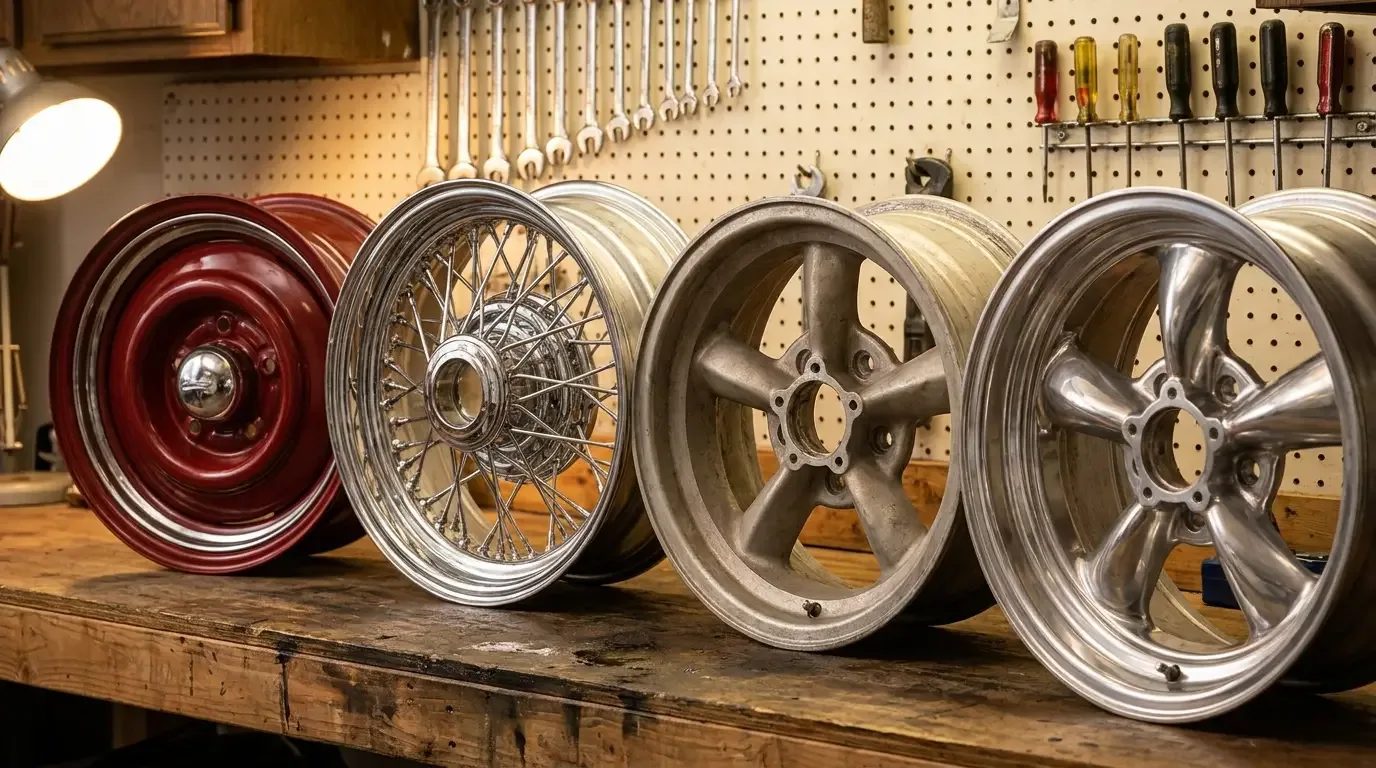
This is the part of the build where taste matters more than money. You do not need the most expensive wheel. You need the right one for the look you are chasing. Below I walk through the four families that cover almost every traditional and street-era hot rod, when each one belongs on a car, and how tires change the whole reading. If you are working out the finished attitude of the car, wheels lock in with the flames and the ride height covered over in our piece on hot rod flames.
Steel wheels with caps and rings
The steel wheel is where hot rodding starts and, honestly, where a lot of the best cars end up too. A painted steelie with a chrome hubcap and a polished trim ring is the default look for a traditional early rod. It is cheap, it is period-correct for anything from the late 1940s through the 1950s, and it just plain looks like a hot rod. The classic move is a body-color or contrasting steel wheel, a small chrome dog-dish or baby-moon cap in the center, and a bright ring around the outer edge that hides the rim seam.
Sizes stayed small in the early days. Fifteen-inch and sixteen-inch steel wheels were the common ground, with a narrow front and a wider rear once guys started running bigger rubber out back. The beauty of a steelie is that it disappears and lets the tire and the stance do the talking. You are not asking the wheel to be jewelry. You are asking it to look honest.
Wire wheels
Wire wheels came onto hot rods and kustoms from two directions. Some came off prewar luxury cars and early sports cars, and some arrived as accessory knock-off wires in the late 1950s and 1960s. A tall, delicate wire wheel gives a car a completely different character than a steelie. It reads older, dressier, and leans toward the kustom and lead-sled crowd more than the stripped-down lakes roadster crowd. On a mild custom, a set of wires with wide whitewalls is a knockout. On a channeled highboy meant to look like a race car, they are wrong.
Two cautions from the shop. First, real wire wheels need their spokes checked and trued, and a neglected set will go out of round or loosen up. Second, there is a world of difference between a quality vintage or reproduction wire wheel and a cheap chrome imitation. The cheap ones flex, rust at the spoke nipples, and never sit quite true. If you go wires, buy good ones and have somebody who knows how to lace and tension them do the work.
Mag and five-spoke wheels
This is the family that changed hot rodding in the 1960s. When lightweight cast wheels showed up, they did two things at once: they cut unsprung weight for the drag guys and they looked fast standing still. Halibrand built magnesium wheels that came off sprint cars and Indy cars and landed on street rods, and the polished five-spoke became one of the defining hot rod images. American Racing followed with the Torq-Thrust, a five-spoke design so right that it has never really gone out of style. A Torq-Thrust on a coupe is a look that works in 1966 and works today.
Real magnesium wheels are light and desirable, but magnesium is porous and can corrode, so a lot of what people call "mags" today are aluminum. That is fine. The look is what people are buying. Five-spokes suit a more aggressive, mid-1960s-and-later hot rod, the kind with a small-block and a four-speed rather than a flathead and a floor shift. They pull the car forward in time. If you want a car that reads strictly 1950, a mag is an anachronism, and a period-conscious builder will notice.
Whitewalls, redlines, and matching tire to wheel
The tire is half the wheel choice, and guys forget that. A wide whitewall bias-ply is the traditional partner for steel wheels and wire wheels on an early rod or a mild kustom. It softens the car and reads 1950s immediately. As the decade turned, whitewall bands got narrower, and by the mid-1960s the redline tire, a bias-ply with a thin red stripe, became the sharp, sporty choice that paired naturally with a mag or five-spoke. Blackwalls read all-business and suit a stripped race-style highboy.
Front-to-rear proportion matters as much as the tread. The traditional hot rod runs a taller, wider tire in back and a skinnier one up front, which sets the nose-down rake and gives the car that leaning-forward attitude. That relationship between wheel, tire, and ride height is the whole ballgame, and it is worth reading how the geometry works in our guide to Rake and Stance: Why Hot Rods Sit That Way. Wheel diameter, tire height, and rake all move together. Change one and you have changed the stance.
| Wheel type | Era it reads | Best tire match | Right for |
|---|---|---|---|
| Steel wheel, cap and ring | Late 1940s to 1950s | Wide whitewall bias-ply | Traditional rod, mild kustom, honest driver |
| Wire wheel | Prewar to early 1960s | Wide or medium whitewall | Kustom, lead sled, dressy mild custom |
| Halibrand mag (five-spoke) | 1960s | Redline or blackwall | Race-inspired street rod, sixties feel |
| American Racing Torq-Thrust | Mid-1960s onward | Redline or blackwall | Small-block coupe, aggressive stance |
| Blackwall on steelie or five-spoke | Race-style, timeless | Blackwall bias or radial | Stripped highboy, lakes look |
Picking the right wheel for your car
Start with the decade you are building toward, not the wheel you saw and liked. Decide whether the car is an early flathead-era traditional rod, a smoothed kustom, or a mid-1960s small-block machine, and the wheel almost picks itself. Then think about front-to-rear sizing before you buy anything, because a mismatched set will fight the stance no matter how good each wheel looks alone. Buy quality, especially with wires and real mags, and remember that a clean steel wheel outclasses a cheap fancy one every day of the week.
Wheels are the last decision that people rush and the first thing anyone notices in a parking lot. Take the time, match the era, and let the tire and stance carry the attitude. When you have the look locked in and you are hunting for a car that already got it right, there are plenty of hot rods for sale where the wheels alone tell you whether the builder understood the assignment. And if you want the full picture of how these cars came to be, start with the classic hot rod story and work outward from there.
Sources and notes
- Period hot-rod and custom-car press coverage of wheel and tire trends across the 1950s and 1960s.
- Manufacturer histories and catalog references for Halibrand and American Racing (Torq-Thrust) wheels.
- Kustom kulture and show-car records documenting steel-wheel, wire-wheel, and mag applications.
- Builder and shop interviews on wheel selection, fitment, and period-correct practice.
Related Reading
Have a
Classic Car
for Sale?
Reach thousands of serious classic car collectors across the US.
Sell It Here →
Are You a Classic Car Dealer?
List your full inventory and connect with targeted classic car buyers.
Join as a Dealer →

About the author
Jim Vasquez
Southern California hot rod and custom car builder with roots in the traditional kustom kulture scene.




Comments
Be the first to comment on this article.