
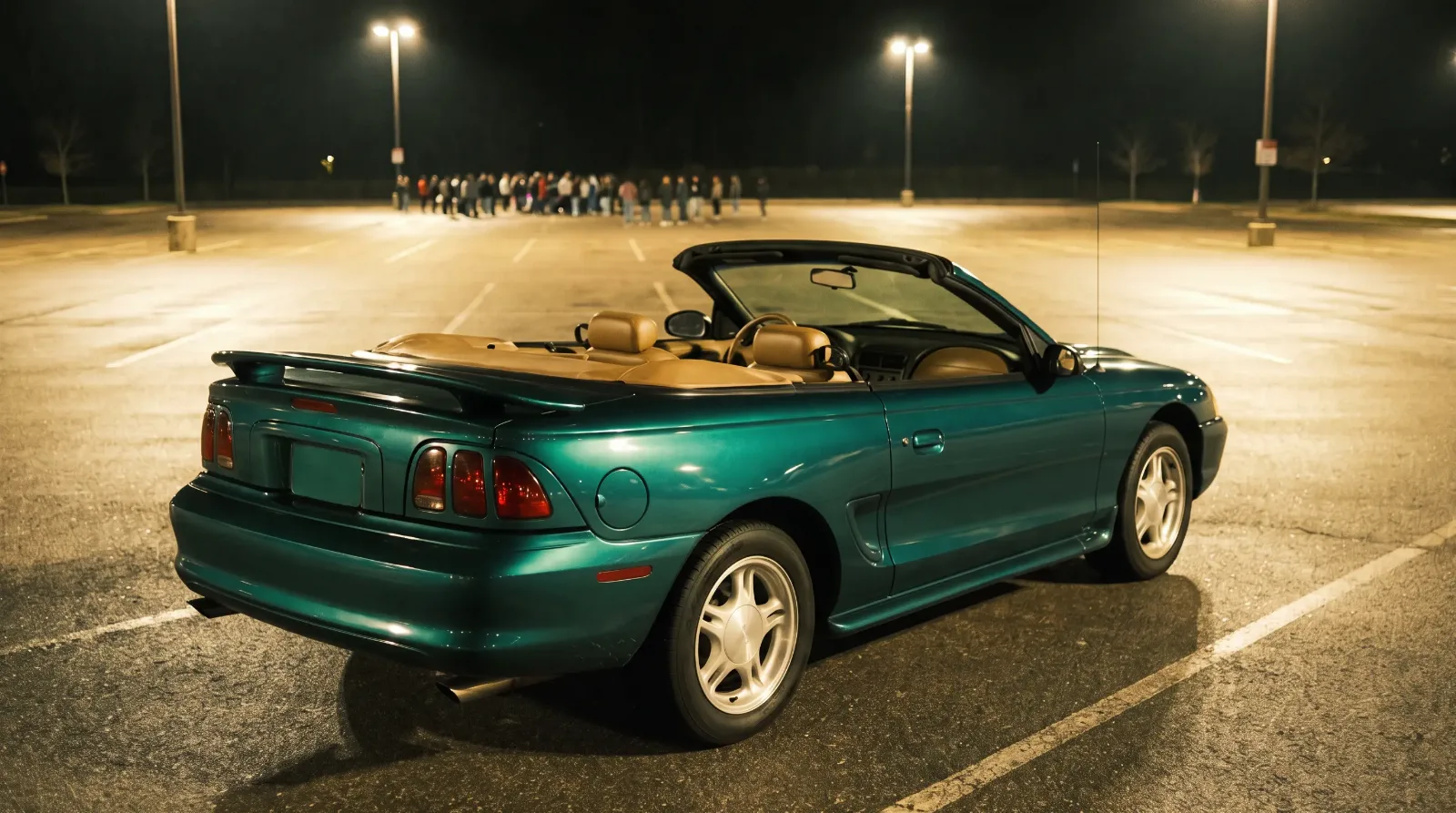
Most of the Mustangs that went home from Ford dealers in the 1990s did not have a 5.0 badge on the fender. They had a 3.8 liter V6 under the hood, a base price that a schoolteacher or a nurse on a second shift could talk themselves into, and a running horse in the grille that looked exactly like the one on the GT parked next to it. The SN95 Mustang V6 was the everyday pony. It took people to work, to college and to the beach, and it did so in numbers the V8 cars never matched.
Car Features
7 min read
The SN95 V6: The Everyday Pony
The 3.8 V6 was the Mustang most people bought from 1994 to 2000: nearly two of every three SN95s, from 145 hp to 190 hp.
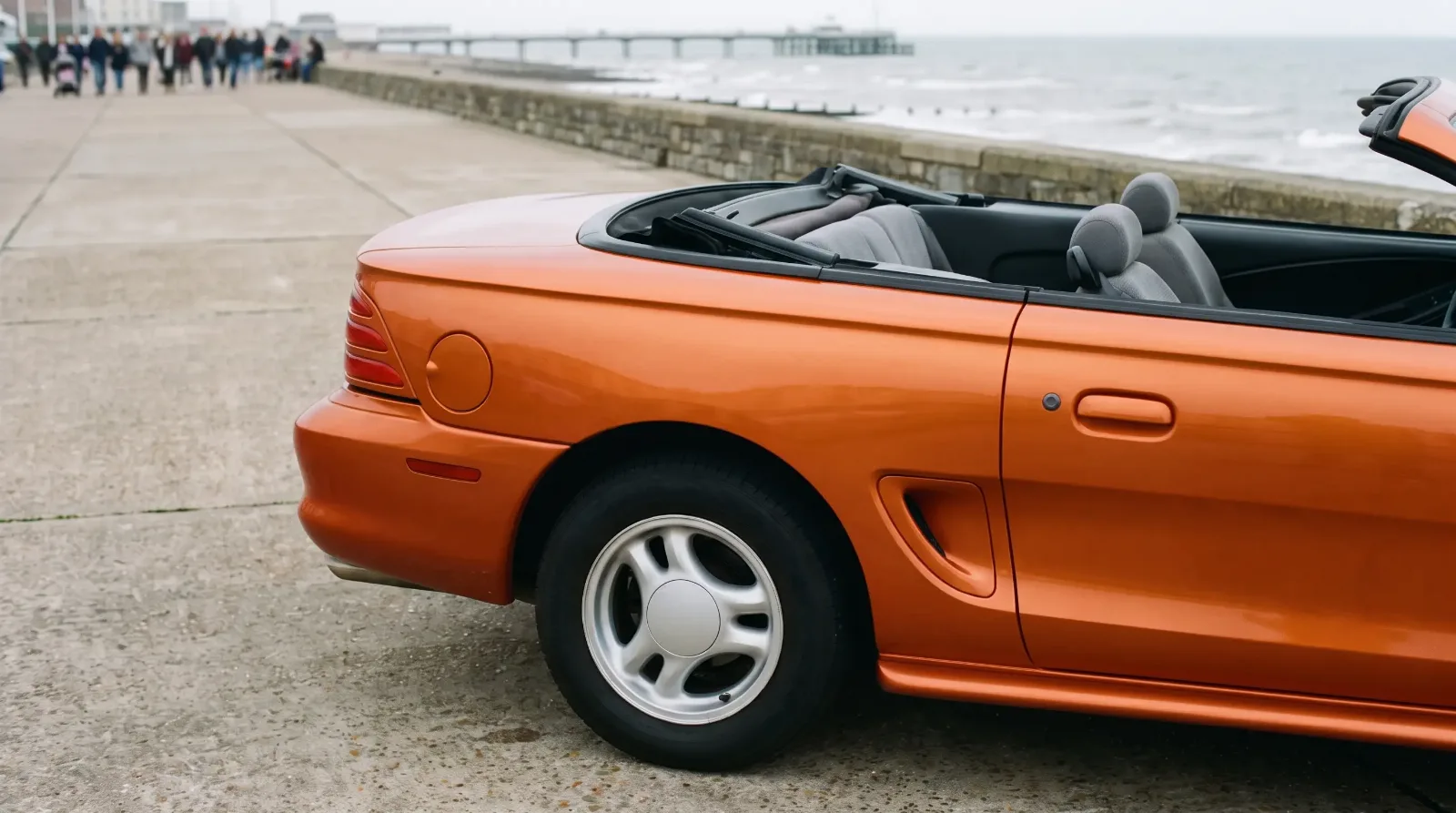
The bigger story of the 1994 to 2000 car, from the skunkworks team to the New Edge restyle, belongs to the SN95 history. This piece stays with the quieter car, the one that sold.
Why the SN95 Mustang V6 became the base car
When the new Mustang went on sale in December 1993, the old Fox body's base engine was gone. Ford dropped the 2.3 liter four entirely and made the 3.8 liter V6 standard. There would be no four-cylinder Mustang in this generation, and that changed what the cheapest Mustang felt like. The entry point was now a six, smooth at idle and willing in traffic.
The price told the rest. A 1994 V6 coupe started at $13,365. A GT coupe started at $17,280. That gap of nearly $4,000 was the difference between a car payment a young buyer could carry and one that kept them up at night. The V6 convertible opened at $20,160, still below the GT convertible's $21,790. The V6 and the GT shared the same body, the same profile and the same three-element taillights, and from across a parking lot they read as the same car.
That was the point. The SN95 kept the notchback and hatchback of the Fox years behind it and offered one coupe shape plus a convertible. The plainest Mustang wore the same sheet metal as the best one, and for a great many buyers that was enough.
The 3.8 by the numbers, 1994 to 2000
The 3.8 was an Essex V6, and it made 145 hp at 4,000 rpm and 215 lb-ft of torque at 2,500 rpm in 1994 and 1995. Those were honest figures for a car that weighed about 300 pounds more than the Fox it replaced. In those first two years it came with a Borg-Warner T-5 five-speed manual or the AOD-E four-speed automatic, and most of the time it simply went about its business.
For 1996 the V6 moved to the stiffer block of the supercharged 3.8 from the Thunderbird Super Coupe, picked up Ford's new EEC-V engine computer, and its rating rose to 150 hp. It held there through 1998. Then came 1999 and the New Edge sheet metal, and the V6 jumped to 190 hp at 5,250 rpm and 220 lb-ft at 2,750 rpm. You will see 193 hp quoted for those years in some places, but that is the 2001 rating carried backward. For 1999 and 2000 the number is 190.
| Model year | V6 output | V6 coupe base price | V6 cars built (coupe + convertible) | Share of all Mustangs |
|---|---|---|---|---|
| 1994 | 145 hp | $13,365 | 61,216 | 49.7% |
| 1995 | 145 hp | $14,530 | 116,972 | 62.9% |
| 1996 | 150 hp | $15,180 | 76,433 | 56.2% |
| 1997 | 150 hp | $15,880 | 68,418 | 63.1% |
| 1998 | 150 hp | $16,150 | 121,055 | 69.0% |
| 1999 | 190 hp | $16,470 | 92,479 | 69.1% |
| 2000 | 190 hp | $16,520 | 162,394 | 75.4% |
That 1999 figure deserves a second look. The 1994 and 1995 GT, with the last of the pushrod 5.0 V8s, made 215 hp. The 1999 V6 came within 25 hp of it, at a base price of $16,470 against $20,870 for that year's GT. The everyday car had quietly closed most of the gap to the V8 car of five years earlier.
It was not all good news. Across town, Chevrolet's Camaro added a 3.8 V6 rated at 200 hp in 1995, and made it the only base engine for 1996, while the Mustang V6 made 145 and then 150. On paper the base Mustang lost that fight for most of the decade. Mustang buyers did not seem to mind, and the production counts show how little.
The car most people actually bought
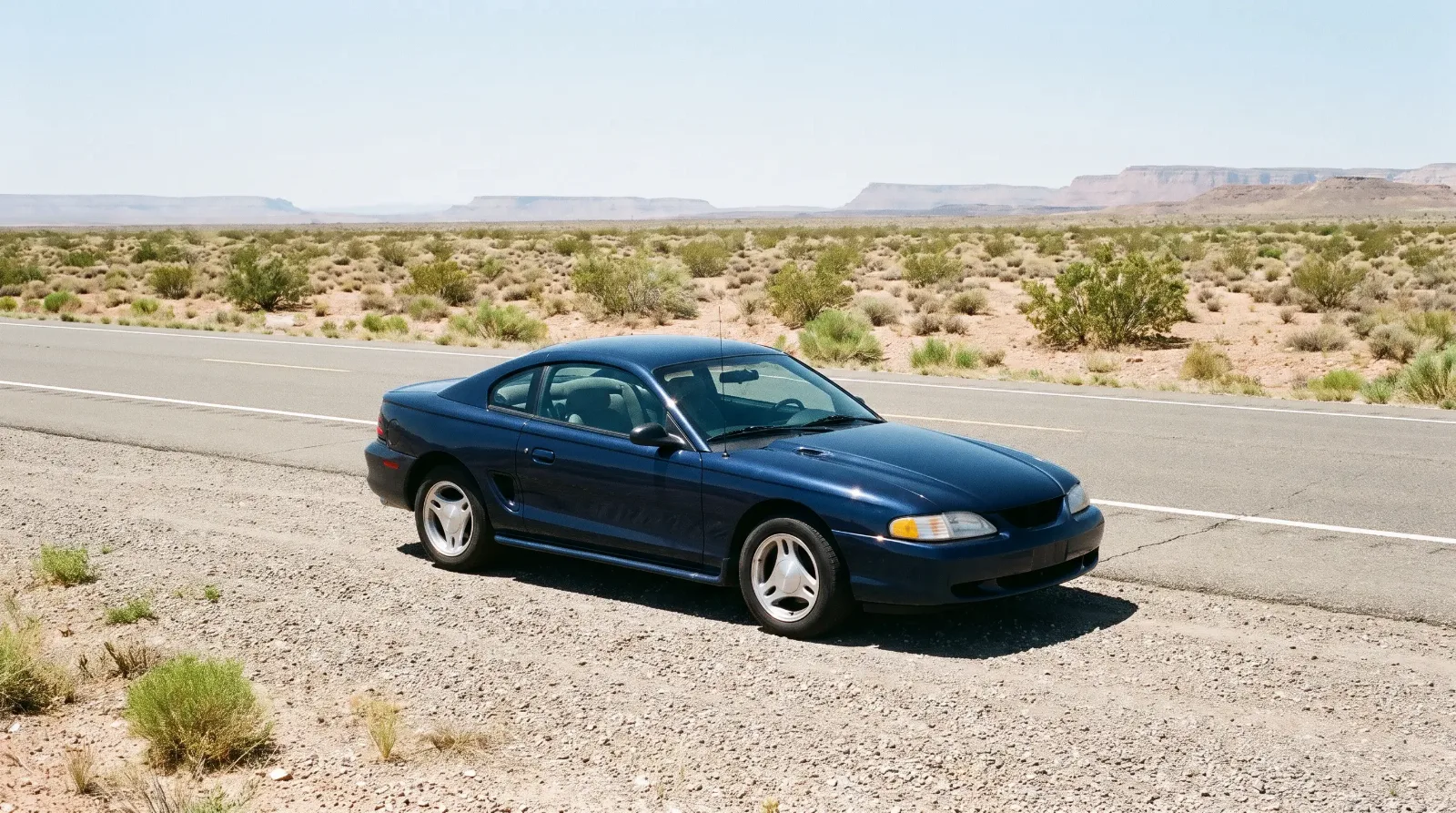
Add the columns up and the shape of the SN95 years comes clear. From 1994 to 2000 Ford built 1,078,176 Mustangs, and 698,967 of them were V6 cars. That is nearly two out of every three. In the launch year the split was close, 61,216 V6 cars against 55,973 GTs. By 2000 it was three to one: 162,394 V6 cars against 52,545 GTs.
Part of that came from Ford making the base car easier to live with. For 1998 the plain Mustang picked up air conditioning, remote keyless entry, a power trunk release, and power windows and locks as standard, and a V6 Sport Group joined the option list. Production of V6 cars jumped from 68,418 in 1997 to 121,055 in 1998. A car that had once felt like the starting point of a negotiation now arrived ready to drive off the lot and into somebody's life.
Those numbers belong to people. A first car bought with savings and a cosigner. A second car for a family that already had the sensible sedan. A car for someone who had wanted a Mustang since childhood and finally had the means for the one with six cylinders. None of them show up in the racing record or the auction catalogs, but they are why the Mustang name came through the 1990s in good health.
"The V8 cars got the magazine covers. The V6 cars got the driveways, and the driveways are where a car becomes part of somebody's story."
Nora Beckett
Top down, six cylinders
The V6 found its warmest audience in open air. Ford sold the 3.8 in the convertible from the start, and in most years the V6 convertible was the more common of the two soft tops. In 1994 Ford built 18,333 of them. In 1995 the count reached 30,593. In 2000 it climbed to 41,368, more than twice the 20,224 GT convertibles built that year.
It is easy to see why. A convertible is rarely bought for lap times. It is bought for a Sunday drive with the radio up and the sun on the back of your neck, and for that the V6 was all the engine anyone needed. In 1998 the V6 convertible started at $20,650, against $24,150 for the GT version. That gap paid for a lot of summer.
How the everyday pony is remembered
Ordinary cars vanish first. They get driven hard, sold cheap, handed down and finally parked when the repair bill passes the value. The SN95 V6 has followed that path, and the clean, original examples that remain now draw a second look at shows, partly because so few people thought to save one.
There is a fair case that the V6 car tells the truth about the SN95 better than any GT. It was the car Ford priced for the many, built in the largest numbers, and sold to people who wanted a Mustang more than they wanted a V8. The New Edge cars of 1999 and 2000 gave it real performance at last, and the 2000 model year, with 162,394 V6 cars built, was the high point of its run.
When one turns up now with its original paint, its cloth seats and a stack of service receipts in the glovebox, it is worth slowing down for. It is not a rare car. It is something rarer, a common car that somebody decided was worth keeping.
Sources and notes
- Roanoke Times, October 1993: 1994 Mustang launch prices
- MustangSpecs: 1994 Ford Mustang (V6 output, production by model)
- MustangSpecs: 1996 Ford Mustang (V6 block, prices, production)
- MustangSpecs: 1998 Ford Mustang (new standard equipment, V6 Sport Group, production)
- MustangSpecs: 2000 Ford Mustang (prices and production by body)
- Wikipedia: Ford Mustang (fourth generation), V6 output by model year
Related Reading
Have a
Ford Mustang
for Sale?
Reach thousands of serious classic car collectors across the US.
Sell It Here →
Selling a classic? Here's how: the best sites to sell a classic car
Are You a Classic Car Dealer?
List your full inventory and connect with targeted classic car buyers.
Join as a Dealer →

About the author
Nora Beckett
Automotive features writer and photographer who tells the human stories behind the cars, from show fields to cross-country road trips.
Related Listings - Ford Mustang
Comments
Be the first to comment on this article.