
Picture a Ford dealer lot in the spring of 1994, the streetlights just coming on, and a salesman walking a couple around a new Mustang with its top folded down. They came in to look at the coupe. They are standing beside the convertible now, and one of them has already opened the door. Scenes like that happened often enough to make the 1994 Mustang convertible one of the quiet surprises of the new car's first year. Of the 123,198 Mustangs Ford built for the 1994 model year, 44,714 had a soft top. That is more than one car in three.
Car Features
7 min read
The SN95 Convertible
More than one in three 1994 Mustangs had a soft top. The story of the SN95 convertible, its prices, the Indy pace car and its output to 2000.
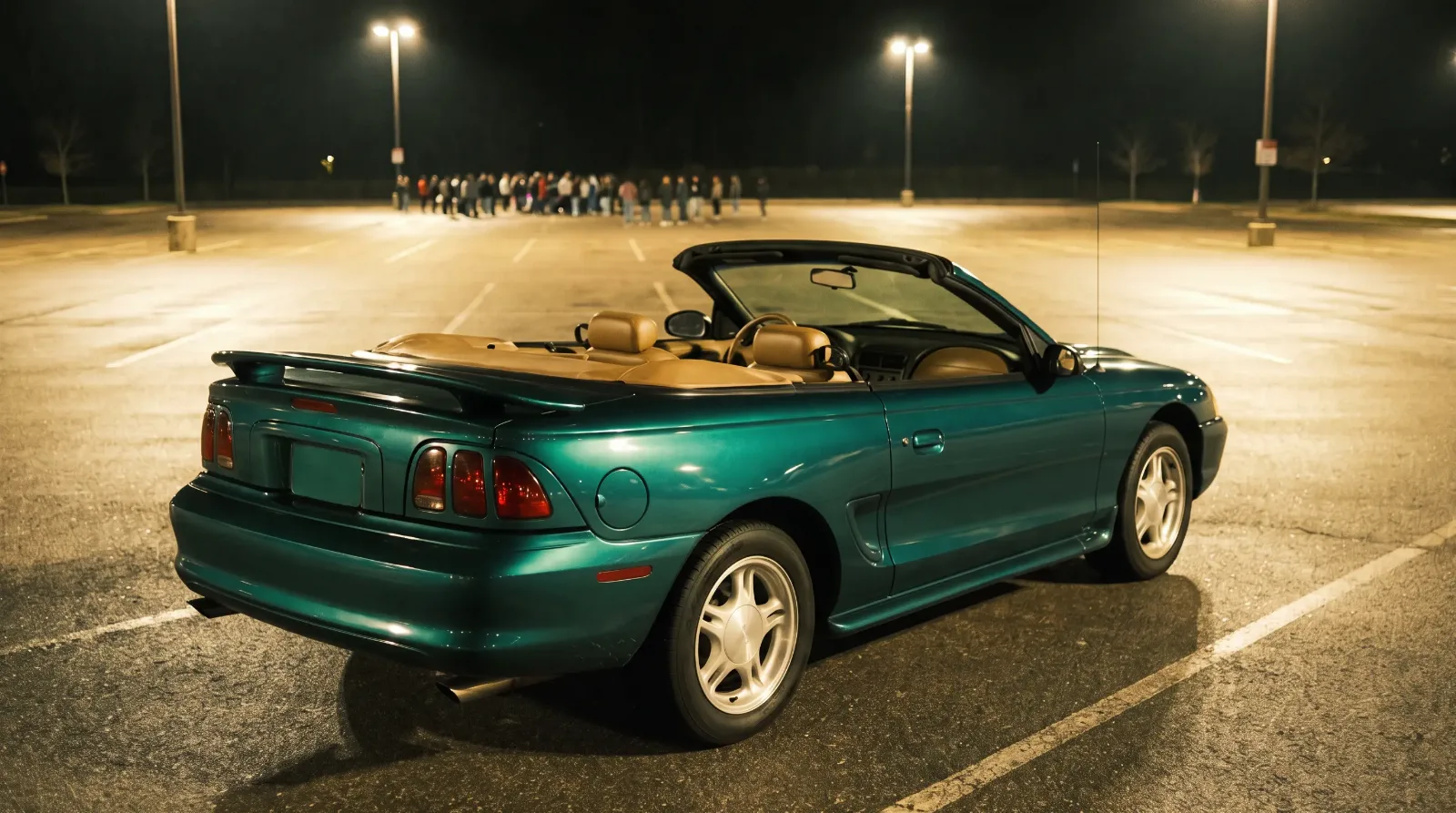
The wider account of the SN95, from the skunkworks team to the New Edge restyle, has been told in full, and there is more on that here. This piece stays with the open car and with the people who kept choosing it, year after year, at a price well above the coupe.
Why the 1994 Mustang convertible mattered
The Mustang had been without a roofless version once before. After 1973 there was no convertible at all until the Fox body brought one back for 1983, and through the rest of the Fox years the open car held its place without ever leading the lineup. In 1993, the last Fox model year, Ford built 27,300 convertibles out of 114,228 Mustangs, a little under a quarter of the total.
The SN95 cleared the table. The notchback and the hatchback were gone, and the new Mustang came in two shapes only, a fastback-style coupe and a convertible. With fewer body styles to spread buyers across, the convertible stopped being a niche and became one half of a very short menu. It was also the first Mustang convertible since 1973 to be built as an open car on the factory line, rather than converted from a finished coupe, and its rocker panels used much thicker steel to make up for the missing roof. Underneath, the car rode on an updated Fox platform, called Fox-4, and Ford said 1,330 of its 1,850 parts were changed. The new body put on about 300 pounds over the 1993 car, and if you want the engineering detail of what changed under the skin, it has its own story.
The buyers answered quickly. Convertible output went from 27,300 in the final Fox year to 44,714 in the first SN95 year, a jump of more than 17,000 cars.
Priced a short step from the GT
The window stickers explain a good deal of what happened next. A 1994 V6 coupe started at $13,365. The V6 convertible started at $20,160, a premium of $6,795 for the fabric top. The GT coupe was $17,280, and the GT convertible was $21,790. Read those four numbers in order and something odd stands out: once a buyer had decided on an open car, the step from the V6 convertible to the GT convertible was only $1,630.
For that money the GT brought the 5.0 liter pushrod V8, rated at 215 hp and 285 lb-ft, against 145 hp from the 3.8 V6. A buyer already stretching to twenty thousand dollars for a top that folded away could see the logic plainly. The production count suggests many of them did. In 1994 Ford built 25,381 GT convertibles and 18,333 V6 convertibles, a lead of more than 7,000 cars for the V8. A fully loaded GT convertible landed around $24,000, which was serious money for a Mustang in 1994, and still people signed for it.
My reading of the figures, and it is a reading rather than a documented Ford explanation, is that the price ladder did the work. In 1995 the V6 convertible started at $20,995, and V6 soft tops jumped to 30,593 while GT convertibles fell to 16,668. The GT convertible edged ahead again in 1996, but never by anything like its first-year margin. Those first two years were also the only ones in which an open SN95 came with the pushrod 5.0, since 1995 was its last year in the Mustang.
Rio Red at Indianapolis
The convertible also had the best seat in the house that first spring. A 1994 Mustang Cobra convertible paced the 78th Indianapolis 500 on May 29, 1994, with Parnelli Jones at the wheel for the start. Ford built 1,000 replicas, and every one of them was Rio Red with a saddle top and saddle leather. Those 1,000 cars were the entire 1994 Cobra convertible run, each with the 240 hp version of the 5.0.
The Cobra stayed in the open-car lineup after that, always in small numbers. Ford built 1,003 Cobra convertibles for 1995, 2,510 for 1996, 3,088 for 1997, 3,480 for 1998 and 4,055 for 1999. For 2000 there was no regular Cobra at all, open or closed, and the convertible lineup came down to the V6 and the GT.
Year by year, 1994 to 2000
Laid out by model year, the open SN95 holds a steady share of the line that few people would guess. The totals below add the V6, GT and Cobra convertibles for each year, including the 2,310 GT convertibles built as 1999 35th Anniversary Limited Editions.
| Model year | V6 convertible | GT convertible | Cobra convertible | All convertibles | Share of Mustang output |
|---|---|---|---|---|---|
| 1994 | 18,333 | 25,381 | 1,000 | 44,714 | 36.3% |
| 1995 | 30,593 | 16,668 | 1,003 | 48,264 | 26.0% |
| 1996 | 15,246 | 17,917 | 2,510 | 35,673 | 26.2% |
| 1997 | 11,606 | 11,413 | 3,088 | 26,107 | 24.1% |
| 1998 | 21,254 | 17,024 | 3,480 | 41,758 | 23.8% |
| 1999 | 19,299 | 13,699 (incl. 2,310 35th Anniversary) | 4,055 | 37,053 | 27.7% |
| 2000 | 41,368 | 20,224 | none | 61,592 | 28.6% |
Across the seven years that comes to 295,161 convertibles out of 1,078,176 Mustangs, or about 27 percent. The low point was 1997, when the whole Mustang line had a lean year and only 26,107 soft tops were built. The high point was 2000, when V6 convertibles alone reached 41,368, more than twice that year's GT convertibles.
Prices barely moved for the people at the bottom of the open-car ladder. The V6 convertible listed at $21,060 in 1996, $20,650 in 1998 and $21,370 in 2000, and by 1998 the base car had added air conditioning, remote keyless entry and power windows and locks as standard. The GT convertible went the other way, from $23,495 in 1996 to $24,150 in 1998 and $25,270 in 2000. The gap that had been $1,630 in 1994 had grown to $3,900 by the end of the run, and the buyers sorted themselves accordingly.
A hardtop, a brace and the long goodbye
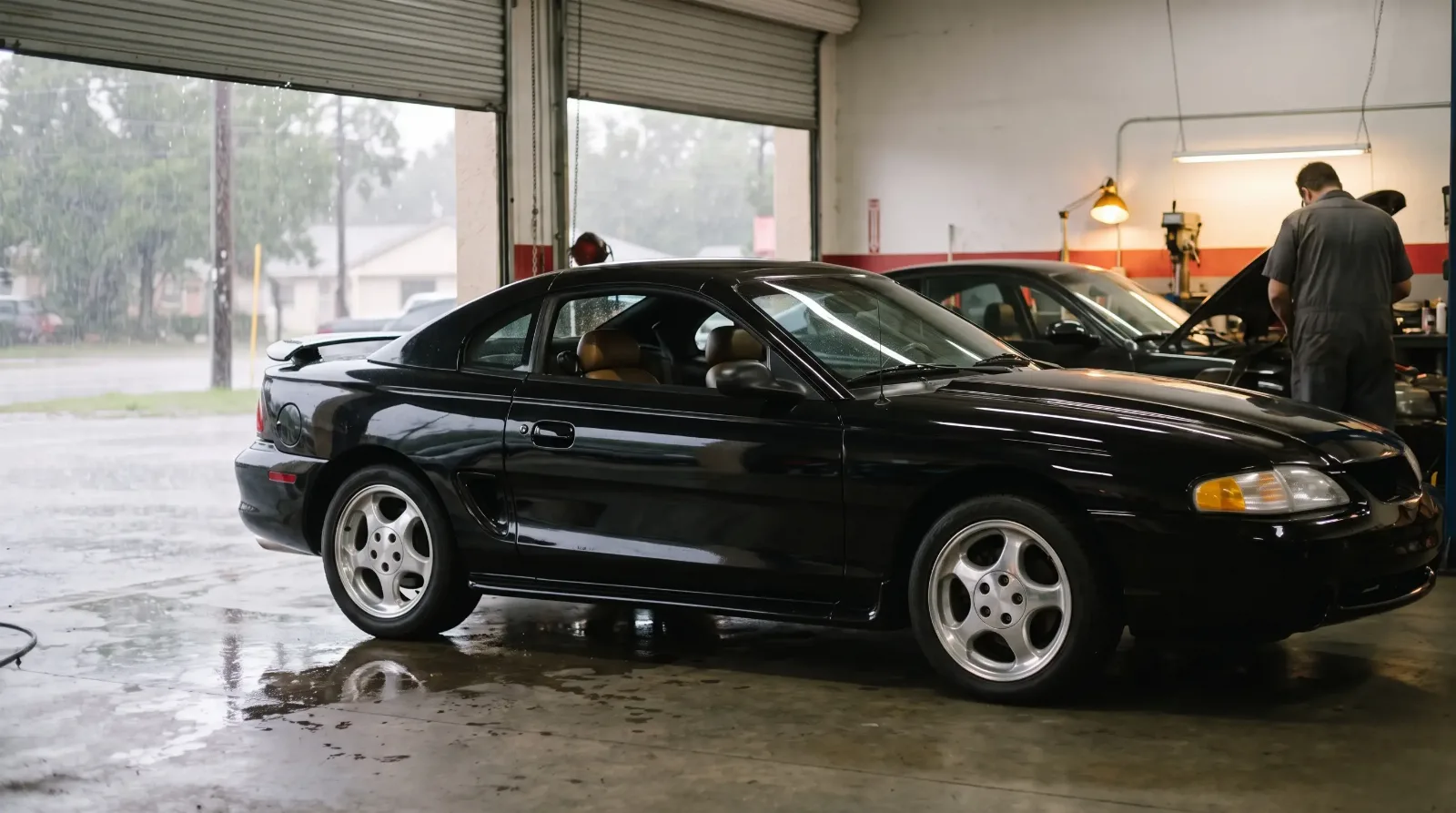
Ford kept tinkering with the open car in ways that are easy to miss. For 1995 a removable hardtop joined the option list, but only for the SVT Cobra convertible; it was not offered on the GT. It cost $1,825, added about 90 pounds, and lasted a single model year. Supply problems and that price kept it rare: 499 of the 1,003 Cobra convertibles built for 1995 left with one. Every one of those 1,003 cars was black with saddle leather, a neat reversal of the all Rio Red run a year earlier.
The bigger change came with the 1999 New Edge cars. The convertible received a subframe connector to cut vibration, and like every 1999 Mustang it got foam-filled rockers and a rear track 1.4 inches wider. Power rose too, to 190 hp for the V6 and 260 hp for the GT, so the late open cars were both tighter and quicker than the 1994 originals. They were also the most popular: the 2000 model year built more SN95 convertibles than any other year from 1994 to 2000.
"You drive a coupe. You plan a day around a convertible, and in 1994 nearly forty-five thousand people decided they wanted their days planned that way."
Nora Beckett
The SN95 shape carried on past 2000, and the last of the line was built on May 10, 2004, a closing chapter you can follow to see where this sits in the timeline. But the convertible's real story is the one in that first year. A new car arrived with only two body styles, and more than a third of the people who bought one wanted the sky overhead. Many of those cars are still out there, top stacked behind the seats, waiting for the first warm evening of the year.
Sources and notes
- MustangSpecs: 1994 Ford Mustang production and prices
- MustangSpecs: 1999 Ford Mustang changes and production
- Old Cars Weekly: Car of the Week, 1994 Ford Mustang GT convertible
- Martin Auto Museum: 1995 Mustang Cobra hardtop convertible
- Roanoke Times, October 1993: the new Mustang and its prices
- Wikipedia: Ford Mustang SVT Cobra
Related Reading
Have a
Ford Mustang
for Sale?
Reach thousands of serious classic car collectors across the US.
Sell It Here →
Selling a classic? Here's how: where to sell your classic car online
Are You a Classic Car Dealer?
List your full inventory and connect with targeted classic car buyers.
Join as a Dealer →

About the author
Nora Beckett
Automotive features writer and photographer who tells the human stories behind the cars, from show fields to cross-country road trips.
Related Listings - Ford Mustang
Comments
Be the first to comment on this article.