
The 1996 Mustang GT 4.6 made 215 hp and 285 lb-ft. So did the 1995 GT it replaced. Same horsepower, same torque, 21 fewer cubic inches. Ford pulled the pushrod 302 out of its V8 pony car after 1995 and put in an overhead-cam engine that had started life in a Lincoln Town Car, and on the window sticker nothing moved. Under the hood, almost everything did.
Car Features
7 min read
The Modular 4.6 Arrives: 1996
The 1996 GT swapped the pushrod 5.0 for the SOHC Modular 4.6 and matched it exactly: 215 hp, 285 lb-ft. What changed, and how it drove.
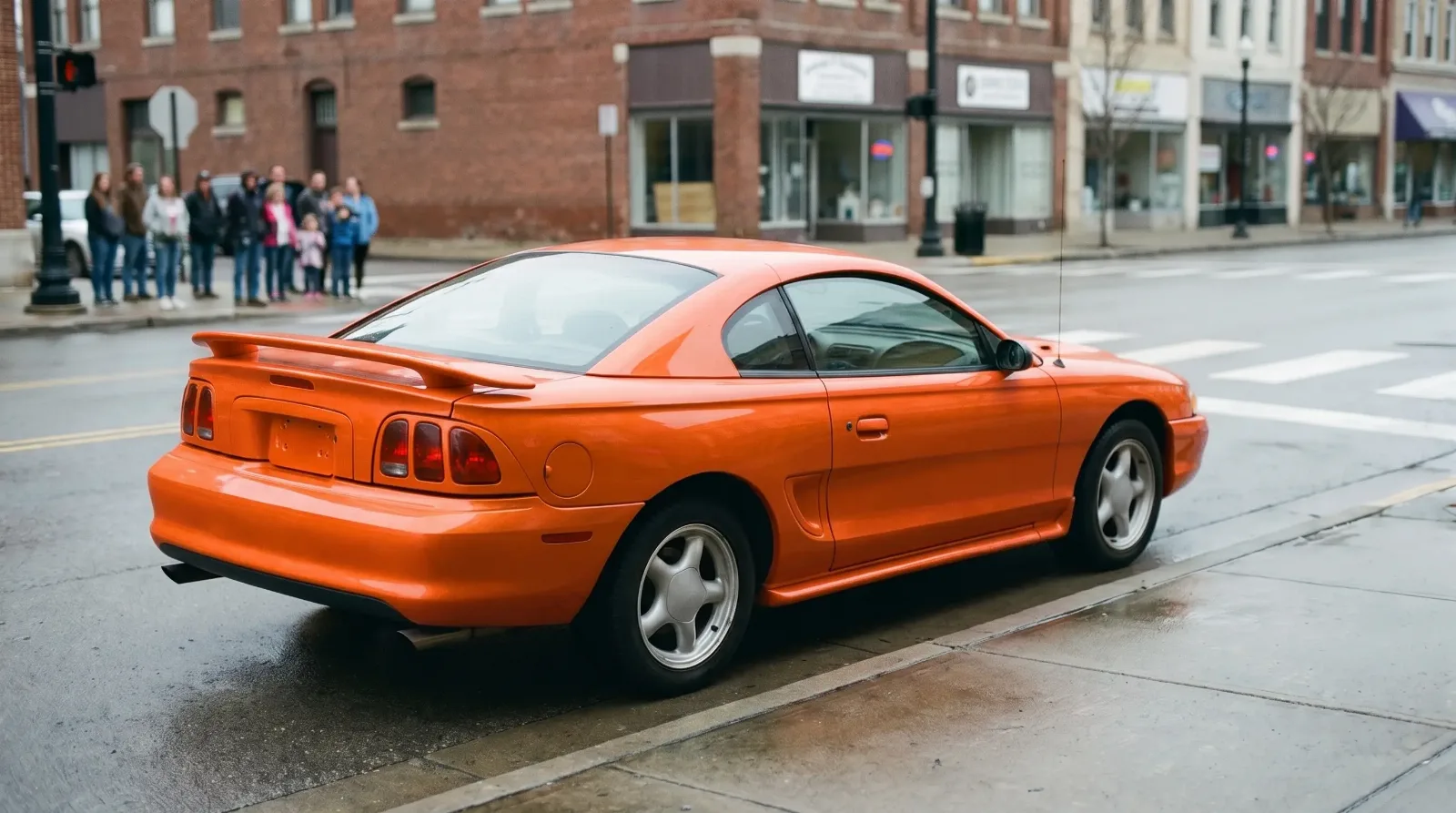
The car around it was the same body Ford launched for 1994, and the bigger picture of the SN95 Mustang is covered in its own story. This one stays on the engine swap Ford did at the factory: what the 4.6 was, where it came from, what else changed with it, and how it actually compared with the 5.0 people did not want to give up.
The 1996 Mustang GT 4.6 by the numbers
Lead with the spec sheet, because that is where the argument started. The 1994 and 1995 GT ran the 5.0 HO pushrod V8 at 215 hp at 4,200 rpm and 285 lb-ft at 3,400 rpm. The 1996 GT's 4.6 SOHC two-valve made 215 hp at 4,400 rpm and 285 lb-ft at 3,500 rpm. Identical peaks. The new engine just got there 200 rpm later for power and 100 rpm later for torque.
Displacement went down, not up. The 4.6 is 281 cubic inches against the 302's 302. That works out to about 0.77 hp per cubic inch for the 4.6 and about 0.71 for the 302. On paper the smaller engine was doing more with less. On paper is the key phrase.
| Spec | 1994 to 1995 GT 5.0 | 1996 to 1997 GT 4.6 |
|---|---|---|
| Layout | Pushrod V8, cam in block | SOHC V8, cam in each head, 2 valves per cylinder |
| Displacement | 302 cid (sold as 5.0) | 281 cid (4.6 L) |
| Bore x stroke | 4.00 x 3.00 in | 3.55 x 3.54 in |
| Horsepower | 215 hp @ 4,200 rpm | 215 hp @ 4,400 rpm |
| Torque | 285 lb-ft @ 3,400 rpm | 285 lb-ft @ 3,500 rpm |
| Manual gearbox | Borg-Warner T-5 five-speed | T-45 five-speed |
| Automatic | AOD-E four-speed | 4R70W four-speed |
Look at the bore and stroke. The 4.6 is almost exactly square, 3.55 inches by 3.54. The 302 is a short-stroke, big-bore engine, 4.00 inches across and only 3.00 deep. That one difference tells you a lot about how each one wanted to be driven, and I will come back to it.
Where the Modular V8 came from
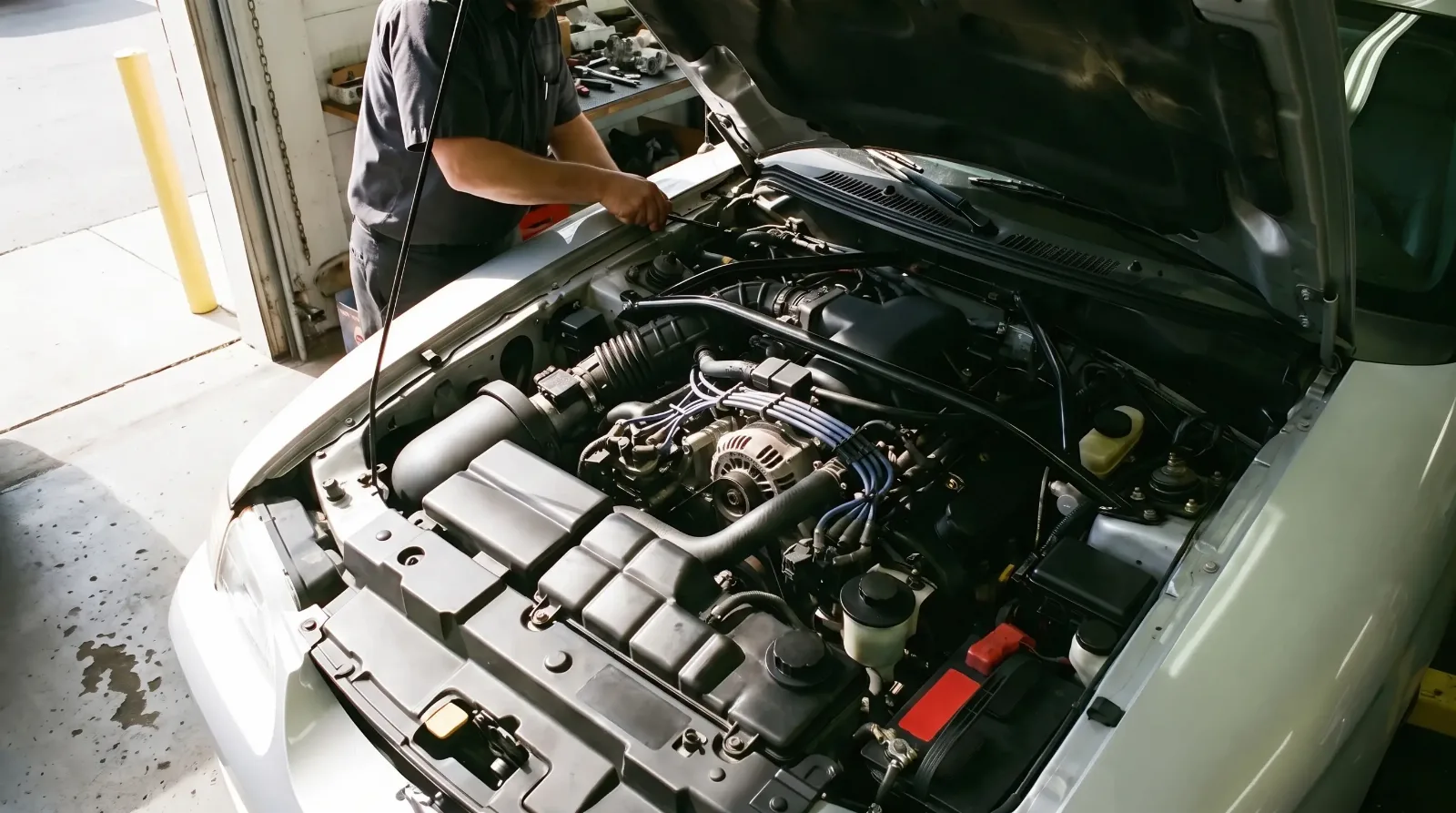
The 4.6 was not built for the Mustang. The first production Modular engine was the 4.6 SOHC in the 1991 Lincoln Town Car. By the time it reached the GT it had five model years of luxury-car duty behind it. Ford's reasons for moving the Mustang onto it are not spelled out in anything I have in front of me, so I will not dress up a guess as a fact. What the hardware says is plain: Ford now had one modern V8 family, and the old pushrod small-block was the odd engine out.
Two plants built the two-valve engines, Romeo in Michigan and Windsor in Ontario. They were not identical. The cam caps, cam sprockets, valve covers, cranks and main caps differed between the two. For a parts counter that matters more than any brochure claim.
You can tell which one a car got from the VIN. On 1996 to 1998 Mustangs, an X in the eighth position is the Windsor-built 4.6 SOHC GT engine, and a W is the Romeo-built 4.6. Which plant supplied which share of Mustangs in a given year is something I have not seen confirmed, so do not assume every 1996 GT is one or the other.
What else changed under the 1996 GT
The engine did not come over alone. The 1996 GT also brought the EEC-V engine management system, introduced with this car. The Borg-Warner T-5 five-speed gave way to the T-45, and the AOD-E automatic was replaced by the 4R70W. Behind both sat an 8.8 inch solid rear axle. The 1996 spec lists 2.73:1 gears as standard and 3.27:1 as the option, though the source does not split that out by GT and V6.
If that 2.73 applies to the GT, it is worth a second look. A square engine that makes its peak torque at 3,500 rpm, behind a tall gear, is not going to feel urgent off the line. On a car like this the axle ratio decides more about the first sixty feet than the extra 200 rpm at the top ever will.
Outside, Ford changed just enough to tell the year. The 1996 cars got a honeycomb grille and taillights turned vertical, the old tri-bar theme stood on end. The cheaper-GT idea carried over too. The GTS name was gone, but option package 248A kept a stripped GT on the order sheet through 1998, now with the 4.6.
Ford built 31,624 GT coupes and 17,917 GT convertibles for 1996, out of 135,980 Mustangs total. Add up the 1995 GT, GTS and GT convertible figures and you get 63,756. So GT volume fell by about 14,000 cars in the first 4.6 year. A GT coupe listed at $17,610 and a GT convertible at $23,495. The 1996 GT also came in a one-year Bright Tangerine, 829 cars by the count enthusiast references repeat, all of them GTs.
How the 4.6 drove against the 5.0
Here is the honest result. The 4.6 was smoother and it liked to rev a little more. The 302 hit harder down low, and that is what most owners noticed first. Same peak numbers, different curves, and owners drive the curve, not the peak.
I have not found a 0 to 60 mph time for the 1996 GT that can be tied to a named magazine test. The figures that circulate, 6.7 seconds among them, come without a source, so I will not lean on them. What is on record is the verdict. Car and Driver found the 4.6 would keep pulling to 5,500 or 5,700 rpm, where the 302 ran out of breath around 5,000, and still wrote that the new GT "failed to impress in testing." The 1994 GT, the pushrod car that started this body and the subject of this piece, is usually put in the high-six-second range, again without a named test behind it. Nothing I can point to shows the new car quicker than the old one. That fits everything else on the sheet: same peaks, arriving later in the rev range.
"Ford matched the 5.0 on the window sticker and called it even. The peak numbers agreed. The seat of your pants didn't, and that is what the 4.6 had to live down."
Dan Reeves
The 302 also had a head start nobody could put on a spec sheet. It had been the Mustang V8 for years, and the parts and the know-how around it were deep. A brand-new overhead-cam engine with two plant variants started that race from zero. That gap was about familiarity, not engineering, and it closed as the 4.6 got older.
What the 4.6 grew into by 2000
The two-valve engine did not stay at 215 hp. For 1997 the changes were elsewhere: PATS anti-theft became standard on every Mustang. For 1998 the GT went to 225 hp at 4,750 rpm and 290 lb-ft at 3,500 rpm. For 1999, with revised heads, cams and intake, it jumped to 260 hp at 5,250 rpm and 302 lb-ft at 4,000 rpm. That is 45 hp more than the 1996 engine from the same 281 cubic inches, and it is the number that settled the 4.6 argument for a lot of people.
The same 1996 model year put a four-valve version in the SVT Cobra, a 4.6 DOHC rated at 305 hp, and Saleen kept developing its own 351 Windsor after Ford moved the GT to the 4.6. Both stories belong to the wider SVO, SVT and Saleen history. The base engine moved too: the 3.8 V6 got a stiffer block for 1996 and a 150 hp rating, and the V6 car has its own write-up.
If you are looking at the 1996 Mustangs that are still around, start with the eighth digit of the VIN. On a GT it reads X or W, and that one character tells you which plant built the engine before you open the hood.
Sources and notes
- MustangSpecs: 1996 Ford Mustang (specs, axle ratios, production, prices)
- MustangSpecs: 1996 Ford Mustang GT (with the Car and Driver test excerpt)
- Wikipedia: Ford Modular engine
- Wikipedia: Ford Mustang (fourth generation)
- Wikipedia: Ford Windsor engine (302 bore and stroke)
- NHTSA vPIC: VIN decode of an X-code 4.6 Mustang GT
Related Reading

Have a
Ford Mustang
for Sale?
Reach thousands of serious classic car collectors across the US.
Sell It Here →
Selling a classic? Here's how: where to sell your classic car online
Are You a Classic Car Dealer?
List your full inventory and connect with targeted classic car buyers.
Join as a Dealer →

About the author
Dan Reeves
Performance engine builder from North Carolina's motorsports corridor, focused on swaps, forced induction and making real, repeatable power.
Related Listings - Ford Mustang

Comments
Be the first to comment on this article.