
Park a finished street rod next to a rat rod at any show and you can read the owner's whole philosophy from ten feet away. One car is wet-sanded, color-sanded, and buffed until the paint looks like poured glass. The other wears surface rust on purpose, runs exposed welds, and might have a shifter made from a trailer hitch. Same starting point, a pre-1949 American body, and two completely opposite ideas about what to do with it. I've built both, and I'll tell you straight off they are not rivals so much as the two far ends of one long spectrum.
Car Features
7 min read
Street Rod vs Rat Rod
Same pre-1949 body, two opposite philosophies. How the polished, reliable street rod differs from the raw, unfinished rat rod in cost and attitude.
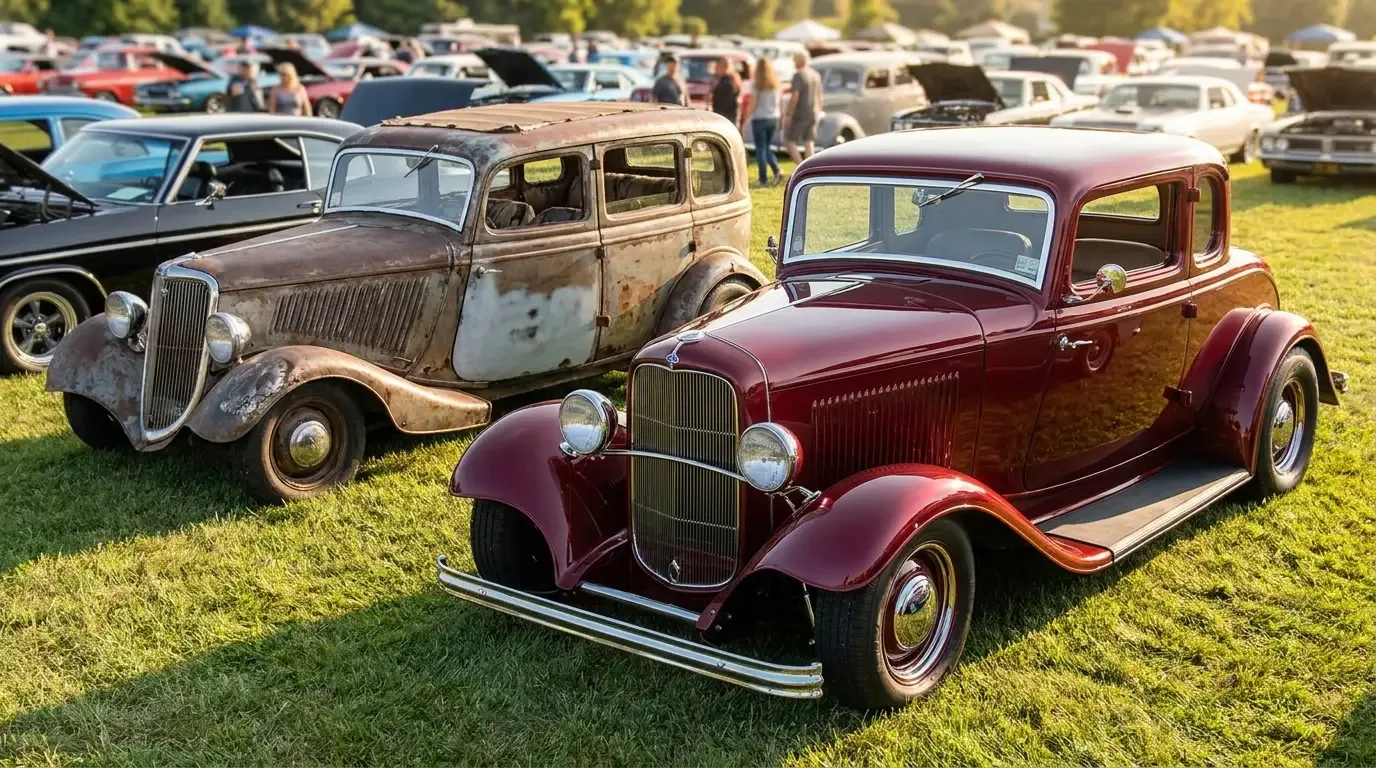
The confusion usually comes from people lumping every old modified car into one bucket. It helps to separate street rod from rat rod first, then understand that a traditional hot rod sits between them. If you want the middle ground spelled out, the street rod vs hot rod breakdown covers where the period-correct crowd draws its lines. This piece is about the two extremes: polished and reliable on one side, raw and unfinished on the other.
Two different definitions of finished
A street rod is a pre-1949 car built to drive like a modern one. Crate engine, independent front suspension, four-wheel discs, air conditioning, an overdrive trans, and paint you are almost afraid to lean on. The whole point is that you can drive it three states over to a national event, run the AC the whole way, and arrive without grease under your nails. Comfort and reliability are the mission. The car is done, and done means every panel gapped, every wire loomed, every bolt torqued.
A rat rod flips that on its head. It is built to look unfinished, and often it genuinely is. The aesthetic borrows from the late 1940s and 1950s jalopy look but pushes it into caricature: matte or bare-metal bodies, mismatched parts, gennie flathead or small-block power, skinny front tires, and zero interest in shine. A rat rod is a statement against the checkbook builds. Where the street rod hides its engineering, the rat rod puts every weld and every scavenged part on display and dares you to judge it.
Both of them start from the same body cutoff, and that cutoff matters. If you are fuzzy on why 1948-and-earlier is the magic line for this whole family of cars, The Pre-1949 Cutoff Explained walks through the NSRA history behind it. Cross that line into 1949-and-up modernized cars and you have left both camps and wandered into restomod territory.
Cost, and where the money actually goes
People assume the rat rod is the cheap one. Sometimes it is. A backyard build using a junkyard small-block, a swap-meet grille, and no paint booth can get on the road for a fraction of what a show street rod costs. But do not confuse "looks cheap" with "was cheap." A well-sorted rat rod still needs a straight frame, brakes that stop, steering that tracks, and a drivetrain that will not strand you. Those parts cost the same whether they live under matte primer or three-stage pearl.
The street rod is where the real money stacks up, and most of it goes into things you cannot see in a photo. Bodywork and paint alone can run into five figures on a quality build. Add a crate engine, an IFS clip, a finished interior, AC, and the wiring to run it all, and the invoice climbs fast. The savings on a rat rod come from deleting those finishing steps, not from the mechanical bones underneath.
| Trait | Street Rod | Rat Rod |
|---|---|---|
| Body cutoff | Pre-1949 American | Pre-1949 American |
| Finish | Show paint, buffed | Bare metal, primer, or matte |
| Drivetrain | Crate engine, overdrive | Often older or scavenged, running |
| Suspension | Modern IFS, discs | Mixed, sometimes traditional straight axle |
| Comfort | AC, sound deadening, full interior | Minimal, exposed, spartan |
| Typical build cost | Higher, most spent on finish | Lower, savings from deleting finish |
| Attitude | Polished, arrive-clean | Raw, anti-establishment |
Attitude is the real dividing line
Strip away the parts talk and what actually separates these two is posture. The street rod owner wants to be comfortable, wants the car to work every time, and takes pride in a flawless finish. The rat rod owner is making a point: that character beats perfection, that a car built with your own hands and a pile of found parts has more soul than a catalog build. Neither is wrong. They just want different things from the same hobby.
"I have wet-sanded a hood at two in the morning for a customer who wanted glass, and I have welded a bare-metal roof chop for a kid who wanted grit. What kills me is the guy who buys a fake-rusted 'rat rod' off a lift gate and thinks he outsmarted the whole hobby. Build it or don't, but do not cosplay it."
Gary Nowak
That last point is where I get opinionated, and I don't much care who it offends. There is a difference between a real rat rod, welded and scavenged and genuinely raw, and a factory-produced "distressed" look sold as attitude. The whole spirit of the thing is that it was built cheap and hard by hand. Pay someone to fake the rust and you have missed the entire idea. If you want the counterpoint from the other camp, the rat rod side of the comparison lays out how rat rods stack up against the period-correct traditional hot rod crowd, which is its own long argument.
Which one should you build
Be honest about how you actually want to use the car. If you plan to drive long distances, sit in traffic, and want to arrive clean and cool, build the street rod. If you want a hands-on project that costs less to finish, does not care about a rock chip, and turns heads for the opposite reason, the rat rod is your answer. The mistake is building one while wanting the other.
At the end of it, both cars answer to the same pre-1949 body and the same American rodding tradition. One chose polish and reliability, the other chose grit and defiance. Pick the one that matches how you drive and who you are, and build it like you mean it.
Sources and notes
- Street rod and rat rod definitions cross-checked against period hot rod press and enthusiast reference material.
- NSRA pre-1949 body-cutoff convention as it applies to the street rod category.
- Build-cost ranges drawn from general shop experience and published enthusiast build accounts; figures are approximate.
- Origin of the "rat rod" term per widely cited hobby histories from the early 1990s reaction against high-dollar builds.
Related Reading
Have a
Classic Car
for Sale?
Reach thousands of serious classic car collectors across the US.
Sell It Here →
Are You a Classic Car Dealer?
List your full inventory and connect with targeted classic car buyers.
Join as a Dealer →

About the author
Gary Nowak
Lifelong Midwest rodder who has been building and driving traditional pre-war hot rods since the 1970s.




Comments
Be the first to comment on this article.