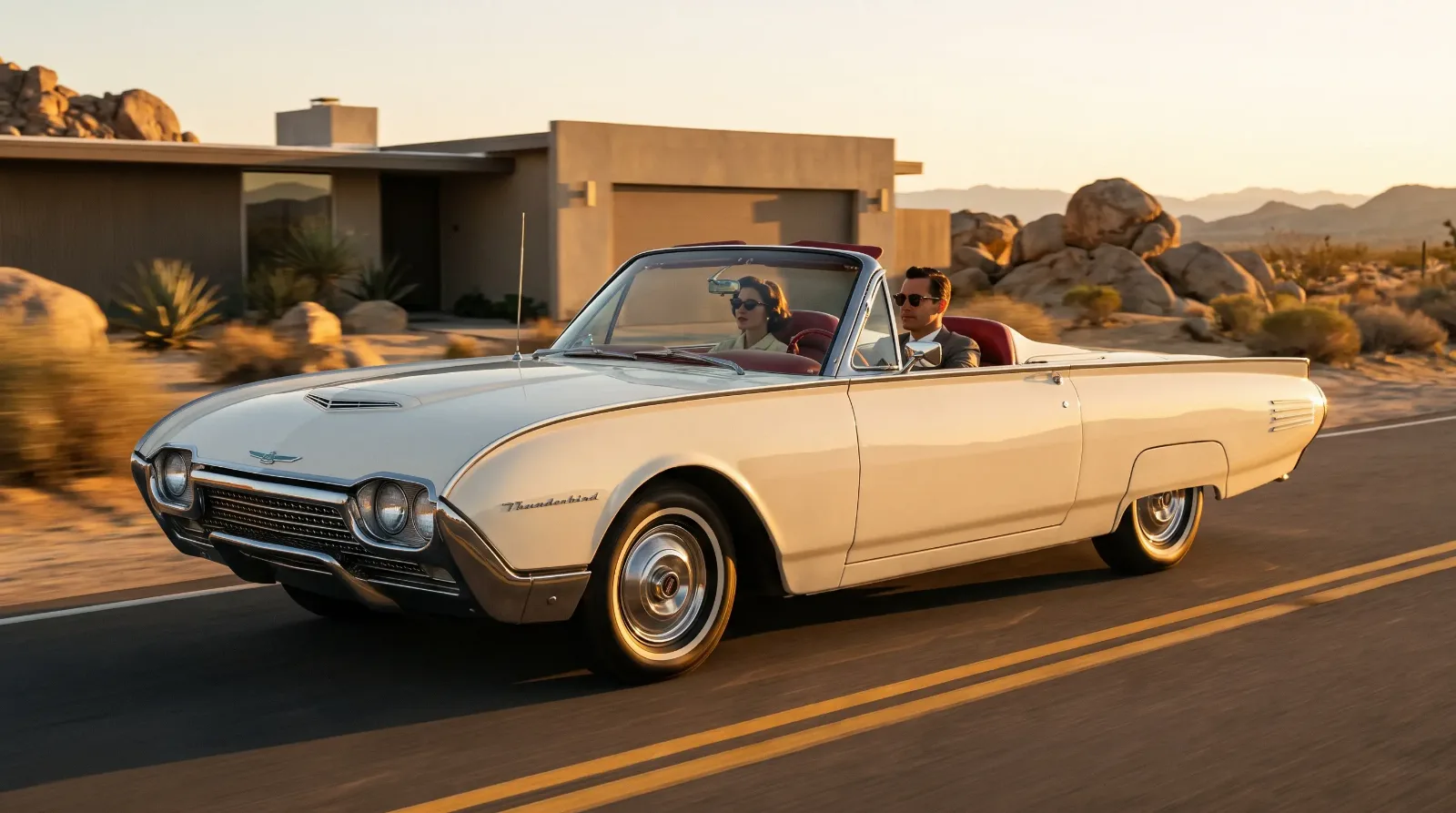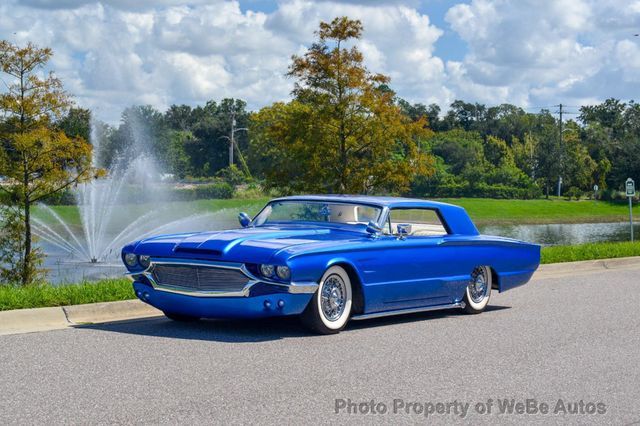
Every car club has that one member who chases the cars nobody else even knows to look for, and in Thunderbird circles that usually means somebody eventually starts asking about the Italien. I've had this conversation at least a dozen times at swap meets over the years: a newer member sees a grainy period photograph of a fastback Thunderbird with no rear roofline at all, nothing like the notchback hardtops and Landaus everyone else is restoring, and they want to know where they can find one. The honest answer is that they can't buy one, not really, because Ford built exactly one Thunderbird Italien and it was never sold to the public in the first place.
What the Italien actually was
Ford built the Italien as a one-off factory custom, starting life as a brand-new 1962 Thunderbird convertible that was shipped straight from the assembly line to Dearborn Steel Tubing, Ford's outside coachbuilding contractor. There, working from Ford Styling drawings created by designer John Orfe and built by Vince Gardner, the car received a fiberglass fastback roofline that swept from the windshield all the way to the rear bumper without a break, along with new 1963 Thunderbird front fenders and doors, roughly 80 custom trim pieces, and a Ferrari-inspired egg-crate grille, finished in a deep Candy Apple Red. Where the production Thunderbird's roof ended in the boxy trunk profile familiar from every hardtop and Landau on the road, the Italien's greenhouse tapered continuously into the rear deck, giving it a silhouette that looked genuinely European by comparison to anything else wearing a Ford badge that year. The name itself was a deliberate signal, Ford wanted showgoers to connect the car's proportions with Italian coachbuilding houses like Bertone and Pininfarina, whose fastback designs were drawing serious attention in enthusiast magazines during this period.
The Italien toured Ford's 1962 to 1963 Custom Car Caravan and appeared at Autoramas in cities including Detroit, Los Angeles, and Miami, later showing at the 1964 New York World's Fair's Cavalcade of Custom Cars. It was built to gauge public reaction and generate press coverage rather than to preview an actual near-term production plan. This was standard practice across the industry at the time. Manufacturers built dramatic one-off or limited-run show cars specifically to keep their brand in magazine coverage between actual new model launches, and the Italien served exactly that purpose for Ford during a year when the production Thunderbird lineup was already getting plenty of attention from the Sports Roadster and Landau introductions.
Why it never reached production
Fastback rooflines were genuinely fashionable in early 1960s design circles, but building one into the existing Bullet Bird unibody platform would have required substantial structural engineering work that Ford's product planners evidently decided was not worth the investment given how close the entire generation was to being replaced. The 1964 Thunderbird redesign was already well into development by the time the Italien toured the show circuit, and Ford's engineering resources were understandably focused there rather than on retrofitting a dramatic new roofline onto a platform with a limited remaining production life. The Italien's fastback idea did not disappear entirely, though echoes of that sleeker silhouette thinking would resurface in later Ford products through the decade.
Building a genuine running show car also cost real money for a return that was purely promotional, and Ford's decision to greenlight the Italien at all says something about how much value the company placed on magazine coverage and dealer buzz during this period. Concept vehicles like this rarely paid for themselves in any direct sense, but they kept the brand's name attached to forward-looking design ideas between actual product launches, which mattered a great deal in a competitive market where General Motors and Chrysler were both running similarly ambitious show car programs of their own.
What happened to the car afterward
Tracking a one-off show car's fate decades later is usually exactly the kind of research project that keeps marque historians up late at night, and plenty of contemporaries built by other manufacturers were quietly scrapped once their show duty ended, since manufacturers rarely saw long-term value in preserving vehicles that had already served their promotional purpose. The Italien is the exception that proves the rule: it survived because Ford sold it to a private owner rather than sending it to the crusher, and its documented ownership chain from Dale Robertson through to Tom Maruska's restoration is unusually well established for a car of this kind. That kind of documentation is precisely what separates a verified original show car from a modern fastback conversion built to resemble one, and it is why the Italien's provenance is treated as settled rather than speculative among Thunderbird historians.
The uncertainty surrounding survivors is itself part of the appeal for serious researchers. Unlike a production Thunderbird, where body tags and factory build sheets offer a relatively clear paper trail, a show car like the Italien often left the factory outside normal production recordkeeping entirely, built and modified by a specialty department rather than the standard assembly line. That makes period photography, magazine coverage from 1962 auto shows, and any surviving Ford internal correspondence far more valuable to a researcher than the kind of body tag decoding that works for a standard hardtop or convertible.
"Everybody wants to find the Italien because it looks like nothing else Ford ever put on a showroom floor. Half the fun of chasing this car is admitting up front that you are probably chasing a photograph more than an actual vehicle."
- Wayne Coburn
Its place in the Bullet Bird story
The Italien matters to Thunderbird history precisely because it shows what Ford's designers were considering alongside the production cars that actually reached buyers during the Bullet Bird years. Understanding it properly means understanding the platform it was built from, and readers who want read the background on the 1961 redesign that established the unibody chassis and styling language the Italien borrowed from will get a much clearer picture of just how far this concept car departed from the standard production shape.
For club members and collectors, the Italien functions less as a car to actually own and more as a reference point, proof that Ford's designers were experimenting well beyond what reached dealer lots during these years. It is a useful reminder that the production Thunderbirds people can actually buy and drive today, including the standard hardtops, Landaus, and Sports Roadsters, represent Ford's chosen production path rather than the full range of what the company's design studio was exploring at the time. Anyone ready to pursue an actual, buildable piece of this generation rather than a show-car unicorn can find a classic Thunderbird currently available on the market.
Why the story still gets told
The Italien never sold a single unit to the public, never appeared in a production catalog, and technically has almost no direct bearing on what most Thunderbird owners actually drive today. And yet the story keeps getting retold at club meets and swap meets year after year, because it captures something true about this era of Ford design: a willingness to chase dramatic ideas on the show circuit even when the business case for production never quite added up. That willingness is part of what makes the whole Bullet Bird generation, production cars and concept experiments alike, worth studying as closely as we do.
Sources and notes
- The Only One Made: The Ford Thunderbird "Italien" Show Car - Silodrome
- The Shop That Built This One-Off T-Bird Saved It from Certain Death - Hagerty Media
- Design of the 1961 Thunderbird Sports Roadster and Italien - Dean's Garage
- Ford Thunderbird Italien Fastback - Supercars.net
- Ford Thunderbird Italien restoration - Tom Maruska Cars