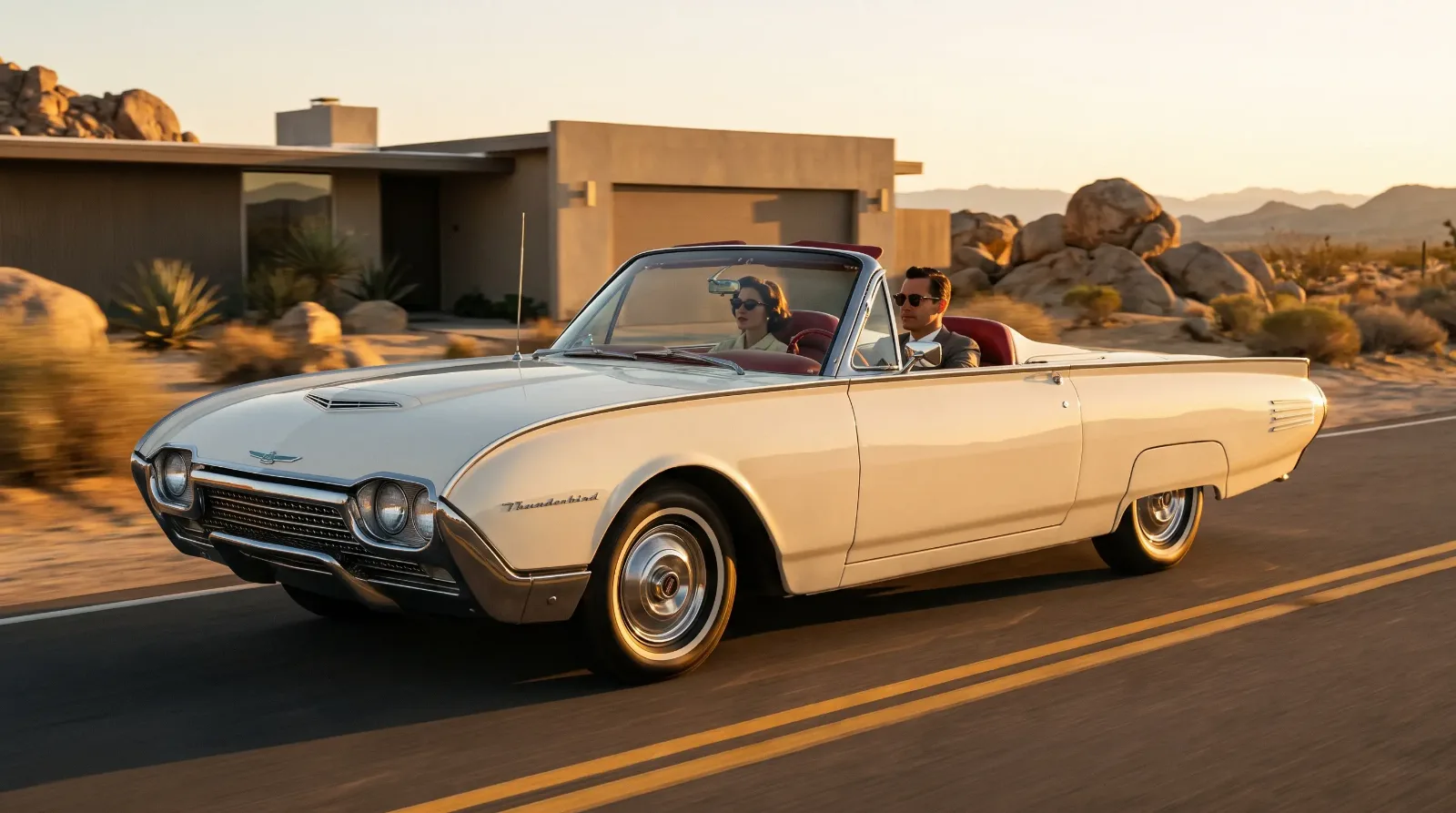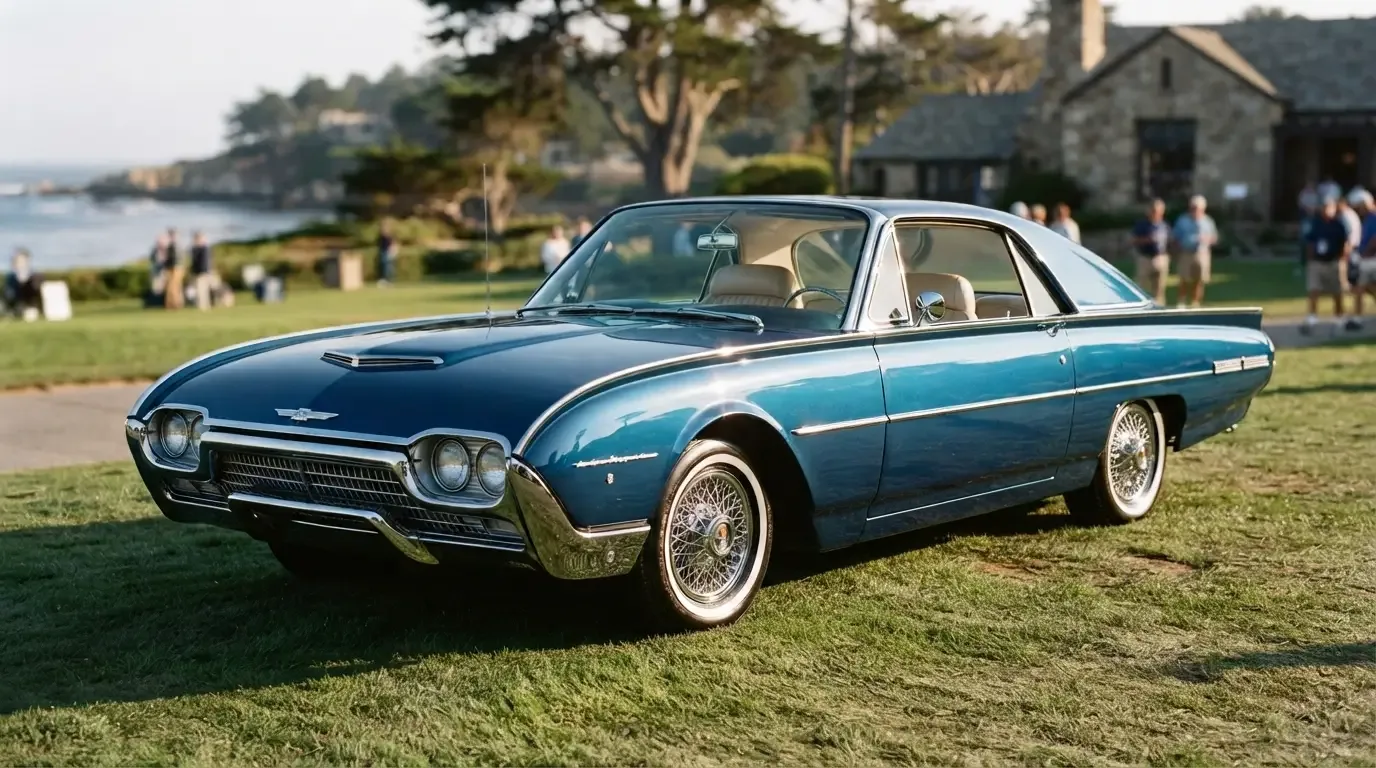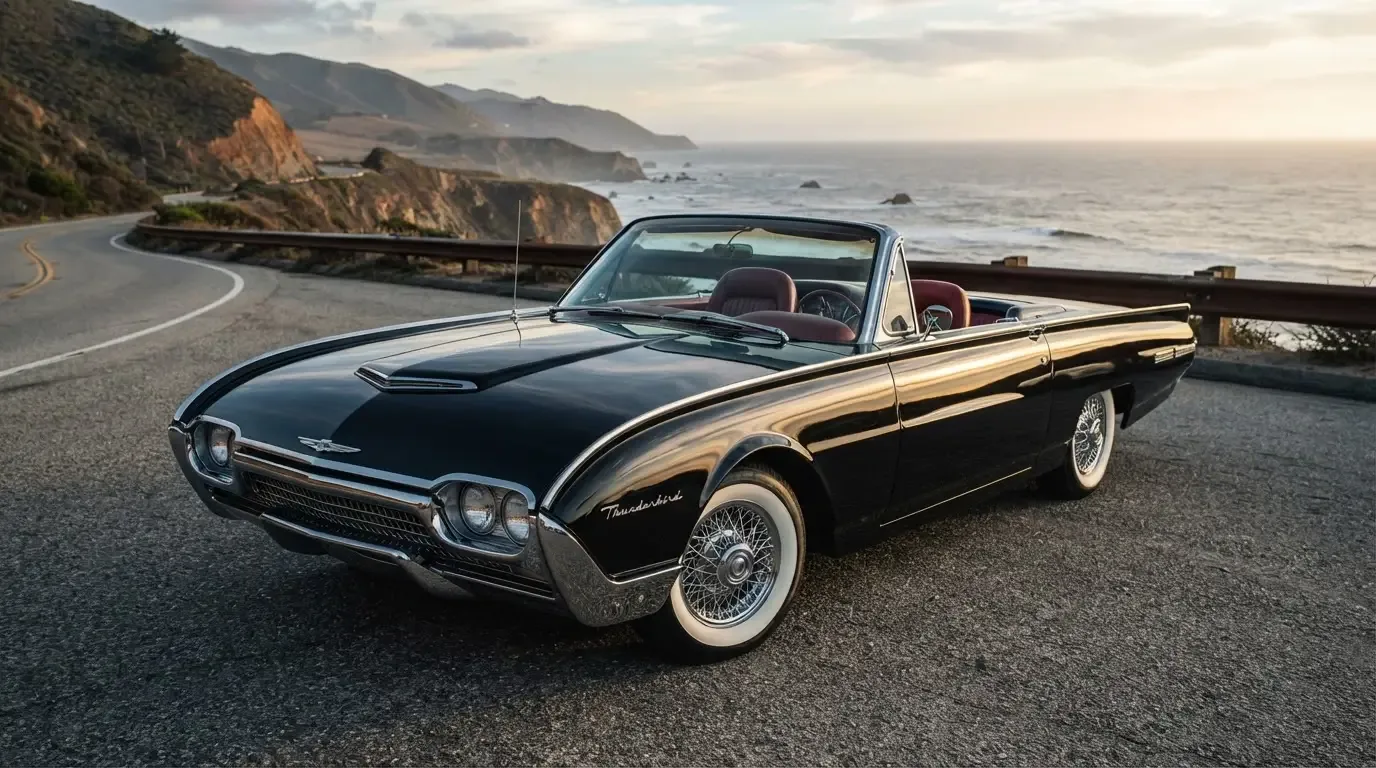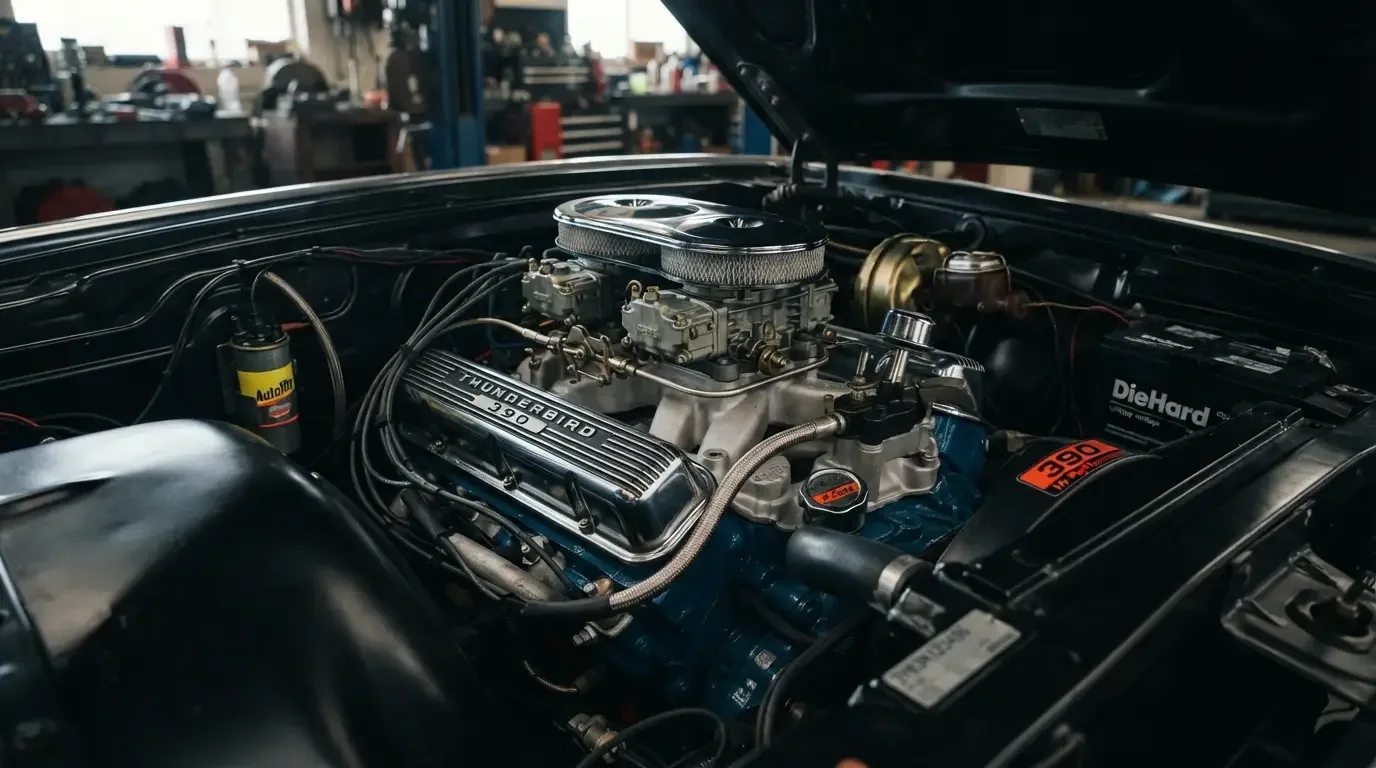
Pop the hood on a real M-code Thunderbird and the first thing you notice is the linkage. Three two-barrel carburetors sitting in a row, throttle rods ganged together, air cleaner shaped like nothing else Ford put under a T-Bird hood. That is the thunderbird m-code tri power setup, and it is the closest the early-1960s Thunderbird ever got to a factory street fighter. I have had exactly two of these on my lift over the years. Both times I found things the parts books do not tell you.
The M-code designation lives in the VIN and the door tag, not on a badge. Ford used a letter in the engine-code position to identify which 390 a given Thunderbird carried, and M meant the Tri-Power version: three Holley two-barrels instead of the standard four-barrel Z-code setup. Rated output on the M-code came in around 340 hp at 5,000 rpm with 430 lb-ft of torque, a real jump over the standard Z-code 390's 300 hp, and torque followed the same climb. On paper it sounds like a mild bump. In the shop, with the center carb doing all the idle and cruise work and the two outboard carbs opening under load, it drives like a different car.
What the tri power actually does under the hood
People hear "three carbs" and picture triple the fuel going in all the time. That is not how it works and it never was. The center carburetor handles idle, part throttle, and light cruising by itself. The two end carburetors stay closed until the vacuum-operated linkage opens them, usually somewhere past half throttle. Get into it hard and all three open together, and that is the moment the M-code Thunderbird stops being a boulevard cruiser and starts pulling like something with real intent behind it.
I have set up more than one Tri-Power linkage that some previous owner "improved" by hooking the end carbs to open earlier for more punch off the line. It never works the way they think. You get a flat spot, a rough idle, and a plug reading that tells you the whole story before you even pull the heads. Ford tuned this progression for a reason, and every M-code I have gotten running right came from putting the linkage back to stock geometry, not away from it.
Why the M-code is harder to find than people assume
Tri-Power was never a volume option. Most 1962 and 1963 Thunderbird buyers checked the box for power windows and a vinyl top, not a triple-carb 390 that needed more attention to keep in tune. Take rates on the M-code stayed low, and low-production options are exactly the ones that get swapped away by a later owner chasing simplicity, or a mechanic in 1975 who was tired of balancing three carburetors and bolted on a single four-barrel intake instead.
That history matters if you are trying to understand how few M-code cars survive today: total production across 1962 and 1963 is generally put at only a few hundred units, with published counts for the two years varying by source but all landing in roughly that range. The number that gets thrown around in club circles is small, and every one I have inspected in person had some kind of paper trail attached, because owners who know what they have tend to hang onto the documentation. A Thunderbird with a numbers-matching M-code block and its original Tri-Power intake is not a common find at a swap meet. It is closer to a hunt.
Working on one without ruining it
The number one mistake I see is guys treating the three carburetors as three separate rebuild jobs done in isolation. They are not independent. The center carb's metering has to be right before you touch the end carbs, because everything downstream of it depends on that baseline. Pull the wrong carb apart first and you will chase a rough idle for a weekend that a five-minute baseline check would have solved.
Fuel delivery is the other spot where I have seen good intentions cause real damage. The stock fuel pump and lines were sized for the era, and a modern in-line electric pump bolted on without matching the pressure spec will flood a Tri-Power setup fast. I have pulled spark plugs out of an M-code that looked like they had been soaking in gasoline, because someone wanted "more flow" and did not think about what three carburetors do with unregulated pressure. Get shop classic Thunderbird listings before you commit to a project like this, and look hard at whether the seller can document the Tri-Power components as original to the car, because reproduction intake and carb sets exist and they are not cheap to sort out from the real thing on sight.
"A Tri-Power that runs rough isn't a Tri-Power problem, it's usually a vacuum leak or a lazy owner who never learned to sync three carburetors instead of one. Fix the boring stuff first."
- Mike Sullivan
What it means for the car's identity
The M-code option did not last long in the Thunderbird lineup, and that short window is part of why it holds the interest it does now. It represents a brief stretch where Ford let the Thunderbird carry genuine performance hardware instead of just performance styling. The Sports Roadster got most of the attention for its tonneau cover and wire wheels, but under the hood, the Tri-Power engine was doing the real work of backing up the car's looks with output.
If you want the whole picture on where this generation of Thunderbird came from and why Ford was building a car that could carry an engine like this in the first place, that is worth reading alongside anything specific to the M-code. The Tri-Power option only makes sense in context. It was Ford's answer to a market that wanted the Thunderbird to be more than a personal luxury car, even if only a small number of buyers actually checked that box.
Buy one right and an M-code Thunderbird rewards you with something no Z-code car can match: a triple-carb 390 that still surprises people who think they know what a 1960s Thunderbird is capable of. Buy one wrong, without checking the numbers, and you end up chasing someone else's shortcuts for years. I have seen both outcomes plenty of times, and the difference always comes down to what got verified before the money changed hands.
Sources and notes
- Ford FE Engine Forum: 1962 Thunderbird M-code 390-6V 340hp discussion
- Carscoops: Rare M-Code Roadster, a 1962 Ford Thunderbird with Talons
- Wikipedia: Ford Thunderbird (third generation)
- RM Sotheby's: 1962 Ford Thunderbird M-Code Sports Roadster
- RM Sotheby's: 1963 Ford Thunderbird Convertible M-Code (Sam Pack Collection)
- Automobile Catalog: 1963 Ford Thunderbird Hardtop 390 Special V-8 specs