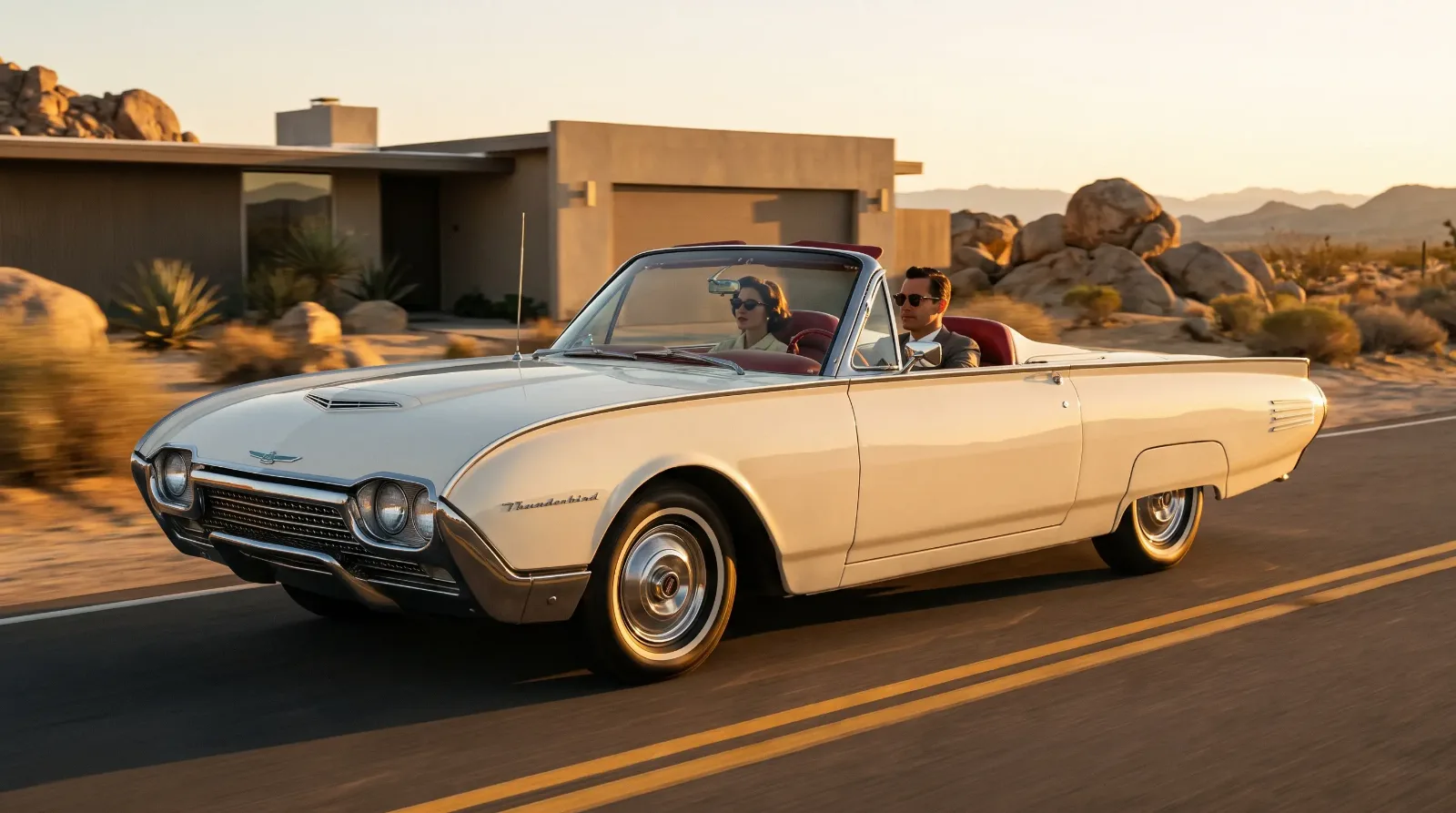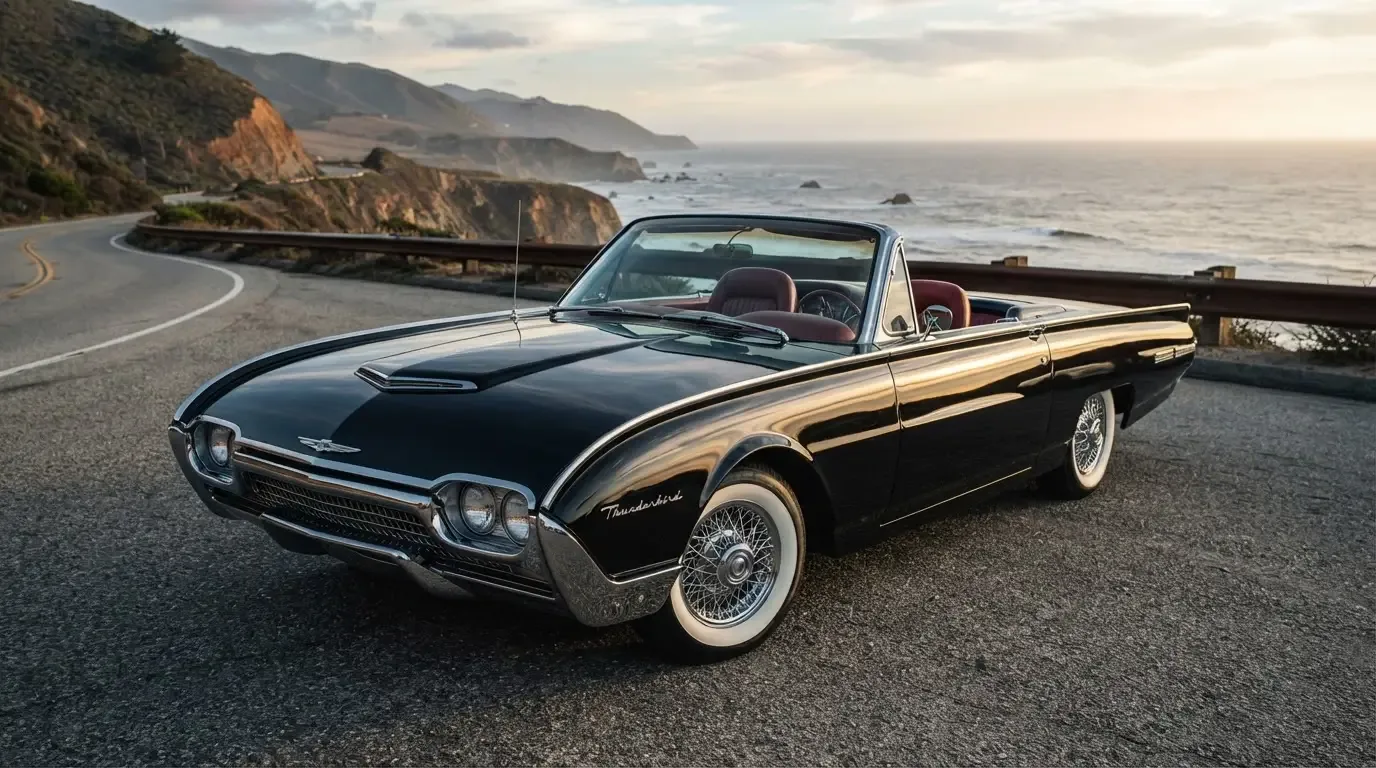
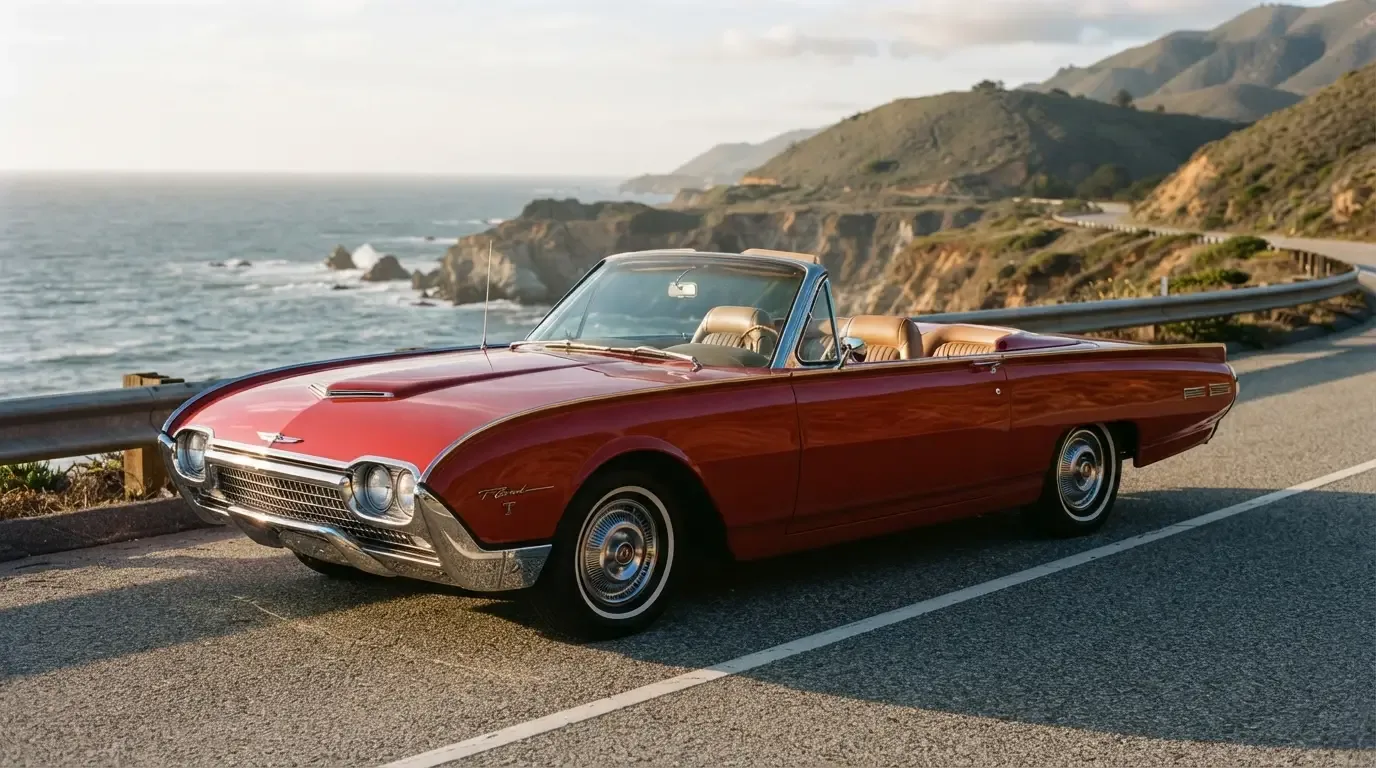
Production records from Ford's Wixom assembly plant tell a clearer story about the 1962 Thunderbird convertible than most secondhand accounts do, and the numbers correct a few assumptions that have hardened into folklore over the decades. This was the second model year of the Bullet Bird body, and the convertible carried forward one of the more genuinely inventive pieces of engineering Ford put into a production car during this era: a fully automatic power top and tonneau system that folded the roof down and covered it beneath a hinged rear deck panel without the driver touching a single latch by hand.
Ford had introduced this mechanism the prior year, and by 1962 the system had been refined rather than reinvented. Reliability improved, and the sequence itself, roof folding back, deck lid rising, tonneau panel closing over the stowed top, remained a genuine selling point at dealerships where salesmen would run the full cycle for prospective buyers as a demonstration. It is worth being precise about what the system actually did, because enthusiast accounts sometimes exaggerate the complexity. The top folded into a well behind the rear seat, and the tonneau panel, hinged at the rear, closed forward to conceal it. No other American convertible offered anything comparable at this production volume.
Production numbers and what they actually show
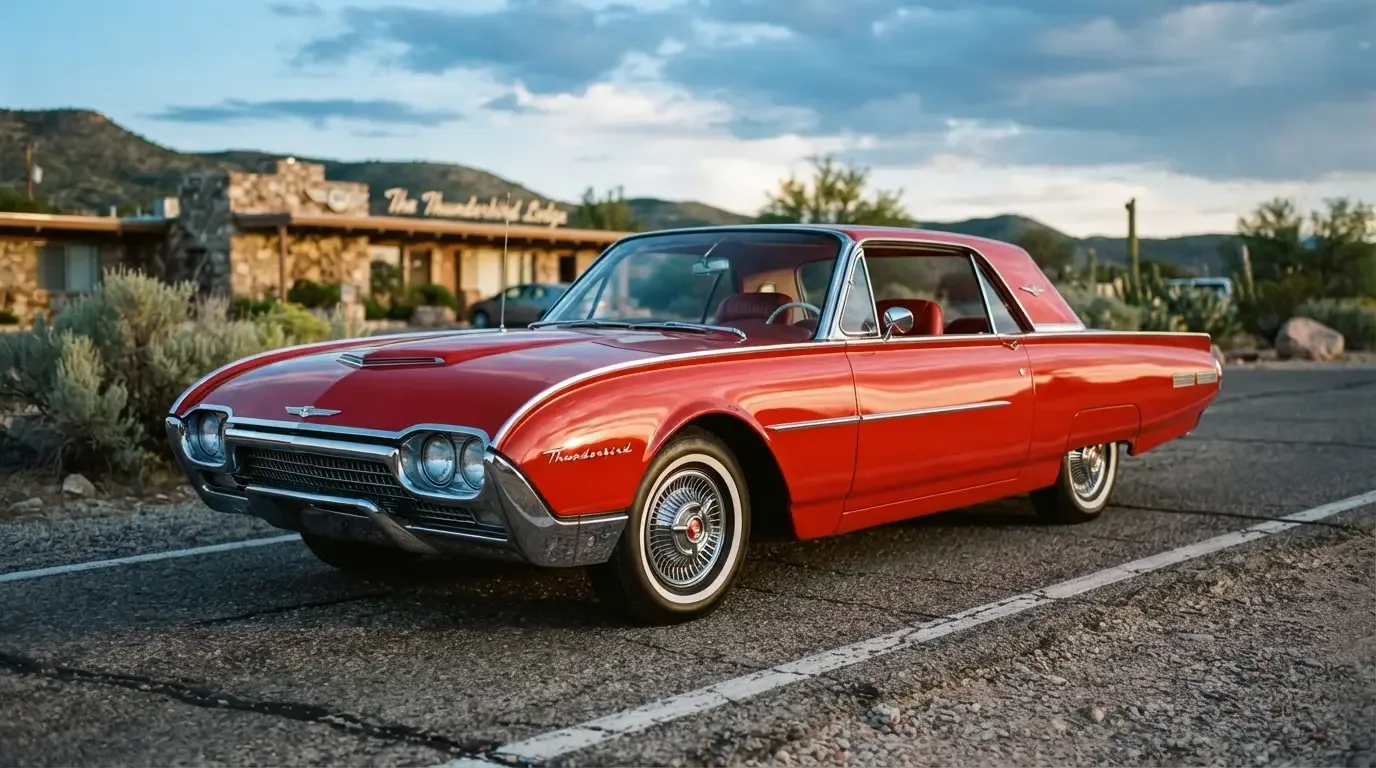
Total Thunderbird production for the 1962 model year came in at 78,011 units across all body styles, with the convertible representing a distinct minority of that figure, roughly 9,800 units by most published tallies. Those numbers matter because they explain the convertible's standing today relative to the hardtop and the Landau, which sold in far greater volume. A convertible was a more expensive proposition to build and to buy, and Ford's own dealer order data from the period reflects that buyers skewed toward the hardtop body style by a wide margin.
Where accounts get sloppy is in conflating the standard convertible with the Sports Roadster, a distinct package built on the convertible body that added a fiberglass tonneau cover over the rear seat area and Kelsey-Hayes wire wheels. The Sports Roadster was a low-volume variant within an already low-volume body style, and Ford's own production breakdowns treat it separately from the standard convertible in the build records that survive. Anyone researching a specific 1962 Thunderbird convertible should confirm which configuration they are actually looking at before assuming rarity figures that belong to the Sports Roadster apply to their car.
What buyers actually got for their money
Standard equipment on the 1962 Thunderbird convertible included the 390 cubic inch V8 in its four-barrel Z-code configuration, putting out a factory rating of 300 hp. The M-code Tri-Power version remained available as an option this year, carried over from 1961, though take rates stayed low relative to the standard engine. Buyers could add power steering, power brakes, a power driver's seat, and the swing-away steering wheel that had become one of this generation's signature features, all as factory options documented in period order guides.
Base pricing put the convertible near the top of the Thunderbird lineup, and the automatic top mechanism alone represented a meaningful share of the manufacturing cost Ford absorbed to keep the car competitive on features rather than price. This is a detail that gets lost in casual retellings, which tend to focus on the top's novelty rather than the engineering investment it represented for a company producing tens of thousands of these mechanisms a year without a documented pattern of major reliability complaints in period service bulletins.
Correcting a few persistent misconceptions
One claim that circulates in enthusiast forums holds that the automatic top mechanism was unreliable from new and that most surviving cars have had it disabled or removed. Ford's period service documentation does not support this as a widespread factory-era problem. What does hold up is that decades of deferred maintenance on cars that changed hands multiple times before the collector market matured left many of these mechanisms in poor working order by the 1980s and 1990s, which is a different problem with a different cause. A well-maintained example, serviced consistently, functions largely as designed.
Another point worth correcting: the Sports Roadster's wire wheels and tonneau were not available as standalone options on a standard convertible order. Ford sold the Sports Roadster as its own package, and a standard convertible cannot be retroactively classified as one simply because a later owner added similar equipment. This distinction affects value assessments considerably, and it is the kind of detail that separates a documented, accurately described car from one being sold on assumption. Readers looking for the full story of how this generation came together, including the styling program behind the body the convertible shares with its hardtop siblings, will find the broader context useful before evaluating any specific car.
"The build sheet doesn't lie, but a lot of the stories told about these cars over the past sixty years have drifted pretty far from what Ford actually documented at the time."
- Tom Ramirez
| Spec | 1962 Thunderbird Convertible |
|---|---|
| Body style | Two-door convertible, automatic power top and tonneau |
| Standard engine | 390 cid V8, Z-code, four-barrel carburetor |
| Optional engine | 390 cid V8, M-code, Tri-Power (three two-barrel carburetors) |
| Standard output | 300 hp |
| Wheelbase | 113 inches |
| Approximate convertible production | roughly 9,800 units |
What to look for in a surviving example
Originality on a 1962 Thunderbird convertible hinges heavily on the condition and completeness of the top mechanism, since replacement components have become scarce and expensive relative to more common Thunderbird parts. A functioning automatic top, verified against the car's build plate for correct engine code and trim, represents a meaningfully more complete and historically accurate car than one where the mechanism has been bypassed or replaced with a manual conversion, which happened often enough during the decades before restoration standards caught up with collector interest.
Buyers evaluating a classic Thunderbird for sale should ask directly whether the top cycles through its full sequence without manual assistance, and should request whatever build documentation the seller has retained. A 1962 convertible with intact, functioning original systems and clear documentation of its engine code and options is a genuinely different proposition from a car assembled from parts over the decades, even when the two look similar from across a parking lot.
It is also worth checking the trunk floor and the tonneau hinge mounts directly, since the automatic top's motor and linkage sit in that area and any water intrusion over the decades tends to show up there first as rust or replaced sheet metal. A seller who can point to a documented history of the mechanism, receipts for any motor or relay replacement, and a build plate that matches the VIN is offering something closer to verified history than a car sold on a general description of "runs and drives." That distinction, more than any cosmetic detail, is what separates a well-documented 1962 Thunderbird convertible from one that simply looks the part in photographs.
Sources and notes
- Automotive Mileposts: 1962 Ford Thunderbird Specifications
- Squarebirds.org: 1962 Ford Thunderbird Production Numbers
- Motoexotica: 1962 Ford Thunderbird Z-code Sports Roadster
- Old Cars Weekly: Car of the Week, 1962 Ford Thunderbird Convertible
- Autoevolution: This Rare 1962 Ford Thunderbird Ragtop
- Wikipedia: Ford Thunderbird (third generation)