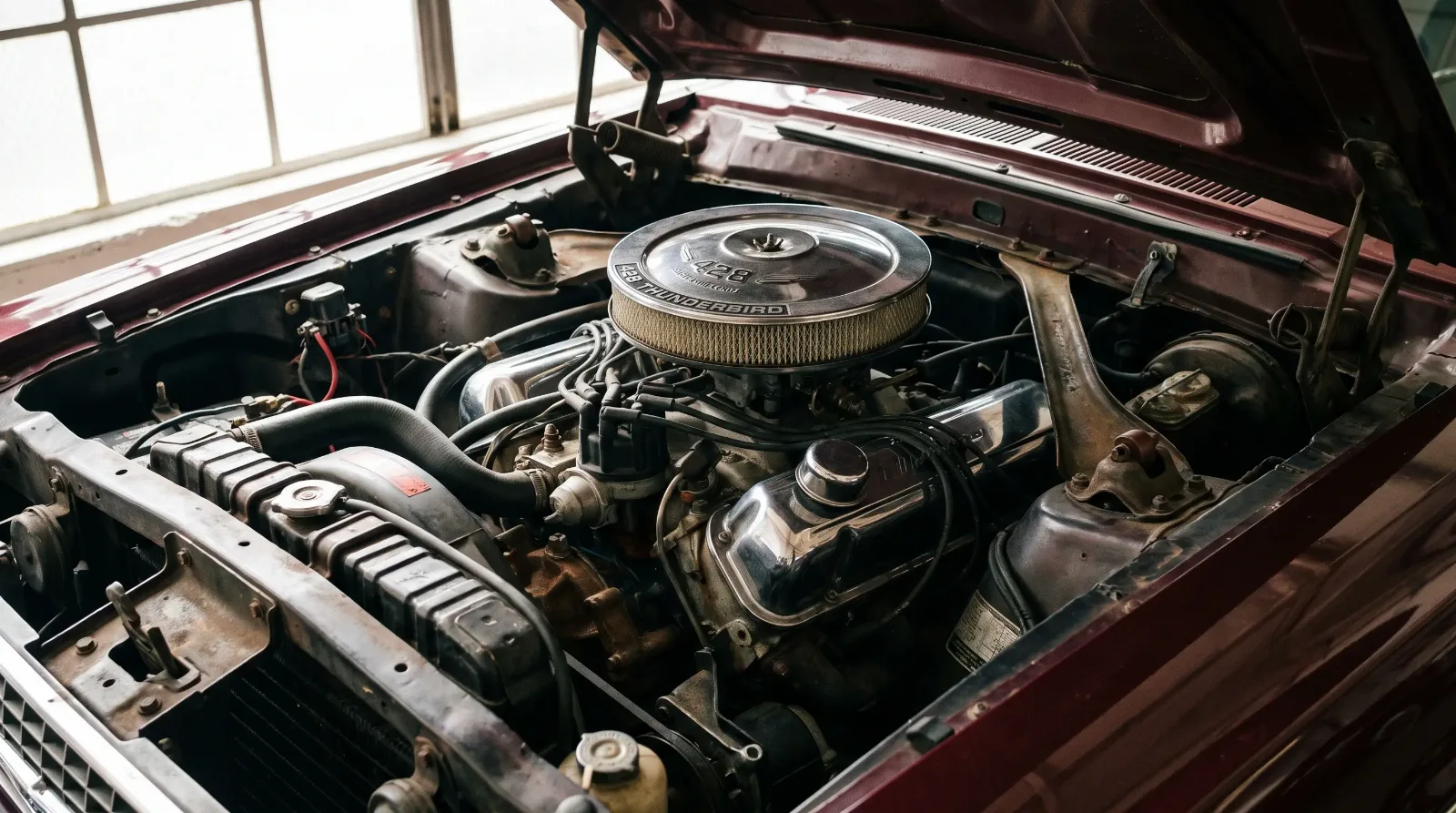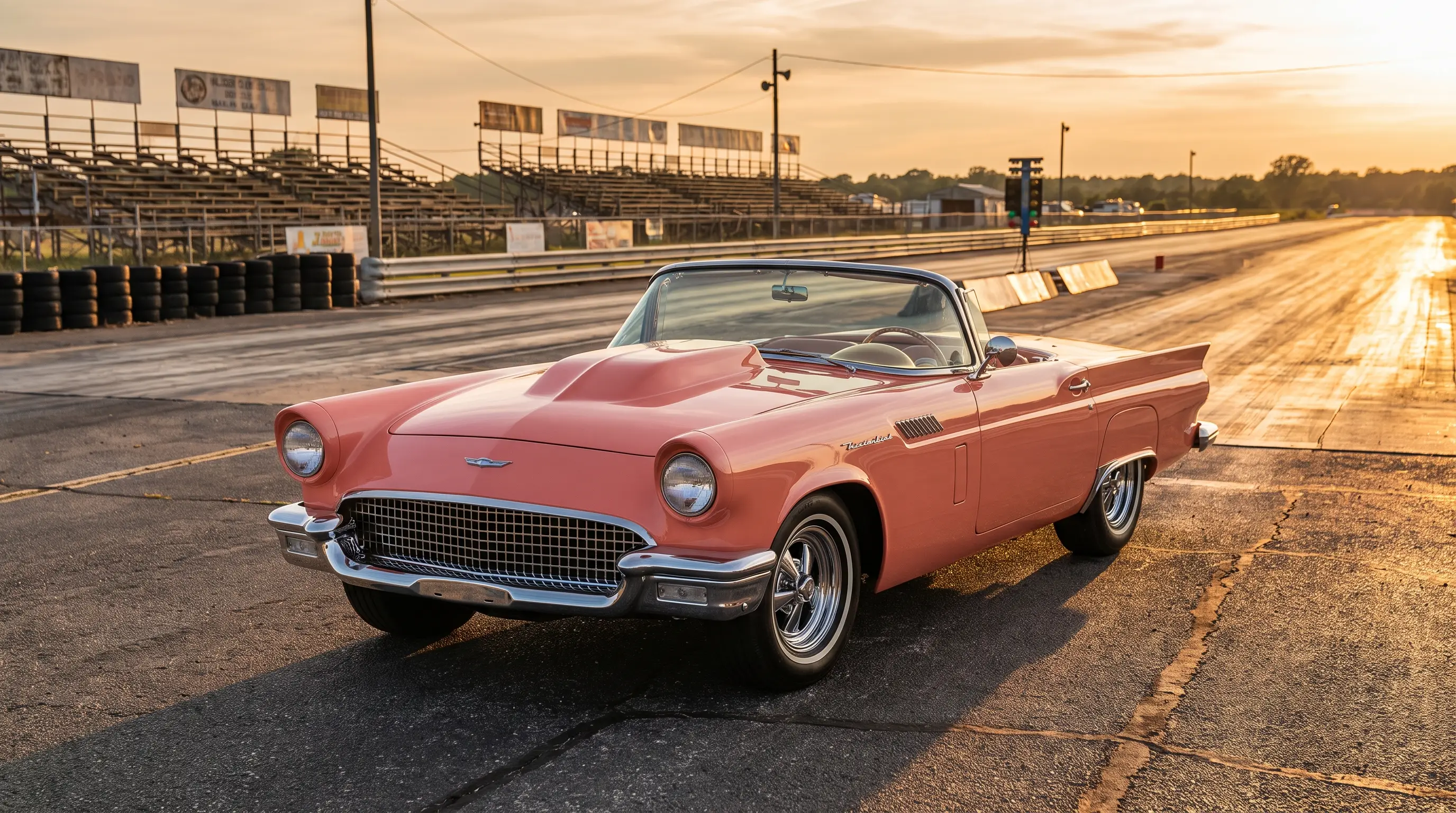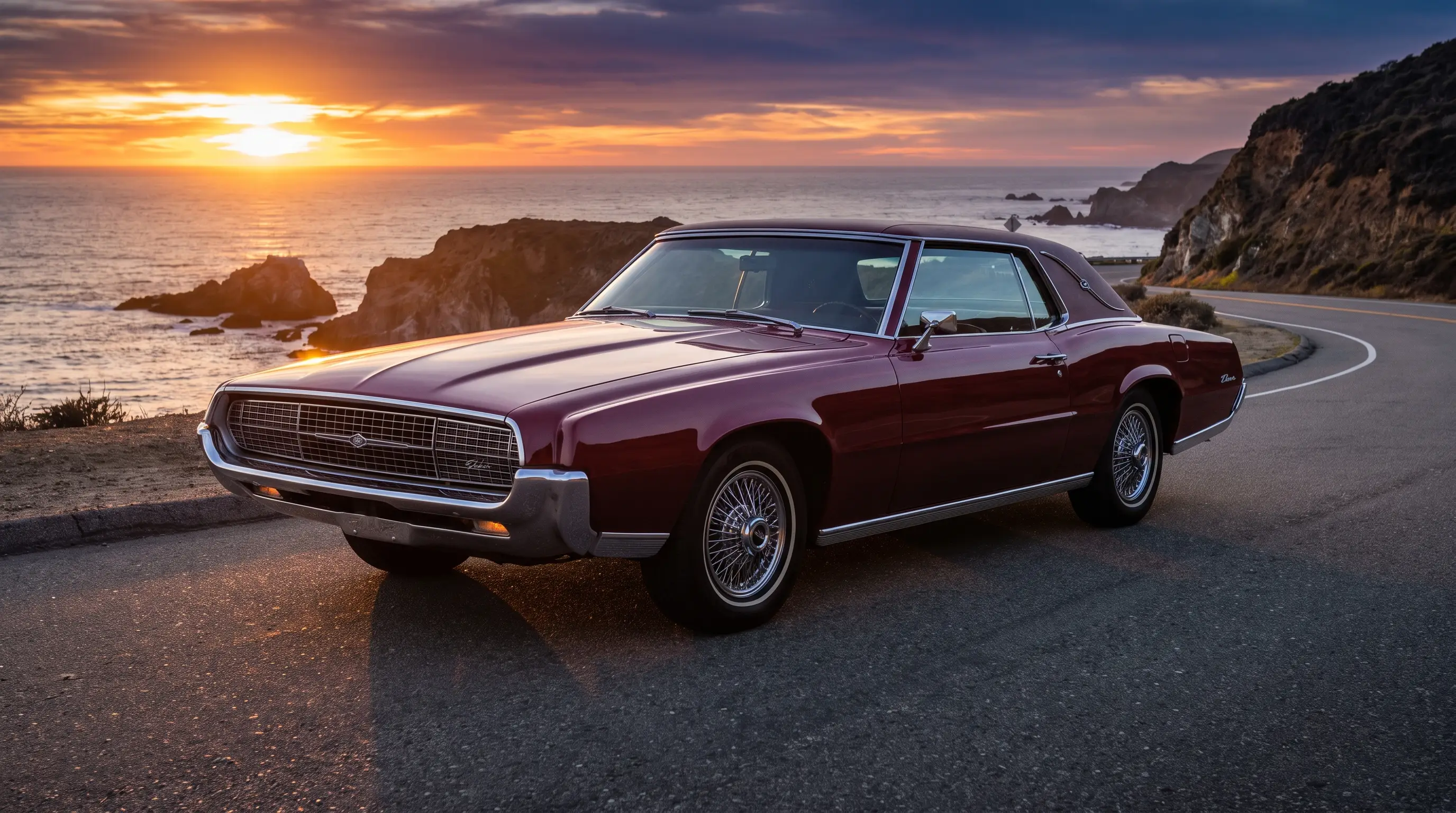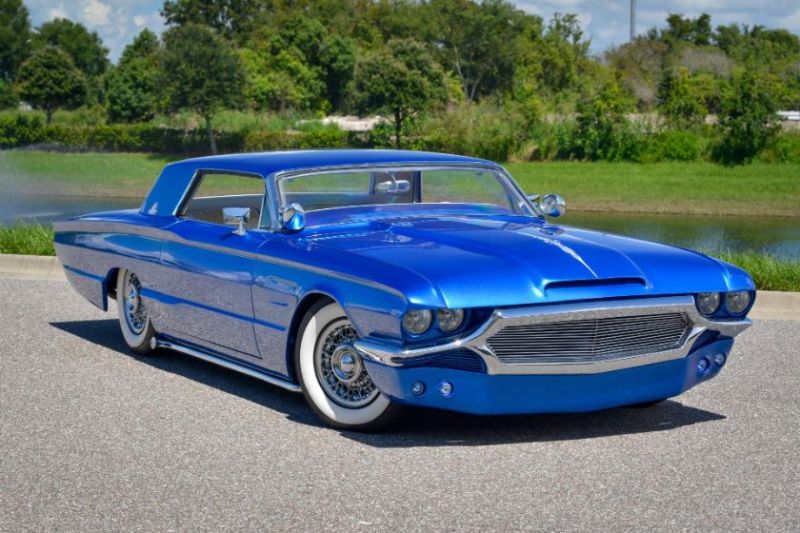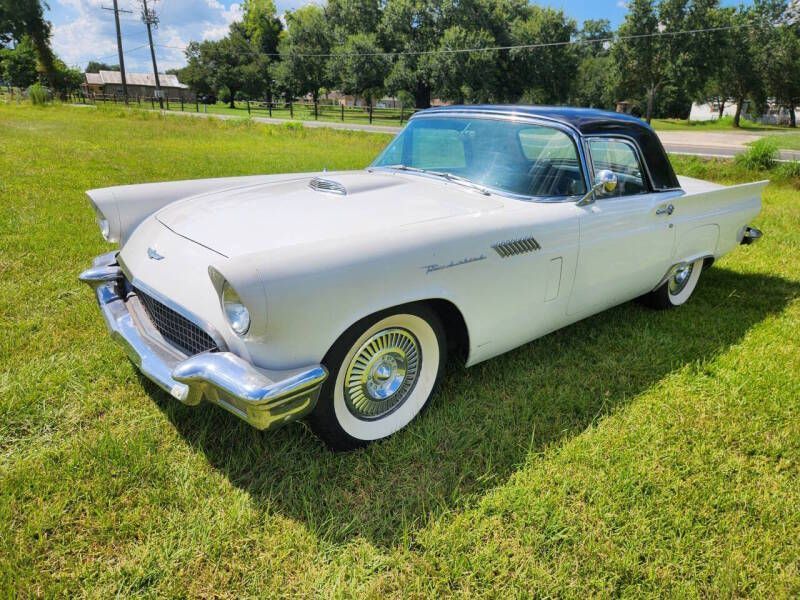
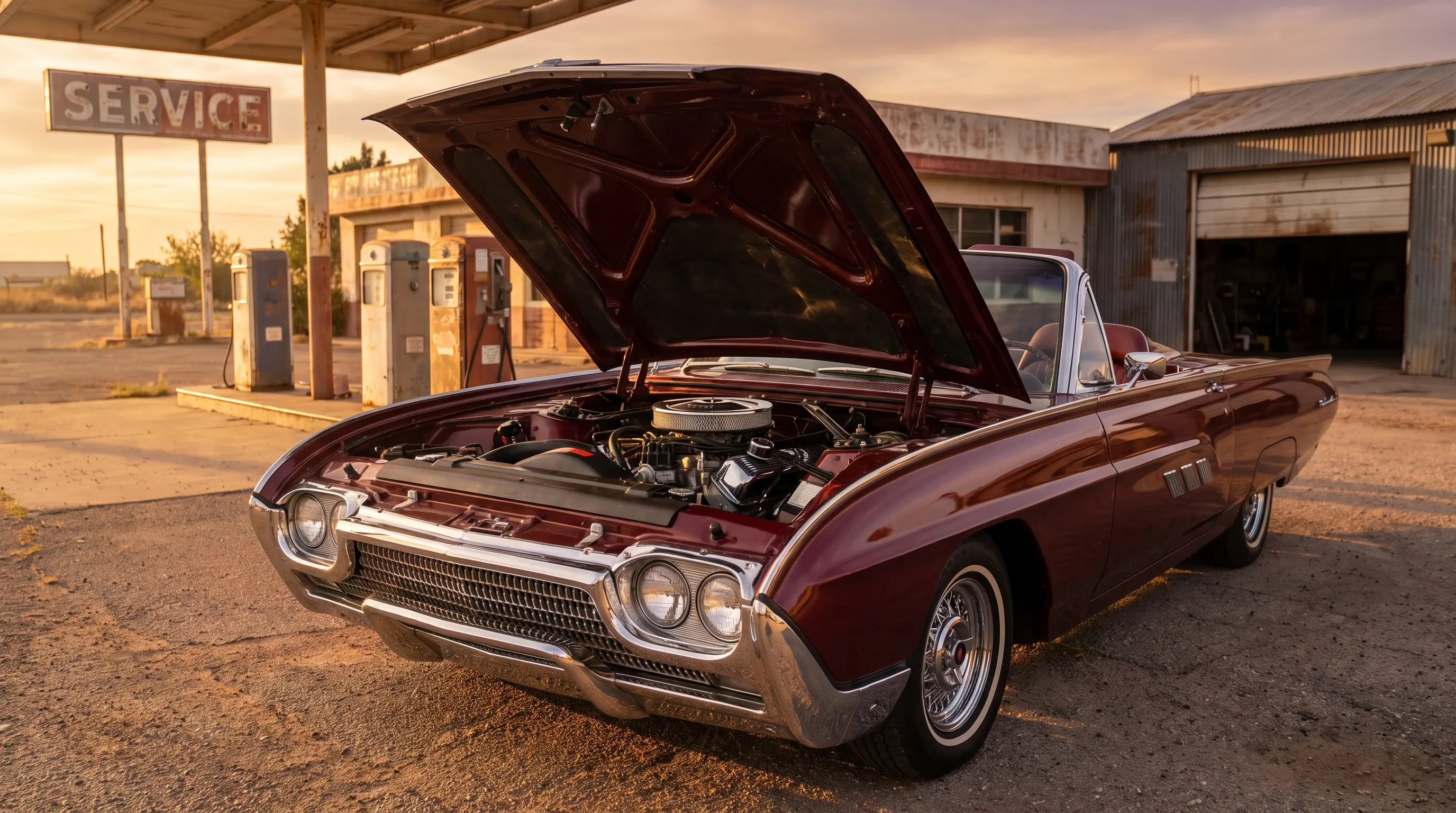
1961 changed everything about the Thunderbird's shape and everything about what sat under its hood. Ford dropped the old Y-block-derived 352 for the new third-generation "Bullet Bird" and replaced it with the thunderbird fe 390, a bored and stroked member of the FE big block family rated at 300 horsepower in standard form. That single number tells you most of what you need to know. This was the moment the Thunderbird stopped being a dressed-up personal car with adequate power and started being a genuinely quick two-ton coupe.
The FE family gets bigger
Ford introduced the FE big block in 1958 at 332 and 361 cubic inches, replacing the Y-block in full-size applications that needed more displacement than the older architecture could reasonably deliver. FE stood for Ford-Edsel, a nod to the divisions the engine was designed to serve across both brands. By 1961, Ford had stroked the FE out to 390 cubic inches, and that displacement became the standard Thunderbird engine for the entire third-generation run from 1961 through 1963, and it continued as an option into the fourth-generation cars through 1966. The 390 was not an exotic engine. It was Ford's mainstream big block, used across full-size Fords, Mercurys, and eventually Mustangs and Fairlanes, which meant parts support and mechanical familiarity were strong even when the car was new.
What 300 horsepower meant in a Thunderbird
Standard Thunderbird 390s ran a two-barrel or four-barrel carburetor depending on the exact package, a cast iron intake, and a compression ratio in the 9.6:1 range, tuned more for smooth torque delivery than for maximum peak output. That was the correct call for a car sold on comfort and prestige rather than stoplight bragging rights, and the 390 delivered strong, confident acceleration without the rough edges a higher-strung engine would have brought into a luxury cabin. For buyers who wanted more, Ford offered a Tri-Power triple two-barrel version of the same 390 rated considerably higher, a story with its own dedicated coverage because it earns one, and that variant is worth reading about separately if outright performance is what interests you.
Reliability, weak points, and what to check
The FE 390 has a well-earned reputation for durability when it is maintained properly, but it is not without known weak points that any buyer should understand before writing a check. Early FE blocks can be prone to cracking around the cylinder walls under extreme conditions, though this is far more of a concern in modified or heavily raced examples than in a stock Thunderbird driven normally. Cooling system capacity is another item worth checking on any 60-plus-year-old FE, since the factory radiators were sized for the climate and traffic conditions of their era, not for idling in modern stop-and-go traffic. A properly sorted 390 with a clean cooling system, correct ignition timing, and reasonable maintenance history will run for a very long time, which is exactly the reputation FE engines built across two decades of Ford production.
| Spec | 1961-1963 Thunderbird 390 |
|---|---|
| Displacement | 390 cubic inches (6.4L) |
| Standard output | 300 hp (SAE gross), consistent across 1961-1963 |
| Carburetion | Four-barrel, cast iron intake |
| Compression | Approximately 9.6:1 |
| Engine family | Ford FE big block |
For the fuller arc of how the 390 fit between the earlier Y-block cars and the later 428, read the background on Ford's full Thunderbird engine progression. The 390 was also the last standard displacement before Ford pushed the Thunderbird into genuinely larger territory, a shift covered in a story worth a look too if you want to see where the FE family went next.
"The 390 didn't need a gimmick. It was the right size, the right power, and it was already a known quantity across half of Ford's lineup by the time it landed in the Thunderbird. That's why it lasted so long."
- Dan Reeves
How the Bullet Bird changed the driving experience
The 1961 redesign that brought the 390 also brought unibody construction, replacing the body-on-frame design used by earlier Thunderbirds, and the combination of the stiffer structure with the torquier engine gave the Bullet Bird a noticeably different feel behind the wheel compared to the Square Bird it replaced. Steering felt more precise, the ride stayed composed at highway speed, and the 390's low-rpm torque meant the car never felt like it was working hard even with a full load of passengers. Ford paired the 390 almost exclusively with its automatic transmissions in Thunderbird applications, reinforcing the car's identity as an effortless cruiser rather than a driver-focused machine, a decision that suited the buyer Ford was actually selling to.
The 390's role across the wider Ford lineup
Because the 390 saw duty in full-size Fords, Mercurys, and later Mustangs and Fairlanes through the mid and late 1960s, the engine benefited from continuous refinement driven by a much larger customer base than Thunderbird sales alone could justify. Improvements to carburetion, ignition timing curves, and even minor casting revisions made across the wider Ford lineup often found their way into Thunderbird applications as running production changes, meaning a late 1963 390 is not mechanically identical in every detail to an early 1961 example even though both share the same basic displacement and architecture. This is a useful thing to know when comparing casting numbers during a purchase inspection, since small production-year variations are normal and do not necessarily indicate a non-original replacement engine.
Shopping for a 390-powered Thunderbird
A stock 390 Thunderbird from 1961 through 1966 remains one of the more approachable entry points into big-block Ford ownership. Parts, rebuild kits, and knowledgeable mechanics are not hard to find because the FE family stayed in production well past the Thunderbird's use of it, powering Galaxies, Fairlanes, and even early Mustang GTs into the late 1960s. That commonality keeps ownership costs reasonable compared to rarer, lower-production engine options in the same generation.
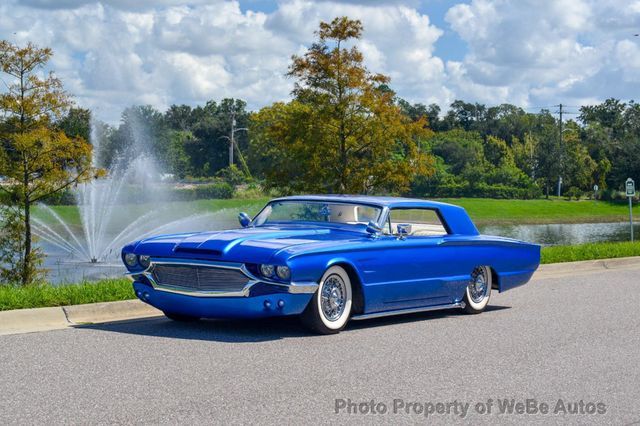
Values for 390-powered Thunderbirds vary considerably based on body style, with convertibles commanding a substantial premium over hardtops and the four-seat Landau roofline configurations sitting somewhere in between. Originality of the drivetrain plays into that valuation directly, and a documented, numbers-matching 390 with clean casting numbers and a verified build sheet, where one survives, will always outsell an equivalent car with an undocumented replacement engine even if the replacement is period-correct in displacement and specification.
Inspecting a prospective purchase means checking the same fundamentals that apply to any FE big block. Compression should be even across all eight cylinders, oil pressure should hold steady at idle and under load, and the cooling system should show no sign of chronic overheating, evidenced by discolored coolant, a repeatedly replaced water pump, or an aftermarket electric fan added specifically to compensate for marginal factory airflow. None of these checks are difficult or expensive to run before purchase, and skipping them on a big-block car with six decades of unknown history is a mistake buyers make far too often simply because the engine idles smoothly in a driveway. A smooth idle tells you almost nothing about long-term mechanical condition.
If you are ready to start looking, go shop classic Thunderbird listings and pay attention to whether the seller can confirm the original 390 is still under the hood, since these cars have seen their share of engine swaps over six decades on the road. A quick conversation about maintenance history, cooling system upgrades, and any prior mechanical work will tell you more about a specific car's condition than any spec sheet ever could, and it costs nothing but a few extra minutes before you commit.