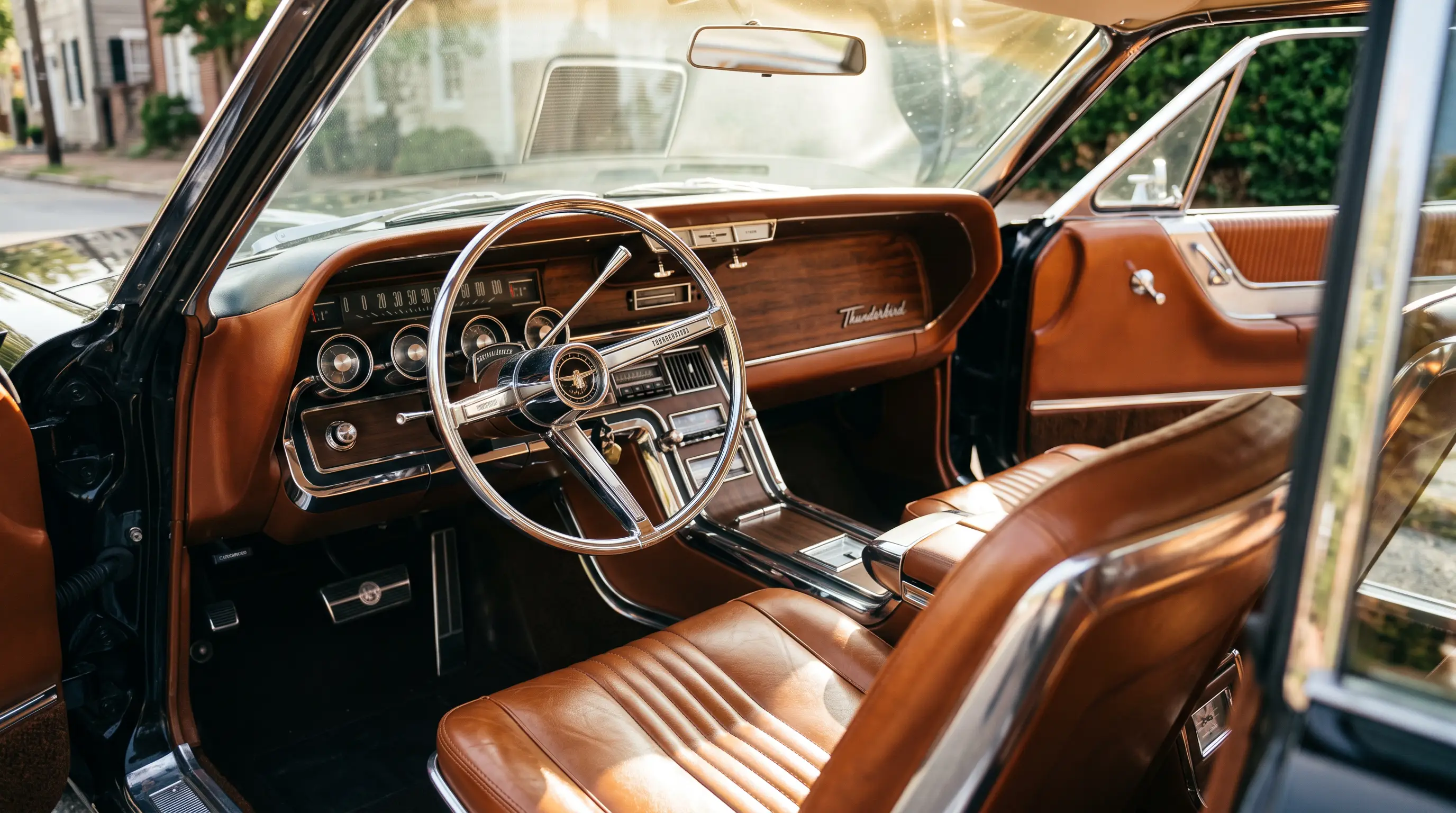
Production records for the 1966 Ford Thunderbird show a cabin that Ford's own engineers referred to internally as a "cockpit," and the word wasn't marketing exaggeration so much as an accurate description of the layout. The 1966 thunderbird interior wrapped the driver in a full-width instrument panel, deeply sculpted door panels, and a center console that ran unbroken from the dash to the rear seat, a configuration Ford had committed to since the start of the fourth generation and refined by its final model year. Reading the factory documentation on this interior corrects a few assumptions that have crept into casual Thunderbird history over the decades, and it's worth setting the record straight on what the cabin actually offered versus what nostalgia has exaggerated.
The full-width console, verified
A persistent claim in enthusiast circles holds that the Thunderbird's front-to-rear console was a one-year-only feature or a rare option. Factory build sheets and Ford's own 1966 sales literature contradict that. The console ran the length of the cabin as a standard design element across the Flair Bird generation's hardtop and Landau models, separating the rear seat into individual bucket-style positions rather than a bench. This wasn't a late addition either. Ford had committed to the layout with the 1964 redesign and carried it through with only detail changes to switchgear and trim finish by 1966. The console housed the transmission selector, an array of warning lights, and on higher trim cars, additional instrumentation that a base-model Galaxie simply didn't offer.
What did change year to year within the generation was the switchgear finish and the specific warning light cluster embedded in that console, along with small revisions to the parking brake release and ashtray placement. Anyone restoring a 1966 car should not assume a 1964 console interior is a drop-in match. The parts share a family resemblance but not always interchangeable hardware, and Ford's own parts catalogs from the period list them under separate numbers for exactly that reason.
Swing-Away steering, correctly dated
Another detail worth correcting concerns the Swing-Away steering column, which pivoted the wheel toward the door to ease entry and exit. This feature is often misattributed as new for 1966, but Ford had actually introduced Swing-Away on the Thunderbird several years earlier, and by the 1966 model year it was a well-established, mature feature rather than a novelty. What was genuinely new in the 1966 cabin update involved revised seat trim patterns and an updated instrument cluster face, not the steering mechanism itself. Getting this sequence right matters for anyone dating a car by its interior features rather than by trim tags, since assuming Swing-Away means "this must be a late Flair Bird" can lead a buyer astray when evaluating an earlier example that already had the same hardware.
Seating and materials
The standard interior used a vinyl and cloth combination on the hardtop, with all-vinyl available and increasingly chosen by buyers who wanted easier cleaning and a more formal look to match the Landau's vinyl roof outside. Bucket seats were the norm up front regardless of trim level, another point that separated the Thunderbird's cabin from the bench-seat default still common across most of Ford's regular passenger line. The 1966 thunderbird interior offered reclining seatbacks as an available feature as well, a genuinely unusual comfort option for an American car of this era, and one that Ford's own literature promoted heavily as evidence of the Thunderbird's position above ordinary family cars.
You can trace the broader design logic behind these cabin decisions back through 1964 ford thunderbird history, where the driver-focused cockpit layout was first established for the generation and then carried forward with running refinements through 1966. It's also worth reading a related story on what these interior details mean for collector values today, since an intact, unmolested cabin with correct upholstery patterns commands a real premium over a car with mismatched replacement seat covers.
Instrumentation and switchgear
Ford positioned the Thunderbird's instrument panel as a driver-oriented feature well before that language became common industry marketing. The full-width panel wrapped controls toward the driver's side, and higher trim configurations added supplementary gauges beyond the basic speedometer and fuel level that a standard Ford sedan carried. Warning lights embedded in the console handled functions like low fuel and door-ajar alerts, a level of feedback integration that was ahead of most competitors in the same price range.
| Feature | 1966 Thunderbird status | Common misconception |
|---|---|---|
| Full-width console | Standard across the generation since 1964 | Sometimes claimed as rare or 1966-only |
| Swing-Away steering | Established feature by 1966, not new | Often misdated as introduced in 1966 |
| Reclining seatbacks | Available option | Assumed standard by some sellers |
| Bucket seats front | Standard on hardtop and Landau | Rarely confused, but worth confirming on bench-seat claims |
The dash and gauge layout in detail
Ford's own service documentation for the 1966 Thunderbird describes the instrument cluster as angled slightly toward the driver's seat, a small detail but a deliberate one, reinforcing the cockpit language the engineers used internally. The speedometer sat in a deep-set housing that reduced glare from side windows, a genuine functional improvement over the flatter, more exposed gauge faces common on contemporary Ford sedans. Supplementary gauges available on higher trim configurations included oil pressure and amperage readouts positioned within easy sightline of the steering wheel, rather than tucked away on a lower panel where a driver would have to look down and away from the road to check them.
Switchgear for climate control and the optional power features sat within the console rather than scattered across the dash, another decision that reflects how seriously Ford's designers took the idea of a driver-centered cabin. Reaching for the climate controls meant a short movement toward the console rather than a stretch across the passenger side of the dash, a layout choice that period reviewers specifically praised when comparing the Thunderbird against less thoughtfully arranged competitors in the same price range.
Upholstery patterns and how they've aged
The vinyl and cloth combinations Ford offered for 1966 used specific stitch patterns that varied by trim level, and getting these patterns right matters enormously to anyone doing a correct restoration. Aftermarket upholstery kits sold today don't always replicate the original pattern spacing precisely, and a close look at original, unfaded material next to a modern reproduction often reveals subtle differences in pleat width and stitch density. Original interiors that have survived in usable condition, even if faded or lightly worn, carry real value for restorers who want an accurate pattern reference rather than relying on old photographs or incomplete parts catalog illustrations.
Why the details matter to a buyer
None of this is trivia for its own sake. A buyer evaluating a Thunderbird from this generation benefits from knowing which interior claims are documented fact and which are enthusiast folklore repeated so often it starts to sound authoritative. A seller who confidently tells you their car has a "rare, first-year" console feature that was actually standard for three consecutive model years is either misinformed or hoping you won't check. Either way, the correct information protects your wallet.
If you're actively shopping and want to see how these interior details show up in real inventory, Thunderbirds for sale now are worth cross-referencing against Ford's original order guides before you commit to a price. The 1966 thunderbird interior remains one of the most thoughtfully executed cabins Ford produced in the decade, and getting the history right only makes it easier to appreciate what the engineers and designers actually accomplished, without the exaggeration some corners of the hobby have layered on top of it over the years.