
Ford's product planners ran an internal naming contest before the 1955 launch of what would become the Thunderbird, and the record of that process, preserved in company histories and repeated by Ford itself for decades, credits a Ford stylist with suggesting the name that beat out a shortlist of competitors including Runabout and Beaver. The winning suggestion earned its author a modest cash prize and gave Ford one of the most recognizable nameplates in American automotive history.
Car Features
7 min read
How Ford Named the Thunderbird
Ford's Thunderbird name came from an internal employee contest and drew on Thunderbird mythology from Indigenous peoples of the American Southwest, a choice that shaped the car's identity from day one.
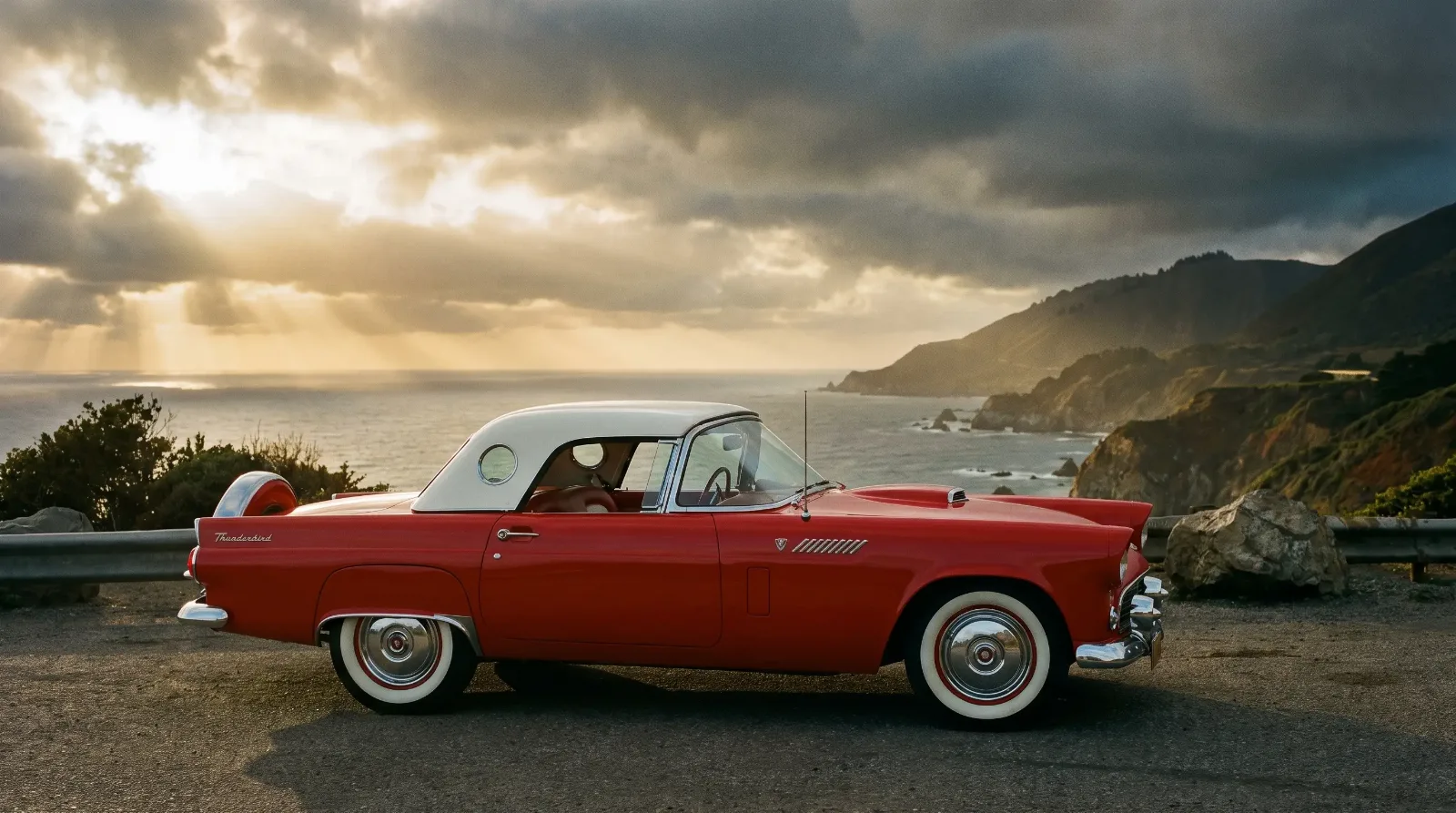
A contest, not a boardroom decree
Contrary to the assumption some enthusiasts make that a car this significant must have been named by committee vote or executive fiat, the historical record describes an open internal contest among Ford employees, inviting suggestions for the new two-seat car's name ahead of its public debut. Multiple names made the shortlist before Thunderbird was selected, and the process itself reflects a fairly ordinary corporate practice of the era, one used across the industry to generate names while also creating some internal enthusiasm and buy-in for a new product before it reached dealers.
The prize on offer was a $250 suit of clothes, put up by Ford executive Lewis Crusoe as a challenge to anyone who could beat the names already on the table. Ford stylist Alden "Gib" Giberson won with Thunderbird, though he reportedly never claimed the full prize, settling for a far more modest suit from a Detroit tailor instead. It is a prize structure that sounds almost quaint compared to how much marketing value the name would eventually generate for Ford over the following decades.
Where the word Thunderbird actually comes from
The name draws on Thunderbird mythology found among a number of Indigenous peoples of North America, particularly in the desert Southwest, where the thunderbird figure appears in oral tradition and visual art as a powerful spirit associated with storms, strength, and protection. Ford's choice tapped into imagery that was already culturally present in American popular culture by the mid 1950s, filtered through decades of Southwestern art, tourism marketing, and regional design motifs that had entered the mainstream vocabulary well before Ford's stylists borrowed the word for a car.
This borrowing was neither unique to Ford nor especially unusual for the period. American product naming in the 1950s regularly reached for words evoking power, speed, and a certain romanticized version of the American landscape, and Thunderbird fit comfortably within that pattern while still standing out as a genuinely distinctive choice compared to the more literal or descriptive names Ford's competitors were choosing for their own new models.
How the name shaped the car's identity from day one
A name chosen through an employee contest might easily have become a footnote, but Thunderbird proved durable enough to define the car's entire personality rather than simply label it. The logo Ford developed to accompany the name, a stylized bird emblem, appeared on badging, steering wheel centers, and promotional material from the car's earliest advertising, reinforcing the name's imagery in a way that made the two inseparable in the public mind almost immediately.
That branding discipline mattered. A weaker name might have needed the car's performance and styling to carry the entire marketing burden, but Thunderbird arrived already carrying connotations of speed, power, and a certain mythic weight that Ford's advertising copy leaned on repeatedly through the two-seat car's three model years and well beyond, long after the nameplate had moved on to different body styles entirely.
"A name selected by contest is not automatically a weak name. Thunderbird did more marketing work for Ford in three syllables than most advertising campaigns manage in three years."
- Sarah Whitfield
The names that almost won instead
Runabout and Beaver were reportedly among the finalists Ford's contest produced, and it is worth pausing on how differently the car's entire public identity might have unfolded under either alternative. Runabout describes a function rather than evoking a feeling, the kind of name that tells a buyer what the car does without telling them anything about how it should make them feel behind the wheel. Beaver, whatever internal logic led to its inclusion on the shortlist, carries none of the drama or motion that Thunderbird conjures immediately.
Naming committees across the auto industry in this period frequently generated lists that mixed genuinely evocative options with names that, in hindsight, clearly never had a real chance. The surviving record of the Thunderbird contest suggests this was no exception, and the eventual selection of Thunderbird over its competitors looks, from a modern marketing perspective, like the contest working exactly as intended even if the process itself was informal by today's standards.
How the emblem reinforced the name
Ford paired the Thunderbird name with a stylized bird emblem from the very beginning, and that visual mark did as much work as the word itself in cementing the car's identity. The emblem appeared on the steering wheel hub, on exterior badging, and throughout period advertising, giving the name a consistent visual anchor rather than leaving it to exist purely as text on a brochure. This kind of integrated branding, obvious as it seems now, was not universal practice across every new model launch in the 1950s, and Ford's consistency with the Thunderbird mark from day one reflects real intent behind the naming decision rather than an afterthought bolted on once the contest wrapped up.
Later Thunderbird generations, well beyond the two-seat cars this article focuses on, kept the bird emblem even as the car itself changed dramatically in size, shape, and market position. That continuity across decades of redesigns is unusual, and it speaks to how well the original name and mark were chosen in the first place.
Separating the documented history from the folklore
Decades of retelling have added embellishments to the Thunderbird naming story that are difficult to trace back to primary sources, including specific claims about exactly which department the winning employee worked in and precisely how the final decision was made among the finalist names. Serious researchers treat the core facts, the contest format, the winning name, and the cultural source of the word, as reasonably well established, while treating some of the more colorful specific details with appropriate caution until they can be traced to a documented primary source rather than a repeated secondhand account. That caution is not skepticism for its own sake. It is simply good practice whenever a story has been told and retold across seventy years of enthusiast conversation, car show anecdotes, and company-authored histories that were themselves written well after the fact.
For readers who want the full context of the car this name eventually described, more on the 1957 ford thunderbird covers the model's three-year run in detail, while our complete history traces the Thunderbird nameplate across every generation that followed. And for anyone whose interest in the name has turned into genuine interest in owning a piece of it, classic Thunderbirds on the market is worth a look before the story ends here. The name got the car noticed in 1955. Seventy years on, it is still doing exactly that job.
Sources and notes
Related Reading
Have a
Ford Thunderbird
for Sale?
Reach thousands of serious classic car collectors across the US.
Sell It Here →
Are You a Classic Car Dealer?
List your full inventory and connect with targeted classic car buyers.
Join as a Dealer →
#ford thunderbird
#1955 Thunderbird
#thunderbird history
#two-seat thunderbird
#Thunderbird name origin
#Ford naming history

About the author
Sarah Whitfield
Third-generation classic car collector specializing in pre-war American and European coachbuilt automobiles. Researcher and concours enthusiast.
Related Listings - Ford Thunderbird




Comments
Be the first to comment on this article.