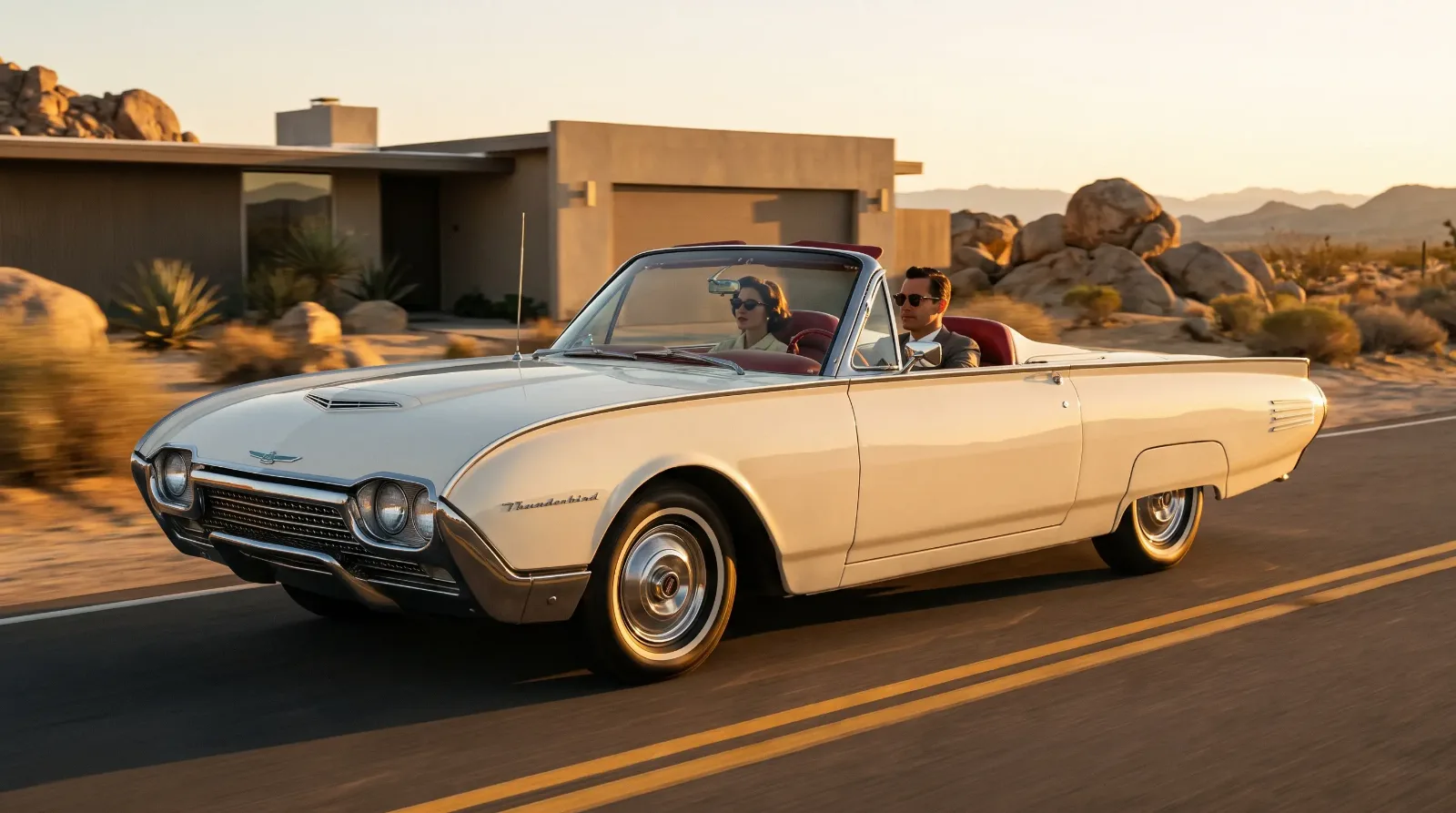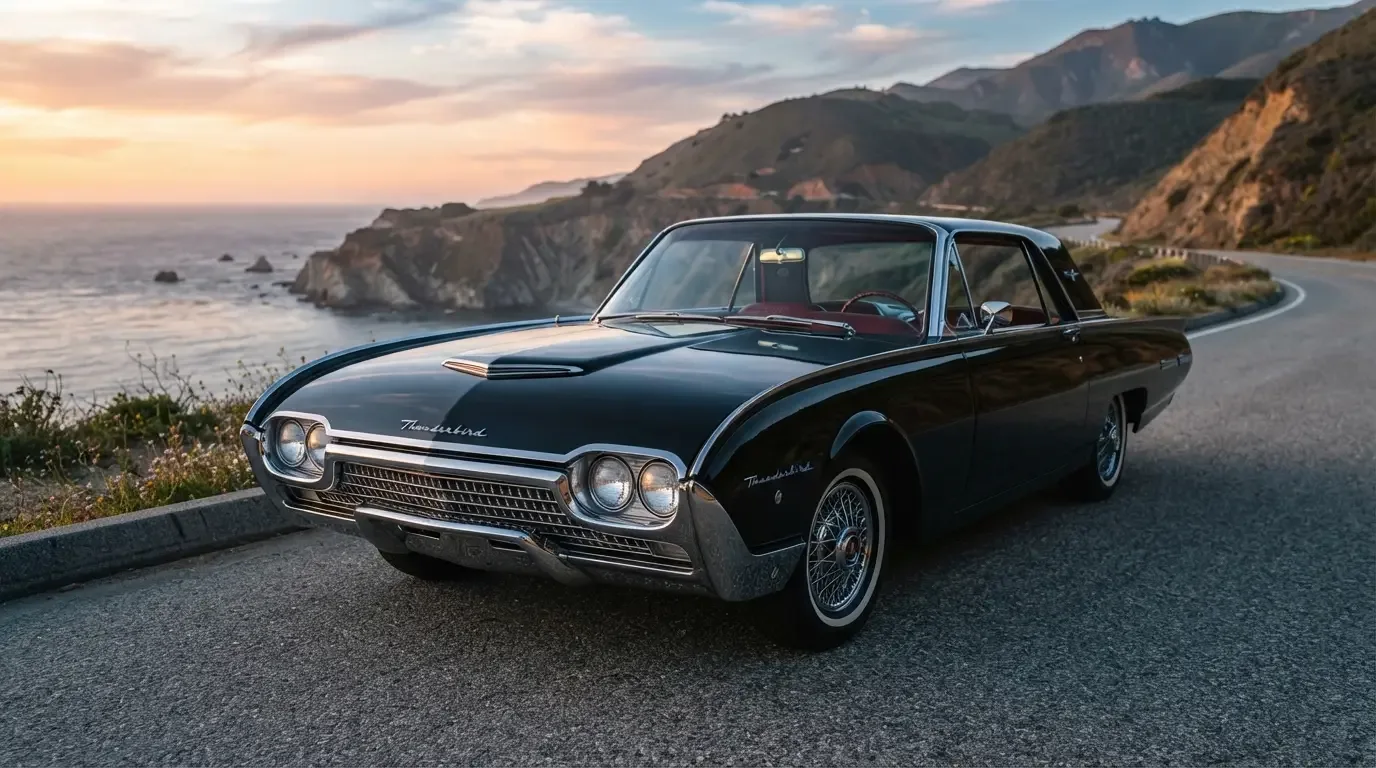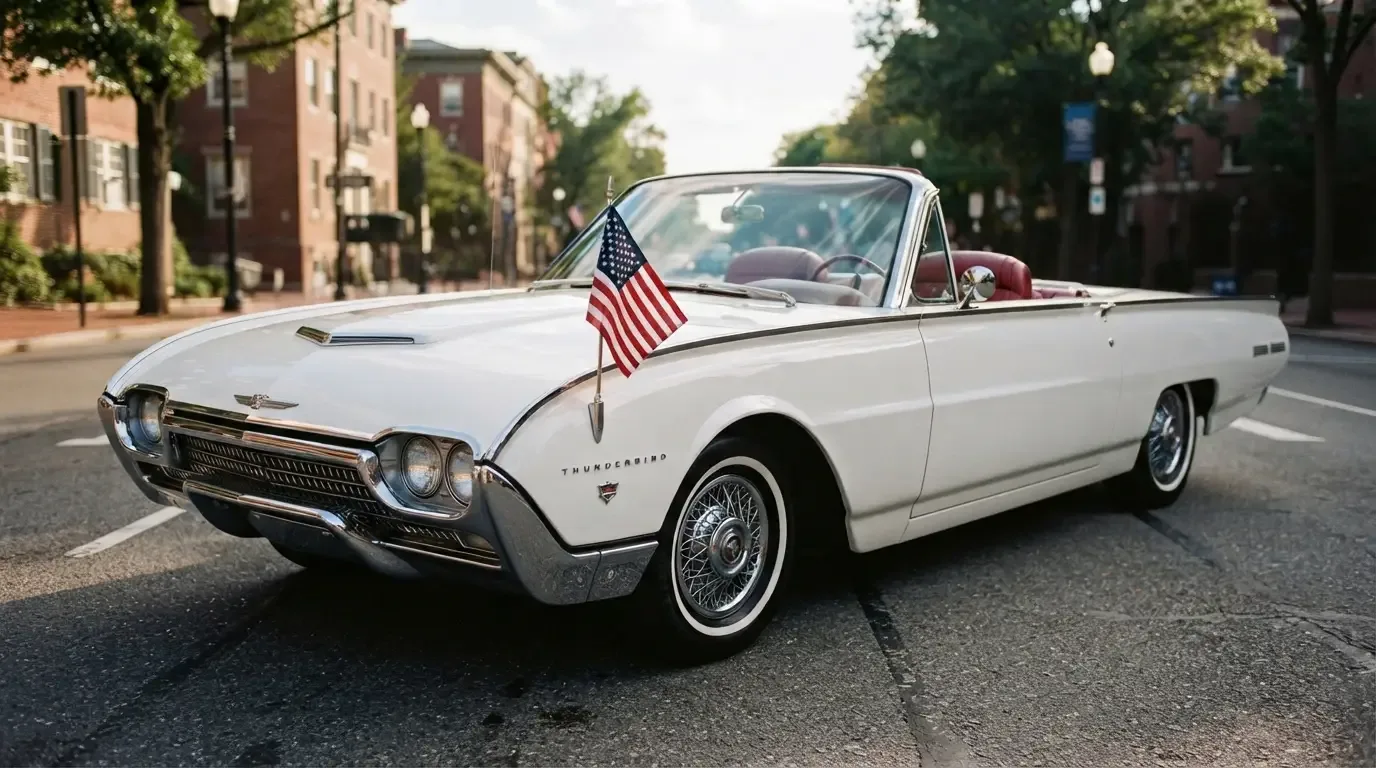
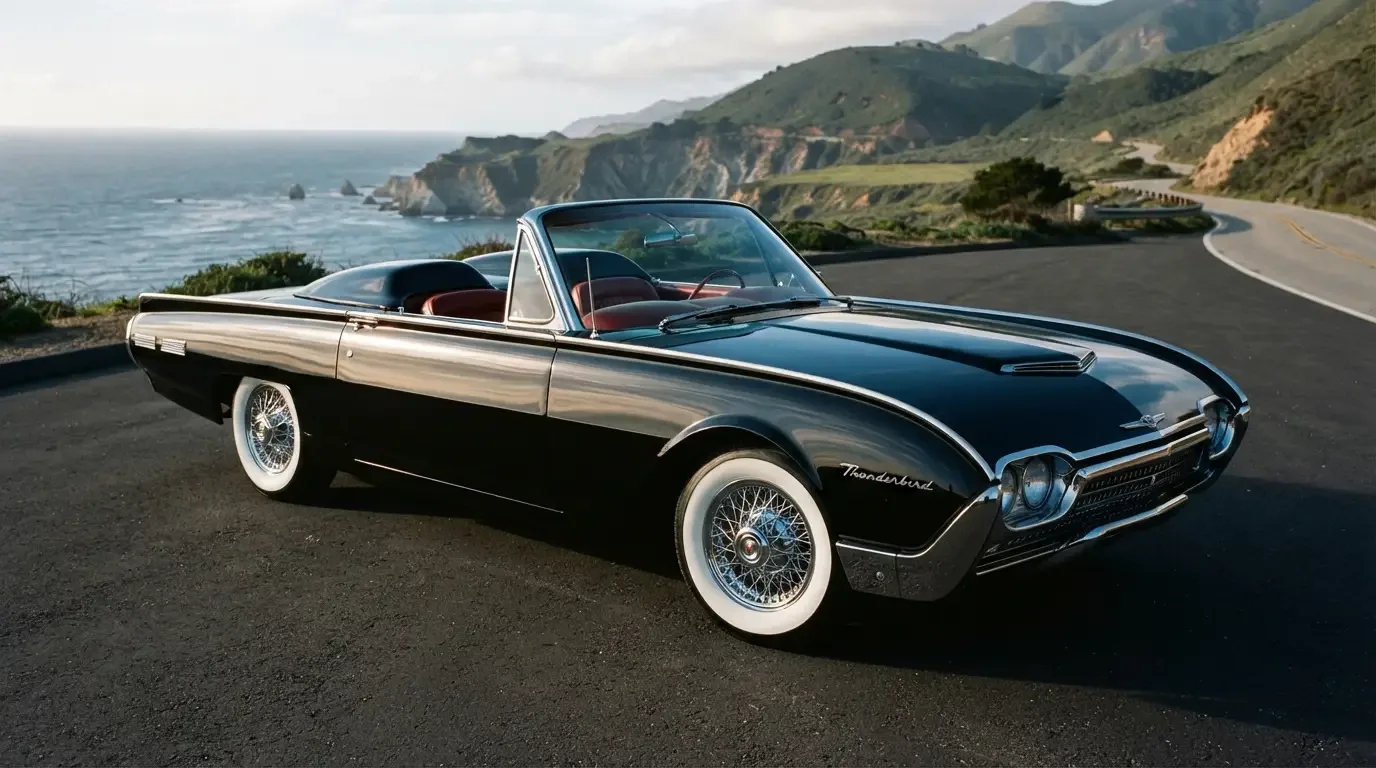
There is a fellow at our club's spring meet who parks his 1962 Thunderbird Sports Roadster at the far end of the lot every single year, not because it is embarrassed to be there but because he wants people to walk the whole way over to see it. Wire wheels catch the morning light differently than the standard hubcaps, and by the time you have crossed the gravel you already know this is not an ordinary Thunderbird. He bought it from the second owner in 1994 with the tonneau cover still in the trunk, wrapped in a moving blanket like it was made of glass. In a way it kind of was.
The Thunderbird Sports Roadster arrived for the 1962 model year as Ford's answer to a question nobody had really asked out loud, which was whether the big four-seat Thunderbird could recapture some of the sporting spirit of the original two-seater without giving up the back seat entirely. The solution Ford landed on was clever and expensive: a fiberglass tonneau cover that snapped over the rear seat area, transforming the convertible into a visual two-seater whenever the driver wanted that look, with faired-in headrests molded right into the cover itself.
How the tonneau actually worked
The tonneau was not a simple tarp. Ford engineered it as a fitted fiberglass panel that bolted down over the rear seat, complete with a raised hump behind each headrest position that echoed the original 1955 to 1957 two-seat cars. Removing it took real effort and generally two people, which meant most owners picked a configuration for the season rather than swapping it back and forth for every drive. Club members who still run their Sports Roadsters today will tell you the fit tolerances were tight from the factory and have only gotten tighter with sixty years of fiberglass shrinkage, so a panel that does not need trimming or shimming is worth real money on its own.
Wire wheels and the Kelsey-Hayes connection
Alongside the tonneau, Ford specified genuine Kelsey-Hayes wire wheels as standard equipment on the Sports Roadster, a detail that separated it instantly from any other Thunderbird on the lot. These were not the bolt-on wire wheel covers that showed up on lesser trim levels later in the decade. They were actual chrome wire spoke wheels with knock-off style hubs, requiring careful maintenance to keep the spokes tensioned properly and the chrome from pitting. Combined with the tonneau, a Sports Roadster announced itself before you even noticed the badge, which was exactly the point of the package.
Under the hood
Buyers who wanted their Sports Roadster to match its looks with genuine muscle could option the M-code 390 cubic inch V8 fitted with three two-barrel carburetors, an engine that pushed output well past the standard 300 horsepower four-barrel unit. This "Tri-Power" 390 remains one of the most desirable engine options across the entire early 1960s Thunderbird lineup, and cars that left the factory with it carry a meaningful premium today. Most Sports Roadsters, it should be said honestly, left the factory with the standard four-barrel 390 rather than the triple-carb setup; only about 120 of the 1,427 Sports Roadsters built for 1962 were true M-code cars, so verifying which engine a given car originally wore matters enormously to value.
Identifying a genuine M-code car takes more than reading the seller's description. The Tri-Power intake and center two-barrel carburetor were distinctive enough that reproduction parts have circulated in the hobby for years, sold honestly by restorers rebuilding a car back to its original specification but occasionally used less honestly to dress up a standard four-barrel engine as something rarer. The engine's casting numbers, stamped date codes, and the corresponding notation on the body data plate all need to agree before a buyer should pay the premium that a true M-code Sports Roadster commands. Clubs dedicated to the marque maintain registries that can help cross-reference a given VIN against known production, and that kind of outside verification is worth the effort on a car this rare.
Suspension and brakes carried over largely unchanged from the standard convertible, since the Sports Roadster package was fundamentally a trim and equipment upgrade rather than a mechanical overhaul. Ford did not chase a sportier ride height or firmer springs for this model, which means a Sports Roadster drives essentially like any other 1962 or 1963 Thunderbird convertible despite looking considerably more aggressive parked next to one. That gap between appearance and actual driving character surprises some first-time owners who expect the wire wheels and tonneau to come with a correspondingly sharper feel behind the wheel.
Here is the part club members tend to skip over when they are showing off a beautifully restored example: the Sports Roadster was not a commercial success when it was new. It cost several hundred dollars more than a standard convertible, the tonneau was fussy to use, and the wire wheels required upkeep that plenty of owners simply did not want to bother with. Ford discontinued the package after the 1963 model year, and for a long stretch afterward the Sports Roadster was a footnote rather than a headline act. It took decades of collector attention, and the growing recognition of just how limited production had been, for the model to earn the reputation it has now.
"Nobody bought a Sports Roadster because it made financial sense. They bought it because for one model year they could own a Thunderbird that looked like it belonged on a racetrack, even if it never went near one."
- Wayne Coburn
Finding one today
Locating a genuine Sports Roadster now takes patience, and locating one with its original tonneau, matching-numbers engine, and correct wire wheels takes even more. Reproduction tonneau covers exist and are honestly good enough that provenance documentation becomes the deciding factor between a real Sports Roadster and a standard convertible dressed up to look like one. Anyone chasing the full context of the generation this car came from should start with our complete history of the Bullet Bird years before narrowing in on the Sports Roadster specifically, since the two stories fit together closely.
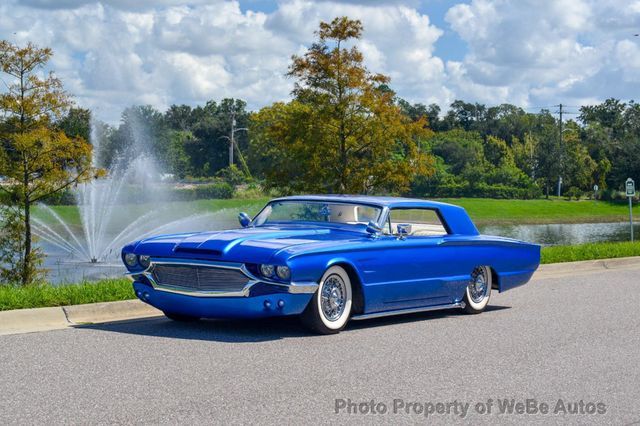
For collectors who have decided the Sports Roadster is worth the hunt, or who simply want something from this generation without chasing the rarest variant, it helps to find a classic Thunderbird currently on the market to compare pricing and condition against what is actually available right now rather than what shows up in old auction catalogs. The market moves, and Sports Roadster values in particular have climbed steadily as more buyers learn just how few of these cars Ford actually built.
Why it still matters to the club
Every generation of Thunderbird has its quiet cars and its showstoppers, and the Sports Roadster earned its place firmly in the second category the moment it rolled onto the show floor in 1962. It represents a moment when Ford was willing to spend real engineering effort chasing a niche audience rather than simply badging a standard car differently, and that willingness to gamble on something impractical but genuinely special is exactly why members still walk the whole length of a parking lot to go look at one.