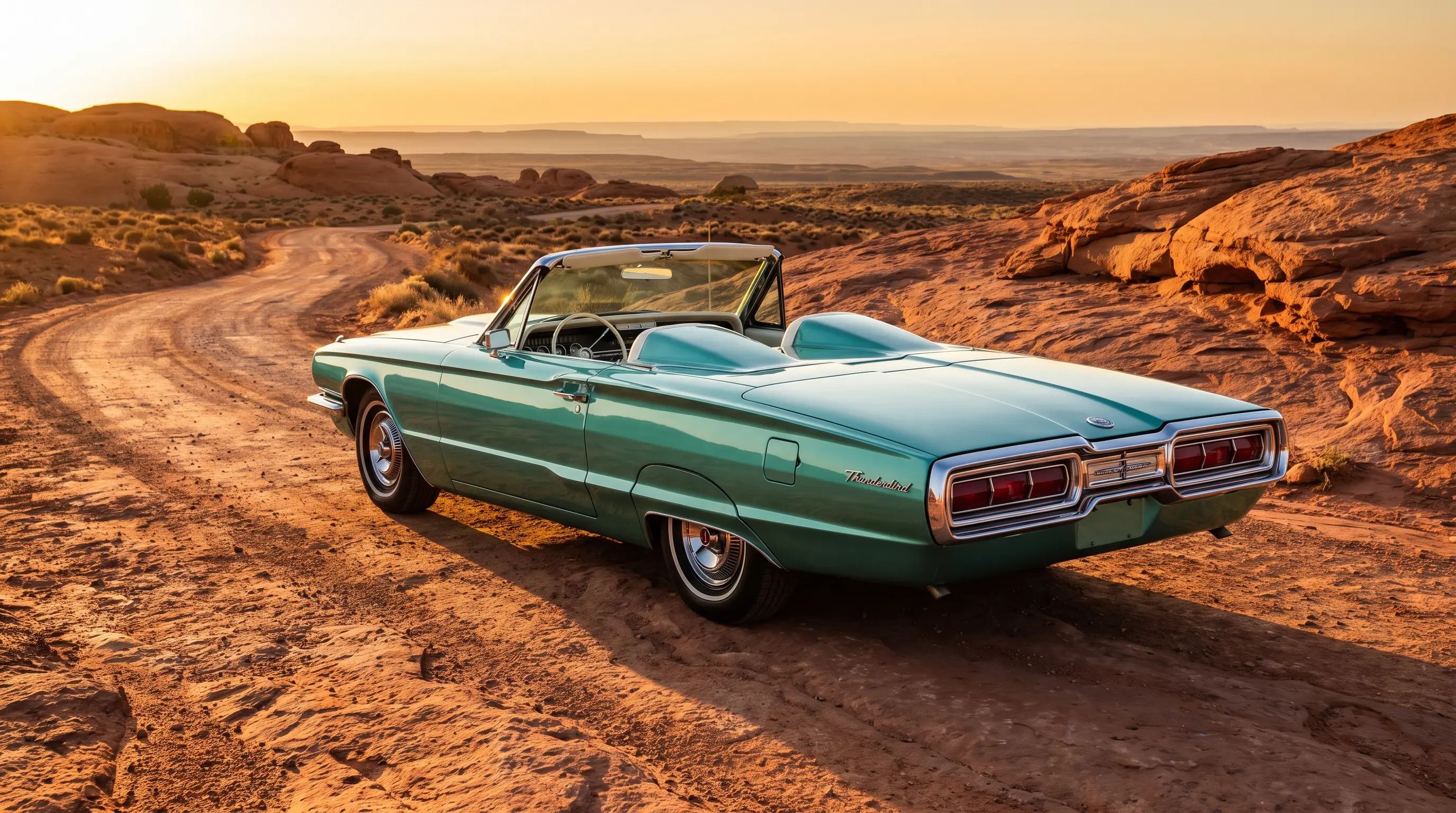
Two women, a green 1966 Ford Thunderbird convertible, and a stretch of open highway that ends at the edge of the Grand Canyon. Nobody who has seen Thelma and Louise forgets the final shot, and few remember it without also remembering the car that carries them there. The Thunderbird in Thelma and Louise is not scenery. It is the third character in the story, and the choice of that specific model was never accidental.
Setting the scene before the story even starts
Ridley Scott's 1991 film opens with Thelma and Louise packing for what they believe will be a quiet weekend fishing trip. The car they take, a 1966 Thunderbird convertible finished in a striking turquoise green, immediately signals something the script has not yet said out loud. This is not a practical road trip vehicle. It is a statement car, chosen by two women who, even before anything goes wrong, are reaching for a taste of freedom bigger than their ordinary lives allow. The Thunderbird's low stance and long hood do that work visually before a single line of dialogue explains it.
Scott and his production team reportedly considered several classic convertibles before settling on the Thunderbird, and the choice fits the character of the film in a way a more common muscle car simply would not have. A Mustang or a Camaro would have read as youthful rebellion. The Thunderbird, by 1991 already a nostalgic icon of an earlier decade of American road culture, read as something closer to reclaimed glamour, two women taking back a piece of the good life that had been slipping past them for years.
"You put two women who feel invisible into a car built to be looked at, and suddenly the whole film has its engine, in every sense of the word."
- Patrick Walsh
A color that became its own character
The specific turquoise green paint on the film's Thunderbird has become almost as recognizable as the car's shape itself among fans of the movie. It reads as vivid without tipping into gaudy, matching the tonal balance the film strikes between comedy and tragedy in its opening act before the story turns dark. Costume and production designers on the film have talked about wanting every visual choice, the car included, to carry a sense of heightened Americana, bright and open, the kind of color that belongs on a postcard rather than a commuter's driveway. A 1966 Thunderbird convertible in that shade did exactly that, standing out against the desert backdrop for the entire back half of the film.
Five 1966 Thunderbirds were reportedly used during filming, including a hero car for close-ups, a backup, a camera car modified for equipment, and two stunt cars for the climactic sequence, standard practice for any production involving a vehicle central to major stunt work, including the film's unforgettable final sequence. That consistency of green paint across every version kept the car instantly identifiable in every scene, a detail that mattered enormously once the film became a cultural touchstone and the car's image started appearing on posters independent of any specific frame from the movie itself.
Why the Thunderbird specifically fit the ending
The film's closing choice, driving forward rather than turning back, needed a car capable of carrying real weight as a symbol of agency. A convertible put the two women in full view of the camera and the desert around them at once, no roof to obscure the moment. The Thunderbird's particular shape, wide and confident rather than sleek and small, gave the final image a sense of scale that matched the emotional stakes of the scene. It never reads as a small car making a small gesture. It reads as two women in command of something substantial, right up to the final frame.
That choice has aged into something bigger than the film itself. Thelma and Louise remains a touchstone in conversations about female friendship and autonomy on screen, and the Thunderbird has become inseparable from those conversations, referenced in everything from magazine retrospectives to gallery exhibitions built around the film's iconography three decades later.
Where this fits in Thunderbird's larger story
The 1966 model featured in the film sits within one of the most collected generations of Thunderbird, a period when the convertible body style still existed before Ford phased it out later in the decade. Readers interested in how this particular film moment connects to the wider arc of the model's presence in American culture can find our complete history covering decades of appearances across film, music, and public life. The Thunderbird did not need Hollywood to matter, but moments like this one certainly did not hurt its reputation among generations who never saw the car new on a showroom floor.
For anyone who watched that final scene and started wondering what it would take to own a piece of that same era, genuine 1960s Thunderbird convertibles do still surface on the market with real regularity, and collectors specifically chasing the green-adjacent color palette from the film often start their search the same way everyone else does, by seeing what is actually out there. You can find a classic Thunderbird and compare condition, originality, and color against what made this particular car so unforgettable on screen.
Three decades after release, the image of that Thunderbird suspended in the air above the canyon still shows up in film retrospectives, greeting card designs, and dorm room posters. Few cars have carried that much narrative weight in a single closing shot, and fewer still have done it while looking that good doing it.
What keeps the scene alive, beyond nostalgia, is how deliberately every choice supports the story rather than decorating it. The color was chosen to read against the desert. The body style was chosen to keep the actresses visible to the camera and to each other. The specific model year, sitting near the end of the convertible Thunderbird's production run, gave the production a car with genuine period presence rather than something that felt borrowed from a costume department's spare inventory. Film cars often feel like props first and vehicles second. This one never does, and that is a large part of why the ending still lands with the same force it had on release.
Talk to enough Thunderbird owners at a show and someone will eventually bring up this film unprompted, usually while standing next to their own convertible in a color nowhere near the movie's turquoise green. That is the mark of a genuinely effective piece of casting, automotive or otherwise. The specific car fades a little and the idea of the car, freedom, open road, no roof between you and the sky, takes over instead.