
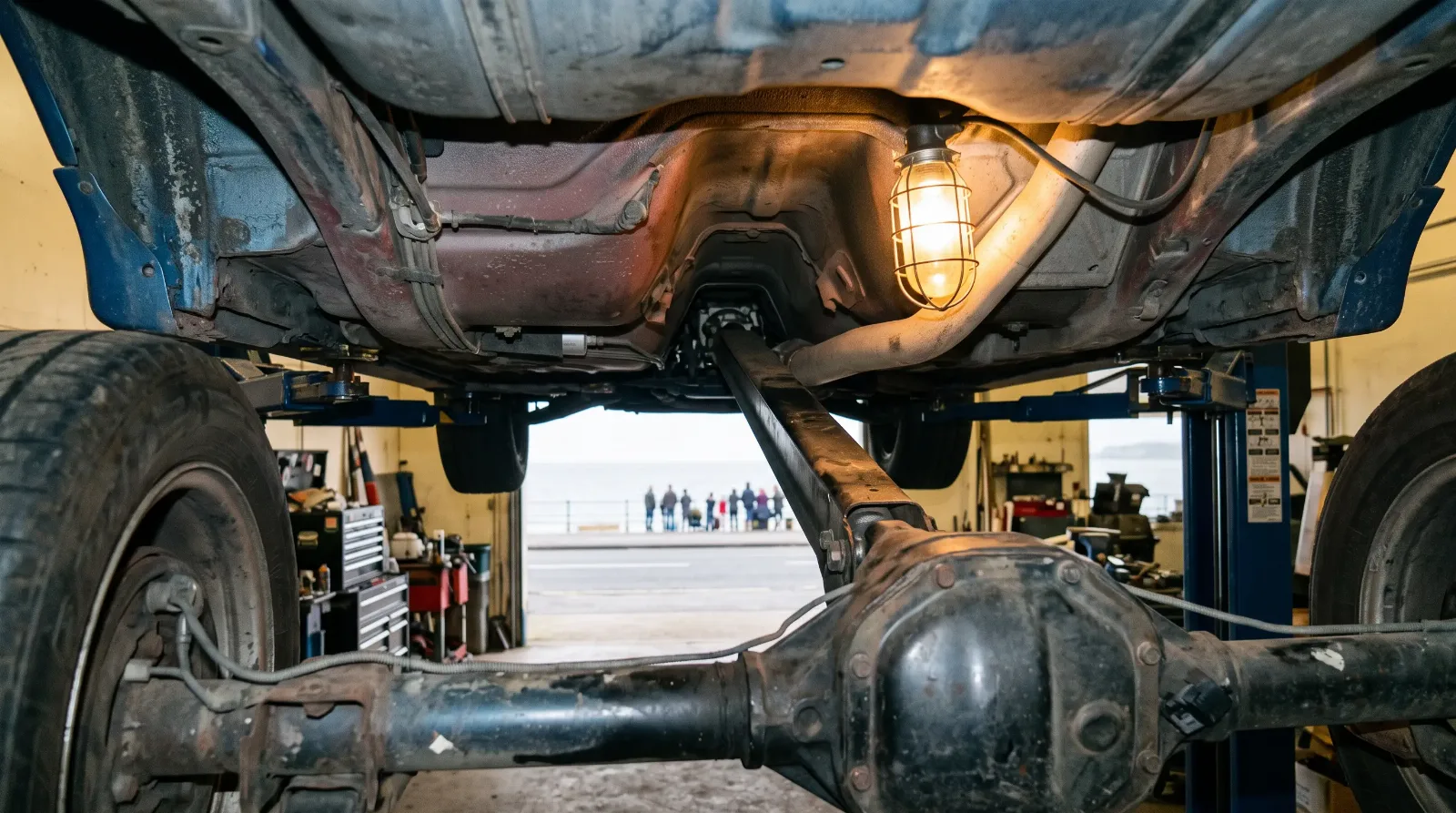
Put a third-gen Camaro on a lift, walk under the back of it and look forward from the differential. That long bar running alongside the driveshaft, bolted to the axle housing and reaching almost to the transmission, is the third gen camaro torque arm, and it does a job most rear suspensions split across several parts. Understanding what it does is the first step before you buy a single adjustable piece for it, because almost every upgrade for these cars either makes the torque arm work better or makes room for it when the drivetrain changes. This piece covers how the factory layout works, where it gives up, and the order I would tackle the rear in. For the bigger picture of modern chassis work on the older cars, start with Camaro restomods and pro-touring builds.
Third-Gen Camaro Suspension: The Torque Arm and Its Upgrades
How the 1982 to 1992 Camaro's torque arm rear works, where the stock parts give up, and the order to install connectors, arms, Panhard bar and torque arm.
Where the torque arm came from
GM did not invent this layout for the Camaro. It first used a torque-arm rear suspension on the 1975 Monza 2+2, the H-body, and on its Buick and Oldsmobile twins. The mid-1975 Cosworth Vega got it, and so did every 1976 and 1977 Vega and Astre.
The thinking was simple and smart. The engineers kept vertical coil springs, threw out the Vega's twin upper control arms, and added a transverse track bar plus a long torque arm running forward alongside the driveshaft. That moved the rear suspension's instant center from under 2 feet on the Vega to nearly 6 feet. A longer effective arm spreads the axle's reaction to throttle and brakes over a longer lever.
When the third-generation Camaro arrived for 1982, the layout came with it, and so did the Monza's light-duty 10-bolt axle. GM then kept the torque arm under every Camaro from 1982 to 2002 with minimal changes, which is why parts and know-how cross over between third and fourth gens.
How the third gen Camaro torque arm works
The full rear layout on a 1982 to 1992 car is coil springs, a long torque arm, a Panhard rod, two trailing links (the lower control arms), a sway bar and shocks. Up front it is a MacPherson strut with a lower A-arm and a coil spring, mounted on a K-member, because the second-gen's bolt-on front subframe was folded into the unibody.
Each rear part has one job. The lower control arms locate the axle fore and aft. The Panhard rod keeps it centered side to side. The torque arm handles axle wrap: when you get on the throttle, the axle housing wants to rotate, and the arm resists that rotation and feeds the load forward into the chassis.
The front of the arm is the detail people miss. The torque arm bolts to the differential housing with two bolts, but its front end clamps a rubber bushing on a mount that sits on the transmission tail housing. In other words, the factory design asks the transmission to carry the arm. The arm itself also changed during the run: the 1982 to 1983 parts differ from the 1984 to 1992 parts, so check what you have before you order.
Where the stock setup gives up
The factory parts were built for a car rated well under what most people run today. The best third-gen V8 from the factory was the 1990 to 1992 L98 350 at 245 hp and 345 lb-ft. Add sticky tires, a swap or just thirty-plus years of rubber aging, and the soft parts become the limit.
The rubber bushings are the first thing to go. A tired front bushing on the torque arm lets the axle wind up before the arm catches it, and soft lower control arm bushings let the axle move in the chassis under load. Vendors of aftermarket arms claim that a stiffer, adjustable torque arm controls axle torque under acceleration, reduces nose-dive under braking and eliminates wheel hop. Treat those as vendor claims, not test data, but they line up with what you feel in a car with worn factory rubber.
The axle is the other limit. The factory 10-bolt was a 7.5-inch ring gear with 26 splines in 1982 to 1984, then 7.625 inches with 26 splines in 1985 to 1989 and 28 splines in 1990 to 1992. A Borg-Warner 9-bolt with a 7.75-inch ring gear was available from 1987. None of them loves big torque, so suspension that stops hop also protects the gears.
"Do not bolt in an adjustable torque arm and then guess at the pinion angle. Put an angle finder on the driveshaft and the pinion yoke, write the numbers down, and set it before the car leaves the lift. A wrong angle shows up as vibration and worn U-joints long before it shows up as speed."
Ray Delgado
The upgrade order that works
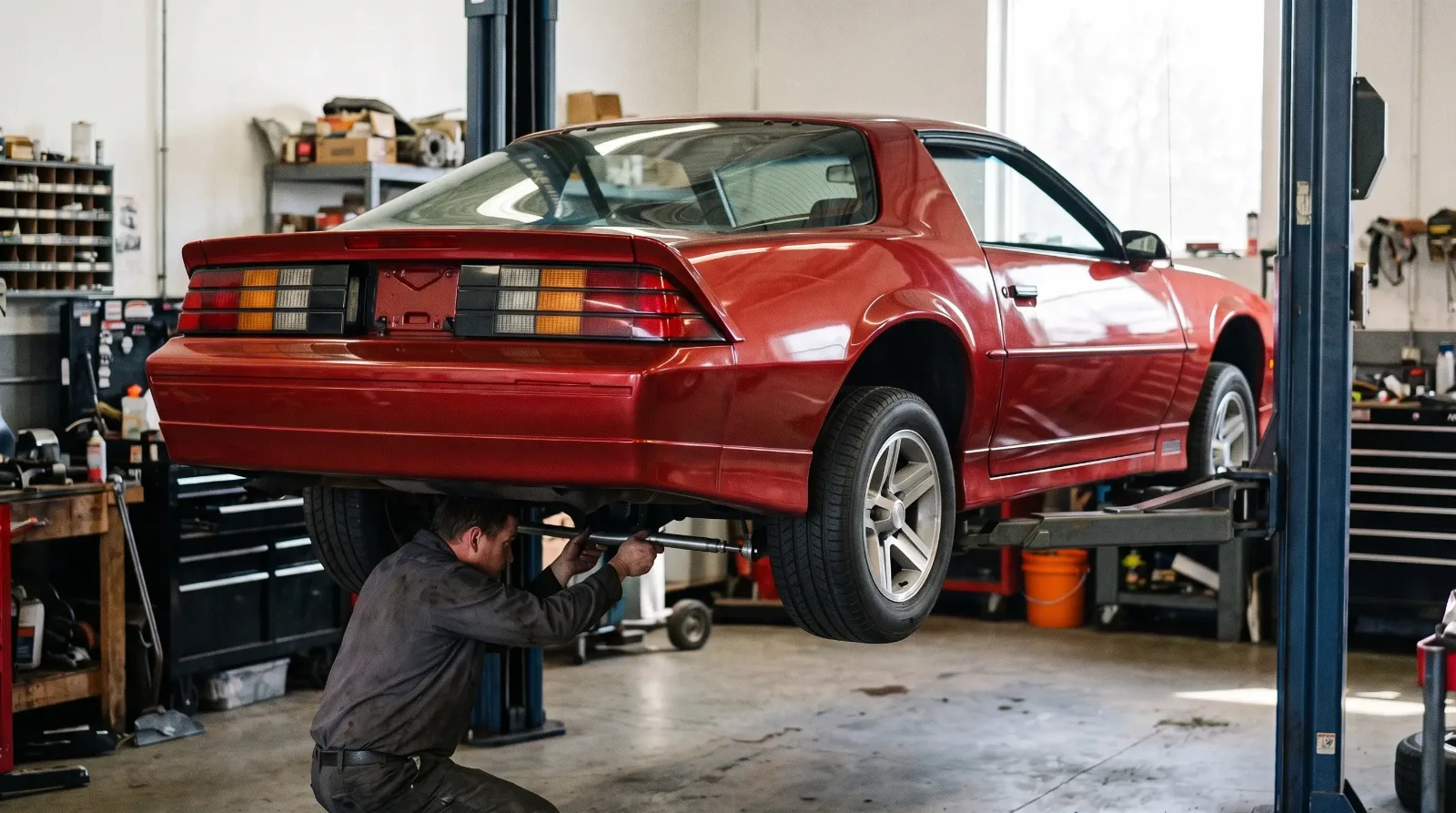
A typical third-gen rear package, the kind Heidts listed for these cars in 2015, has five pieces: inner and outer subframe connectors, an adjustable Panhard bar, adjustable lower control arms and an adjustable torque arm. The order you install them in matters as much as the parts.
| Step | Part | What it fixes |
|---|---|---|
| 1 | Subframe connectors | Ties the front and rear of the unibody together so the rest of the suspension works off a stiffer base |
| 2 | Adjustable lower control arms | Replace soft factory rubber; set fore-aft axle location |
| 3 | Adjustable Panhard bar | Centers the axle under the body, which matters once the car is lowered |
| 4 | Adjustable torque arm | Controls axle wrap; lets you set pinion angle |
| 5 | Front: tubular lower A-arms or K-member | Replaces aging stock parts; a full K-member package can save weight |
Why that sequence? Connectors first, because there is no point tuning the rear geometry on a shell that flexes. If yours weld in, do it with the car sitting on its wheels or on ramps, not hanging from the body, so the shell is loaded the way it will be on the road. Then control arms, because they set where the axle sits. Then the Panhard bar, centered with the car at ride height. The torque arm goes last, because pinion angle depends on everything else being where it will live.
Up front, the options are a pair of tubular lower A-arms or a full tubular K-member. Spohn sells a 1.50 inch by .120 inch DOM tubular A-arm, part 782-F, at $589 a pair, built to keep factory springs, ride height and steering radius. One 1992 Camaro build with a BMR tubular K-member and tubular lower A-arms saved about 30 lb over stock, and that car also got coilovers, an adjustable Panhard bar, sway bars, rear control arms and subframe connectors.
Torque arms for swapped cars
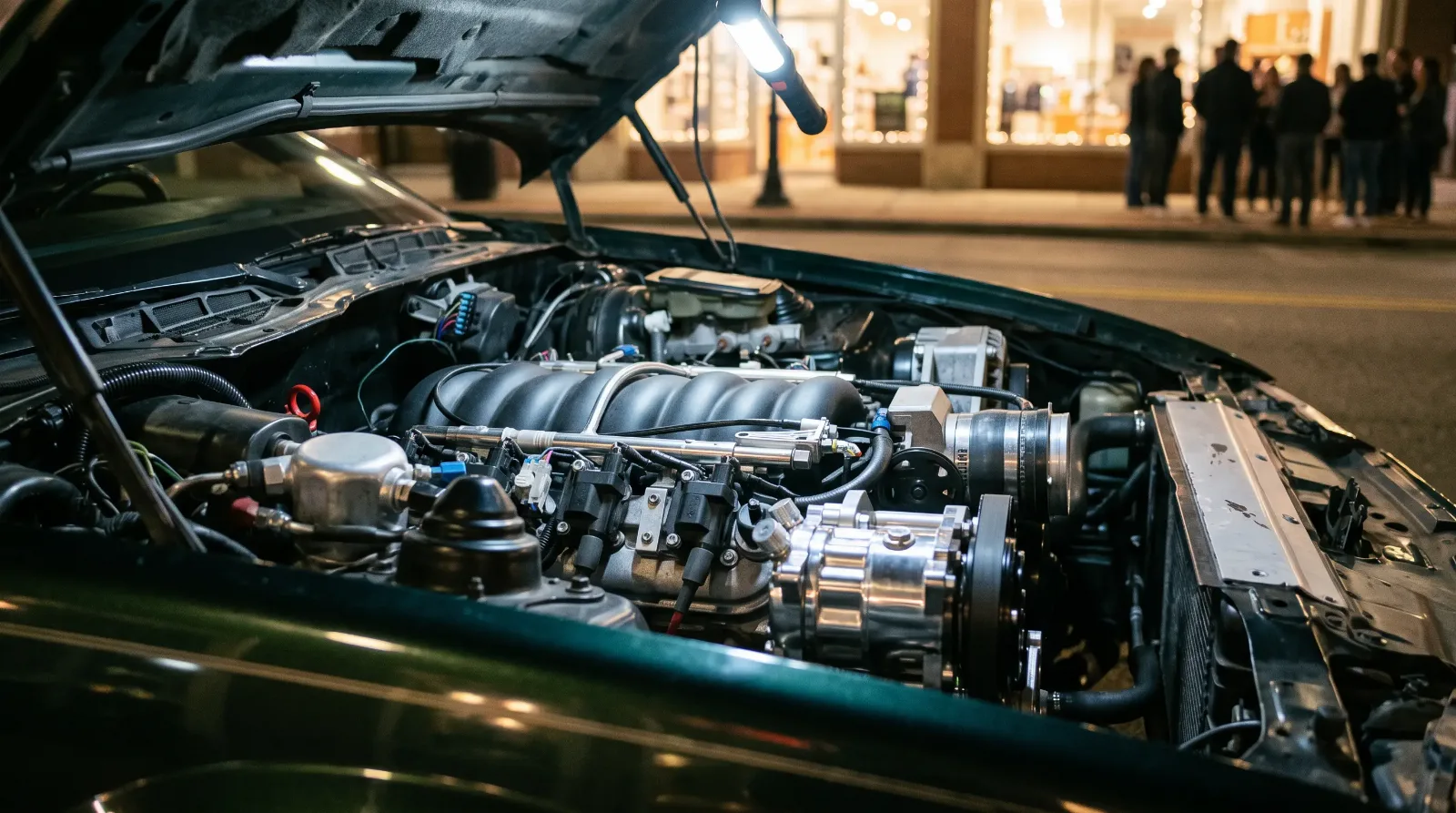
Remember that front mount on the transmission tail housing. Change the transmission and the arm may have nowhere to bolt. That is the most common reason a third-gen engine swap needs a new torque arm, not just new motor mounts.
There are two ways around it. UMI sells an LS and T56 kit, part 223910, at $289.99, whose T56 mount has no torque-arm provision, so you have to pair it with UMI's short aftermarket torque arm (2235 or 2236). Spohn's 332-PS, at $629, takes the other route: it moves the pivot off the transmission entirely onto a supplied crossmember, is built from 4130 chrome-moly, gives over 6 degrees of pinion adjustment, bolts in, and has to be used with Spohn's own LSx mounts. Both prices are the vendors' own, as of October 2026.
One real build shows how this comes together: a 1992 Camaro that went from a TBI 305 to a junkyard LQ4 with a 4L60E on a Hawks crossmember, a Ford 8.8 rear and a BMR adjustable torque arm. If your car is a later F-body, the same thinking applies on the LS1 bolt-on path, since the fourth gen kept the torque arm too. And if you are working on a 1970 to 1981 car with leaf springs instead, that is a different job, and you can read more here.
Sources and notes
- In The Garage Media: the torque-arm rear and its Monza roots
- Camaro Tech: third-generation Camaro description
- Camaro Tech: third-gen differentials and torque arm
- Chevy Hardcore: Heidts bolt-on parts for 1982 to 1992 F-bodies
- Spohn: adjustable torque arm for LSx and T56 swaps
- UMI Performance: 1982 to 1992 F-body LS and T56 swap kit
Related Reading

Metal fabricator and chassis builder who has spent 25 years turning flat sheet and mild steel into hot rods, gassers and restomod underpinnings.
Related Listings - Chevrolet Camaro
Comments
Be the first to comment on this article.